The world has been fundamentally changed by the shock and devastation of a 21st century pandemic. COVID-19 has claimed six million lives; we process a daily deluge of often conflicting and/or overwhelming information; and humanity has no way of knowing when this collective trauma will finally end. Will our lives ever be the same again? It seems not.
Now, try to imagine the plague that devastated Europe in the Middle Ages and beyond: more than 25 million dead. Almost 400 years of outbreaks caused by a bacterium that would not be identified until the 19th century. The mortality rate was close to 85%, with as much as 70% of the population wiped out in some locations. Superstition was pervasive, and medical practices were frequently ineffective and harmful. What caused this tragedy, and what could have been done about it? For years, we thought we knew … but we often had it wrong.
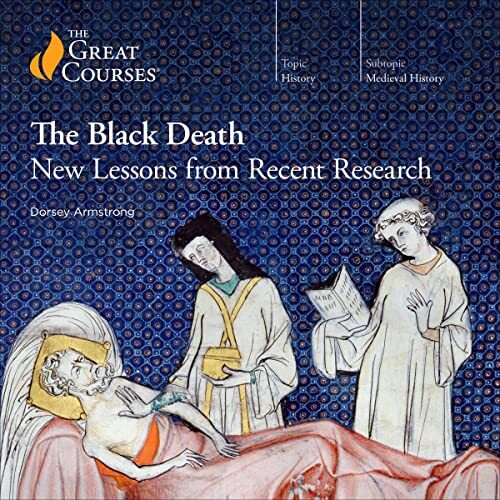
In The Black Death: New Lessons from Recent Research, celebrated medievalist Dorsey Armstrong shares the fascinating new story of this old pandemic—revealed by dedicated researchers working with 21st-century technologies and a knowledge of language and history that now provide input from all geographic areas of the medieval world. In seven engaging lectures, Professor Armstrong corrects explanations of the pandemic that are now known to be inaccurate and offers a more robust description of plague biology than has ever been known. COVID-19 isn’t likely to be humanity’s last experience with a zoonotic disease, so what can we learn now from these two pandemics that could help us in the future?
Dr. Dorsey Armstrong is Associate Professor of English and Medieval Literature at Purdue University, where she has taught since 2002. The holder of an A.B. in English and Creative Writing from Stanford University and a Ph.D. in Medieval Literature from Duke University, she also taught at Centenary College of Louisiana and at California State University, Long Beach. Her research interests include medieval women writers, late-medieval print culture, and the Arthurian legend, on which she has published extensively, including the 2009 book Sir Thomas Malory's Morte Darthur: A New Modern English Translation Based on the Winchester Manuscript and Gender and the Chivalric Community in Sir Thomas Malory's Morte d'Arthur, published in 2003. In January 2009, she became editor-in-chief of the academic journal Arthuriana, which publishes the most cutting-edge research on the legend of King Arthur, from its medieval origins to its enactments in the present moment. Her current research project-Mapping Malory's Morte-is an exploration of the role played by geography in Malory's version of the story of King Arthur.
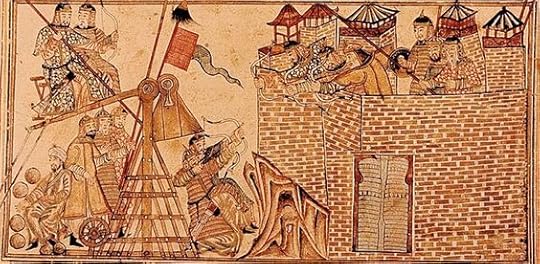
The skinny gist is that thanks to different experts in their respective fields sharing information with each other, they've found that some of their information about The Black Death wasn't accurate. Several long-held assumptions about the spread were wrong, including Gabriele de Mussi’s famous plague story of the Mongol siege of Caffa where corpses were catapulted over the wall as the world's first attempt at biological warfare. Good stuff, and a reminder that not even history is written in stone.
Ok, so this was recorded in 2022. That means that COVID-19 was still big news and highly politicized. And an unfortunate portion of this (very short) lecture is focused on scolding people who weren't doing what the experts were telling them to do, and making comparisons between the two pandemics. I get where she's coming from, but the righteous anger at the end of the lecture came off as a tad cringy if I'm being honest. I really wish she'd just stuck to the new information because I don't think this lecture will age well, even though I very much agree with the sentiment that blaming the others for our problems seems to be an irksome part of the human condition. Recommended for Plague Doctors.
The Black Death: New Lessons from Recent Research provides what it says on the tin. This lecture series is an addendum to Armstrong's previously published course (2016) on the Black Death. I found the subject matter interesting, especially the new information, but as a whole, this lecture series was a bit repetitive. I'm also of two minds on the inclusion of all the Covid 19 comparisons with the Black Death.
This is a course by Dr. Dorsey Armstrong, who's a professor of English and Medieval Literature. This audiobook (part of The Great Courses) is a follow up of professor Armstrong's previously published course in 2016 'The Black Death: The World's Most Devastating Plague'. Since 2016 new research has developed and some different facts have come to light that professor Armstrong wants to shed a new light on, especially in the wake of the Covid pandemic.
At 2 hrs and 43 mins, this is a quick and smooth audiobook to listen to, especially with professor Armstrong herself as a narrator. I've listened to three other courses of hers (Great Minds of the Medieval World, Powerful Women of the Medieval World and Medieval Myths & Mysteries), which I would all very much recommend. I also appreciate that she gives us some updates on the research, which I think should happen more often with these kind of audiobooks.
In the 2016 course it was stated that Siege of Caffa (which was led by Khan Jani Beg from 1345 to 1347) was to blame for the black death of 1346 arriving in Europe but with the new research this has been proven wrong. I find it actually really exciting that as technology advances that researchers can validate or in this case rebut things that were previously states as facts. And who knows what the research will say in a couple of more years?!
Professor Armstrong's input about the Covid-19 pandemic was also very interesting to hear. Some reviewers have found this to be too woke or political, which I just can't fathom because what the hell is political about a pandemic that has killed millions of people? Anyways, I found all the lectures very informing, fascinating, insightful and very easy to listen to. I'm already looking forward to professor Armstrong's the next course, whatever the topic may be.
I finished her first set of lectures a year ago and kept thinking how I would like to learn about this period now that we have experienced a different sort of pandemic. It doesn't disappoint! I especially appreciated her willingness to take on the lessons that we should have learned but are ignoring out of convenience.
The book had some interesting information, but the political commentary and comparison to Covid-19 are cringeworthy.
I found some parts interesting, like the analysis of why Jew’s traditions and genes may have caused them to be less susceptible to the plague, and with less Jews dying blaming them for it may have made sense to people at the time (of course the author compares this to blaming China for Covid-19 - not the same at all.) Also interesting that Catholics may have become less religious during this time period since the pope quarantined instead of assuming God would spare the holiest man on earth.
The part comparing the black plague to Covid-19 is ludicrous. A pandemic with an 82-85% mortality rate, where 50-70% of the entire population was wiped out (author’s numbers) vs. one with a 2% mortality rate (also author’s numbers at the time the book was written, I have read it’s probably more like .25%). A mortality rate of 82-85% vs. .25-2%, yeah, totally similar. I would have liked to hear more about what medieval people did to avoid getting the plague, if they quarantined etc. There was only a small mention of prevention measures that one part of Italy put into place after the plague had actually ended. The author probably just wanted to draw similarities between the two pandemics because she got five minutes of fame when journalists were suddenly interested in the black plague after covid-19 broke out.
The author’s political commentary is even worse. She says since Covid-19 “It’s now clear that any social, economical or political safety nets we may have thought we had in place have largely failed.” REALLY?? That’s why people out of work got unemployment as well as an additional $300 per week, had student loan payment forbearance, and evictions and foreclosures for those who couldn’t pay their rent or mortgage were halted for over a year. Totally sounds like no safety net to me! By contrast, the author describes the safety net during the black plague - there were charities, orphanages, and dowery help for young women without any money so they could get married and re-produce to increase the dwindling population.
Towards the end of the book I found myself suddenly wondering: if we can’t trust the author’s analysis of what happened during Covid-19 can we trust it when it comes to what happened hundreds of years ago during the black plague?
This lecture series is an English professor's excuse to put together a long conclusion in the form of a woke political screed by tying the Black Death aftermath into COVID-19 and how they each highlighted other issues in society. She alleged that COVID-19 taught us that we are all racist and homophobic and managed to bring up climate change as well (no, not that climate change contributes to the creation of pandemics - the lecture was about Black death after all - but that COVID-19 brought to the forefront all the terrible things about Western Society when viewed through the critical lens of a leftist).
She went so far as to claim "In the United States of America In the 21st century, I would contend that what we need is to take a step back, we need to shore up certain social safety nets, which is something that certain medieval institutions seemed to do a much better job of in the wake of the plague than what we are doing today." This was based on the fact they instituted a government board on health and donated to charities in Florence. How does this lady teach at one of our "elite" institutions?
Dorsey, is your claim that the medieval board of health and regulations put out by the board in Florence hundreds of years ago was more effective than the CDC? Or that the CDC and all of our state and local health organizations aren't as well funded/supported? How much money do you think the federal government should be spending? Do you ignore the double-digit percentage increase in the CDC budget in the wake of the COVID-19 pandemic? Do you actually believe that the United States does not seriously support a nonprofit sector? Did you know that charitable giving in the United States in 2021 was almost half a trillion dollars? That it went up after the pandemic?
I will not be checking out any other lecture by this academic. Her last few lectures were way out of left field. She spent a lot of time correcting mistakes she made in the first lecture series she gave on Black Death, so it probably would not be worth going back and listening to anyway. I do have great hope this is not her only lecture series with an emphasis on correcting her previously flawed work. Hopefully it's her opinions that are corrected in a future lecture series.
Glad this professor took the opportunity to share new insights from recent research. And I now know more about rat and flea behavior than I did before. Win.
It’s a shame that the siege of Caffa was actually NOT the catalyst that unleashed the black death in 1346 – admittedly, I, like most reviewers have been captivated by that story since I first watched this course. It is equally interesting how new research has exposed the probability of the Khan dynasty role in the chain of events, hopefully as Asiatic history becomes more mainstream, we’ll be able to uncover more and further explore the details of this interesting time.
Although, I’m always up for a new course from Dorsey Armstrong, I don’t know if I think this was absolutely necessary. Many of the new facts could have been condensed into 2-3 lectures, and the rest is just repetitive exploration into what we already know.
Yersinia Pestis continues to entice modern historians and it’s good to know that the science of the time is now a much stronger leading force in historical research than the standard historical first-person account.
I’m always up for a new course from Dorsey, hopefully we get something new and exciting from her in the future.
A pretty interesting lecture series that I think reveals a lot in comparing the Black Death to COVID. That said, I thought it unfortunate that the series was released when it was and not with a bit more retrospection a few years later because it made the context feel immediately dated. I also think that the timeframe of this analysis made the point about the massive efforts taken to rebuild society after the Black Death feel especially teasing. I know in spite of power changes in our government that sizable change has taken place since COVID and that’s not necessarily the same changes that were needed after the Plague. I want that retrospection perhaps in a separate lecture series discussing if the post Black Death recuperation project was truly as wholly successful as its touted here and I really want to know how we’re doing after COVID. I want to really hear the process it took to conceptualize these plans of attack so I can understand how you successfully crisis manage on this scale, though perhaps that’s asking for too much from the time period and the records we have available.
This is a companion series of 7 lectures recorded in late 2021 in the midst of the Covid- 19 pandemic to complement her acclaimed 24 lecture series of 2015. Armstrong uses the latest research to update her original series and makes important changes such as the origin of the plague strain or mutation is now thought to have occurred in central Asia about 1250,( not China as Armstrong hypothized in 2015) then spread by the grain trade and the Mongol Empire to reach Europe by 1347.She makes excellent comparisons between the societal impacts of Covid and the Black Death and her ultimate lesson is the importance of both learning from history and being willing to change your mind when new research emerges.
This was quite entertaining but I do wish the lectures had been more in-depth (yes, that probably would have made them very long and not as approachable but as someone who has read a few books about the Black Death that's what I would have loved). Also, as others have said, the whole Covid-thing threw me off, even if I can understand the inclusion of it. Maybe I'm still tired of hearing about Covid and that's why it bothered me. All in all: quick, entertaining but a bit too shallow for my taste.
Skip this. Was hoping to dive into the history, insights and second effects of Black Death and instead got gratuitous lectures on morality during Covid and a bunch of (in my opinion) unsubstantiated opinions. The lecturer ends the program advocating universal income (please cite a case where it has ever worked out in history esp. after a pandemic (vs destroying the economy already hurt by population and tax decline), or don’t force it on the listeners…).
An attempt to update some stuff from the original course about the black death. The very short course is part update of the science of black death and part commentary on the covid pandemic.
Such great information and I appreciate and agree with the moral injection. However, how quickly current history and knowledge has changed. We could use a "new" new lesson book.
This is a very good follow-up to Dorsey Armstrong’s 2015 lecture series The Black Death: The World's Most Devastating Plague, with new historical and scientific information to add to our understanding of the bubonic plague pandemic that ravaged the medieval world. Recording in November 2021, Professor Armstrong links the Black Death to the then raging COVID-19 pandemic. She noted that at the beginning of our century’s plague, there was around a 2% chance of a person dying if they caught the disease. During the medieval era, it is estimated that 80-86% of people who became infected with the plague died. It gives us perspective on the immense toll the Black Death took on society back then. Our modern world experienced significant upheaval even with our understanding of how disease works and medical technology (keeping us at a relatively small 7,010,681 death total out of 704,753,890 infections, as of April 13, 2024 - with my country, the United States of America, suffering the most). We can only imagine what it was like in Europe between 1346 and 1353 when approximately half of the continent died from the bubonic plague! Armstrong provides a very interesting look into the science and history here, with energy and humor.
Title:The Black Death: New Lessons from Recent Research Author(s): Dorsey Armstrong Series: The Great Courses Year: 2022 Genre: Nonfiction - Epidemiology and medieval history Length: 2 hrs and 43 mins Date(s) read: 7/2/24 Book #131 in 2024 **
The Black Death: New Lessons from Recent Research by Dorsey Armstrong is a course that I'm deeply torn about. A sequel to her earlier course on the Black Death, Armstrong describes several things that she got wrong - most notably regarding the siege of a Genoese port on the Black Sea being a major vehicle for the spread of the plague, as well as several new advances. These are all well and good. But two things nag at the back of my mind. First, this course does not stand alone, and thus should not have been offered. This is not a sequel, it is an addendum. Second, this course was released too closely to the COVID-19 pandemic, and thus there are several lengthy digressions onto that pandemic. While at the time that was likely incredibly useful to the first round of listeners, as time progresses this will increasingly date the course and distract from the main subject material. Therefore, I give this 3 stars. For what it is, it is fine. A very quick foray and revisit to a very good course. You can finish it in an afternoon, as its about as long as a movie when listened to at a somewhat faster speed (1.3 for me).
But, really, this course should have done what Armstrong provided as an example. The lecturer invokes a revised edition to an earlier landmark book that went from about 400 pages to over a 1000. Rather than this small course with frequent callbacks to an earlier course, we should have received a revised and expanded version of the old one. The Great Courses used to do this, and I have no idea why it didn't. I imagine I would have greatly enjoyed a longer, revised, second edition to The Black Death rather than what we received.
This could have been a lot better -- the Black Death (which really was a thing at least 3 times, probably more) is a super interesting topic, and there's been a lot of new research since the early 2010s, leading to this updated Great Courses course. The author's previous work was outdated and this was a correction to those mistakes.
Unfortunately, it was released mid-Covid, and by someone who was 1) not a scientist and 2) very bought into the then-current Establishment position on covid. A lot of that did not age well, ironically in exactly the ways she pointed out, and this detracts from the decent black death research update.
(The main update to theories is that the disease originated from Central Asia, rather than China, and spread simultaneously West and East, thus leading to an outbreak in China at the same time as Europe. There is also a more-developed theory of progression of disease (rather than separate illnesses, they appear to often be stages), as well as a theory of the life cycle of fleas and rats (less severe in winter but waves of rats and fleas being moved by grain shipments during that period, remaining latent, and then exploding in summer, for multiple reasons. Also, amusingly, Jews (who were persecuted for being believed to spread the plague) actually probably did potentially have some degree of protection from the plague (not merely due to passover food disposal and living separately from others, but also due to other genetic diseases which provide some kind of protective effect), and also the Mongols probably spread plague through marmots and grain, but the Siege of Caffa story, prominent in the author's previous work, was probably false.)
I have listened to several of Dr. Armstrong’s courses and become a fan. Great Minds of the Medieval World is one of my top three favorite Great Courses.
I am also very interested in medical history.
When Audible put Dr. Armstrong’s book on the Black Plague on sale, there was no question that I must have it.
While i enjoyed learning about the updated developments in plague science, and learning about her OTHER plague course, which I will have to get, even knowing it contains errors, I don’t think this is her best work.
I think the last two lectures were padding and, at the least, could have been combined into one lesson, or perhaps a ten minute epilog.
I would have liked a little more review of the previous course, and more discussion of the Mongol love of marmots. (Did the Mongols have cartloads of marmots that they carted around for snacking or were they common everywhere the Mongols rode and somehow picked up the fleas that were just hanging around the horde? I was genuinely confused by being unable to figure where the marmots that seemed to travel with horde came from. Also, I like the word “marmot”.)
If awarding partial stars was possible, I would have given 3.75 stars for this course, but am rounding up to 4.
If this is your first course by Dr. Armstrong, I urge you to listen to Great Minds and Analysis and Critique. Both are excellent.
Dorsey Armstrong’s The Black Death: New Lessons from Recent Research is a compelling deep dive into one of history’s most devastating pandemics. Armstrong skillfully blends fresh archaeological discoveries and updated epidemiological insights to offer a new perspective on the Black Death’s origins and its profound impact on medieval society.
The book stands out for its dual focus on being both interesting and informative. Armstrong reexamines historical records and integrates recent research findings, shedding light on how the pandemic reshaped social structures, economies, and public health responses—elements that resonate even today. Armstrong's engaging narrative makes complex data accessible, inviting readers from both academic and general backgrounds to rethink established assumptions about the plague.
While some sections delve into dense historical detail, these moments rarely overshadow the overall readability and insightfulness of the work. The comparisons drawn between medieval responses and modern epidemic strategies add an extra layer of relevance, prompting thoughtful reflection on how societies adapt to crisis.
Overall, The Black Death: New Lessons from Recent Research is an enlightening read that refreshingly updates our understanding of a pivotal historical event. A solid 4-star contribution to plague studies that both informs and intrigues.
The Black Death: New Lessons from Recent Research by Dorsey Armstrong is an absolute gem for anyone interested in history and science. Armstrong’s approach is both refreshing and enlightening, as she doesn’t shy away from addressing previous inaccuracies in the understanding of the plague. Instead, she actively explains how new discoveries have reshaped our knowledge, making the case for why it's so important to correct these things in the media as well.
One of the best parts of the course is how Armstrong draws parallels between the Black Death and the COVID-19 pandemic, tackling issues like xenophobia and the necessity of listening to new scientific findings. It’s a thoughtful reflection on how history can inform our response to modern crises.
I was genuinely surprised by how much I learned, even though I already had some (biological) grasp of the plague. The research is clearly up-to-date, and Armstrong's way of presenting it is engaging and insightful. Short, yet surprisingly good.
Armstrong is a phenomenal teacher in all she does and she’s particularly good here in taking the complicated hard science and simplifying it to a level we non-science-minded folk can understand. I thoroughly enjoyed her first series on the Black Death, but I found this one more exciting as it revealed answers to questions that hadn’t been discovered at the time of the first series!
She also articulated very well the importance of history, why we should remember it, and - most importantly - the many things we should learn from our ancestors who survived the Black Death.
That is one way in which, I think, the Medieval world is inarguably superior. The people then had a much greater capacity to suffer a little for a moment to prevent greater suffering in the future and they seemed much more willing to learn and change than we are now. Today we live for the moment and suffer for it. Then, they lived for the future and survived because of it.
Following on from Dorsey Armstrong's previous lecture series, this gives an update and amendments in the light of up to date evidence and research findings on the causes and consequences of the Black Death plague. These lectures were recorded in 2021-2022 during the Covid pandemic and provide a fascinating comparison on how society was affected in the Middle Ages and what came afterwards.
Armstrong's focus is particularly on how the plague spread, both during the Black Death period (the deadliest pandemic humanity has ever seen) and the other 2 pandemics caused by Yersinia Pestis. This gives a fascinating insight into the nature of the particular bacterium and also how the world and society functioned at the time of the outbreaks.