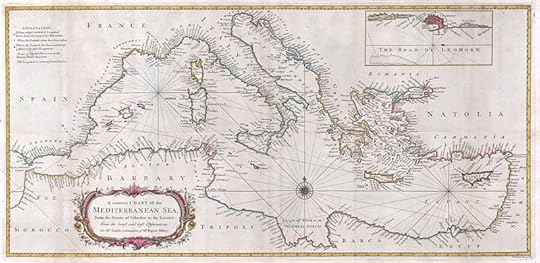
A one-volume narrative history of the Mediterranean from Ancient Egypt to 1919. Written in the racy, readable prose for which the author is famous, this is colourful, character-driven history at its most enjoyable.
This magnificent undertaking tackles a vast subject — vast in time (from the oldest surviving pyramid to the First World War); vast in geography (from Gibraltar to Jerusalem); and vast in culture, including as it does the civilizations of the Phoenicians, the Ancient Egyptians, Greece, Carthage, Rome, Byzantium, as well as the Borgias and the Medicis, Mohammed and El Cid, Napoleon and Nelson, Moslems, Jews and Christians.
The Middle Sea is not a dry record of facts; it is a rackety read about historical figures — dissolute Popes and wily Emperors, noble-hearted Generals and beautiful Princesses. But his greatest strength is naval and military history: from the Crusades to the expulsion of the Moors from Spain; from Trafalgar to Gallipoli. Towns are besieged and sacked, Kingdoms are won and lost. The narrative covers the glories of Constantinople and Venice, and the stirring history of the islands of the Mediterranean — Malta, Sicily, Crete and Cyprus.
The Middle Sea is the culmination of John Julius Norwich’s long and distinguished career as one of the greatest enthusiasts for anecdotal history, and the highways and byways of scholarship.
John Julius Norwich was an English historian, writer, and broadcaster known for his engaging books on European history and culture. The son of diplomat and politician Duff Cooper and socialite Lady Diana Manners, he received an elite education at Eton, Strasbourg, and Oxford, and served in the Foreign Service before dedicating himself to writing full-time. He authored acclaimed works on Norman Sicily, Venice, Byzantium, the Mediterranean, and the Papacy, as well as popular anthologies like Christmas Crackers. He was also a familiar voice and face in British media, presenting numerous television documentaries and radio programs. A champion of cultural heritage, he supported causes such as the Venice in Peril Fund and the World Monuments Fund. Norwich’s wide-ranging output, wit, and accessible style made him a beloved figure in historical writing.
Don’t expect me to write a comprehensive review of this magnificent narrative. In about six hundred pages Norwich has covered about five thousand years. It would be mad to try and summarize what is already a packed summary.
I also began this book about a year ago, then, halfway, I put it aside. Other readings took over my reading attention, not necessarily because they were more interesting, but because art exhibitions, trips, courses etc, required their prompt reading. I finally picked it up again and finished it with the determination that I shall read it again, taking notes. The account is so flowing as it moves from one major historical event to the next, that one feels as if gliding at great speed down a playground slide. Upon landing at the bottom one then wonders: what was that?
This book made it into my handbag last August as I was about to take a plane to Mallorca. Friends with a house perched on the Eastern coast of the island had invited me for the celebration of a special birthday. What a better place to read this account of the Middle Sea than sitting on a hammock in the middle of it?
Looking at the beauty of the blues and the sun combined with reading about a broad array of stories, in which wars loomed demoralisingly high, had a hypnotising effect. How could the scenery of such beauty have witnessed, for so long, so much violence?
Hypnotising is also the scope and the complexities of the material which Norwich had to tackle in offering us this superb account.
The proportion of centuries to pages decreases fast. About two and a half millennia are dealt with in under thirty pages. He chose to finish also after the WW1 because had he continued to the end of WW2, he would have had to add another volume of, at least, six hundred pages more. Apart from the acceleration of historical changes, which required the slowing of the narration, another difficulty was selecting the countries and the events which were properly Mediterranean. For some countries, such as Italy, it was clear--even if the peninsula was fragmented for a long part of its history. And Norwich’s explanation of the Risorgimento is one of the fascinating parts of the book. Other countries such as Greece are also clearly Mediterranean but, as he explains in his preface, for several centuries they don’t make a distinct presence in his pages, since it belonged to either Byzantium or the Ottoman Empire. Spain is a tricky case because a great part of its coast is on the Atlantic and it also shifted its interest to the West from the sixteenth century for about three centuries. And then the War of Spanish Succession was fought mostly outside its land. A similar problem is presented in other conflicts that had the Mediterranean as just one of its scenarios, such as its closing episode, WW1 . The book though, offers some gripping pages when dealing with the islands such as Corfu, Crete, Malta, that most of the time have belonged to other political units and tend to be left out of most histories.
I particularly enjoyed Norwich’s explanation of the hybrid episodes – meaning those that involved more than one country, and which happened in terrains with different frontiers to the present ones. To these I identify the various tribes that brought the downfall of Rome; Belisarius’s campaigns as he zoomed around sent by Constantinople; the never ending Christian efforts at launching their incomprehensible Crusades; the complex catalogue of pirates and corsairs; the constant tension amongst the three monotheistic religions – all born around this Middle Sea; the importance of the monarchical principle in the formation of new modern countries (such as the idea of putting a German prince as King on a modern Greece); the extraordinary story of the The Most Venerable Order of the Hospital of St. John of Jerusalem; the account of why would it be the Savoy and not the Bourbon who would spearhead the unification of the Italian peninsula; the growth of another catalogue of self-serving nationalisms in the Balkan region..
Norwich’s conclusion takes me back to the hypnotising effect that I felt while sitting on a hammock and looking at the blues--for he finishes with a warning. Now that the Mediterranean has ceased to have its former weight in world affairs and has become a massive tourism playground, we need to shift our attention to the damage caused by plastics, and the distorting effect of the large cruises.
I reviewed this for someone, maybe the Spectator, a few years ago - like this:
‘Its character is complex, awkward, and unique,’ wrote the French historian Fernand Braudel, in the preface to the First Edition of his The Med and the Med World in the Age of Philip II. ‘No simple biography beginning with date of birth can be written of this sea; no simple narrative of how things happened would be appropriate to its history.’ But then, no French historian could reckon on JJN, either. Historian, broadcaster, champion of Venice, he can be viewed almost any day in the year in the Reading Room of the London Library, where he bones up on his facts, and writes his books. Over the years these have included a history of Sicily, two volumes on Venice, and three on Byzantium. If anyone could come up with a simple narrative of how things happened in the Mediterranean, it would be the man who has travelled and guided other travellers across those wine dark seas for well over half a century. In the preface to this amusing, absorbing and companionable history, Norwich claims to be an amateur, not a scholar; a claim we can take with a pinch of sel gris, because he has done an impressive amount of research here, taking us from the first pyramids to the outbreak of the First World War. The airy disavowal is, I suppose, a reminder that history can be a pleasure; it helps to establish his role as a genial storyteller, slipping across a surprisingly large amount of important information. The trick is always to make it look easy, and Norwich never falters; his tone, throughout, is that of a brilliant conversation with his reader. It’s a totally one-sided conversation, of course, like the talk that opens a Conrad novel, between men drawing on cigars in the warm darkness. Norwich must cover the whole of classical civilization, as well as the renaissance. He must deal with Nelson, Nice, Nineveh and the War of the Sicilian Vespers. It is a Muslim story, a Christian story – and the cockpit of the Jewish story, too. Art, music, sailing rigs, gunpowder: these are a few of the obvious topics; but Julius Caesar, Constantine, Jesus Christ and Roger, the Norman king of Sicily, need their say, too, among a cast of characters which must run into the thousands. Above all, it’s the weave, as any decent rug merchant from Tyre to Gadez would be likely to point out. Now that the shores of the Med are coated in an almost continuous line of resinous foliage and concrete holiday houses, lapped by a warm embrocation of salt, algae and Factor 15, connected like a cat’s cradle by no-frills airlines, charter yachts, ferries and motorways, borders extinguished between Gibraltar and Kylithos, poverty to the south, prosperity to the North, with euros doubling as currency the whole way round – we need reminding that the Middle Sea was, until recent times, a varied universe; a stew of such variety that only a fisherman’s paella could do it justice. Norwich’s answer is to toggle the focus as the centuries unwind. Egypt, Crete and ancient Greece, the rise and fall of Rome: all these are covered in the first seventy pages. He devotes fifty pages to the Napoleonic escapade, and its fallout in Egypt, as well as Italy, Spain and France. He often uses great set pieces – the Battle for Malta, the story of Gibraltar – as forward bases to launch raids into neighbouring territories – a technique which allows full rein to his enthusiasm for vigorous narrative and the telling detail. And when Norwich says he’s no scholar, all he means is that he lacks the desire to be dispassionate. The Middle Sea is a book that Braudel could never have foreseen, but he might have welcomed its air of high-tone gossip. Piazza San Marco, which Norwich knows so well, was the finest drawing room in Europe; but step through the French windows and there’s a party on the lawn going on outside, too. Those Phoenicians? ‘Herodotus tells us that in about 600BC, at the behest of Pharaoh Necho, they circumnavigated the continent of Africa.’ Fellow with the red beard? Kheir-ed-Din. ‘He may not have had quite the panache of Aruj, but he possessed all his brother’s ambition, all his courage, and – arguably – rather more statesmanship and political wisdom.’ Avoid the kumiss, by the way, ‘that fermented mare’s milk so unaccountably popular with Turks and Mongols alike.’ Stout lady in a veil? Caterina, wife of James of Lusignan; her father was a diplomat, her uncle the Auditor of Cyprus; ‘on her mother’s side her lineage was still more distinguished: there she could boast as a great-grandfather no less a person than John Comnenus, Emperor of Trebizond.’ The Emperor, of course, is there as well; and so with the urbane Lord Norwich murmuring the introductions at your elbow, you move gracefully through the best Mediterranean society. ‘There is little point in speculating on how history might have been changed had Constantine Dragases indeed married Maria Brankovich,’ he murmurs; but it’s worth a small aside, isn’t it? The Byzantines were doomed – we shake our heads - and now we’re off again, with the Ottomans rolling up the eastern Mediterranean, to discover the fate of the islands and the shores of Greece. Everyone stands to learn things from this book. However well we think we know our patch, most of us have difficulty placing our knowledge in context; the march of events eludes us; whole epochs and areas are to us a closed book. Our historical training and experience, from school to university, has been bitty and selective, in direct opposition to the sort of history Norwich – or Braudel, for that matter – revel in. We need these grand sweeps, these energetic narratives, because we just don’t know enough. How did the Knights of Rhodes wind up in Malta? Why did the puff go out of the Venetians? What was, all jokes aside, the War of Jenkins’ Ear? How did we get Gibraltar – and who won the War of Spanish Succession? Norwich is a superb narrative historian: he will give you the lowdown on, say, the history of Greek independence, or Giulia Gonzaga’s escape from Barbarossa’s clutches, without distorting the facts, or leaving out the jokes; his grasp of the diplomatic essence is no less assured than his command of strategy. Nor does he overreach. Nowhere does he really present an argument for taking Mediterranean history as a whole: he assumes it, just as we do. People connect; battle is joined; there may not have been, since the time of the Greeks, a pan-Mediterranean culture, but the sea has always been a stage. Constantine moved his capital from Rome to Byzantium, 2000 miles across the sea; Roger of Sicily lit up the world with his fertile tolerance; Barbarossa quartered his sailors in Toulon, with French connivance, in 1546; and an English admiral, Nelson, destroyed the French fleet, and effectively created the emperor Napoleon, on the Nile in 1799. Norwich leaves us with the impression that we share an old friend: the wide locus of our hopes, our speech, our culture and ideals, with ever a leavening hint of spice from the world beyond. You can take your Blue Guide, or your Rough Guide, anywhere you like; but if you are planning to go anywhere south of the Alps, or north of the Sahara, to an island, perhaps, studded with Venetian fortresses, orthodox churches, cafes and pines, this is your book.
There is little point in speculating on how history might have been changed had Constantine Dragases indeed married Maria Brankovich.
The Middle Sea is as generous, sweeping and relentless as the Mediterranean itself might prove -- but likely not. I am all about half measures this morning. We have been given an airport history but one of a relative heft. I am not ashamed to admit it filled in gaps, I didn't have a clue about the fate of the Republic of Venice. This is also the historical equivalent of Gosford Park as events become the focus until attention drifts elsewhere without resolution. I found that compelling except when it wasn't. I think this is a fair assessment of the coastal players and I don't belief anyone is ignored. Norwich is obviously self-conscious about tying things up at war's end and the 1919 treaties. There is an illuminating epilogue in the chapter on the Suez Canal where Ike is allowed his, "Nah," to the UK, France and Israel.
Няма как основният гръбнак на книгата да не е добре познат – от Древна Гърция през бляскавата история на Рим като република и империя; кървавия възход на исляма и не по-малко кървавите кръстоносни походи и резултатите от тях. Византия, на чието основно съществуване един от тях слага край, а особено внимание е обърнато и на формалното ѝ изчезване с падането на Константинопол. Сложните противоборства между могъщите градове и техните властници в Италия, както и абсурдно сложната мозайка на наследствата и противоборствата в бъдещите германски и италиански земи, отразени и в последователното противопоставяне между императори и папи в различните периоди.
The Middle Sea’ tells within its six hundred pages some five thousand years of the history of the Mediterranean region. It begins with ancient Egypt and meanders through Greeks, Romans, Fenicians, Huns, Goths, Arabs, Byzantium, Holy Roman Empire and all the others that populated our more recent history until the end of the first world war. This is a history like no other and considering the scope no small achievement, but composing such enormous work did come at a price. Tough choices had to be made, and hard priorities had to be applied, resulting in some confusion every now and then, when the “scope cookie cutter”, intersected the flow of historical events. At times, I also had to admit the limits of my personal abilities, when the events were less familiar and I found the speed and the amount of detail rather overwhelming. But on the whole, regardless of the occasional challenge, it was a real feast. I enjoyed filling up the gaps and just completing the picture with context and details that only a helicopter view of the whole region and a longer period of time can give. I certainly gained a better understanding of many historical facts , from the sweeping history of the crusades, the Arab caliphates and their long dominance in the region, to the emergence of the Italian state, not to mention many other things that have previously escaped my attention. In all that, there is only one thing that I hold against Mr Norwich - his overzealous interest in wars and battles. It is obviously a matter of personal interest, and probably if I was to share this reflection with all other readers of this book, for every one that would agree with me, there would be another one that would point to this very feature as the book's strongest point…. So, it is a highly personal note, to wish that the balance of the narrative was leaning more towards how people lived, instead of how they died… The amount of knowledge gathered on those pages is breathtaking. And the perspective of the whole of the Mediterranean region slicing the usually more linear and geographically bound knowledge into pieces and then stitching them back together again in a completely different way is refreshing and useful to say the least.
This was a disappointing book. I was really looking forward to a history of the Mediterranean which included both shores and a history of the maritime and geographical impact of the sea on the peoples living around it and really it was little more than an historical travelogue.
The work focused on more traditional histories of the people on the Med and offers nothing new.
If you are unfamiliar with Southern European history this is a good intro. But, if you are interested in a comprehensive history of the Med this isn't it. The work is hamstrung by a powerful Euro-centric sensibility and pretty much discounts the southern inhabitants of the sea and wholly ignores the importance and impact of the Black Sea.
Very disappointing....but a good noob intro to South European History.
Много харесах предната книга на Норуич за Византийската империя, но тази е разочарование.
Има изобилие от факти и много малко яснота защо са се случили, a понякога и какво общо имат със Средиземноморието. За сметка на това не липсват лични оценки на Норуич кой какъв е и защо има или няма полза от него за историята. Липсва широта на погледа, всъщност липсва голямата картина. Достъпността, която е налице, не замества липсващия анализ. Фактите, които са безброй, така и не успяват да сглобят пъзела на средното море.
През повечето време основният въпрос, който се плетеше в главата ми, беше: “И какво от това?”.
Спирам след 5 глави, по-ясно и интересно няма да стане.
I found this book an entertaining read which filled in a few gaps in my knowledge within its stated remit. A more thoroughly educated student of history would probably regard it as review material only, but as a lay reader catching up on the history he never learned at school I found it a pleasant and fairly thorough introduction to the political history of the governments of the states on the Mediterranean littoral. If you are also a lay reader of history for enjoyment, this book may be for you. However, it promotes and partakes of a typical bias in history writing that has come to grate on my nerves over the years - the invisibility of the life of the common man and woman, their diet, their tools and their homes.
You will not find information on the following in this book:
1. How the inhabitants won salt.
2. How fish catch has changed, how it was caught, and how it affected the culture and cuisine of the region.
3. How the climate has been governed by the presence of the sea and how this has affected agriculture.
4. The economic significance of the olive.
5. How the fertility of the Mediterranean has been affected by the growth of civilisation.
6. How the Scylla and Charybdis of the the Straits of Messina entered Greek mythology and how they have influenced water-borne commerce.
7. How shipbuilding has progressed and how the conditions on the Mediterranean influenced it.
8. Anything else about fish or olives.
It is, basically, the usual annotated list of who fought whom in order to rule over whom. If you like hearing about kings, it's a good read. If you like hearing about cooks, farmers and shipwrights, it's more disappointing. All the same, it is an entertaining introductory volume.
Sve u svemu, zgodna sinteza povijesti mediterana, od Minojaca do završetka prvog svjetskog rata. malo eurocentrična, ali puna zanimljivih anegdota i faktoida koji se ne uče u školi.
This book is reminiscent of one of those tours where today you visit the Eiffel tower, tomorrow you rush through the treasures of the Hermitage Museum and the following day you find yourself in the outer Hebrides. Having time travelled through several centuries on a whirlwind tour of the history of the Mediterranean, I am now suffering from a severe case of information overload. Don't get me wrong; this book is excellent, but there is a lot of information to process. In places I became more confused than enlightened, simply because of my own lack of knowledge and the sheer volume of information. To be honest, I have managed to only absorb a small fraction of the information presented here. Fortunately John Julius Norwich has written several books which provide more information on specific subjects, which will allow me to focus on those topics of particular interest to me.
Essentially this book is a summary of the history of the Mediterranean starting about 3000BC and continuing to the first half of the twentieth century condensed into 688 pages. Almost anything I say is bound to be inadequate, but here is a listing of the chapters (plus a few miscellaneous tidbits) to give you some idea of what is discussed in this book: Beginnings Egyptians, Phoenicians, Crete, Mycenae, Troy, Canaan (Palestine), Babylon, etc.
Ancient Greece The Golden Age: Aeschylus, Sophocles, Euripides, Aristophanes, Socrates, Plato, Aristotle ”Aristotle was more than a philosopher; his surviving oeuvre also contains works on ethics, history, science, politics, literary and dramatic criticism, nature, meteorology, dreams and –a particular interest of his –zoology. He was, in short, a polymath –perhaps the first in history. And he left behind him the first true library, a vast collection of manuscripts and maps which was the prototype for Pergamum, Alexandria and all the other great public libraries of antiquity.” Alexander the Great, Ptolemy, Cleopatra
Rome: The Republic Carthage, Hannibal, Punic Wars, Sulla, Pompey, Marcus Licinius Crassus, Gaius Julius Caesar, Spartacus, Mark Antony
Rome: The Early Empire Virgil and Horace - Roman art and literature vs that of the Greeks plus Roman achievements in law, science and engineering Rome’s golden age and the Emperor Hadrian Constantine and Constantinople (“When Constantine first set eyes on Byzantium, the city was already nearly a thousand years old.”), Justinian Goths, Huns, Visigoths and Vandals The Huns: “For clothing they favoured tunics made from the skins of field mice crudely stitched together. These they wore continuously, without ever removing them, until they dropped off of their own accord. Their home was the saddle; they seldom dismounted, not even to eat or to sleep.”
Islam The Prophet Mohammed, Charles Martel, Tariq, Abdul-Rahman and his grandson Abdul-Rahman II ”Abdul-Rahman’s later years were a good deal more tranquil. He never succeeded in imposing political unity on Spain, but he was a wise and merciful ruler and a deeply cultivated man. His capital city of Cordoba he transformed, endowing it with a magnificent palace, a famously beautiful garden and –most important of all –with the Mezquita, its great mosque, begun in 785 on the site of the early Christian cathedral, which when completed was the most sumptuous mosque in the world and still stands today.” The Alhambra Palace complex in Granada, Spain. ”Mathematics and medicine, geography and astronomy and the physical sciences were still deeply mistrusted in the Christian world; in that of Islam, they had been developed to a point unequalled since the days of ancient Greece.” Adelard of Bath
Medieval Italy The Lombards Pepin, King of the Franks The Papal States Charlemagne Invasion of Sicily by North African Arabs The arrival of the Normans in the south and the de Hauteville family ”In Roger II Europe saw one of the greatest and most colourful rulers of the Middle Ages. Born of an Italian mother, raised in Sicily where – thanks to his father’s principles of total religious toleration – Greek and Saracen mingled on equal footing with Norman and Latin, in appearance a southerner, in temperament an oriental, he had yet inherited all the ambition and energy of his Norman forebears and combined them with a gift for civil administration entirely his own.” "His supreme monument is the Palatine Chapel, which he built during the 1130s and 1140s on the first floor of the royal palace of Palermo."
The Christian Counter-Attack The crusades, The Knights of St John and the Templars, Louis VII of France and his queen, Eleanor of Aquitaine Salah ed-Din (Saladin), Emperor Frederick Barbarossa, Richard Coeur-deLion of England, Philip Augustus of France, etc. ”Constantinople in the twelfth century was the most intellectually and artistically cultivated metropolis of the world, and the chief repository of Europe’s classical heritage, both Greek and Roman. By its sack, Western civilisation suffered a loss far greater than the sack of Rome by the barbarians in the fifth century – perhaps the most catastrophic single loss in all history.”
The Two Diasporas
Stupor Mundi Frederick II, Holy Roman Emperor, known as Stupor Mundi ”It was impossible to find a subject which did not interest him. He would spend hours not only in study but in long disputations on religion, philosophy or mathematics." "The Emperor took full control of criminal justice, instituted a body of itinerant judges acting in his name, curtailed the liberties of the barons, the clergy and the towns, and laid the foundations of a system of firm government paralleled only in England, with similar representation of nobility, churchmen and citizens.”
The End of Outremer Charles of Anjou The Sicilian Vespers: ”The French were already hated throughout the Regno, both for the severity of their taxation and for the arrogance of their conduct, and when, on the evening of 30 March, a drunken French sergeant began importuning a Sicilian woman outside the Church of Santo Spirito just as the bells were ringing for vespers, her countrymen’s anger boiled over. The sergeant was set upon by her husband and killed; the murder led to a riot, the riot to a massacre. Two thousand Frenchmen were dead by morning.”
The Close of the Middle Ages Philip the Fair and the Templars The Knights Hospitaller of St John The Black Death ”It was in 1341, only twenty years after Dante’s death, that Petrarch was crowned with the poet’s laurels on the Capitol, but in those twenty years lay all the difference between late medieval scholasticism and the humanism of the Renaissance.” The Avignon Popes
The Fall of Constantinople “Cross gave way to Crescent; St Sophia became a mosque; the Byzantine Empire was supplanted by the Ottoman; Constantinople became Istanbul. At twenty-one, Mehmet II had achieved his highest ambition.”
The Catholic Kings and the Italian Adventure ”The Spanish Reconquista was making slow progress, but the salient date for Spain –perhaps one of the most significant dates in all Spanish history –was 17 October 1469, which saw the marriage of Ferdinand II of Aragon to his cousin Isabella of Castile.” Christopher Columbus (Cristoforo Colombo) of Genoa Charles VIII of France, Ludovico Sforza of Milan, Girolamo Savonarola, Francesco Gonzaga and the Borgias
The King, The Emperor and the Sultan King Francis I of France, Charles V Holy Roman Emperor and Suleyman the Great The Sack of Rome, 1527
Barbary and the Barbarossas
Malta and Cyprus The siege of Malta The Venetians and the struggle for Cyprus
Lepanto and the Spanish Conspiracy ”And so Lepanto is remembered as one of the decisive battles of the world, the greatest naval engagement between Actium – fought only some sixty miles away – and Trafalgar.” The expulsion of the Moriscos from Spain. The Spanish Conspiracy: ”For some weeks before the appointed day, Spanish soldiers in civilian clothes would be infiltrated in twos and threes into Venice, where they would be secretly armed by Bedmar. Then, when all was in readiness, Osuna’s galleons, flying his own personal standard, would advance up the Adriatic and land an expeditionary force on the Lido, together with a fleet of flat-bottomed barges in which that force would be rowed across the lagoon to the city. The Piazza, Doge’s Palace, Rialto and Arsenal would be seized, their armouries ransacked to provide additional arms for the conspirators and for any Venetians who might be prepared to lend them support. The leading Venetian notables would be killed or held to ransom.”
The remaining chapters are: Crete and the Peloponnese The Wars of Succession The Siege of Gibraltar The Young Napoleon Neapolitan Interlude Egypt After Napoleon The Settlement of Europe Freedom for Greece Mohammed Ali and North Africa The Quarantotto Risorgiment The Queens and the Carlists Egypt and the Canal The Balkan Wars The Great War The Peace
This book is written in the author's signature chatty style, and there are extensive notes at the end of each chapter. In addition to the bibliography there are maps, family trees and illustrations.
I read this one little by little, savoring John Julius Norwich's fluent prose and lively commentary on European history as it impinged on those countries in Europe, Asia, and Africa bordering on the Mediterranean, the "middle sea." I had previously read his long narrative history of the The Normans in Sicily: The Normans in the South 1016-1130 and the Kingdom in the Sun 1130-1194, but he is probably best known for his histories of Byzantium and of Venice. All of these specialties of his got their due attention in this book, but he cast light on other topics such as Napoleon's ill-fated foray into Egypt and the breakup of empires after World War I. Norwich is in some ways idiosyncratic and anecdotal in his approach--he is a writer, not an academic historian--but throughout offers a memorable perspective in a skillful storytelling voice--a modern bard of history.
2.5 stars. Good god this was a slog. It felt like I was reading this book forever, like a realtime reconstruction of Mediterranean history.
But, it is certainly pretty comprehensive. My biggest complaint would be that there is no particular perspective or structure on the part of the historian. My favorite history books are those which use a macrohistoric point of view to follow recurring themes and concepts to make a broader point. Instead, this ends up being a rather dull recitation of facts.
I think the book treats too superficially the topics. Too many names with too little associated to them and mostly anecdotes or dates. It is a big undertaking trying to sum up the history of all those people that made the history of the Mid Sea. This book fails very short of achieving it. I found the book dry, cold and uninspired.
Grande compendio con un Grande titolo opera di un Grande divulgatore che più British non si può! J.J.Norwich riesce ad accompagnare il lettore con ironia e leggerezza attraverso la storia plurisecolare del mar mediterraneo e dei paesi che vi si affacciano mettendo in fila la storia, i sovrani, le religioni, le guerre e tutto quanto ha formato e trasformato la zona di mondo in cui ci troviamo oggi. Il libro si chiude all'indomani della prima guerra mondiale nel momento plastico in cui la Storia del mondo assume traiettorie diverse e più lontane dal "mare di mezzo" ed è vero che a tratti la cronaca storica si fa un pò didascalica, sicuramente per l'immane lavoro affrontato ma confesso di avere trovato il libro davvero scorrevole nonostante la discreta lunghezza: in effetti le stelle sarebbero più quattro e mezzo che quattro.
الكتاب طويل وغني بالتفاصيل،لكن أغلبها غير مهم،يغلب عليه السرد ويندر التحليل والشرح،كما أن تركيزه على التاريخ السياسي والحربي أكثر من الأجتماعي والديني والفني... شخصياً عجزت عن أكمال أخر مائتي صفحة فيه.
John Julius Norwich, radio and television host and prolific author, has written his most expansive work yet. His past works have focussed primarily on historical Britain or particular areas/periods/civilizations around the Mediterranean; this work weaves together chronologically the rich history of that Middle Sea, focussed on the several great civilizations over the centuries and millennia, but supplemented with the comings and goings of many, many other small and middle powers, leaders, and peoples.
Unfortunately Norwich has chosen as the book’s subtitle, “A History of the Mediterranean”, and if this is truly his aim, he falls short. It is a history of conflict in the Mediterranean, with politics and religion playing supporting roles, but with culture almost non-existent. On this slightly smaller but still enormous canvas, Norwich delivers a very richly detailed and coloured portrait.
His writing is clear and straightforward, with not infrequent sly asides or subtle humour. Given the different eras, civilizations, and languages covered, Norwich’s expansive lexicon will have readers scrambling frequently for their dictionaries. (I read the book on an e-reader and found myself using its built-in services almost every page). To complicate matters further, many historically significant places are now either small villages or non-existent, or have had their names changed over time (think Constantinople to Istanbul, but hundreds of times over and on a smaller scale). The included maps and illustrations are helpful, but readers will still benefit from either some prior knowledge or some supplementary reference material.
An abridged list of the 33 chapter headings gives an idea of the book’s scope: Ancient Greece Rome Islam The Two Diasporas The Fall of Constantinople The Catholic Kings and the Italian Adventure Barbary and the Barbarossas The Young Napoleon The Settlement of Europe Mohammed Ali and North Africa Egypt and the Canal The Great War
What is apparent even from this selected list is that the level of detail increases dramatically as time progresses. Ancient Greece gets one chapter, Rome two, and Napoleon more than two. Norwich himself notes, in explaining why he chose to end the book at the conclusion of WWI states, “In the early chapters of this book, a century could be covered in a page or two; towards the end of it, an entire chapter may barely accommodate a decade.”
For readers interested in Norwich’s particular focus and who don’t expect an equal treatment of all events, Norwich is an excellent guide through the Mediterranean’s rich history. A long but very enjoyable read.
Letto con grande piacere, questo corposo libro è un lungo ma appassionante viaggio nella storia del mar Mediterraneo. Molto scorrevole, rivolto al grande pubblico ma senza per questo perdere un eccellente contegno storiografico. Molto interessanti alcuni capitoli (quelli sulla Sicilia normanna e sulla guerra d'indipendenza greca in primis, e in generale i molti riguardanti l'Italia - si vede che l'autore è stato un appassionato di storie italiche, dotato di grande competenza e perspicacia). Meno interessanti altri, con particolare riguardo agli ultimi relativi agli ultimi anni dell'Ottocento e alla I guerra mondiale, con cui si chiude il libro, un pò troppo anglocentrici.
La lettura come detto è molto godibile, nonostante la mastodontica mole che potrebbe spaventare il lettore non particolarmente appassionato di storia: su questo, segnalo una notevole scomodità di lettura, a letto possibile solo (almeno per me) con sostegno sottostante, ovvero un cuscino sulla pancia.
Al netto di questo, di qualche errore di stampa di troppo e del fatto che le copertine leggere della Sellerio non sono fatte per libri di questa mole, ne consiglio caldamente la lettura.
I'm not sure how to rate this. It's very interesting - the history of the Mediterranean makes for great reading - and well systematised, but it's also quite frivolous with historical facts in places, and what's worse, it has ringing imperalistic tones, especially when it comes to the Greeks and Egyptians. At places it was downright unpleasant to read.
A monumental undertaking, written with all the style and verve one has come to expect of Norwich. From ancient Hellas to the blood-sodden field of the First World War is quite a journey- yet the knowledge acquired upon the way is worth the travail- The Middle Sea is an investment above all else.
A good read about the history of the lands surrounding the Mediterranean, but not so much is told about the sea itself: who controlled it, what ships sailed there, what goods they carried are topics little mentioned.
Gli do 4 stelle per l'interesse del libro e per il piacevole piglio narrativo. Ci sono parti ben note soprattutto a chi ha studiato la storia si libri italiane, e parti molto meno note, per dire la presa turca di Creta o l'assedio di Gibilterra. Purtroppo ci sono alcuni errori materiali sui fatti. Ovviamente , visto dall'Inghilterra il Mediterraneo è esotico e ci son spesso richiami alla storia inglese. Interessante anche la parte sull'Italia, ci sono dettagli sul Risorgimento che non conoscevo. la querela di Mazzini sulla censura inglese che, su richiesta di Vienna, gli leggeva le lettere. Vinse e si fece pubblicità
This was an intensely educational book that hit all the missing elements of my own spotty understanding of european history starting so very far back with Greece, then Rome, then the Crusades, then the Popes, then WWI. It is rich and amusing territory for storytelling, though in this multi-national and multi-century account a bit overwhelming with breeziness--it is broad in scope and yet minuscule in detail, and all this told in perfect dactyls, or are those iambs, or pentameter?: that rhythm that clutches your throat and won't let you stop reading even when you're late for an appointment and starving for dinner. Looking at Europe from the point of view of the Mediterranean seems to make available another perspective on the Crusades and the concept of European identity. Yet the book's archly Anglo perspective is sometimes hilariously narrow. Norwich, a son of British nobility, can't seem to suppress the persona of well-meaning British colonialist. The word "we" slips in alarmingly often--"we" being alternately everyone who's not Muslim, everyone who wasn't Axis in World War II, etc. It's pop history I guess, not stellar writing; not primary research; blinkered about its ethnocentrism. That said, it does the job if, like me, you're -- alas --not planning to to read Baudrilard anytime soon.
Norwich, il quale era un diplomatico e non uno storico accademico, era anche un grande amante dell'italia, della sua cultura e della storia della penisola. Questa che mi piace descrivere come un opera, racchiude la storia del mediterraneo, dei paesi bagnati da questo mare e delle vicissitudini di tutti i personaggi che dai tempi dell;antica grecia alla fine della prima guerra mondiale ne hanno agitato le acque. I capitoli sono descrittivi di un paese in particolare, o personaggi o periodi storici che hanno segnato questo mare. A partire dall'antica grecia, a roma, a constantinopoli passando per Tripoli, Malta, c'e' un po per tutti. La scrittura e' brillante, divertente, agile. Raccoglie anedotti sui tantissimi personaggi e incuriosisce i lettori sulle loro manie, le loro stranezze e le loro unicita'. Perfetta per una lettura che scorre, ma che puo' essere interrotta quando siete indaffarati, per poi esser ripresa ancora una volta. E' un libro per coloro che a scuola si sono persi qua tra I capitoli di storia. Lo consigliamo perche, come detto da un famoso personaggio del nostro paese: un popolo che ignora il proprio passato non sapra' mai nulla del proprio presente e noi vogliamo partecipare a questo sforzo che aggiunge non solo la passione e l'amore per la nostra terra ma anche alla coscienza storica.
Norwich is a charming writer and a master of the material, especially the complicated dynastic ins and outs and all the national catastrophes that start when some feckless imbecile inherits a throne. Nevertheless, the book is somewhat of a disappointment overall. It does not integrate the various stories into a history of the Mediterranean as a whole. Rather, it gives accounts (well-written ones, to be sure) of various more or less well-known Mediterranean episodes in the histories of the surrounding nations. Antiquity is covered somewhat briefly, but we get the Crusades, the fall of Constantinople, the Hospitallers' heroic defense of Rhodes and then of Malta, Venices's long and valiant and finally unsuccessful defense of the Greek islands against the Ottoman tide, the centuries-long contest between the French, the Austrians, and the Italians for the control of northern Italy, the War of the Sicilian Vespers, Napoleon's Egyptian expedition, the Carlist wars in Spain, the Gallipoli campaign. For several of the stories Norwich confesses to "shamelessly" drawing from others' secondary histories. There is no end or conclusion worthy of a 667-page book; it simply terminates arbitrarily with the disintegration of the Ottoman Empire at the end of World War I.
This is an ambitious single volume romp through 5,000 years of Mediterranean history. I found the first half of the book most entertaining; where we galloped through pen portraits of great civilisations and leaders, interspersed with engaging anecdotes and titbits of contemporary gossip.
I got bogged down a little in the last quarter of the history, where I rather lost track of the dizzingly complex dynasties and regents jostling for position in the area. That's not to say it's not an interesting read, it's just that the first part of the book is rather easier to digest.
The book ends at the close of WWI, when, as the author notes, of the five empires contesting the middle sea, three were dismembered and one was in its death throes. The Mediterranean now is a very different place, but in a thoughtful conclusion, Norwich wonders whether becoming a mere playground isn't such a bad thing after all; " for isn't it better that waters which once ran with so much blood, should now run instead with a thin film of Ambre Solair?"
JJN's execution falls somewhat short of his promise, with several swathes of the Mediterranean coastline given brief coverage - or none at all - compared to others. The authorial decision to embark on "historical dilation" by providing more and more detail with each passing century creates frustration on both sides of the sweet-spot. Moreover, JJN proudly crafts his prose from an Englishman's partisan chair, which manifests, over time, as pro-euro, pro-Western, then pro-Anglo bias. The culmination of these three faults results in, for example, a dozen (nearly) one-sided pages spent on the debacle of Gallipoli, while centuries of Egyptian history lay untouched.
Though marred by the above, "The Middle Sea" remains an ambitious, accessible, and engaging introduction to Mediterranean history, and well worth reading for those not already versed in the topic.
Other notes: - Several passages are apparently taken from singular sources; at least JJN notes where he does this. - The book is helpfully organized with "main topics" labelled across the top of each even page.
Good idea, but badly executed (luckily, though, not so badly written). Author didn't know how to write a history of a complex region, and wrote chronologically ordered history of states around Mediterranean Sea. We can find here long passages which has little to do with the topic of the book (e.g. assassination of Julius Ceasar, investiture controversy, unification of Italy), and at the same time important things, that were not part of state politics, are hardly mentioned (e.g. invasion of Egypt by the sea people, changing routes of sea trade, evolution of transport and communication, sea-related inventions, that made the sea more accessible, role of the Mediterranea in the keeping Roman Empire together or later West-East trade and its demise after the Age of Discoveries).
When you approach a topic as broad as this, and when your history necessarily covers millennia, and most of the history of the Western world, then the book is going to be extremely large and lacking in cohesiveness. Nonetheless, Norwich is an enjoyable writer, and there were many episodes in this history that were very engaging: the Siege of Gibraltar, the Fall of Constantinople, the tragedy of the Fourth Crusade, etc. The book rather arbitrarily ends at the end of WW1.
So I don't say to rush out and get this one, but if you want a rambling journey through history, with a focus on the lands immediately around the Mediterranean, you could do much worse.