

What do you think?

We Are Made Of Diamond Stuff
Polar bears emerge from t-shirts. Reeboks come to life. Nothing is normal, in the house of Mother Normal.
In their second novel, Isabel Waidner blends critical writing and fiction with anarchic joy. We follow Shae, a character who looks like Eleven from Stranger Tings, but is 36 years old, and who works for minimum wage in a run-down hotel on the Isle of Wight.
This is fiction that extends the avant-garde tradition beyond the upper-class experience that it usually chronicles - making it over as an ally of working-class queer experience. Set against a backdrop of austerity and decline, We Are Made of Diamond Stuff is an irreverent, boundary-erasing piece of work, celebrating the radical potential of resistance, ingenuity, and friendship.
In their second novel, Isabel Waidner blends critical writing and fiction with anarchic joy. We follow Shae, a character who looks like Eleven from Stranger Tings, but is 36 years old, and who works for minimum wage in a run-down hotel on the Isle of Wight.
This is fiction that extends the avant-garde tradition beyond the upper-class experience that it usually chronicles - making it over as an ally of working-class queer experience. Set against a backdrop of austerity and decline, We Are Made of Diamond Stuff is an irreverent, boundary-erasing piece of work, celebrating the radical potential of resistance, ingenuity, and friendship.
110 pages, Paperback
First published January 20, 2019
About the author
Isabel Waidner
13 books149 followersIsabel Waidner is a writer and critical theorist.
Their books include We Are Made Of Diamond Stuff (2019), Gaudy Bauble (2017) and Liberating the Canon: An Anthology of Innovative Literature (ed., 2018), published by Dostoyevsky Wannabe.
Waidner's critical and creative texts have appeared in journals including AQNB, Cambridge Literary Review, The Happy Hypocrite, Tank Magazine and Tripwire.
They are the co-founder of the event series Queers Read This at the Institute of Contemporary Art (with Richard Porter), and an academic at University of Roehampton, London.
Their books include We Are Made Of Diamond Stuff (2019), Gaudy Bauble (2017) and Liberating the Canon: An Anthology of Innovative Literature (ed., 2018), published by Dostoyevsky Wannabe.
Waidner's critical and creative texts have appeared in journals including AQNB, Cambridge Literary Review, The Happy Hypocrite, Tank Magazine and Tripwire.
They are the co-founder of the event series Queers Read This at the Institute of Contemporary Art (with Richard Porter), and an academic at University of Roehampton, London.
Ratings & Reviews
Friends & Following
Create a free account to discover what your friends think of this book!
Community Reviews
Displaying 1 - 30 of 152 reviews

March 3, 2019
From Britain's most exciting and important writer. Shortlisted for the 2019 Goldsmiths Prize and 2020 Republic of Consciousness Prize - the only book to be shortlisted for my two favourite prizes and the only author to be twice shortlisted for the Republic of Consciousness Prize
Shae starts with the large and partially derelict Lee-Bul-style chandelier hanging from the very high ceiling. (Icicle-shaped mirror shards, diamantés, dangling silver chains and blocks of transparent acrylic, all stuck together in one big gaudy bauble.)
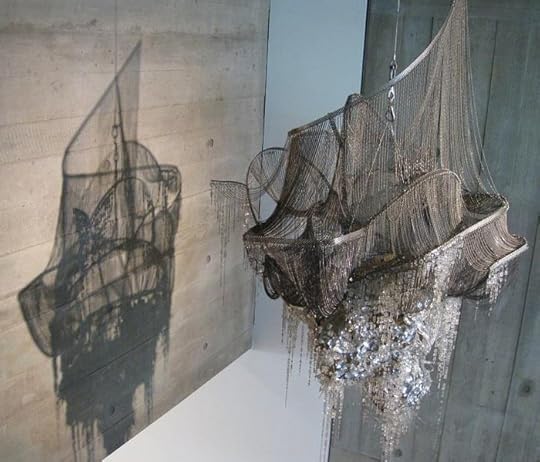
one of Korean artist Lee Bul's 'chandeliers'
Isabel Waidner's unique and brilliant Gaudy Bauble was the most unexpected revelation when judging the 2018 Republic of Consciousness Prize, and was deservedly shortlisted.
In the week that the 2019 shortlist has come out, it is fitting I've read this their (Waidner's preferred pronoun) second novel, which is, remarkably, even better and a surefire contender for the 2020 RoC and hopefully, this time, for the Goldsmiths Prize as well. [update - it made the Goldsmiths shortlist!!]
And credit to the brilliant publisher Dostoyevsky Wannabe and their innovative print-on-demand publishing model:
We are Diamond Stuff begins:
I look like Eleven from Stranger Things, I’m 36. Similar hair, similar face. Similar fears (childhood terrors). I will not grow out my hair at the next opportunity (Season two). Hello? Where am I. I’m alone on a beach. (What beach.) It’s early. It’s cold, where’s my blue worker’s jacket. It’s raining lightly. (A British beach.) HELLO—!? Where is everyone. Oh good—it’s getting lighter over the Solent (the stretch of water that separates the Isle of Wight from the British mainland). (This is the Isle of Wight off the south coast of England, the beach outside Ryde.) One, two, three Victorian military forts in the Solent – an early indication they have a thing about foreign invasion down here. Other than that, the beach is reassuringly pretty. Pinks and whites in this situation. Ochres. I take in the sea air—aaah. So far so good. But looking at the sea won’t help. I have talents, I’ll use them.
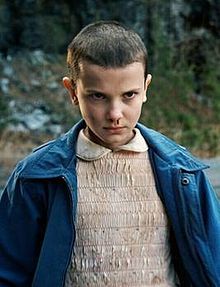
Eleven from Stranger Things
So far, so relatively conventional (?) but in paragraph 2, the disenfranchised things return:
A soldier, look! The soldier is wearing an army green t-shirt with black polar bears on it, what does it mean. Black oversize joggers, white Reebok classic trainers. The pronoun is “they”, the soldier signals to include the black polar bears the white reeboks. Ok, I say. Like me, Shae (the soldier), the polar bears and the reeboks are new to the Isle of Wight. They are second generation economic migrants (Shae), ecological refugees (the polar bears) and African elopers I mean antelopes (the reeboks) from North West London.
But while reebok trainers, polar bears from t-shirts and others of their ilk are as present as the human characters, and often out of control, the first person narrator doesn't let them seize control of their story.
The narrator and Shae end up working together in a hotel on the island:
The Isle of Wight is home to a large working-class demographic. Shae, for one, works in a hotel in Ryde. Minimum wage rates, Shae says, but free board and lodging. Not bad, as far as it goes. I have no money, no debit card, I interview for a job. This is the manager—House Mother Normal, formerly of B. S. Johnson’s eponymous novel (1971), pertaining to British avant-garde literature.
...
The polar bears are novelists (infantry soldiers), the reeboks are poets (intelligence operatives). Given how busy Shae and I are, toiling, that’s a beautiful thing. When they’re not pursuing their aspirations (writing), the novelists and poets like to gnaw on raw squid. I deposit a saucerful under the kitchen sink. No one will notice—. GOOD MORNING! It’s House Mother Normal patrolling her kitchen. I employ my foot to push the saucer of squid further under the kitchen sink where the polar bears and the reeboks are hiding with bated breath. Cut triangles that’s it, House Mother Normal says. Nice and even. Then the arms, or is it tentacles—eugh. Pieces like Hula skirts. Hah! Hah! Put one round your finger, like this. Crikey—a lot of “waste” in your bucket. Can you make soup. Don’t bother rinsing—just boil the lot, the sand will sink to the bottom of its own accord. About your contract—, House Mother Normal says. Yes? I’m all ears. We’ll keep it under the tax threshold, shall we. No National Insurance contributions, no sick pay, no holidays. Ok, I say. (Not ok.)
Yes House Mother Normal is another character, representing the exploitative employer in the zero-hours, no benefits, shortfalls docked from pay world of employment. The nod to B.S. Johnson is Waidner's acknowledgement of historical avante-garde experimental fiction, but one of Waidner's purposes is to demonstrate the challenge the normativity and exclusivity of even this form, drawing in authors from underrepresented groups. At one point Shae reads "Samuel R. Delany (not Beckett)" and other authors referenced include Tommy Pico (see below), Dennis Cooper, Nisha Ramayya and Mojisola Adebayo (the last two who featured in the highly-recommended Waidner-edited Liberating the Canon: An Anthology of Innovative Literature)
As in Gaudy Bauble, Waidner is brilliant at the chain of association. As a US-made Chinook helicopter flies overhead, the narrator broods on how the US military has chosen to name helicopters after Native American tribes and chiefs, whereas in Germany they use the names of large cats (rather than after populations they colonised), such as leopards.
This leads to reflection on the work of Tommy Pico and his Nature Poem (which includes the line I can’t write a nature poem bc that conversation happens in the Hall of South American Peoples in the American Museum of Natural History.)
And another key character in the book - Shae and the narrator's main adversary in fact, is a leopard, also from another of Shea's t-shirts.
The t-shirt that inspired the idea:
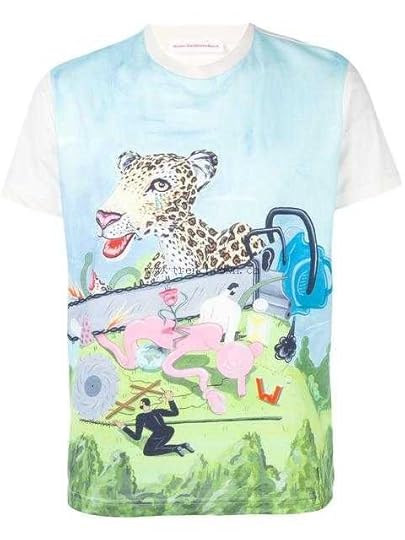
Or rather their adversary is a "lypard", a term which allows the author to successfully make another point about exclusion from the literary canon:
I look like Eleven from StrangerThings,I’m 36.Similar hair, similar face. Similar fears (childhood terrors). Fears rhymes with fierce, this is no coincidence, not in this house. The Tyger by William Blake (1794) is one of four canonical poems included in the Life in the UK test official handbook. Romantic verse is not normally part of Shae nor my educational capital but there you go—a lypard is a literary leopard (to a naturalised British citizen).
And when it is vanquished, the narrator taunts it:
Lypard lypard - your eyes are tearing. Are you diamond? Probably not! We’re made of diamond stuff, that is, harder stuff than you’re made of.
Later another link with military names comes via the Needles rocks and the British rocket projects that were secretly conducted there. Britain's most important military secrets, such as the nuclear programme, were protected under a series of 'Rainbow Codes' (https://en.m.wikipedia.org/wiki/List_...) such as Brown Bunny, Violet Club and Purple Possum. These, of course, becomes more characters in the novel, but the link is also drawn to the (presumably mutually undeliberate) crossover with Gilbert Baker’s now famous rainbow flag.
Shae's escaped Reeboks allow Waidner to explore another theme - how the working class seem often destined to be locked in that state, and whether this is the result of societal prejudices (Tonya Harding also appears as a character to illustrate this point) and/or self-fulfilling behaviour (the irony of working class votes voting for a Brexit backed by ultra-right neo-capitalists).
The Reebok Working Class Plus, sorry Reebok Workout Plus, is a classic trainer design connected to a particular British stereotype ... a self-fulfilling prophecy?
Which reminded me of this Daily Mail story from several years ago (not referenced as such in the novel): https://www.dailymail.co.uk/news/arti...
And despite the novel being only 100 pages long, I have barely scratched the surface - for example the thread on the narrator's frustrating attempts to secure their post Brexit future in the UK as a REU citizen.
Isabel Waidner's own take on the novel, from their academic homepage:
Waidner is perhaps one of the UK's most important novelists - and I recommend this without reservation.
Shae starts with the large and partially derelict Lee-Bul-style chandelier hanging from the very high ceiling. (Icicle-shaped mirror shards, diamantés, dangling silver chains and blocks of transparent acrylic, all stuck together in one big gaudy bauble.)
one of Korean artist Lee Bul's 'chandeliers'
Isabel Waidner's unique and brilliant Gaudy Bauble was the most unexpected revelation when judging the 2018 Republic of Consciousness Prize, and was deservedly shortlisted.
In the week that the 2019 shortlist has come out, it is fitting I've read this their (Waidner's preferred pronoun) second novel, which is, remarkably, even better and a surefire contender for the 2020 RoC and hopefully, this time, for the Goldsmiths Prize as well. [update - it made the Goldsmiths shortlist!!]
And credit to the brilliant publisher Dostoyevsky Wannabe and their innovative print-on-demand publishing model:
We "publish" independent/ experimental/ underground things. We're a zero budget operation. There's no money in this.If I had one small reservation with Gaudy Bauble is that it took me three goes to get past page 1; indeed it wasn't until I read the author's thesis, of which the novel formed a part, that I really could appreciate the form. Perhaps armed with that knowledge I was better prepared this time round but I found We Are Made Of Diamond Stuff immediately accessible, but equally innovative, and, most strikingly, politically and artistically harder hitting. Although Waidner is always thought provoking, seldom polemical. As a white, native English, London house owning, 50-ish, heterosexual, married with kids, male, Oxbridge-educated (albeit from a state-school working class background) former investment banker, and admirer of mainstream experimental fiction, in a way I'm everything this book isn't - but I felt challenged rather than attacked.
Pretty much the only criteria that we have for writers or artists who want to work with us is that what they produce must be very good, very bad in a good way, or very cool.
We are Diamond Stuff begins:
I look like Eleven from Stranger Things, I’m 36. Similar hair, similar face. Similar fears (childhood terrors). I will not grow out my hair at the next opportunity (Season two). Hello? Where am I. I’m alone on a beach. (What beach.) It’s early. It’s cold, where’s my blue worker’s jacket. It’s raining lightly. (A British beach.) HELLO—!? Where is everyone. Oh good—it’s getting lighter over the Solent (the stretch of water that separates the Isle of Wight from the British mainland). (This is the Isle of Wight off the south coast of England, the beach outside Ryde.) One, two, three Victorian military forts in the Solent – an early indication they have a thing about foreign invasion down here. Other than that, the beach is reassuringly pretty. Pinks and whites in this situation. Ochres. I take in the sea air—aaah. So far so good. But looking at the sea won’t help. I have talents, I’ll use them.
Eleven from Stranger Things
So far, so relatively conventional (?) but in paragraph 2, the disenfranchised things return:
A soldier, look! The soldier is wearing an army green t-shirt with black polar bears on it, what does it mean. Black oversize joggers, white Reebok classic trainers. The pronoun is “they”, the soldier signals to include the black polar bears the white reeboks. Ok, I say. Like me, Shae (the soldier), the polar bears and the reeboks are new to the Isle of Wight. They are second generation economic migrants (Shae), ecological refugees (the polar bears) and African elopers I mean antelopes (the reeboks) from North West London.
But while reebok trainers, polar bears from t-shirts and others of their ilk are as present as the human characters, and often out of control, the first person narrator doesn't let them seize control of their story.
The narrator and Shae end up working together in a hotel on the island:
The Isle of Wight is home to a large working-class demographic. Shae, for one, works in a hotel in Ryde. Minimum wage rates, Shae says, but free board and lodging. Not bad, as far as it goes. I have no money, no debit card, I interview for a job. This is the manager—House Mother Normal, formerly of B. S. Johnson’s eponymous novel (1971), pertaining to British avant-garde literature.
...
The polar bears are novelists (infantry soldiers), the reeboks are poets (intelligence operatives). Given how busy Shae and I are, toiling, that’s a beautiful thing. When they’re not pursuing their aspirations (writing), the novelists and poets like to gnaw on raw squid. I deposit a saucerful under the kitchen sink. No one will notice—. GOOD MORNING! It’s House Mother Normal patrolling her kitchen. I employ my foot to push the saucer of squid further under the kitchen sink where the polar bears and the reeboks are hiding with bated breath. Cut triangles that’s it, House Mother Normal says. Nice and even. Then the arms, or is it tentacles—eugh. Pieces like Hula skirts. Hah! Hah! Put one round your finger, like this. Crikey—a lot of “waste” in your bucket. Can you make soup. Don’t bother rinsing—just boil the lot, the sand will sink to the bottom of its own accord. About your contract—, House Mother Normal says. Yes? I’m all ears. We’ll keep it under the tax threshold, shall we. No National Insurance contributions, no sick pay, no holidays. Ok, I say. (Not ok.)
Yes House Mother Normal is another character, representing the exploitative employer in the zero-hours, no benefits, shortfalls docked from pay world of employment. The nod to B.S. Johnson is Waidner's acknowledgement of historical avante-garde experimental fiction, but one of Waidner's purposes is to demonstrate the challenge the normativity and exclusivity of even this form, drawing in authors from underrepresented groups. At one point Shae reads "Samuel R. Delany (not Beckett)" and other authors referenced include Tommy Pico (see below), Dennis Cooper, Nisha Ramayya and Mojisola Adebayo (the last two who featured in the highly-recommended Waidner-edited Liberating the Canon: An Anthology of Innovative Literature)
As in Gaudy Bauble, Waidner is brilliant at the chain of association. As a US-made Chinook helicopter flies overhead, the narrator broods on how the US military has chosen to name helicopters after Native American tribes and chiefs, whereas in Germany they use the names of large cats (rather than after populations they colonised), such as leopards.
This leads to reflection on the work of Tommy Pico and his Nature Poem (which includes the line I can’t write a nature poem bc that conversation happens in the Hall of South American Peoples in the American Museum of Natural History.)
And another key character in the book - Shae and the narrator's main adversary in fact, is a leopard, also from another of Shea's t-shirts.
The t-shirt that inspired the idea:
Or rather their adversary is a "lypard", a term which allows the author to successfully make another point about exclusion from the literary canon:
I look like Eleven from StrangerThings,I’m 36.Similar hair, similar face. Similar fears (childhood terrors). Fears rhymes with fierce, this is no coincidence, not in this house. The Tyger by William Blake (1794) is one of four canonical poems included in the Life in the UK test official handbook. Romantic verse is not normally part of Shae nor my educational capital but there you go—a lypard is a literary leopard (to a naturalised British citizen).
And when it is vanquished, the narrator taunts it:
Lypard lypard - your eyes are tearing. Are you diamond? Probably not! We’re made of diamond stuff, that is, harder stuff than you’re made of.
Later another link with military names comes via the Needles rocks and the British rocket projects that were secretly conducted there. Britain's most important military secrets, such as the nuclear programme, were protected under a series of 'Rainbow Codes' (https://en.m.wikipedia.org/wiki/List_...) such as Brown Bunny, Violet Club and Purple Possum. These, of course, becomes more characters in the novel, but the link is also drawn to the (presumably mutually undeliberate) crossover with Gilbert Baker’s now famous rainbow flag.
Shae's escaped Reeboks allow Waidner to explore another theme - how the working class seem often destined to be locked in that state, and whether this is the result of societal prejudices (Tonya Harding also appears as a character to illustrate this point) and/or self-fulfilling behaviour (the irony of working class votes voting for a Brexit backed by ultra-right neo-capitalists).
The Reebok Working Class Plus, sorry Reebok Workout Plus, is a classic trainer design connected to a particular British stereotype ... a self-fulfilling prophecy?
Which reminded me of this Daily Mail story from several years ago (not referenced as such in the novel): https://www.dailymail.co.uk/news/arti...
The most popular choice of trainers among burglars are Reebok Classics, according to a study which examined footprints left at crime scenes.I had to check this was the Daily Mail and not the satirical Daily Mash.
...
PhD student Matthew Tonkin found that for every extra £1 spent on trainers the level of social and economic deprivation of the crook increased by 0.75 per cent.
...
He said that his research could help cops collar repeat offenders simply by the kind of shoes they wear.
And despite the novel being only 100 pages long, I have barely scratched the surface - for example the thread on the narrator's frustrating attempts to secure their post Brexit future in the UK as a REU citizen.
Isabel Waidner's own take on the novel, from their academic homepage:
They Are Made of Diamond Stuff (2019) is a formally innovative novel set in a queer working-class milieu in post-EU-referendum Britain. It is designed as an intervention against the normativity of experimental publishing contexts in the UK, and, more widely, against the rise of conservativism and nationalism globally. In a 'post-truth' sociopolitical context where powerful narratives and imaginaries shape public opinion and influence electoral results, They Are Made of Diamond Stuff explores the potential of innovative fictions to help advance a progressive politics within marginalised (migrant, LGBTQ, BAME) communities and beyond, and to act as a mode of cultural resistance.And they expand on that in this article here - https://partisanhotel.co.uk/Isabel-Wa...
Waidner is perhaps one of the UK's most important novelists - and I recommend this without reservation.

October 8, 2019
Shortlisted for the Goldsmiths Prize 2019
Shortlisted for the Republic of Consciousness Prize 2020
I can't write a detailed review of this book, but like the earlier Gaudy Bauble, this book is surreal, entertaining and challenging.
This time the surface story sees the narrator working in a run-down hotel on the Isle of Wight, where they and their co-worker Shae entertain themselves in a series of bizarre and surreal adventures. There are numerous allusions, and a list of the works that inspired it (not all of them literary) appears at the book.
This is a book that thoroughly deserves its Goldsmiths shortlisting, and deserves a better review than this one, but fortunately there are already several of those here from my Mookse friends.
Shortlisted for the Republic of Consciousness Prize 2020
I can't write a detailed review of this book, but like the earlier Gaudy Bauble, this book is surreal, entertaining and challenging.
This time the surface story sees the narrator working in a run-down hotel on the Isle of Wight, where they and their co-worker Shae entertain themselves in a series of bizarre and surreal adventures. There are numerous allusions, and a list of the works that inspired it (not all of them literary) appears at the book.
This is a book that thoroughly deserves its Goldsmiths shortlisting, and deserves a better review than this one, but fortunately there are already several of those here from my Mookse friends.

October 22, 2019
I've been wanting to read Isabel Waidner for a while, but the recent Goldsmiths Prize shortlisting of their novel “We Are Made of Diamond Stuff” encouraged me to finally buy a copy. Because it's an award which honours books which “open up new possibilities of the novel form” I was prepared to read something experimental but I think this must be one of the most original novels I've read for some time. This novel is ‘Stranger Things’ fan fiction while also being an avant-garde form of social commentary. It’s at once fantastical and as real as grit caught in your teeth. These dualities might feel too testing for the reader if it weren’t for the wonderful sense of humour this novel possesses in satirising the dominant institutions and ideologies which inhibit its protagonists. In its playfulness it carves an opening in the world for its narrator and Shae who work for minimum wage in a hotel on the Isle of Wight. They ally themselves with or battle against the logos of corporate institutions which come to life as well as contending with the manager who withholds their wages, the locals who exclude them and the government which restricts their access to citizenship. Seeing the world through their point of view this story questions the meaning of belonging and nationality in a way which is poignant and personal.
Read my full review of We Are Made of Diamond Stuff by Isabel Waidner on LonesomeReader
Read my full review of We Are Made of Diamond Stuff by Isabel Waidner on LonesomeReader

June 5, 2021
Properly bonkers experimental novel set on the Isle of Wight with copious B.S. Johnson references and fiery satire on Brexit Britain. UK publishing needs more diamond stuff.

November 29, 2019
3.5, rounded up.
I fared a mite better with this, Waidner's second novel, than I did with 'their' first, hence rounding up to 4 stars, rather than down to 3, as I had with Gaudy Bauble. It either is more accessible - or that first exposure just made this easier to read - and I found it more fun. THAT said, I still don't quite 'get it', partially as I am unaware of many of the UK references and historical underpinnings, but also because I think Waidner delights in being intentionally obtuse. It seems, from the much more erudite reviews from the 'usual suspects' on here (Paul, Neil, G.Y., etc.) that a second reading and a delve into Waidner's doctoral thesis makes things even more explicable, but am not sure I care enough to do either...
[Parenthetical screed: Ok, I DO get the whole non-binary/gender non-specific thing, but the use of the plural (they/them/their) for a single individual still grates on me ... and half the time whenever Waidner used it, I had to stop for a second and ask myself to whom ELSE she was referring. I pray this is only a temporary juvenile fad/aberration, and will soon go the way of the hula hoop. I say if you want to REALLY embrace your 'otherness', there is a perfectly good singular pronoun you can use: IT!!]
I fared a mite better with this, Waidner's second novel, than I did with 'their' first, hence rounding up to 4 stars, rather than down to 3, as I had with Gaudy Bauble. It either is more accessible - or that first exposure just made this easier to read - and I found it more fun. THAT said, I still don't quite 'get it', partially as I am unaware of many of the UK references and historical underpinnings, but also because I think Waidner delights in being intentionally obtuse. It seems, from the much more erudite reviews from the 'usual suspects' on here (Paul, Neil, G.Y., etc.) that a second reading and a delve into Waidner's doctoral thesis makes things even more explicable, but am not sure I care enough to do either...
[Parenthetical screed: Ok, I DO get the whole non-binary/gender non-specific thing, but the use of the plural (they/them/their) for a single individual still grates on me ... and half the time whenever Waidner used it, I had to stop for a second and ask myself to whom ELSE she was referring. I pray this is only a temporary juvenile fad/aberration, and will soon go the way of the hula hoop. I say if you want to REALLY embrace your 'otherness', there is a perfectly good singular pronoun you can use: IT!!]

October 19, 2019
Now shortlisted for the 2020 Republic of Consciousness Prize for UK and Irish small presses.
This book published by Dostoyevsky Wannabe has been shortlisted for the 2019 Goldsmith Prize – which I think could not be more appropriate, and in fact is overdue recognition of Isabel Waidner’s concept of a form of fiction which in line with the prize’s aims “breaks the mould … extends the possibility of the novel form …. embodies the spirit of invention that characterises the genre at its best”.
In 2018 I was one of the judges on the Republic of Consciousness Prize for small press fiction. One of the more unusual and challenging entries we received was “Gaudy Bauble” - their previous novel. I recall at the judges meeting that its shortlisting was quickly agreed as it so clearly fulfilled the aims of the prize – to highlight small presses publishing groundbreaking fiction.
In my review of that book I referenced the author’s thesis (https://pure.roehampton.ac.uk/portal/...) which helped considerably with my understanding of what they had achieved with the novel.
In my own words I believe that Waidner’s key idea is to link two areas: conceptual art (something which she feels has only had limited cross over into literature) and post-identity gender fluidity – this leads to their concept and invention of trans-literature.
A key element of their writing I believe (again in my words) is the rejection of the traditional novelistic structure featuring a main character, other key characters, minor characters and then passive objects with which they interact.
I believe that Waidner implicitly equates this rigid and hierarchical structure with a traditional patriarchal, gender-rigid society. In their writing therefore the dominant character is a fluid concept – and just as an hierarchy starts to form (often to the relief of the tradition-bound reader, who finally starts to be able to identify the book with conventional concepts of plot and character and feels they are returning to something they know), Waidner very deliberately overturns this hierarchy and introduces a new main character, including in many cases what initially seemed inanimate objects – often based around patterns or illustrations on clothing (clothing often described in detail, and all it seems based on items that Waidner or their friends have worn).
Other thematic elements of Gaudy Bauble which stood out to me on my initial read (and before reading the thesis) were: the clear use of Google as a tool to take an idea and extend in a kind of free-association exploration of an initial concept and a search for links or word plays that can be incorporated to alter the course of the novel or to facilitate the introduction of new protagonists; the slightly odd narrative which at times can read like a rather literal translation from their native German.
To my interest, both of these elements (which I initially may have regarded as criticisms) are dwelt on and examined and explained in the thesis as intrinsic to their situation and to their new literary concept.
All of these concepts are explored in this book – which is perhaps a more approachable and accessible version of their first novel but very recognisably from the same genre.
I think part of that may be due to my familiarity with Waidner’s very distinctive techniques and style.
A second element is that the book has a clear overriding and very topical theme of Brexit to go alongside its exploration of: class in Britain, hostility to immigrants, polygenderism – interestingly all themes also explored in the 2019 Booker prize winner Girl, Woman, Other.
It would be appropriate if this book – more of a Person. Jumper, Other – joined that book by winning the 2019 Goldsmith.
This book published by Dostoyevsky Wannabe has been shortlisted for the 2019 Goldsmith Prize – which I think could not be more appropriate, and in fact is overdue recognition of Isabel Waidner’s concept of a form of fiction which in line with the prize’s aims “breaks the mould … extends the possibility of the novel form …. embodies the spirit of invention that characterises the genre at its best”.
In 2018 I was one of the judges on the Republic of Consciousness Prize for small press fiction. One of the more unusual and challenging entries we received was “Gaudy Bauble” - their previous novel. I recall at the judges meeting that its shortlisting was quickly agreed as it so clearly fulfilled the aims of the prize – to highlight small presses publishing groundbreaking fiction.
In my review of that book I referenced the author’s thesis (https://pure.roehampton.ac.uk/portal/...) which helped considerably with my understanding of what they had achieved with the novel.
In my own words I believe that Waidner’s key idea is to link two areas: conceptual art (something which she feels has only had limited cross over into literature) and post-identity gender fluidity – this leads to their concept and invention of trans-literature.
A key element of their writing I believe (again in my words) is the rejection of the traditional novelistic structure featuring a main character, other key characters, minor characters and then passive objects with which they interact.
I believe that Waidner implicitly equates this rigid and hierarchical structure with a traditional patriarchal, gender-rigid society. In their writing therefore the dominant character is a fluid concept – and just as an hierarchy starts to form (often to the relief of the tradition-bound reader, who finally starts to be able to identify the book with conventional concepts of plot and character and feels they are returning to something they know), Waidner very deliberately overturns this hierarchy and introduces a new main character, including in many cases what initially seemed inanimate objects – often based around patterns or illustrations on clothing (clothing often described in detail, and all it seems based on items that Waidner or their friends have worn).
Other thematic elements of Gaudy Bauble which stood out to me on my initial read (and before reading the thesis) were: the clear use of Google as a tool to take an idea and extend in a kind of free-association exploration of an initial concept and a search for links or word plays that can be incorporated to alter the course of the novel or to facilitate the introduction of new protagonists; the slightly odd narrative which at times can read like a rather literal translation from their native German.
To my interest, both of these elements (which I initially may have regarded as criticisms) are dwelt on and examined and explained in the thesis as intrinsic to their situation and to their new literary concept.
All of these concepts are explored in this book – which is perhaps a more approachable and accessible version of their first novel but very recognisably from the same genre.
I think part of that may be due to my familiarity with Waidner’s very distinctive techniques and style.
A second element is that the book has a clear overriding and very topical theme of Brexit to go alongside its exploration of: class in Britain, hostility to immigrants, polygenderism – interestingly all themes also explored in the 2019 Booker prize winner Girl, Woman, Other.
It would be appropriate if this book – more of a Person. Jumper, Other – joined that book by winning the 2019 Goldsmith.

October 29, 2019
(3.5) Likeably odd pop-art/absurdist/intersectional romp in which both self- and social-divisions are treated with a chaotic ambivalence that seems to cause the dissolution of labels and borders, both figurative and real. Also very anti-Tory so there's that for anyone not so charmed by the gruff-twee goings-on. ('Gruff-twee' seems to be a newish thing. Whimsy through gritted teeth.)

March 18, 2019
Now re-read with its inclusion on the Goldsmiths shortlist providing the perfect reason for the re-read I promised myself at the end of my initial review.
In terms of updating this review, I know it seems lazy but I really can't do better than point towards Paul's review: www.goodreads.com/review/show/2702084246
And, as suggested in my initial review, a re-read has confirmed that this is a 5 star book.
---------------
ORIGINAL REVIEW
---------------
When I was involved with the 2018 Republic of Consciousness Prize, we shortlisted Isabel Waidner’s first novel, Gaudy Bauble. It took me three goes to read that book: there was something about it on the first reading that made me want to go back and try again even though I didn’t understand it all. The second reading made some of it a bit clearer, but it became evident a third (and probably more) reading was required. It thoroughly deserved its place on the short list.
We Are Made of Diamond Stuff is a new novel from Waidner. In-between the two novels, they have published an anthology, Liberating The Canon, which is also a great read. So, I was looking forward to reading this new one.
The wonderful thing about ordering a novel from Dostoyevsky Wannabe is that you really don’t know what you might receive when the book arrives. The equally wonderful thing, for me, is that when you have received and read the book, there is still a chance that you will not know what it was you ordered!
It might be because I’ve had some practice with Gaudy Bauble, but this new book is actually more accessible. That said,
A soldier, look! The soldier is wearing an army green t-shirt with black polar bears on it, what does it mean. Black oversize joggers, white Reebok classic trainers. The pronoun is “they”, the soldier signals to include the black polar bears the white reeboks. Ok, I say. Like me, Shae (the soldier), the polar bears and the reeboks are new to the Isle of Wight. They are second generation economic migrants (Shae), ecological refugees (the polar bears) and African elopers I mean antelopes (the reeboks) from North West London.
which is the second paragraph of the book is perhaps not the easiest piece of text to get your head round and does set the tone for what is coming. Like Gaudy Bauble, clothing and clothing designs can be as much narrators or characters in the story as can the human characters.
What else can you expect to come across in We Are Made of Diamond Stuff. Well, as just a few examples, consider
1. Homage/reference to B. S. Johnson and experimental literature. In particular, House Mother Normal is a character here, albeit in a different guise to Johnson’s.
2. An ongoing battle with a leopard, referred to as a lypard. This spelling variant opens up the opportunity to reference Blake and one of the main themes of the novel. The Tyger by William Blake (1794) is one of four canonical poems included in the Life in the UK test official handbook. Romantic verse is not normally part of Shae nor my educational capital but there you go—a lypard is a literary leopard (to a naturalised British citizen).
3. Discussion of several aspects of life on the Isle of Wight. Secret military projects (the Rainbow Codes such as Violet Club and Purple Possum can become characters in Waidner’s world), Sandown zoo and life in a guest house all play a part.
4. Reebok trainers
The reference to the Life in the UK test is important as the book has a continuous undercurrent that often bubbles to the surface which reflects on Brexit and British citizenship as well as on the place of “experimental fiction” in UK publishing. Perhaps the best way to summarise is to let Waidner speak for themself about their book:
They Are Made of Diamond Stuff (2019) is a formally innovative novel set in a queer working-class milieu in post-EU-referendum Britain. It is designed as an intervention against the normativity of experimental publishing contexts in the UK, and, more widely, against the rise of conservativism and nationalism globally. In a 'post-truth' sociopolitical context where powerful narratives and imaginaries shape public opinion and influence electoral results, They Are Made of Diamond Stuff explores the potential of innovative fictions to help advance a progressive politics within marginalised (migrant, LGBTQ, BAME) communities and beyond, and to act as a mode of cultural resistance.
Well worth reading and then, as I will certainly do at some point soon, reading again. At that point, I imagine my rating might well increase to the full 5 stars.
In terms of updating this review, I know it seems lazy but I really can't do better than point towards Paul's review: www.goodreads.com/review/show/2702084246
And, as suggested in my initial review, a re-read has confirmed that this is a 5 star book.
---------------
ORIGINAL REVIEW
---------------
When I was involved with the 2018 Republic of Consciousness Prize, we shortlisted Isabel Waidner’s first novel, Gaudy Bauble. It took me three goes to read that book: there was something about it on the first reading that made me want to go back and try again even though I didn’t understand it all. The second reading made some of it a bit clearer, but it became evident a third (and probably more) reading was required. It thoroughly deserved its place on the short list.
We Are Made of Diamond Stuff is a new novel from Waidner. In-between the two novels, they have published an anthology, Liberating The Canon, which is also a great read. So, I was looking forward to reading this new one.
The wonderful thing about ordering a novel from Dostoyevsky Wannabe is that you really don’t know what you might receive when the book arrives. The equally wonderful thing, for me, is that when you have received and read the book, there is still a chance that you will not know what it was you ordered!
It might be because I’ve had some practice with Gaudy Bauble, but this new book is actually more accessible. That said,
A soldier, look! The soldier is wearing an army green t-shirt with black polar bears on it, what does it mean. Black oversize joggers, white Reebok classic trainers. The pronoun is “they”, the soldier signals to include the black polar bears the white reeboks. Ok, I say. Like me, Shae (the soldier), the polar bears and the reeboks are new to the Isle of Wight. They are second generation economic migrants (Shae), ecological refugees (the polar bears) and African elopers I mean antelopes (the reeboks) from North West London.
which is the second paragraph of the book is perhaps not the easiest piece of text to get your head round and does set the tone for what is coming. Like Gaudy Bauble, clothing and clothing designs can be as much narrators or characters in the story as can the human characters.
What else can you expect to come across in We Are Made of Diamond Stuff. Well, as just a few examples, consider
1. Homage/reference to B. S. Johnson and experimental literature. In particular, House Mother Normal is a character here, albeit in a different guise to Johnson’s.
2. An ongoing battle with a leopard, referred to as a lypard. This spelling variant opens up the opportunity to reference Blake and one of the main themes of the novel. The Tyger by William Blake (1794) is one of four canonical poems included in the Life in the UK test official handbook. Romantic verse is not normally part of Shae nor my educational capital but there you go—a lypard is a literary leopard (to a naturalised British citizen).
3. Discussion of several aspects of life on the Isle of Wight. Secret military projects (the Rainbow Codes such as Violet Club and Purple Possum can become characters in Waidner’s world), Sandown zoo and life in a guest house all play a part.
4. Reebok trainers
The reference to the Life in the UK test is important as the book has a continuous undercurrent that often bubbles to the surface which reflects on Brexit and British citizenship as well as on the place of “experimental fiction” in UK publishing. Perhaps the best way to summarise is to let Waidner speak for themself about their book:
They Are Made of Diamond Stuff (2019) is a formally innovative novel set in a queer working-class milieu in post-EU-referendum Britain. It is designed as an intervention against the normativity of experimental publishing contexts in the UK, and, more widely, against the rise of conservativism and nationalism globally. In a 'post-truth' sociopolitical context where powerful narratives and imaginaries shape public opinion and influence electoral results, They Are Made of Diamond Stuff explores the potential of innovative fictions to help advance a progressive politics within marginalised (migrant, LGBTQ, BAME) communities and beyond, and to act as a mode of cultural resistance.
Well worth reading and then, as I will certainly do at some point soon, reading again. At that point, I imagine my rating might well increase to the full 5 stars.

October 20, 2019
[4.5] A kaleidoscopic, intersectional, funny, and inventive atrocity of a novel deservedly on the Goldsmiths 2019 shortlist. Textually, it shares Finnegans Wake’s phonetic playfulness and opacity but in a miniaturized, politicized, and queered-up form. Thematically, it probes identity (British), class, gender, ecological crisis and other timely topics through more or less baffling symbols such as a polar bear, a lypard, and Reebok sneakers. A challenging but fresh novel with layers to discover.
October 28, 2019
There is a lot to like in this short playful novel set on the Isle Of White:
- it considers a number of the contemporary social issues and ask serious painful questions:
1) is the fate of working class is self-perpetuating from generation to generation?
2) immigration, the hurdles, humiliation and mess an migrant needs to go through in obtaining any legal status in the UK. Being a person who went through this nightmare myself, I cannot sympathise more.
3) queer identities, especially in the case of their overlap with the two factors above (working class and immigrant identities). Also the issues arising between the queer and gay people in the modern day Britain due to their politics.
- I also like how it renders the Isle of White, its landscape and its history;
- the intertextuality is palpable through the book. At the end, there is a list of reference of the books and articles mentioned.
However, unfortunately, I did not enjoy that much the aesthetic choice of the novel. Isabel Wainder is PhD in Creative Writing. In their own words, “it (the novel) collides literary aesthetics with contemporary working class cultures and attitudes.” So i am sure it is a deliberate choice. I felt the style and the language used was deliberately made radically accessible. And I found it problematic. The anthropomorphism and the sentence structures, amount of question marks and capitalisation reminded me of the language one tends to find in a children book. And a hunt for the “lypard” specifically reminded me of a famous children book “We are going on a bear hunt”. I am not quite sure about the reason for such a choice of style. It might be to follow a marxist view that there is no difference between the high and a popular culture. Or, it might be to increase the audience of the readers who would identify with the text and help them to pay attention to the serious issues incorporated and mentions above. The typical example of the style:
“At a later point, House Mother Normal walks in on the polar bear FEEDING, the reeboks in a FRENZY. Who fed them? House Mother Normal works herself up over the polar bears and the reeboks freeloading. She is exploring the possibility of them fixing the boiler in exchange for their squid-. No! I say. The polar bears are novelists, the reeboks are poets, it is not within their remit nor skill set to fix and English boiler!”
It probably would make many people laugh. But I find it a bit tiresome.
The book also shows the tendency of merging material culture with literature. Again, the reason might be that any literature has got a material basis according to some theories. Many characters materialise into the book’s world from the drawings on t-shirts. Reebok trainers play the role of a poet. They are also symbolic as Reebok classics are apparently the favourite trainers of the UK working class people. РАССВЕТ, a Russian youth brand based upon the nostalgia over Soviet Union is used in the plot as well. Other brands like popular cheap chocolate bars are used as metaphors as well. One lyrical passage reads like this:
“What if fear, rage, joy and a sense of humour were actually Milky Ways. What if political urgency, transgression and difference where Kinder Surprises! What of WE THINK YOU ARE BORING were fun size Mars bar. What if life (a lot of it) and love (above all) were mini Galaxies, then there’d be Celebrations for Shae and I after all!”
Someone help me please with the interpretation of this! I do not eat chocolate. Maybe that is why i did not get the wit and beauty of this particular metaphor.
The novel is also a melting pot of genres. And this i actually did not mind in general. However, the last few pages is a collage from on-line reviews (the Trip Adviser) of the Isle of White Zoo. Although relevant, I do not find it super-creative and felt it was overused here. And this tipped of my rating towards 3 stars.
Overall it is an experimental brave novel. The author is definitely taking risks which should be applauded for. But aesthetically i was not very pleased which is rather subjective of course and reflects my taste rather than the book quality. I will try their another novel to know them better.
This novel is nominated on GoldSmith Prize 2019.
- it considers a number of the contemporary social issues and ask serious painful questions:
1) is the fate of working class is self-perpetuating from generation to generation?
2) immigration, the hurdles, humiliation and mess an migrant needs to go through in obtaining any legal status in the UK. Being a person who went through this nightmare myself, I cannot sympathise more.
3) queer identities, especially in the case of their overlap with the two factors above (working class and immigrant identities). Also the issues arising between the queer and gay people in the modern day Britain due to their politics.
- I also like how it renders the Isle of White, its landscape and its history;
- the intertextuality is palpable through the book. At the end, there is a list of reference of the books and articles mentioned.
However, unfortunately, I did not enjoy that much the aesthetic choice of the novel. Isabel Wainder is PhD in Creative Writing. In their own words, “it (the novel) collides literary aesthetics with contemporary working class cultures and attitudes.” So i am sure it is a deliberate choice. I felt the style and the language used was deliberately made radically accessible. And I found it problematic. The anthropomorphism and the sentence structures, amount of question marks and capitalisation reminded me of the language one tends to find in a children book. And a hunt for the “lypard” specifically reminded me of a famous children book “We are going on a bear hunt”. I am not quite sure about the reason for such a choice of style. It might be to follow a marxist view that there is no difference between the high and a popular culture. Or, it might be to increase the audience of the readers who would identify with the text and help them to pay attention to the serious issues incorporated and mentions above. The typical example of the style:
“At a later point, House Mother Normal walks in on the polar bear FEEDING, the reeboks in a FRENZY. Who fed them? House Mother Normal works herself up over the polar bears and the reeboks freeloading. She is exploring the possibility of them fixing the boiler in exchange for their squid-. No! I say. The polar bears are novelists, the reeboks are poets, it is not within their remit nor skill set to fix and English boiler!”
It probably would make many people laugh. But I find it a bit tiresome.
The book also shows the tendency of merging material culture with literature. Again, the reason might be that any literature has got a material basis according to some theories. Many characters materialise into the book’s world from the drawings on t-shirts. Reebok trainers play the role of a poet. They are also symbolic as Reebok classics are apparently the favourite trainers of the UK working class people. РАССВЕТ, a Russian youth brand based upon the nostalgia over Soviet Union is used in the plot as well. Other brands like popular cheap chocolate bars are used as metaphors as well. One lyrical passage reads like this:
“What if fear, rage, joy and a sense of humour were actually Milky Ways. What if political urgency, transgression and difference where Kinder Surprises! What of WE THINK YOU ARE BORING were fun size Mars bar. What if life (a lot of it) and love (above all) were mini Galaxies, then there’d be Celebrations for Shae and I after all!”
Someone help me please with the interpretation of this! I do not eat chocolate. Maybe that is why i did not get the wit and beauty of this particular metaphor.
The novel is also a melting pot of genres. And this i actually did not mind in general. However, the last few pages is a collage from on-line reviews (the Trip Adviser) of the Isle of White Zoo. Although relevant, I do not find it super-creative and felt it was overused here. And this tipped of my rating towards 3 stars.
Overall it is an experimental brave novel. The author is definitely taking risks which should be applauded for. But aesthetically i was not very pleased which is rather subjective of course and reflects my taste rather than the book quality. I will try their another novel to know them better.
This novel is nominated on GoldSmith Prize 2019.

November 4, 2019
I’m not sure what I just read. But I like it 😊

March 26, 2025
Amazing. Fckin incredible. Like a British Kathy Acker, but unique in its own wonderful way, too. 🏳️⚧️

October 21, 2019
I have visited the Isle of Wight many times over the years, for day trips, holidays and visits to relatives, by kayak, dinghy, yacht and ferry, on foot, with a bicycle, motorbike or car. It is a schizophrenic sort of place, part 1950s middle England in miniature, part hippy commune, and both a glitzy and a tacky holiday destination. There are both high-tech jobs, particularly in green technology (or what was thought to be 'green' many years ago), and minimum wage (or lower) jobs in 'hospitality' and agriculture, both of which tend to be seasonal.
If you think I am wittering on about the Isle of Wight because I don't know how to review this surreal and amazing novel, you would be correct, but I can't imagine it set anywhere else.
If you think I am wittering on about the Isle of Wight because I don't know how to review this surreal and amazing novel, you would be correct, but I can't imagine it set anywhere else.
December 11, 2019
Delightfully weird (novelist polar bears and poet reeboks 😁), made me google almost the entire Isle of Wight as well as quite some artists I didn’t know yet and to top it off, it's also a very critical social commentary.
So, it's a brilliant novel in the very best Nicola Barker fashion (and those who know me, know that's the biggest compliment). Just read this book, I will try to get hold of their earlier work.
So, it's a brilliant novel in the very best Nicola Barker fashion (and those who know me, know that's the biggest compliment). Just read this book, I will try to get hold of their earlier work.

February 19, 2020
We Are Made Of Diamond Stuff is like a lyrical firecracker. Every page, no every sentence explodes with wit, energy and verve. Cultural and cult references are flung at you along with puns, metaphors and odd cadences of speech. During my reading of the book, I laughed, raised my eyebrows in astonishment and just said ‘wow’ , at least half a dozen times. This was a reading experience that was jarring and yet fun as well.
Now I spent the intro praising the book, what is it about?
If I were to take a giant sieve and sift through the main themes, I would definitely say that this is a political novel, which criticises current day Britain.
The setting of the book is The Isle of Wight, in which 62% of the population voted leave back in 2016. Known for it’s bunkers and has a terrible zoo. The narrator is an immigrant who documents the British way of thinking and the running in the country. She works in a hotel and scrapes by.
That’s just the surface. We also get the narrator’s views on gender politics, social classes , war, art and literature. Then there’s the surreal bits; ice skater Tonya Harding makes an appearance at the hotel ( a metaphor for how working class people are treated), the narrator resembles Eleven from Netflix show, Stranger Things and wishes she had her psychokinetic abilities, again these are vehicles to comment on immigrant policies. As mentioned there’s a lot going on so it’s up to the reader to pick apart and interpret.
There’s something fresh and unique about We Are made of Diamond Stuff. It’s a bold, original take on a topical subject, and like the void area in the aforementioned Stranger Things, The Upside Down, you do not know what will happen at any turning AND like The Upside Down, a revisit may yield something different. Every book is an experience in itself but We Are Made of Diamond Stuff is of the one of a kind variety.
Now I spent the intro praising the book, what is it about?
If I were to take a giant sieve and sift through the main themes, I would definitely say that this is a political novel, which criticises current day Britain.
The setting of the book is The Isle of Wight, in which 62% of the population voted leave back in 2016. Known for it’s bunkers and has a terrible zoo. The narrator is an immigrant who documents the British way of thinking and the running in the country. She works in a hotel and scrapes by.
That’s just the surface. We also get the narrator’s views on gender politics, social classes , war, art and literature. Then there’s the surreal bits; ice skater Tonya Harding makes an appearance at the hotel ( a metaphor for how working class people are treated), the narrator resembles Eleven from Netflix show, Stranger Things and wishes she had her psychokinetic abilities, again these are vehicles to comment on immigrant policies. As mentioned there’s a lot going on so it’s up to the reader to pick apart and interpret.
There’s something fresh and unique about We Are made of Diamond Stuff. It’s a bold, original take on a topical subject, and like the void area in the aforementioned Stranger Things, The Upside Down, you do not know what will happen at any turning AND like The Upside Down, a revisit may yield something different. Every book is an experience in itself but We Are Made of Diamond Stuff is of the one of a kind variety.

January 3, 2023
This is the Waidner I've been waiting for! I enjoyed her other two books (Gaudy Bauble and Sterling Karat Gold), but they felt more uneven to me. On this one, the Waidner stars aligned like double-wide laced cross trainers. Fashion comes to life literally while doubling as a lens through which to view culture and/or define/confine it. Nationalism and the absurdity of labor/immigration are on parade in what feels like a proletariat Fellini flick laced with a little Salvador Dali showmanship. Pop culture and theory rub shoulders as cultural appropriation helps brand military weapons. Meanwhile, the system grinds along in bureaucratic absurdity (overlooking obvious exceptions and transgressions, abusing its power, and dehumanizing the individual, especially those "othered" socially). I thoroughly enjoyed this one as I thought all the parts worked incredibly well together without losing narrative momentum. A cultural critique as biting as it is delightfully offbeat, humorous, and smart.

November 4, 2019
I read Gaudy Bauble last year, and this offering from Isabel Waidner is a second extract from their thesis (available online) explaining their positioning as part of a “new generation of interdisciplinary queer British writers” .
The American “ New Narrative” movement is the avowed influence, and Diamond (a Print on demand publication) has Dodie Bellamy, a New Narrative founder, providing a glowing endorsement. There is some clever, and innovative writing, but in my personal opinion this is lost in a polemical onslaught.
The final page of Diamond invokes:
****Support non - Oxbridge talent ****
This is no surprise given that Waidner uses every interview as an opportunity to decry posh, elitist “Oxbridge”.
The best way to consider this latest thesis extract(Diamond) is as a response to this “Oxbridge” vitriol:
(1) hypocrisy
Jay Bernard is referenced, and name checked (pages 54,58)
“Jay Bernard (1988), FRSL, is a British writer, artist, film programmer, and activist from London, Bernard grew up in Croydon, London, and read English at Oxford University. Bernard uses the pronouns "they/ them".Their Jamaican-born grandmother, Gee Bernard was the first black member of the Inner London Education Authority (ILEA). Bernard was elected as a Fellow of the Royal Society of Literature in 2018. Bernard's pamphlet The Red and Yellow Nothing was shortlisted for the Ted Hughes Award in 2016. While Bernard’s earlier poetry was largely personal, 2016’s The Red and Yellow Nothing plunged a little known Arthurian knight, Sir Morien, reputed to be “black from head to toe”, into “a queer, black, techno, medieval misadventure” involving Kendrick Lamar and Super Mario (among others). It was duly shortlisted for last year’s Ted Hughes award. TR&YN Kendrick Lamar is referenced in Bernard’s The Red and Yellow Nothing.”
(2) some interesting "Oxbridge" examples
Ali Smith was born in Inverness on 24 August 1962 to Ann and Donald Smith. Her parents were working-class and she was raised in a council house in Inverness. From 1985 to 1990 she attended Newnham College, Cambridge obtaining a PhD in American and Irish modernism. During her time at Cambridge, she began writing plays.
Naomi Alderman Born in London Alderman educated at Lincoln College, Oxford , where she read PPE. In the United States she began to explore the world of fan fiction, focusing on Buffy the Vampire Slayer. (note: 'Fan Fiction', and Science fiction is a particular area identified by Waidner as excluded by the mainstream publishing industry)
Philip Pullman spent time in Norfolk with his grandfather, a clergyman. Discovered John Milton's Paradise Lost, which would become a major influence for His Dark Materials. From 1965, Pullman attended Exeter College, Oxford , He discovered William Blake's illustrations around 1970, which would also later influence him greatly. (note: Blake feature central to Diamond)
Monica Ali was born in Bangladesh in 1967 to a Bangladeshi father and an English mother. When she was three, her family moved to Bolton, England. She went to Bolton School and then studied PPE at Wadham College, Oxford.
A small selection of "Oxbridge" luminaries (hardly stereotypical establishment crusties): Zadie Smith Jeanette Winterson Vikram Seth Alan Hollingshurst Stephen Fry Emma Thompson Stephen Hawking Ian McKellern EP Thompson Eric Hobsbawm Vera Brittain Michael Foot
From the world of small, successful, innovative, independent presses in the publishing world Toby Litt Sam Jordison Eloise Millar
Politics- David Gauke was educated at Northgate High School in Ipswich, Suffolk before attending St Edmund Hall, Oxford. Resigned as Secretary of State July 2019, citing that he could not serve Boris Johnson as Prime Minister. Gauke became known in the media as the "Gaukeward Squad .
Rory Stewart , erstwhile Conservative Minister. The current Conservative leadership (who I can only assume are responsible for the "Oxbridge" backlash), have their own detrators, from within the "establishment"
(3) An alternative (Stormzy) approach to educational aspiration:
BBC 11/10/19 The "Stormzy effect" has contributed to more black students being admitted to the University of Cambridge, it has said. Grime artist Stormzy has pledged to fund the tuition fees and living costs of two students each year.For the first time, black students made up more than 3% of new undergraduates, according to figures released by the university. The university said the new figures were reflective of wider UK society.
This year 91 black students were admitted to the university, up about 50% from the 61 who started courses in autumn 2018. Reacting to the news in a tweet, Stormzy said: "This is amazing - there's no way that this is because of me alone."
He went on to thank the Cambridge University African Caribbean Society and the university itself for their efforts to recruit more black students. He said: "Big up Cambridge ACS for the incredible work they do they would of played a massive part in this. And big up Cambridge—Uni for there continued efforts."
Prof Graham Virgo, Cambridge's senior pro-vice-chancellor for education, said: "This record rise in the number of black students is a credit to their hard work and ability. We have not lowered entry standards."
Cambridge's figures showed that 26.8% of its 3,500 undergraduate students this year were UK residents from black, Asian and minority ethnic backgrounds.
In September the University announced more than 68% of its students came from a state school background. And a total of 67 students from widening participation backgrounds were offered places through Adjustment this year.
My invocation: **** Support creative talent wherever you find it**
The American “ New Narrative” movement is the avowed influence, and Diamond (a Print on demand publication) has Dodie Bellamy, a New Narrative founder, providing a glowing endorsement. There is some clever, and innovative writing, but in my personal opinion this is lost in a polemical onslaught.
The final page of Diamond invokes:
****Support non - Oxbridge talent ****
This is no surprise given that Waidner uses every interview as an opportunity to decry posh, elitist “Oxbridge”.
The best way to consider this latest thesis extract(Diamond) is as a response to this “Oxbridge” vitriol:
(1) hypocrisy
Jay Bernard is referenced, and name checked (pages 54,58)
“Jay Bernard (1988), FRSL, is a British writer, artist, film programmer, and activist from London, Bernard grew up in Croydon, London, and read English at Oxford University. Bernard uses the pronouns "they/ them".Their Jamaican-born grandmother, Gee Bernard was the first black member of the Inner London Education Authority (ILEA). Bernard was elected as a Fellow of the Royal Society of Literature in 2018. Bernard's pamphlet The Red and Yellow Nothing was shortlisted for the Ted Hughes Award in 2016. While Bernard’s earlier poetry was largely personal, 2016’s The Red and Yellow Nothing plunged a little known Arthurian knight, Sir Morien, reputed to be “black from head to toe”, into “a queer, black, techno, medieval misadventure” involving Kendrick Lamar and Super Mario (among others). It was duly shortlisted for last year’s Ted Hughes award. TR&YN Kendrick Lamar is referenced in Bernard’s The Red and Yellow Nothing.”
(2) some interesting "Oxbridge" examples
Ali Smith was born in Inverness on 24 August 1962 to Ann and Donald Smith. Her parents were working-class and she was raised in a council house in Inverness. From 1985 to 1990 she attended Newnham College, Cambridge obtaining a PhD in American and Irish modernism. During her time at Cambridge, she began writing plays.
Naomi Alderman Born in London Alderman educated at Lincoln College, Oxford , where she read PPE. In the United States she began to explore the world of fan fiction, focusing on Buffy the Vampire Slayer. (note: 'Fan Fiction', and Science fiction is a particular area identified by Waidner as excluded by the mainstream publishing industry)
Philip Pullman spent time in Norfolk with his grandfather, a clergyman. Discovered John Milton's Paradise Lost, which would become a major influence for His Dark Materials. From 1965, Pullman attended Exeter College, Oxford , He discovered William Blake's illustrations around 1970, which would also later influence him greatly. (note: Blake feature central to Diamond)
Monica Ali was born in Bangladesh in 1967 to a Bangladeshi father and an English mother. When she was three, her family moved to Bolton, England. She went to Bolton School and then studied PPE at Wadham College, Oxford.
A small selection of "Oxbridge" luminaries (hardly stereotypical establishment crusties): Zadie Smith Jeanette Winterson Vikram Seth Alan Hollingshurst Stephen Fry Emma Thompson Stephen Hawking Ian McKellern EP Thompson Eric Hobsbawm Vera Brittain Michael Foot
From the world of small, successful, innovative, independent presses in the publishing world Toby Litt Sam Jordison Eloise Millar
Politics- David Gauke was educated at Northgate High School in Ipswich, Suffolk before attending St Edmund Hall, Oxford. Resigned as Secretary of State July 2019, citing that he could not serve Boris Johnson as Prime Minister. Gauke became known in the media as the "Gaukeward Squad .
Rory Stewart , erstwhile Conservative Minister. The current Conservative leadership (who I can only assume are responsible for the "Oxbridge" backlash), have their own detrators, from within the "establishment"
(3) An alternative (Stormzy) approach to educational aspiration:
BBC 11/10/19 The "Stormzy effect" has contributed to more black students being admitted to the University of Cambridge, it has said. Grime artist Stormzy has pledged to fund the tuition fees and living costs of two students each year.For the first time, black students made up more than 3% of new undergraduates, according to figures released by the university. The university said the new figures were reflective of wider UK society.
This year 91 black students were admitted to the university, up about 50% from the 61 who started courses in autumn 2018. Reacting to the news in a tweet, Stormzy said: "This is amazing - there's no way that this is because of me alone."
He went on to thank the Cambridge University African Caribbean Society and the university itself for their efforts to recruit more black students. He said: "Big up Cambridge ACS for the incredible work they do they would of played a massive part in this. And big up Cambridge—Uni for there continued efforts."
Prof Graham Virgo, Cambridge's senior pro-vice-chancellor for education, said: "This record rise in the number of black students is a credit to their hard work and ability. We have not lowered entry standards."
Cambridge's figures showed that 26.8% of its 3,500 undergraduate students this year were UK residents from black, Asian and minority ethnic backgrounds.
In September the University announced more than 68% of its students came from a state school background. And a total of 67 students from widening participation backgrounds were offered places through Adjustment this year.
My invocation: **** Support creative talent wherever you find it**

October 5, 2022
Well, that was a right fuckin trip. Did I understand it all? Christ, no! But I sure as hell enjoyed the ride. Waidner is one of those authors who couldn't write a dull sentence if they tried. There's more interest on one page of this novel than in many whole books. A brilliant experimental novel that is never fully within reach. A real pleasure.

Read
March 31, 2020No rating as I don't even know where to start with this. Surreal magical realism, so you decide how much of what's going on is actually happening vs metaphor. It did nothing for me, the style getting in the way of the substance... to the extent I'm not really sure there was much substance (and that goes double for the characters), for all there was plenty of commentary. However, genuinely funny in places.
Read
April 12, 2019 "The Isle of Wight is home to the British space rocket industry and Her Majesty's high security prison complex (HMP Pankfurst). There's Ryde Arena (the boarded up rice rink) and Sandown Zoo. Sandown Zoo?! Yes, and British beaches."
When I was an apathetic and cranky tweenager, I was dragged on a summer holiday to the Isle of Wight. The roads were empty. There were replica tanks parked on flat, green parks. The zoo, like all zoos everywhere, was miserable. It was cold. It rained. And I have not been back since. The Isle of Wight is, to be sure, a shithole. But like all seaside shitholes, its shithole-status has only been consolidated because of a peculiarly gross cocktail of British monarchical rule, postcolonial melancholia, and chronic underinvestment.
Step forward Isabel Waidner's new work We Are Made of Diamond Stuff , an effervescent and brilliantly difficult avant-garde novel about queer life, British citizenship tests and in-work poverty that's located on this crumbling southern rock. "The Isle of Wight is home to a large working-class demographic", Waidner's narrator tells us. But when the narrator plans a Pride parade to coincide with the daily rush hour, they begin marching only to find that the streets are empty and silent: "We expected this to be rush hour, but no. The people of Ryde are not going to work at this hour (8.30am). Unemployment on the Isle of Wight is absolutely horrendous".
The novel's story, if there is indeed a straightforward "story" to this novel, begins with something like this: an "I" narrator, who is and is not Isabel Waider, tells us that they are thirty-six, but they look like Eleven from Stranger Things, who is eleven, not thirty-six ("Similar hair, similar face. Similar fears (childhood terrors)". Our narrator is skint and in need of a job, so they bag an awful, precarious gig at an awful, under-frequented hotel. They cleans dishes and hide from the hotel's guests with their nonbinary friend, Shae, who wears colourful jumpers adorned with embroidered leopards and polar bears that, throughout the novel, will spring into life. Whenever there are no hotel guests around, and whenever the narrator and Shea are not being spied on by their manager (who bears a striking resemble to B. S. Johnson's infamously cruel House Mother Normal), they steal time on-the-job to create bootleg PACCBET t-shirts. Their intention? – to "take designer fashion to the people". Outside the hotel, teenagers eat Wimpy burgers and vape outside Aldi. Brexit is unfolding somewhere in the background. The EDL are planning a march.
In this sense We Are Made of Diamond Stuff is the first good "Brexit novel". Waider writes at one point: "The local MP is delighted with the EU referendum results. The Isle of Wight voted 62% in favour of leaving the European Union. ('We have done it–voted to Leave–,and that is all we can do.')" But rather than creating characters who harken back to a technocratic end-of-history Blairism, and instead of writing overwrought narratorial asides that praise the EU, Waidner's novel brilliantly indexes Britain's contemporary malaise. It does so by showcasing simultaneously how Britain's austeritarian degradation has gone hand-in-hand with the development of a particularly hostile climate for migrants. Throughout the novel, Waidner's narrator is attempting to gain British citizenship. But the permanent residence permit they receive in the post is little more than a flimsy blue card. And when, later on, they take and successfully pass the so-called "Life in the UK Test", "a requirement when applying for British citizenship by naturalisation", the punitive and stingy Home Office reminds our narrator that "Keep this certificate in a safe place. The test centre does not retain records of test outcomes". They are invited to a compulsory "citizenship ceremony" that they must pay £160 for.
What makes this all the more fascinating is that Waidner writes in a self-consciously experimental "British" style – or, at least, a style reminiscent of (without ever being easily reducible to) the writings of Brigid Brophy, Ann Quin, Christine Brooke-Rose, and especially B. S. Johnson. By engaging with this minor literature, this non-canonical other-canon of British literature, Waidner makes sure that We Are Made of Diamond Stuff also pokes fun at – rather than glibly gloom-mongering about – the fucked-up social relations of contemporary life. Replete with word play, chains of signification, and magical metamorphoses that break the confines of realism, We Are Made of Diamond Stuff leaps off the page.
When I was an apathetic and cranky tweenager, I was dragged on a summer holiday to the Isle of Wight. The roads were empty. There were replica tanks parked on flat, green parks. The zoo, like all zoos everywhere, was miserable. It was cold. It rained. And I have not been back since. The Isle of Wight is, to be sure, a shithole. But like all seaside shitholes, its shithole-status has only been consolidated because of a peculiarly gross cocktail of British monarchical rule, postcolonial melancholia, and chronic underinvestment.
Step forward Isabel Waidner's new work We Are Made of Diamond Stuff , an effervescent and brilliantly difficult avant-garde novel about queer life, British citizenship tests and in-work poverty that's located on this crumbling southern rock. "The Isle of Wight is home to a large working-class demographic", Waidner's narrator tells us. But when the narrator plans a Pride parade to coincide with the daily rush hour, they begin marching only to find that the streets are empty and silent: "We expected this to be rush hour, but no. The people of Ryde are not going to work at this hour (8.30am). Unemployment on the Isle of Wight is absolutely horrendous".
The novel's story, if there is indeed a straightforward "story" to this novel, begins with something like this: an "I" narrator, who is and is not Isabel Waider, tells us that they are thirty-six, but they look like Eleven from Stranger Things, who is eleven, not thirty-six ("Similar hair, similar face. Similar fears (childhood terrors)". Our narrator is skint and in need of a job, so they bag an awful, precarious gig at an awful, under-frequented hotel. They cleans dishes and hide from the hotel's guests with their nonbinary friend, Shae, who wears colourful jumpers adorned with embroidered leopards and polar bears that, throughout the novel, will spring into life. Whenever there are no hotel guests around, and whenever the narrator and Shea are not being spied on by their manager (who bears a striking resemble to B. S. Johnson's infamously cruel House Mother Normal), they steal time on-the-job to create bootleg PACCBET t-shirts. Their intention? – to "take designer fashion to the people". Outside the hotel, teenagers eat Wimpy burgers and vape outside Aldi. Brexit is unfolding somewhere in the background. The EDL are planning a march.
In this sense We Are Made of Diamond Stuff is the first good "Brexit novel". Waider writes at one point: "The local MP is delighted with the EU referendum results. The Isle of Wight voted 62% in favour of leaving the European Union. ('We have done it–voted to Leave–,and that is all we can do.')" But rather than creating characters who harken back to a technocratic end-of-history Blairism, and instead of writing overwrought narratorial asides that praise the EU, Waidner's novel brilliantly indexes Britain's contemporary malaise. It does so by showcasing simultaneously how Britain's austeritarian degradation has gone hand-in-hand with the development of a particularly hostile climate for migrants. Throughout the novel, Waidner's narrator is attempting to gain British citizenship. But the permanent residence permit they receive in the post is little more than a flimsy blue card. And when, later on, they take and successfully pass the so-called "Life in the UK Test", "a requirement when applying for British citizenship by naturalisation", the punitive and stingy Home Office reminds our narrator that "Keep this certificate in a safe place. The test centre does not retain records of test outcomes". They are invited to a compulsory "citizenship ceremony" that they must pay £160 for.
What makes this all the more fascinating is that Waidner writes in a self-consciously experimental "British" style – or, at least, a style reminiscent of (without ever being easily reducible to) the writings of Brigid Brophy, Ann Quin, Christine Brooke-Rose, and especially B. S. Johnson. By engaging with this minor literature, this non-canonical other-canon of British literature, Waidner makes sure that We Are Made of Diamond Stuff also pokes fun at – rather than glibly gloom-mongering about – the fucked-up social relations of contemporary life. Replete with word play, chains of signification, and magical metamorphoses that break the confines of realism, We Are Made of Diamond Stuff leaps off the page.

June 16, 2021
wow! this novella/autofiction/queer manifesto was a shock to the system! I can’t really speak to whether it’s good or not, but the author has my attention! reads a bit like a comic book: i didn’t really know what was real or imagination half the time, but i know it was a fun ride. Waidner has alerted me to the existence of an interesting and exciting avant-garde emerging in the UK (imagine if kmart realism was queer instead of miserable) - and charts a map of friends and influences between chaotic action sequences. They are an author to keep an eye on!
100gecs the book, but I’ll allow it.
100gecs the book, but I’ll allow it.

June 16, 2021
3.5
This is pretty strong but not sure if the writer has quite mastered the experimental style she is going for. There's times when she makes choices that are incongruous in a way that has little impact on the rhythm... like it's been done just for the sake of it. I'm definitely going to read more of her books though, this was quite special but just not a favourite.
This is pretty strong but not sure if the writer has quite mastered the experimental style she is going for. There's times when she makes choices that are incongruous in a way that has little impact on the rhythm... like it's been done just for the sake of it. I'm definitely going to read more of her books though, this was quite special but just not a favourite.

February 16, 2020
I’m not going to pretend I understood all or even most of this, but I got enough of it to know it’s worth a reread shortly. I got bogged down in trying to decipher the symbolism and that was frustrating. (Fool’s errand.) Also I’m sure there’s a lot of it I’ll never fully appreciate as it’s very British and very queer and very immigrant-y, and I am none of those things. This is why I read! (To learn.) I have a feeling I’ll be upping my rating to five stars after another go at it. Worth your time if you enjoy a literary challenge.

Read
June 28, 2022🤷♀️

November 14, 2019
A fast and fierce little book, strange and glittering, a fusion of the familiar and the outlandish. I didn’t always grasp what was and wasn’t real, but that’s part of the enjoyment. Absolutely fizzing with ideas and wordplay.
TinyLetter | Twitter | Instagram | Tumblr
TinyLetter | Twitter | Instagram | Tumblr

September 4, 2023
"A soldier, look! The soldier is wearing an army green t-shirt with black polar bears on it, what does it mean. Black oversize joggers, white Reebok classic trainers. The pronoun is “they”, the soldier signals to include the black polar bears the white reeboks. Ok, I say. Like me, Shae (the soldier), the polar bears and the reeboks are new to the Isle of Wight. They are second generation economic migrants (Shae), ecological refugees (the polar bears) and African elopers I mean antelopes (the reeboks) from North West London."
There is simply no one quite like Isabel Waidner out there. This is my second book by them and I can easily say they are unparalleled when it comes to avant-garde experimental literature. In many ways, Waidner's writing reverses the gaze and turns the lens towards the centre, the canon. On the surface, the novel charts the zany, absurd adventures of the narrator and their friend Shae, who is also their co-worker, at the decrepit hotel run by the penny-pinching, authoritarian Mother Normal while various items of clothing gain life and distant parents talk through flickering lights.
Flagged within this surreal, moving landscape is a brilliant exploration of the working-class queer experience at all intersections. While the novel is set in the UK, its concerns map on the universal. It explores what makes certain bodies subject to marginalization and how empirical forces of the state—nationalism, capitalism, racism, sexism—prey on the peripheries, making them vulnerable. Waidner moves beyond the straitjackets of the novel form, queering it in terms of character, structure, voice, and language. They highlight precarity, but also radical joys of friendship and community.

June 24, 2021
I'm giving this a high rating though not sure I can 100% recommend it to everyone, it's one of those works that I'm sure is quite divisive (all the good books are) and that some people - especially outside of the UK - might not get. I definitely feel like I'm on the same page as the author, or at least the same chapter, so maybe it's easier for me to get into the flow of her voice. I'm a little unclear as to what the ultimate point of it all is, unless it's to say that there isn't a point? We're all doomed to die of Brexit and global warming and there's nothing we can do about except laugh and satirise. It'd be nice to have some instruction, or be offered an alternative that's achievable. Actually, I'm just ranting now, maybe I'm not made of diamond stuff.

October 25, 2019
This was lots of fun, but perhaps a bit insignificant? I can't imagine myself remembering much about it in six months. It's very zeitgeist-y, full of pop culture and topical references and the writing style reads like a mixture between Ali Smith and Thomas Pynchon. It's a very 'now' book (preoccupied largely with Brexit and immigration) but it will be almost unreadable in a decade.

February 9, 2020
Well this was a book - it’s surreal and stylish but I think has far less substance than it thinks it does.
Full review - https://www.runalongtheshelves.net/ch...
Full review - https://www.runalongtheshelves.net/ch...

December 6, 2023
Um okay…
Not really getting it. I feel like you have to understand every intertextual reference to really see what’s going on. I get that it’s meant to portray deeper meaning or whatever 🙄 but come on you can write a normal sentence.
Not really getting it. I feel like you have to understand every intertextual reference to really see what’s going on. I get that it’s meant to portray deeper meaning or whatever 🙄 but come on you can write a normal sentence.
Displaying 1 - 30 of 152 reviews