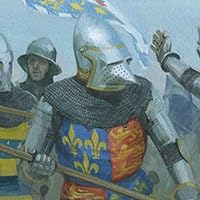
Featuring specially commissioned artwork and maps, carefully chosen illustrations and insightful analysis, this book examines the legendary Mongol warriors and their vastly different European opponents.
Having conquered much of Central Asia by 1237, the Mongols advanced into the northern Caucasus. The fall of several key centres such as Riazan and Vladimir was followed by Mongol victory at Kiev. Moving west, in 1241 two Mongol armies achieved stunning victories at the battles of Liegnitz in Poland and the Sajo River (Mohi) in Hungary, before suffering their only reverse of the campaign at the fortress of Klis. The Mongol forces regrouped in Hungary to prepare for a further advance into Austria and Germany, but the death of their leader, Ogedei Khan, meant that his generals were required to return to Mongolia to choose a successor. Smaller Mongol forces would return to raid in the years to come, but never again would Western Europe be threatened as it was in 1242.
Fully illustrated, this innovative study of the forces that clashed during the Mongol invasion of Europe between 1237 and 1242 allows a comparison to be made between the all-conquering nomad horsemen of the steppes and the mounted knights of the West.
Stephen Richard Turnbull is British a historian specializing in eastern military history, especially the samurai of Japan. His books are mainly on Japanese and Mongolian subjects. He attended Cambridge University where he gained his first degree. He currently holds an MA in Theology, MA in Military History and a PhD from the University of Leeds where he is currently a lecturer in Far Eastern Religions. He has also written a number of books on other medieval topics. He is semi-retired but still holds the post of Visiting Professor of Japanese Studies at Akita International University in Japan.
This book does a good job in “demythologizing” the Mongol invasion of Europe. I’ve heard of it too many times of the invincibility of supposed Mongol hordes coming from the east. The book demonstrates not only their strengths but what ultimately defeated them in the end, that being a combination of stone castles, bad weather and the Danube.
‘Europe’s fate is in the balance’ feels like a modern state of affairs with massed tanks on the borders and warplanes clouding the skies, but in the 1240s it was the Mongol hordes that threatened a developing medieval Europe, and only the knights of Eastern Europe stood in their way. In this book, part of Osprey’s Combat series, Stephen Turnbull surveys the armies facing off and the battles they fought in this pivotal campaign. Turnbull begins with a brief introduction to the war that eastern Europe should have anticipated but tragically did not. The mysterious Mongols of the Far East turned west in 1237 breaking across Rus before pouring into Hungary and the eastern European principalities in 1241. However, Turnbull challenges the common belief that the Mongols were an unstoppable force and only their retirement from Europe saved the day. The knights, he argues, were also not the clumsy oafs we might think they were. An assessment of the two sides follows. Turnbull considers status, recruitment, motivation, command, control, organisation, weapons, dress, and equipment, highlighting the differences and similarities. Nowhere was the difference more apparent than in tactics, with the European knights’ close order charge set against the fluid Mongol tactics of feigned retreat and envelopment, though Turnbull argues they were better in close combat than previously thought. By the 13th Century, Mongols had also become more adept at siege warfare, as Kyiv found out in December 1240. Turnbull turns to the Battle of Liegnitz, fought on 9 April 1241, which was a significant Mongol victory. This battle featured a Mongol smokescreen that debilitated the Polish cavalry. Also in 1241, the Mongols defeated the hubristic Hungarians at Muhi. After narrating those two battles, Turnbull moves on to the ensuing sieges in 1242 at Estergom and Székesfehérvár. At Estergom, the knights held out in the citadel, which could not be breached. Then, at Székesfehérvár, the Mongols faced the Knights of St John, who held out seemingly quite easily. The Mongols, however, destroyed many smaller settlements. Then they left. No one is quite sure why, but Hungary was devastated in their wake. In his analysis, Turnbull highlights Hungary’s rebuilding programme while noting that the Mongols were not the invincible force they claimed to be as seen in the subsequent attacks on Hungary that met with little success. Osprey books can sometimes be a wee bit dry but not this one. Turnbull writes an engaging and insightful narrative mixed with thought provoking arguments, particularly about the Mongols, a subject he knows well. He is helped by his subject matter with this jarring clash of military cultures and the massive stakes involved, and his text is illuminated by Osprey’s customary excellent artwork. For me, the best Osprey books make you want to read more, and this one certainly fits that bill.
When the Mongols came looting into Eastern Europe, it was only a large raid in their mind- but the victimisation and pain they brought with them ;left an impression that would last for Centuries. King Bela IV of Hungary had given sanctuary to tribes pursued by the Mongols and needed punishing. And there was the fact that the Hungarian plain was not as picked over as the Mongol's usual steppe haunts It would make a fine resting place for their camp followers, families and flocks of livestock. So they moved into Poland and Hungary- killing, raping, enslaving and looting anything that could be carried off. Stephen Turnbull, a historian and author of Asian Warfare and Societies tells us what happened when these nomads made war on Eastern Europe, with not always predictable results. This is number 70 in Osprey Publishing's Combat Series, and is packed with b/w and colour photos, maps, diagrams and wonderful colour plates by the illustrator Giuseppe Rava. A strong package on a struggle about which I had known little.
The Mongols were absolute masters of steppe mounted warfare, and of siegecraft, having recently taken China and much of the East, and fielding massive armies by European standards. The Hungarians and their allies had trouble gathering forces large enough to contend with the hordes. Bela IV found that the wooden fortifications that were common in the region were susceptible to Mongol attack, although an active and aggressive defense was able to give the Mongol pause. It is unclear if the Hungarians' defense, dynastic needs back home, or a desire to consolidate the Golden Horde's control of Russia/Belarus/Ukraine and points east made the Mongols retreat this time. But when they returned a few years later- they were met with more Crossbows, more men, and especially more stone fortifications- and were less successful. I liked Turnbull's way of telling the story- and was fascinated both by the Allies infighting and the clash of cultures.
There are some adult themes, and bit of harrowing descriptions of violence, so this is best read by the Junior Reader over about 12/13 years. For the Gamer/Modeler/Military Enthusiast, this is a very useful reference. The Gamer gets a lot of content of both sides- good stuff for scenarios and campaigns of this period. The Modeler gets a lot of Build and Diorama ideas, as well as a good idea of the palette of the period in Rava's paintings. The Military Enthusiast gets a look at a lesser known medieval struggle- and good leads to more materials in the bibliography. A very informative package this time from Osprey.
Stephen Turnbull has been a long-time contributor to Osprey on subjects related to Medieval Asian warfare, almost always to good effect, and this booklet is in keeping with his past work. Besides getting a compare-and-contrast of the military systems of Medieval Europe and the Mongol Empire, Turnbull also provides a good overview of the course of this campaign, as while severely chastised, the Hungarians and their allies were able to make life so difficult for the Mongols, that they came to the conclusion that further advances were not worth it. Besides that Turnbull does provide a solid bibliography for those intending to do more reading.