Icon of the New Stone Age, sculptural and engineering marvel, symbol of national there is nothing quite like Stonehenge. These great sarsen and bluestone slabs, arranged with simple, graphic genius, attract visitors from across the world. The monument stands silent in the face of the questions its unlikely existence who built it? Why? How?
There has been endless speculation about why Stonehenge was built, inspiring theories ranging from the academically credible to the improbable, but far less investigation into how. In the millennia since its creation, pieces of Stonehenge have been knocked over by heavy machinery, found their way to Florida (and back again), and been exposed to radioactive sodium, but the seemingly impossible endeavour of raising the stones with Neolithic technology has remained inexplicable until now.
In the past decade ground-breaking discoveries, made possible by cutting-edge scientific techniques, have traced the precise provenance of the bluestones in Wales, but can we plot their journeys to the Salisbury Plain? And how might teams of labourers lacking machinery or even pack animals have dragged them 150 miles to the site? How did they carve joints into the sarsen boulders, among the hardest stones in the world, and then raise them into place? Mike Pitts draws on a lifetimes study to answer these questions, revealing how Stonehenge stood not in austere isolation, as we see it today, but as part of a wider world, the focus of a megalithic cosmology of belief, ritual and creativity.
The worry with a book like this is that it can slip into dogmatism about current consensus views. Part of the interest in megalithic monuments such as Stonehenge stems from the mystery around the neolithic cultures that built them. While the scientific findings are immensely valuable, I think that there is a risk that the theorising can overreach, congeal, and reduce the value of the monuments. Fortunately this books avoids that and, if anything, should increase our appreciation by showing the sheer scale of the tasks required for Stonehenge’s construction. If you want a balanced, up-to-date, technical, but still very reader friendly overview of the types of stone, where they came from, how they got to the Stonehenge site, how they were shaped and arranged, and later rearranged, then this is the book you want. The science in here will only fuel further speculation on the enduring ‘Why?’ questions.
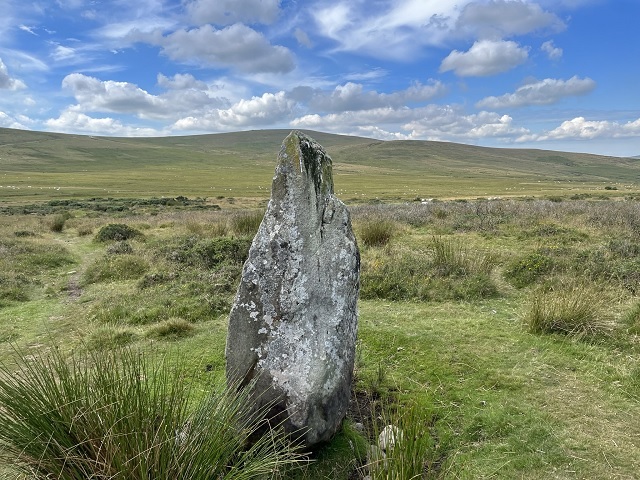
One of the remaining standing stones at Waun Mawn in the Preseli hills, Wales, the area from which the bluestones at Stonehenge were almost certainly sourced. Photo from a recent visit.
When stone and people come together, visually and physically the relationship changes. There is no longer an opposition between the mass of the stone and the energy of the pullers, but an intimate embrace in which ropes, timbers, people and stone are one.
i absolutely disagree with the idea that positing explanations for how stonehenge was built takes anything away from its wonder. this book and the ideas presented in it stunned me. the amount of work and skill it would have taken to build the stone circles at stonehenge is just breathtaking, and it was presented in such a way here. i particularly loved the descriptions of feasting and community and ritual surrounding the moving and erecting of megaliths, both the observations of customs like this in india and indonesia, and the potential of the same in neolithic britain. great book!! made me very emotional at times.
For me, this was a good balance between the conversational and the technical, as the author explains how our current best knowledge of Stonehenge acts to constrain the possible methods by which the site might have been created.
Very well written and informative. Archaeologist Mike Pitts gives you the opportunity to think about what the historical evidences show and how to better understand the significance of this mind blowing monument. I particularly enjoyed the choice of how it's written, making you feel you're listening to the author conversing with you, rather than writing for you. A must read if you enjoy British prehistory.
There is a lot out there to read about Stonehenge, focused on the archaeology or on theories of what it was supposed to be. This one focuses on the mechanics of how it was built and out of what, updating the account to consider the latest studies of the actual stone.
I picked it up because I know Mike Pitts is an engaging writer about archaeology and because what the heck. We know in theory that people hauled these huge stones around and put them into these configurations, but there's always more entertaining stuff to consider and we don't grapple so much with just how they did it, without cranes and monster trucks. The "how" becomes more real and present due to discussion of what was observed in the early 20th century of people in Malaysia and India hauling and erecting huge stones. More can be done without machinery than you'd imagine.
I have to admit that I started losing track of which stones were in which part of the circle when, and which ones came from where, and how they got moved around, and what the Aubrey and Y and R holes indicated. But I tried not to worry about that and just enjoy what I could. For example - the ground on which the henge stands slopes slightly, but the tops of the trilithons are LEVEL. The people who built this think in 3000 BC (give or take) knew how to make something level and adjust to compensate for the non-level ground. !!
He makes the interesting point that Stonehenge started to fall into damage and disrepair less than a thousand years after it was built - there has been a tremendous amount of damage done by 18th-20th century souvenir seekers and some by the public works efforts to preserve it, but those came after a long period of decay.
I bought this when we went to Stonehenge as part of my birthday celebrations (thanks to Jim and Kerry for the tickets - we did one of the early tours, before the site opens to the general public. I would heartily recommend this experience to anyone.).
As Pitts says, there are lots of books about Stonehenge, considering the whys and the wherefores. He's written one himself and I've read that and lots more besides. But this is the first for a hundred or so years that addresses the how. If you want to build Stonehenge, where d'you get your rocks? And how do you get those rocks to your chosen site? Stonehenge famously has two sorts of rocks, the bluestones, which come from Wales, and the sarsens, which are much more local, coming from the Marlborough Downs or even nearer. He addresses various logistical issues in an entertaining and comprehensive fashion, before moving on to how you might then set up your stones, and how much intervention they might need before you're happy with them. Again, famously, the megaliths at Stonehenge are extensively worked, which is something else that makes the site unique.
As promised, the book provides a detailed technical guide on the building of a megalithic monument. From where to find the stones at a small outcropping in Wales, to how to transport them to Salisbury Plain, and how to get them standing one they have made the arduous journey. The author also details some of the physical history of the stones over the centuries – how they have been changed, weathered, damaged, and restored. At the beginning, he acknowledges that the most interesting question about Stonehenge is why it was built. However, there are so many theories, none of which can be proven or discounted on the basis of the evidence, that you are perfectly free to come up with your own. The author leaves it to us to wonder why the stones evoke such a spiritual response in so many of us.
I first discovered this book when it was mentioned, along with the author, on a BBC News article from 19th June 2024, entitled, 'Stonehenge covered in powder paint by Just Stop Oil'. The article states that, about the incident, the author said that it was, "potentially quite concerning", and, "The monument has been fenced off for decades and the megaliths' surfaces are protected. They are sensitive and they are completely covered in prehistoric markings which remain to be fully studied and any surface damage to the stones is hugely concerning. A rich garden of life has grow on the megaliths, an exceptional lichen garden has grown. So it’s potentially quite concerning."
Oh, this is brilliant, especially if you’ve been to Stonehenge or the recent Stonehenge exhibition. Very in-depth look at the building of Stonehenge, where the rocks came from, how they could have been transported, the way they have been treated. If you are interested in the story of the how Stonehenge was built this is a must read
Don’t expect anything revelatory. I didn’t get the impression there was much new here but the blurb and intro lead you to believe there is. One for archaeologists rather than those interested in construction history.
This is a really interesting and reasonably (7.5/10) accessible book on the geology and engineering logistics of constructing Stonehenge. Well-written enough to be quite fascinating for the casual reader and arguably essential reading for anything who's studying the general neolithic period.