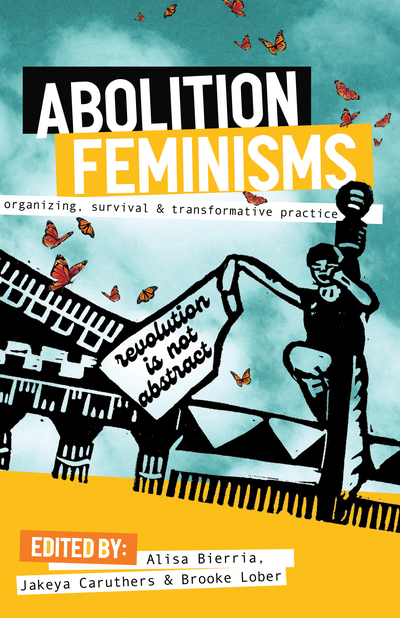
Like in many edited volumes, the individual contributions to Abolition Feminisms Vol 1 vary greatly in quality. There are a few lengthy stinkers that add up to something like 80 pages of the book’s 300. Thankfully, the rest of the book’s essays provide compelling insights into abolitionist feminist organizing both internationally and beyond the traditional prison. Several essays in particular I find especially powerful and perhaps even essential to the corpus of abolitionist literature. Though I don’t think this work should be anyone’s introduction to prison abolition (with or without its vitally feminist inflection), the strong entries make the volume worthwhile for those looking to expand their understanding of carceral structures and histories and methods of resistance.
Let’s start with the bad. Readers would do themselves a favor by ignoring the first essay in the volume, which consists of almost 50 pages of the authors repeating the sound call for an abolitionist movement that has many many adjectives attached: anti-capitalist, feminist, anti-imperialist, anti-colonial, Indigenous-centered, internationalist, etc. Of course the problem is not the argument itself. The problem is that the essay is awash in these signifiers and seems to take them for granted as transparent abstractions. The result is a tiresome slog in which an important political premise is repeated ad nauseum without much development. The essay claims to construct a genealogy of abolition feminism, but you’d be better off reading Abolition. Feminism. Now. for that.
There is another lengthier essay near the end of the book that tries to argue that posting images of femme clothing and bodily adornments with abolitionist slogans on Instagram constitutes “organizing.” Though I find aesthetics an incredibly important tool for creating a field of desire around radical ideas and communities–and an abolitionist bodysuit and acrylic nails that read “FCK ICE” are cool as hell–the breathless extolment of these objects and drawn-out “close readings” had me going cross-eyed. Producing embodied forms of propaganda, while essential, is just not the same as organizing. The author of this essay seems to think that attending Coachella wearing femme abolitionist agitprop (literally the example), with no mention of canvassing or confronting attendees, is a radical act worth spilling several paragraphs over. I want more people to take aesthetics seriously, but there’s no reason to ask of aesthetics what they clearly cannot do (i.e. close prisons).
Complaints about these essays aside, the rest of Abolition Feminisms Vol 1 presents a range of generative materials that excavate experiences of incarceration, histories of colonial violence, and strategies for organizing and community accountability. April Harris’ courageous and harrowing diary recounting her experience of the brutal conditions of COVID quarantine in a California prison lay bare the system’s depravity and torture. A history of the California Coalition for Women Prisoners (CCWP) relates the catalyzing acts of persistent care between incarcerated women that spawns a movement. This movement produces literature for and connections between inside and outside parties that fight for an end to life without parole and better conditions for women in prison. Another essay identifies the economic shifts that produce mass incarceration with the fashion industry’s reliance on sweatshops that put women of color in the global south in conditions comparable to incarceration. Other essays consider the late 20th-century history of migrant detention for queer, trans, and gender non-conforming Cubans and Haitians in light of Trump-era migrant detention and examine the political lives of Palestinian women in Israeli prisons.
The best academic essays, interviews, reproductions of artwork, and personal narratives of Abolition Feminisms present the abstract principles of the volume’s first essay in a much more useful and invigorating form. Together, these contributions form an inspiring work that dutifully constellates abolitionist movements and ideas across space and time.