
What do you think?
Rate this book


280 pages, Paperback
First published January 1, 1997
But one thing was clear – the war had ended. Never again would anyone travel in the Third Reich. - Julia Boyd, Travelers in the Third Reich

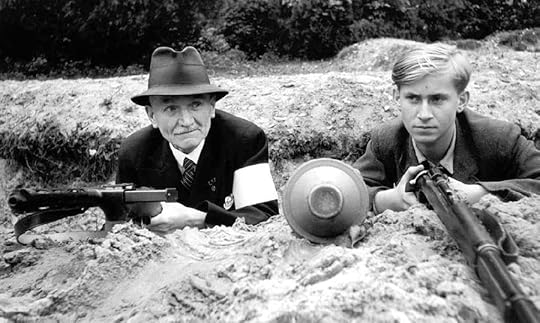
The faces of these three German civilians show they know at first hand the bitterness of defeat. For 84 hours they huddled with 7,000 others in a mine slag pile while Allied bombs wrecked Wehofen. They tried to hoist a white flag, and their troops Tommy-gunned them. These faces are unhappy but hard and arrogant. Not yet had these Germans, whose reactions to defeat are described on pages 69-76, been forced to see the atrocities (pp. 32-37) committed in their name. (22)Barnouw tries to understand that reading of the facial expressions as “arrogant”, a discussion which leads into the book’s larger project of analyzing the controversial idea of collective guilt and punishment. One immediate explanation of the “arrogant” reading is the fact, alluded to in the caption, that the same issue of Life also contained some of the first published photos from liberated concentration camps, viewable here. (Click the link at your own discretion – there are horrifying images, albeit ones the editors of Life felt the American public needed to see.)
Yet she thinks the war started “because Germany wanted a small strip of territory which was the Polish Corridor and everybody agreed that it was ridiculous and unnatural to separate East Prussia from the rest of Germany. Then the Poles started to kill Germans, many of them, and Hitler finally had to protect them and then England came in.”The absence of captions makes it necessary to read extensively in the book’s text to understand the context of the photographs; this produces a work in which words and pictures are particularly well-integrated. The author looks carefully at each picture, trying to capture what the photographer intended to communicate, what contemporary viewers saw, and what additional or contradictory evidence might be seen in the photographic image by a modern viewer.
She says, “In America I found people everywhere discussing racial problems and I was very gratified because I was sure then that it was all right to discuss them in Germany, too.” She says that she was never forced to join the Nazi Party and that she never had to do anything against her conscience. She says that Americans must feed the German people because otherwise the whole country will go Bolshevist, and she complained bitterly because the Germans have been put out of their homes to make room for the American occupation troops.


