Socially awkward, anxiety-riddled Beverly Bonnefinche only loves three things in life: her parents, books, and a homeless man named Bill. Without them, the only way Beverly manages to get by each day is with the help of a peculiar coping mechanism that allows her to dissolve her feelings.
Yet everything changes for Beverly when she meets Henry, a persistent, friendly man who sees something in Beverly most people have missed. As their relationship develops, despite her best intentions, Beverly soon finds herself stepping outside of her carefully controlled life and forging new friendships.
It’s only when a series of twists and turns threatens to unravel her new life, and her mind, that Beverly must determine if she’s got it in her to stop trudging through life—and finally start living it.
Uplifting and emotional, Beverly Bonnefinche is Dead is an unforgettable story of love, loss, friendship, and what it means to ultimately find the courage to be who you are.
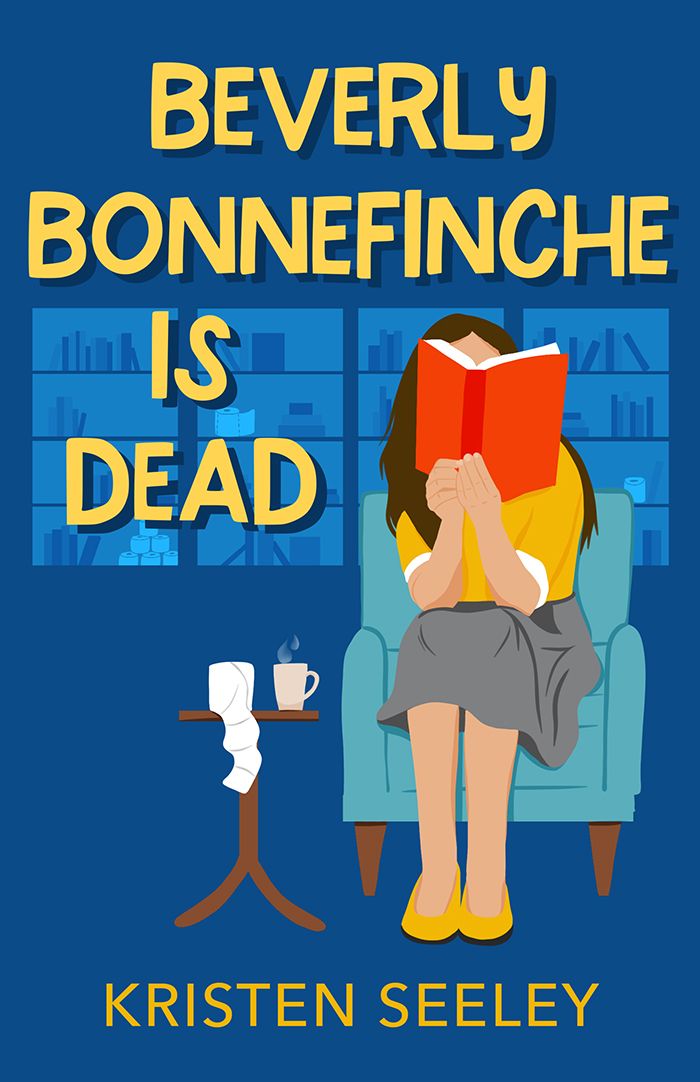
Don't let the cartoony cover fool you, this book is dark and I loved it so much! It's a terribly sad story that focuses on the issue of mental health. It is told in a very realistic and sensitive manner and with a light touch of humour. There are many other heavy topics through these pages and reading the author's trigger warnings before forging ahead is a good idea. There is suicide, loss of a child and mental illness throughout.
Beverly isn't your typical quirky female character but she does learn what having friends can do to your psyche. Beverly has a job, makes some friends, gets married and even becomes pregnant, but when all the walls come tumbling down in Beverly's life she is faced with the truth and has to decide what to do about it. I felt so bad for Henry he tried, he really did but it was all for naught. As sad as this book was I was compelled to keep reading. Even though she is not very likeable I kept hoping for the best for Beverly and cheered her on while reading the book.
I liked how the book showed how mental illness affects those around the sufferer and I enjoyed being on Beverly's journey to better health. Beautifully told and poignant in all aspects Kristen Seeley will draw you in and won't let you go until the last page is turned. All. The. Stars.
Thank you to NetGalley and the publisher for the Advance Readers Copy.
good on you Beverly! if you found a really good book and don't want people to interrupt your reading time just tell them you are dead... if they don't value a good story they are probably not worth knowing anyway...
Mental health and trauma are the two biggest themes in this story. I felt the author did a fantastic job writing about these topics. The storyline itself is so real and raw. I was immediately pulled into the story and invested in the lives of each character. I felt their emotions, and found myself rooting for their well being and success.
Full disclosure, I found it really hard to like Beverly for a big chunk of the story. That was until I started to understand her more, as someone who needed help and struggled with their mental health.
Side note - I wasn't hating on her, I just wanted her to be nicer to people. She was so negative and mean.
Overall I really enjoyed this book. The cover fits the story absolutely perfectly!
Beverly Bonnefinche is Dead hits shelves this September!
My thanks to Rising Action Publishing Co for this gifted copy!
I would love to be able to read this book but it is no longer available on NetGalley. Can't find it on Amazon either. What gives? It got rave reviews but no library has it on order. Does this book actually EXIST? I think I've been reading too many thrillers.
This is an achingly sad story told in a sympathetic voice. Ms. Seeley tackles some really tough subjects, such as attempted suicide, grief, child loss, and the many intricacies of mental illness. Please read the author’s trigger warnings in the beginning of the book if you’re in any sort of a fragile state of mind when you start the book.
Beverly knows she is quirky, introverted and tends to be very blunt, so when Henry shows an interest in her, she is gobsmacked. She slowly allows him into her life and she finally feels content. But when tragedy strikes, Beverly falls into a deep depression with no interest whatsoever in participating in life. Henry is forced to make some tough decisions in order to care for her. And Beverly herself is forced to come to terms with her illness and choose to either help herself or lose everything.
The author has found a beautiful way to tell a sad story. I was drawn in and thoroughly engaged in Beverly’s well-being, cheering for her to see that hope is around the corner, and crying for the circumstances she was in. I have mental illness in my family and see firsthand the struggles it can cause. It is a stigmatized and misunderstood illness. Shining a light on it, such as Ms. Seeley does, is brave and it is needed.
I highly recommend this five-star book. It is due to be published on September 5, 2023. Thank you, NetGalley and Rising Action Publishing Company for the advanced eARC.
Beverly Bonnefiniche is Dead is an absolutely beautiful, poignant, and moving story, so powerful in its raw truth. The author draws the reader in from the first line and unleashes a full emotional experience. I laughed, I cried, I got angry. I felt deeply sad. I felt seen. I felt triumphant. There are exquisite turns of phrase, immersive sensory details, and such clever use of humour--both light and dark. What an important story the author has told, and she has done so masterfully. I recommend this novel with the highest conviction.
Talking about mental health is hard. Writing about it and making it an enjoyable experience for the reader is pure talent. I have read some novels that were great, but a slow read. You know the kind where you know you could have finished 350 pages in a couple of days but for some reason it gets drawn out. Maybe you weren’t as eager to pick it up, or were just uncomfortable, or it was too heavy to absorb it so quickly. Beverly Bonnefinche is Dead is not one of those. Do not get me wrong there is serious and heavy subject matter (read the trigger warnings) but Kristen Seeley was able to compose such an amazing experience through her words. Beverly is endearing, even with her lack of people skills and very blunt statements. She is also very funny, and her blunt unfiltered thoughts and observations are often times extremely amusing. As the story progresses, Beverly's life changes in good and difficult ways. There are losses, which seem to hit harder with a "different brain." We see the toll her friends, family and husband take on; the way the illness wears them down too. Just like real life, there are great days, regular days and days that sink her spirit. The recovery journey is there too, and it hit home with me big time. Even with the more difficult subject matter, I was still drawn into the story and Beverly's life. I couldn’t put it down. I was rooting for Beverly the whole time. If you pause before reading a mental illness rep book (I do it too) because it might be too much, trust me when I say this is written so well. It grabbed me and held on. I couldn’t put it down.
I received this book via NetGalley for my honest review. First and foremost, there are definitely trigger warnings to be aware of with this book. The storyline touches on suicide, loss of child, grief, alcoholism, homelessness, adultery and severe mental health struggles over all. Please be aware of your own mental and emotional state before taking this on.
All that said, I gave this 3 stars because while I went through an entire journey with the main character Beverly, I don't know that I, or she, really learned anything from it. I don't want to give any spoilers away, but the POV of the story is Beverly telling an unknown person her story from present day. It isn't clear who this person is until the very end and once revealed, frankly it does nothing for the story. My response to the reveal of her final location and listener was "okay...so what?" The format of the story telling suggested a significant reveal or revelation at the end. We as readers do not get that. I believe the story could have been told without the snippets of present day and the author just allowed the final chapter to be Beverly arriving in this final place to live her life. The "listener" added nothing to it for us, the reader.
That downfall aside, the depictions of mental health struggles felt genuine for me. Neither Beverly nor the author makes excuses for the behavior throughout and oftentimes it's obvious Beverly has not grown or learned anything. Her motivation and ultimate desires aren't entirely clear as the story moves. At the beginning, she just wants to read her books in peace but as the story continues on it is not clear what her new "happiness" looks like as she forms and navigates a relationship with Henry.
Unfortunately, despite Beverly's odd coping mechanism and the difficulties she faces throughout her life (some her own fault, some not) I fear this book will be forgotten quickly for me. Doesn't mean that isn't right for someone else of course!
Thank you for reading Beverly’s story. Books should always bring pleasure, and never cause harm, for this reason if you have any content that may be harmful to your mental wellbeing, I encourage you to visit https://mariestill.com/contentwarnings to ensure Beverly’s story is one you wish to read.
Please know that you are never alone.
If you are in crisis or in need of someone to speak with, please reach out for help. Below are the crisis lines.
US readers dial 988
UK readers, text SHOUT to 85258
Canadian readers (youth) call 1-888-668-6810 or text WELLNESS to 686868; Canadian readers (adults) call 1-866-585-0445 or text WELLNESS to 741741.
Wherever you are, there are people who care, I encourage you to reach out when in need.
Beverly’s story, more than any of my other stories, is a personal one. As a society we get physicals annually, we talk openly about physical diseases, and support those battling them. Mental health isn’t treated with the same care and openness. While we have taken great strides, there is still more work to do. Preventative mental health is a life saver. You deserve to be happy just like you deserve to be physically and mentally healthy.
Each person’s journey with a mental health crisis or disorder is different. This story, while completely fictional, has been my way of processing one of the hardest battles I’ve had to fight.
Please show empathy for each other, you never know what demons someone is fighting internally, or if they are fighting a battle for someone they love very much.
Take care of yourself and those around you. No matter how different and unique your mind is, you, like Beverly, are perfect the way you are.
Beverly Bonnefinche Is Dead (ARC) by Kristen Seely (aka Marie Still) Hits the shelves September 2023
📖 Quick summary: Beverly is perfectly content living with her parents, working at a quiet bookshop, and having coffee every morning with a man named Bill, who is houseless. But when Henry shows up at her bookshop and asks her on a date, Beverly finds herself stepping out of her introverted walls.
A series of events threatens to upend Beverly’s new life, and Beverly is forced to confront her greatest enemy: her mind.
🧐 My thoughts: While beautiful and emotional, please CHECK THE TRIGGER WARNINGS! This book deals with death and mental health in more ways than one, and if I hadn’t been prepared for it, this book would have absolutely wrecked me.
Seely (Still) approaches mental health and grief in such a profound way - she is gentle, yet she doesn’t sugarcoat. She writes Beverly as a character who isn’t always likable, but yet you’re still invested in her story and growth.
If you have a darker sense of humor, this book will probably make you laugh, and if you’ve ever been touched by grief or mental illness, you will feel a deep sense of connection with Beverly.
Read this if you love: ✅ great character development ✅ a character’s personal growth journey ✅ self-love over romantic love ✅ semi-unreliable narrators ✅ plot lines that tackle complicated or emotional subjects
‼️⚠️ Trigger Warnings ⚠️‼️ (non-exhaustive) ⚠️ mental health ⚠️ death (adult, child/infant) ⚠️ pregnancy and loss/stillbirth ⚠️ grief ⚠️ PPA/PPD ⚠️ Pica ⚠️ Self-harm ⚠️ Attempted Suicide ⚠️ Alcohol addiction
Thank you so much to Rising Action Publishing Co and NetGalley for an advance read in exchange for this review.
Beverly Bonnefinche loves only 3 things - her parents, her books, and a homeless man named Bill. She struggles with her mental health and has a peculiar coping mechanism. She slowly starts to change things as she meets a man named Henry that she starts to date and she also has a new best friend named Quinn. A series of events change things and she has to decide how she wants to live her life.
This book is filled with so many heavy topics. While there are moments of humor and joy, so much of Beverly's life is affected by her mental health. She's lucky to have people in her life who care about her. I liked reading about her take chances socially, and all the characters in the book help to make this story. The author writes about mental health in an honest and sensitive way. I was rooting for Beverly and it was hard to read about how much she struggled, as well as how those struggles affected those around her. Some of it was not easy to read but I so very much appreciate this book.
I thought this book was very good. It deals with some pretty heavy topics and is very sad at times, but I really enjoyed reading it.
Beverly Bonnafinche is socially awkward and full of anxiety. She works in a bookshop that doesn't get much traffic, so she is able to get lost in her books. She has her parents and one friend named Bill, who happens to be a homeless alcoholic. She also has a very strange coping mechanism to deal with her stresses. When she meets Henry, her life starts to change she opens up to a relationship and even makes friends. She starts to step out of her comfort zone. But when tragedy strikes, she has a hard time dealing with her emotions and staying out of her own head. Just when she starts living a somewhat normal life, things are turned upside down. Is Beverly destined to be alone? Can she ever overcome her grief to keep on living?
This story of love, loss, and mental illness was very compelling. It was so well written and held my attention right from the beginning. I felt so many emotions throughout the book and became very attached to Beverly. The things she had to deal with truly broke my heart. I wanted to see her be ok and even happy. I was definitely rooting for her. I really liked this book and would highly recommend it, but there are trigger warnings, so I would read them if are someone who reads them.
Thank you @mariestillwrites @KateRockbooktours @RisingActionPublishingCo @BlackstonePublishing for my complimentary copy. My thoughts are my own.
Don’t let the cover on this one fool you! This is not a light read! Instead, it is a touching and emotional story that focuses on mental health and the darkness that encompasses not only the main character, but those around her.
Beverly is an introverted 25 year-old who is totally content to live with her parents and read books. She works in a bookstore and she doesn’t appreciate it when customers bother her! She also has a rather strange way of coping with anxiety.
Then Beverly meets Henry, a man who grows to love her for who she is. Henry coaxes Beverly through some awkward moments and they eventually marry. Beverly becomes pregnant and, at first, is not sure how she feels about it. However, soon she finds joy and happiness during this stage of life; and then things fall apart.
The author tells this story with sensitivity and a touch of humor. I found Beverly to be likable and I wanted her to work through her issues. I loved her friend set and watching Beverly as she learned that others could love her! There are some content warnings and if you have triggers, please check out the author’s website.
It was weird being in Beverly's head. I wanted to bail several times, but I'm glad I stuck it out.
Beverly thinks everyone is judging her. She has one friend, the homeless alcoholic Bill. And when Henry asks her out to dinner, while she's reading "Carrie", she thinks it's a prank that might involve litres of blood.
A story about mental illness, loss, grief, attempted suicide, attempted murder, but also about recovery.
Meh this book wasn’t bad but it also wasn’t good. Beverly was just an awful person no matter how you try to sweeten it up. She treated everyone, including herself, terribly. The ending was not satisfying and just left a bad feeling.
I went into this book thinking it was one kind of book, part was through I thought it was a different kind of book, and then finally I just let go of trying to figure out what I thought it was and just let it be itself. This book was definitely a bit darker then I anticipated but it was also a lot more powerful. Beverly is a hard character to like, purposely so. I am glad I stuck through this one and I think it will need a reread one day to pick up what I missed the first time around. The story of Beverly is one about honesty, learning to be honest with yourself and others about who you truly are so you can truly live. A brilliant book tackling some tough subjects. Releasing September 6 2023. Thank you to Netgalley and Rising Action Publishing Co for allowing me to get this one a bit early in exchange for a review.
"I received a complimentary copy of this book. Opinions expressed in this review are completely my own."
It was a book that I was definitely not in the right mindset to read, but I'm glad I did. It is a very unique story with unique characters. As someone who deals with many mental health issues Ifound it a hard read,but not triggering.
3.5 This book is honestly hard to even give a one sentence tease of....Let me explain.
Beverly is going through life with so much going on in her head that it makes it hard for her to interact with others. As then book goes on, you realize it is all even worse than you think. It was hard to read this book at times. It was genuinely terrifying because of the first person POV. You are dropped right into Beverly's thoughts and even they are deceiving at times. It's hard to explain all of it without giving too much away, just know this book is not for the faint at heart.
Check trigger warnings and be prepared for a very large, emotional ride.
Thank you to the author, publisher and NetGalley for the gifted copy. My reviews are always honest.
Thank you NetGalley and publisher for the ARC Copy
Deserved a standing ovation and hype.
I had put TW all over this book despite its harmless cover. How many people around us are struggling with mental illness? Probably more than we are aware of. They are good at hiding and concealing. Do we understand them enough to dwell into their problems? Or how people's treatment reflects in their eyes and minds. This story dive into Beverly's mind and when I said dive, like really deep and focus only in her mind. And that's an interesting part of the main story concept. Instead of focusing on the plot itself, it changes to a different angle which is how Beverly's mind works.
I'm not going to go in deep into the mental health issues because as a person who didn't experience it, I think it is not my right to assume what they've been through. But I think there's a quote in the story that attracts me (which I don't remember and not a quote person) something along the lines of 'people with mental illness only think about themselves and not the people around them.' They can't take care of others when they can't take care of themselves. But they surely at some point will exhaust people around them whether they are sincerely there to help them or not. And you will end up sympathizing with both Beverly and Henry for their situation.
And not to mention the plot twist in the story is a TICKING BOMB. Or maybe a Mine yard. You're careful enough but suddenly there's a plot twist in front of you. And the experience is amazing, if that's the right expression!
I would like to thank Net Galley and Action Publishing for the opportunity to read this as an ARC. This was , for me, a difficult book to read. The forward to the book warns that it addresses topics that might be difficult , and this is the truth. I am usually upbeat, but this book very very depressing. It is not just the content, but the way it is written. I have read books before about suicide, child loss etc, and have considered them a good book. This is unrelentingly depressive. It is about Beverly, who has had mental health issues all her life( she is now mid 20's), she does not socialize well, she avoids people and she has a coping mechanism that is different, to say the least. She begins to change, and marries, but her undiagnosed and untreated issues prevent her from any "happy endings". This book is well written. but bleak . Sorry, just not for me.
Engaging character-driven novel that handles difficult wisely and delicately without being cliche or maudlin. I received an ARC from Netgalley in exchange for an honest review.
Beverly is a character that is extremely relatable even if you don’t want to admit it. She suffers from anxiety that a lot of people in their mid twenties are experiencing. She is still living at home and doesn’t know what to do with her life, much less how to go about dating. She's scared that a potential partner will see her as gross, judge her habits and overall not like her. She’s extremely insecure and I think a lot of us young people, especially with social anxiety, can relate to that.
Now she does go off the rails a little bit. She’s extremely judgmental and sees herself as better than everybody else, but she is self-aware knowing that she shouldn’t think these things and people do call her out, but it just got so annoying and frustrating for me to read. If you're somebody who likes the weird girl books, the unhinged women books, then this is one that you’re going to like. It really shows how somebody struggles with mental illness and how that impacts their relationships. It also shows that people who are mentally ill aren’t always likable, but they can’t help that they’re the way that they are. That can be extremely hard to read, but it is important to depict, but at the same time I really struggled connecting with the character as that character arc went on.
The atmosphere didn’t play a huge role in the story, but our character does start out the book by working at a bookshop so this atmosphere is perfect for literary lovers particularly ones who love Stephen King. The character really reminds me of the story of ‘Carrie’ and the plot reminds me of ‘The Bell Jar’ by Sylvia Plath.
I did struggle with the pacing of the book once we had the relationship develop. It’s boom boom boom, very choppy with a lot of events without a lot of connection between the scenes just going from one life point to the next without building the story that flows very well. This book also has so much trauma dumping, and I was so scared of some places that I thought the book was going to go, but also some of those unhinged moments did make me laugh. I highly doubt that that was intentional, but I did find some comedy here. This is mainly a dive into the character’s head rather than a plot driven story. This is one that I would recommend with a maybe, if any of it intrigues you.
This is a book that is going to make you feel all the feels. Experiencing life with Beverly is not an easy ride. She is a socially awkward person that feels at ease in very limited circumstances. She is filled with anxiety, insecurities and overthinks everything. She is embarrassed about things that other people wouldn’t even think twice about. I appreciated the author’s unvarnished portrayal of Beverly’s mental health illness, even though it was difficult to read at times. The heavy stuff is broken up with bits of humor, which the reader needs at times. I learned a lot about mental illness reading this book. Even though I typically read lighter books, I enjoy reading books that challenge me from time to time. I think this is an important book that readers will want to read.
Socially awkward, anxiety-riddled Beverly Bonnefinche only loves three things in life: her parents, books, and a homeless man named Bill. Without them, the only way Beverly manages to get by each day is with the help of a peculiar coping mechanism that allows her to dissolve her feelings. Yet everything changes for Beverly when she meets Henry, a persistent, friendly man who sees something in Beverly most people have missed. As their relationship develops, despite her best intentions, Beverly soon finds herself stepping outside of her carefully controlled life and forging new friendships. It’s only when a series of twists and turns threatens to unravel her new life, and her mind, that Beverly must determine if she’s got it in her to stop trudging through life—and finally start living it. Uplifting and emotional, Beverly Bonnefinche is Dead is an unforgettable story of love, loss, friendship, and what it means to ultimately find the courage to be who you are.
I was provided a complimentary copy of this book from Kate Rock Book Tours, the author and Rising Action Publishing. All opinions are my own.
This book deeply affected me because of its painful, honest portrayal of mental illness. The author tells the story in first person, giving the reader an up close and personal account of the main character’s thoughts and emotions, many of which are disturbing. The content warning in the beginning of the book is necessary. Dealing with themes like severe mental illness, stillbirth, attempted suicide, love, loss, and grief, this is not a light read.
I have read numerous stories about mental illness and many of them depict characters with extreme psychiatric problems meant to shock, horrify and entertain. In my opinion, this treatment mocks the afflictions that cause agony for so many. While, in this book, Beverly displays some startling behaviors, she still felt like a real person with a real ailment, and I could relate to many of her thoughts, such as her tendency to overthink everything.
To summarize, at the beginning of the story, Beverly is socially awkward, accustomed to bullies targeting her, but she knows what she wants, knows her limitations, and is very content with her life. Enjoying time spent alone and reading more than anything, she has a job in a bookstore that allows her hours of solitude. She has her parents and one friend, a homeless alcoholic named Bill. The character of Bill is charming and her friendship with him—how they talk, and she brings him food and coffee every day—shows how deeply Beverly cares about people. For someone who is often unkind to strangers and uncomfortable with social interaction, she profoundly cares for everyone she lets into her life. This is partly why I felt a strong connection to the character.
There were also times when I questioned whether Bill was a real person or a figment of her imagination. The author does an excellent job of making the reader question whether Beverly’s thoughts are real or imagined throughout the book, creating a sense of mystery within the sad story.
As the story progresses, Beverly steps outside of her comfort zone and begins to cultivate new relationships. She meets Quinn in a boutique and Henry in the bookstore where she works. Soon she has a best friend and a boyfriend, and her life becomes more normal from the outside. But she continues to suffer from profound anxiety, which she neutralizes with a strange habit.
The most intense segment of the story for me was the deep depression Beverly falls into after she suffers a great loss. The author describes the episode beautifully and plausibly in a way that made me truly feel her pain. With everyone and everything against her, I rooted for her to overcome her depression while maintaining the personal growth she had achieved.
There is a stigma that the mentally ill are weak, but, in my opinion, the opposite is true. It takes a lot of strength just to survive when your brain chemistry has failed you. This novel is a testament to that idea, and I admired Beverly for how hard she fought to pull herself out of a very deep hole. Her fortitude never wavered. I highly recommend this book to anyone who has ever suffered from mental illness or is looking for a deeply emotional journey with a fascinating character.
I received this book via NetGalley for my honest review. First and foremost, there are definitely trigger warnings to be aware of with this book. The storyline touches on suicide, loss of child, grief, alcoholism, homelessness, adultery and severe mental health struggles over all. Please be aware of your own mental and emotional state before taking this on.
All that said, I gave this 3 stars because while I went through an entire journey with the main character Beverly, I don't know that I, or she, really learned anything from it. I don't want to give any spoilers away, but the POV of the story is Beverly telling an unknown person her story from present day. It isn't clear who this person is until the very end and once revealed, frankly it does nothing for the story. My response to the reveal of her final location and listener was "okay...so what?" The format of the story telling suggested a significant reveal or revelation at the end. We as readers do not get that. I believe the story could have been told without the snippets of present day and the author just allowed the final chapter to be Beverly arriving in this final place to live her life. The "listener" added nothing to it for us, the reader.
That downfall aside, the depictions of mental health struggles felt genuine for me. Neither Beverly nor the author makes excuses for the behavior throughout and oftentimes it's obvious Beverly has not grown or learned anything. Her motivation and ultimate desires aren't entirely clear as the story moves. At the beginning, she just wants to read her books in peace but as the story continues on it is not clear what her new "happiness" looks like as she forms and navigates a relationship with Henry.
Unfortunately, despite Beverly's odd coping mechanism and the difficulties she faces throughout her life (some her own fault, some not) I fear this book will be forgotten quickly for me. Doesn't mean that isn't right for someone else of course!
*Book cover: perfect for Beverly. Sitting in a chair, book covering her face w/ toilet paper and coffee beside her.
*POV: h Beverly
*Setting: Newport, RI
*Genre: CR, Women's Fiction, Adult Fic, Suspense
*Tropes:
✅Mental Health ✅ virgin heroine ✅ makeover or transformation of the h ✅ love that helps h find her true self
Look out for: ⚠️ grief, suicide attempts, pregnancy/loss of a child, alcoholism, homelessness, bullying
*Synopsis:
Beverly Bonnefinche loves three things in life: her parents, books, and a homeless man named Bill. She is riddled with social anxiety and self-doubt, so she hides from everything else. Things changes when she meets Henry- a friendly, unassuming insurance salesman. Their relationship allows Beverly to step outside of her comfort zone and make new friends. When faced with challenges, it blows up Beverly's carefully constructed world. She learns to pick up the pieces and start living.
*Characters: Beverly-the heroine. 25, lives w/ her parents. Works at a bookstore, no friends, no life outside of reading and her homeless friend Bill Bill-an alcoholic homeless man w/ a wife and kids 10years estranged. He meets Beverly outside her job on a white bench everyday where they talk about life. Henry-walks into the bookstore (a little awkward and shy himself) asks Beverly out. After a disastrous 1st no date, they try again and have a meaningful relationship that changes Beverly.
*Review: I've cried tears of joy because someone finally captured what social anxiety/depression is as a daily nonstop fight inside your mind and heart.
*Rating: 5/5 ⭐⭐⭐ ⭐⭐
Thanks to NetGalley and Rising Action Publishing Co. for this ARC🖤! I voluntarily give my honest review and all opinions are my own.
Beverly is an interesting character. Introverted, ready to be forever alone save for her books and her one friend- another social outcast that would throw no stones at her. Slowly, two new people force their way into her life- Henry with his warmth and wide smiles that would be the person she loved; and Quinn, who would become the only other friend she felt she needed.
But her demons won’t let her rest. Always seeing the worst case scenario, fixating and cycling, her mind won’t be quiet. She is a study in how mental health issues mess with people, with their lives. It broke me watching her move through life, not understanding for so long. That in itself seemed very real to me. Our brains are sometimes the worst liars. I loved the growth she showed toward the end, but it was an incredibly hard road and hard to read at times. She isn’t a character you’ll always like, but she’s real and damaged and part of her calls out to you. Dual timelines of “then” and “now” add to the suspense of the novel, keeping you wondering about her story.
Advertisements
REPORT THIS AD For me, this was a five star book.
⭐⭐⭐⭐⭐ Rating: 5 out of 5. It wasn’t an easy or comfortable book. Parts of it broke me and others gave me hope, but there was definitely more pain than laughter. Still, it was a well written and introspective look into the mind of someone with untreated (for most of the book) mental illness. Well written and easy to follow, this was a book that I flew through simply because I had to know what happened.
As far as adult content, this has a lot. Drinking, language, bullying and gas-lighting. It is definitely geared towards adults. Trigger warnings: self harm, attempted suicide, thoughts of self harm and harming others.
I was lucky enough to receive an eARC of this book from Netgalley and Rising Action Publishing in exchange for an honest review. My thanks.
There was something about this cover that lured me in, and I'm so happy I had the chance to read Beverly Bonnefinche Is Dead by Kristen Seeley!
Reading a character driven story is like making a new friend, and Beverly is a friend I won't soon forget. This character-led novel is another example of a heavy yet worthwhile read. Normally, I place my trigger warnings at the end of the review, but I feel they need to be first with this one: pregnancy/child loss, mental health struggles, suicide and self-harm. Again, it is a very intense book.
I started reading it back in July, finally finishing it at the end of August. This book sat on my currently reading shelf for 53 days. Why? It's truly a sad story. And when I was falling asleep after it ended, I was thinking about it in a new light, and my heart broke for the characters all over again.
This is the best mental health representation I have EVER read. As someone who has been diagnosed with depression and has had family members face other aspects represented in the book, reading the inside of Beverly's mind was so spot on. The plot also shows how there is no one-sized fits all cure and just how important it is to have someone advocate for you.
I loved how this book was written. I don't want to say too much about it, but it's done in such a way that had me trying to piece it together, but I never quite managed to.
I can't help but love Beverly with all my heart. The growth she experienced within these pages was incredible to see; she is real, raw, and incredibly powerful . She's now my friend, claiming a special spot in my mind, and I will think of her and wonder how she has been doing for a long time.
Thank you NetGalley and Rising Action Publishing Co for the complimentary copy to read and review.
What if you were your own worst enemy? Kristen Seeley explores the darkness of mental illness through her character Beverly Bonnefinche, whose childhood experiences with rejection and ridicule have turned her into a bitter and reclusive adult.
Beverly works in a bookstore—rather, she reads all day, annoyed when she has to deal with customers who interrupt her escape into imaginary worlds. To combat her emotional crises, she hides in the bathroom, chewing toilet paper. Her only friend is a homeless alcoholic who shares her negative outlook on life. Unsurprisingly, she doesn’t know how to respond when kindness comes knocking at her door.
The author succeeds wonderfully at depicting the world through the eyes of a deeply disturbed young woman. Beverly’s anger, depression, and paranoia stand out in her hateful descriptions of people whom she doesn’t know, even those who care about her. Yet there is hope in her determination to break out of her downward spiral. We find ourselves cheering not only for Beverly, but for the people who are willing to accept her as she is and offer her their strength.
I found this novel absolutely riveting. It’s obvious that Kristen Seeley speaks through Beverly from a foundation of personal experience. Sadly, I cannot give her book the five-star rating it would have deserved if she had left out the offensive language and submitted her work to an editor to catch some narrative gaffes and incorrect word usage. If you are willing to overlook these shortcomings, you will find Beverly Bonnefinche Is Dead very much worth your while.
So this fun illustrated cover kind of threw me. I knew this story was about Beverly, a bookish, slightly awkward person, with a homeless man as her only friend. But I had no idea how emotional and heartbreaking this story truly was. Several topics should be listed as triggers, but I fear I’ll be accused of giving spoilers, so please ask if you are concerned. But I will say that mental health, loss, and grief are major themes running throughout this book.
Life changes for Beverly when a man named Henry walks into the bookstore where she works. Henry persists in asking Beverly out. As the two begin their journey together, a string of events happen - joys and losses - that overwhelm Beverly’s mind. She goes to dark places in her mind, and the grief takes hold.
If this sounds really sad, honestly, it is. But, it is written well, especially since it gives a little insight into the turmoil within Beverly and how her mental illness affects those who love her. I enjoyed Beverly’s book club and how books played into her life. Another important thing I noted was her friends; the ones she made along the way didn’t give up on her, no matter how long her recovery took.
Beverly Bonnefinche will stay with me for some time.
Thank you @mariestillwrites @KateRockbooktours @RisingActionPublishingCo and @BlackstonePublishing for a spot on tour and a gifted book.