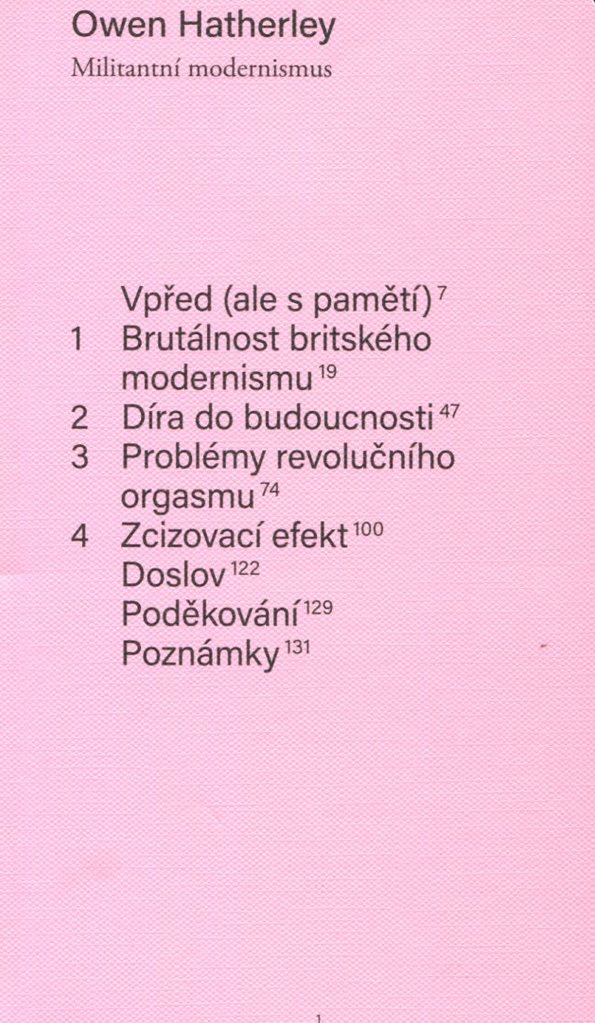
Kniha Owena Hatherleyho Militantní modernismus (2009) zkoumá fenomén modernismu 20. století a nabízí nová východiska pro jeho pochopení. Věnuje se modernímu designu, filmu, pozornost je zaostřena především na architekturu (ať už z hlediska ruského konstruktivismu, či britského brutalismu). Čtyři kapitoly knihy – věnované brutalitě, totalitě, bezpohlavnosti a odcizení – jsou obhajobou radikálních modernistických pozic; eklekticky vystavěné texty vedou čtenáře od vorticismu přes sovětskou filmovou teorii k analýze Bertolta Brechta, tu odkazují k utopickým sociálním projektům v první sovětské pětiletce, jinde k radikálním vizím Wilhelma Reicha (Sexpol) atd.
In Glas, Derrida strikingly compares his method to
“a sort of dredging machine. From the dis-simulated, small, closed, glassed-in cabin of a crane, I manipulate some levers and, from afar, I saw that... I plunge a mouth of steel in the water. And I scrape the bottom, hook onto scones and algae there that I lift up in order to set them down on the ground while the water quickly falls back from the mouth. And I begin again to scrape, to scratch, to dredge the bottom of the sea, the mother [mer]”
This kind of salvaging is an appropriate image for the reclamation of lost futures OH engages in. Building on Fisher’s concept of popular modernism, OH uncovers an archive of difficult art intended for the masses that he dubs militant modernsm. We are disabused of any naive hope that we may simply return to these past moments, but the text succeeds in showing how the hegemony of There Is No Alternative (TINA) catastrophically lowered our expectations. OH is not content to merely deliver the bad news of what we have lost, and the text evinces a tempered hope that understanding the past can inform and guide political strategy. OH recovers these lost futures in three domains: brutalist architecture, Brechtian theater and the Freudo-Marxist demystification of love.
First, architecture. In contrast to the comforts of traditional architecture, OH suggests brutalism is fruitfully understood as a spatial implementation of Trotskyism. The brutalists were faithful to the “psychotic, suicidal notion of building with the ruins already in mind: a death-drive architecture, where posterity’s opinion is internalised to such a ludicrous degree that, in a sense, the corpse has been designed before the living body.” To plan a building accounting for its inevitable decay is to change not just the style but the institutional affiliations of architecture. Where traditional architecture is concerned with preservation, brutalism self-consciously erases its own traces, “outrunning the old world before it has the chance to catch up with you.” Where traditional architecture clearly demarcates between inside and outside, constructivist (=brutalist) architecture “made a fetish of the extraneous, and adverts, banners or radio masts can be found as features of most of the original plans. In fact, the chaotic advertising that blocks out the lines of the original buildings is closer to the original impulse than is the urge to preserve.” Brutalism strips the mystique from the ‘alien building’ which can “become an object of distant, awed contemplation. When, on the other hand, the alien enters everyday life, when it can’t be ignored but has to be lived with, then the boundaries between the alien nation and our alienated cities might start to be breached.”
Second, theater. Unlike the classical 3 act structure, Brecht’s ‘Epic Theater’ is organized by montage, “based on interruption and via that interruption, the listener has to ‘take up an attitude towards the events on stage’: the laying bare of the device induces a stance. An early play of Brecht’s featured the banner ‘DON’T STARE SO ROMANTICALLY’: instead the audience has to assume a critical engagement.” Amusingly, OH observes that it’s no accident that so many of Brecht’s works are musicals (think of pirate Jenny): the musical is “the culture industry’s most truly Brechtian form.” In a memorable passage, OH contrasts the paths of Beckett and Brecht: “Beckett is not fun. For all his virtues, he is a supremely difficult writer, almost all of his mature works extremely forbidding: one might extract a quote or two from Worstward Ho, but few try reading the bastard thing. To be crass, people think they would like Beckett but wouldn’t, and think they wouldn’t like Brecht – but they would.” This reverses Adorno’s judgment: what Adorno didn’t anticipate was that Beckettian high modernism would be more easily mass-marketed, in the form of navel gazing media which makes its consumers feel smart for ‘getting it’. Brecht’s modernism, on the other hand, continues to trouble us, and is extremely difficult to assimilate into a spectacular economy of imagines. One can imagine a Disney film with all the magic of Beckett’s nihilsm, but a Disneyfication of Brecht is impossible.
Third, Freudo-Marxism. OH suggests that the heart of the project of demystification that grounds the left-Modernist project “is a demystification of Love. However, this demystification is too frequently an abandonment or a fear of love altogether, an avoidance of it – the sense that it is somehow uncomfortable.” An example of the double bind produced by this situation is Mayakovsky, who “essentially traps himself: he can’t bear the ‘petrified crap of the present’ and the sentiment and possessiveness of its sexuality, yet the future dreamt of by the Constructivists, biomechanicists and rationalists purges love in favour of a strictly utilitarian sexuality which is barely an improvement.” A Freudian upgrade of traditional Marxism is necessary. Against the transliteration of love and desire “into curlicues and Corinthian columns” OH reclaims Reich’s insight that “the freedom from sexual oppression is meaningless without freedom from economic, i.e. that sexual freedom is a condition of Communism and vice versa.” Crucially, the Freudo-Marxists modify the concepts that Freud is content to keep transhistorical, in particular locating the Oedipus complex within specific relations of reproduction: “the Oedipus complex is a socially conditioned fact which changes its form with the structure of society. The Oedipus complex must disappear in a socialist society, because its social basis, the patriarchal family, will itself disappear, having lost its raison d’etre.”
One objection. OH frames militant modernism as a form of anti-naturalism. This is a mistake, albeit an understandable one. The alienation effects that characterize modernism are only construable as contrary to nature if we adopt a broadly Platonic conceptual strategy. A Hegelian strategy is preferable: alienation is better understood as a progressive externalization. Crucially, this means that the domain of alienation isn't the heaven of forms; rather the domain of alienation is objective spirit. OH's popularization, unsurprisingly, erases these finer details. An account faithful to Hegel would, by contrast, emphasize that modernism's peculiar power is its ability to criticize the form of reified objectivity in which we represent ourselves. What makes militant modernism compelling is its *conceptuality* - militant modernism shocks us into thinking. To reduce this shock to the destruction of the familiar is to trivialize it - capitalism is perfectly good at grinding old meanings out of the life-world. Popular modernism may be bleak, but it is fiercely optimistic: the only possible meaning in a world where the old ways of life have been revealed to be hollow is its radical transformation. Militant modernists "know how to swim against the stream in the deep conviction that the new historic flood will carry them to the other shore. Not all will reach that shore, many will drown. But to participate in this movement with open eyes and with an intense will - only this can give the highest moral satisfaction to a thinking being!" (~Trotsky, TMAO)
To be fair, I’m not encountering much original here, and I feel that if you follow the Zero Books imprint to any degree, you would probably feel the same. Ergo, that through some heady combination of avant-garde cinema, brutalist architecture, and forgotten Roxy Music singles, we can constitute a counternarrative of a liberatory and alternative modernism, versus the various currents bundled together as “postmodern” (q.v. Mark Fisher and the gang). Were its theses correct? Probably. Did I need to read this? Probably not. But I am curious to read more of Owen Hatherley.
I first read this book about this time 3 years ago, absorbed 62 pages one evening in a hotel room in Russell Square whilst on a college residential trip to London, and it really blew me away. I have recently revisited it to aid an essay I am currently writing and it's just as brilliant as I remember, if not better.
Hatherley provides a fantastic "defence" against left-wing Modernism, particularly Brutalist architecture, in the name of strides towards a socialist utopia that sadly never quite came to be, with further references to popular culture (I found the half-a-page on lyricism and technical innovation of late-70s electronic groups such as The Human League and Ultravox in relation to Brutalism particularly compelling) and contrasts with the rather trite "Barratt Homes Modernism" and "Ikea Modernism" of today. Avoiding the empty fetishisation that can come with the aesthetic and theoretical appreciation of Brutalism with scant regard for its original context, Hatherley refutes the idea that the social housing demographic were forced into these concrete boxes by heartless councils. (For a more in-depth exploration of that idea with specific examples, I would highly recommend "Concretopia" by John Grindrod) There's also a nice sprinkling of wry humour there along with the lefty optimism, which is wonderful.
In order to move forward, we must look to the past and learn.
“England loves the 1960s: its indie rock obsesses over a retread of a retread of the last time it seemed internationally significant, its populace yearn for the 1966 of Revolver and being good at football, the haircuts and the Bond films become perennial. The exception to this is in architecture.”
I forget just how good Hatherley can be when he’s on form, there were times during the first couple of essays where this seemed to sing off the page, so many cutting and incisive observations, from his hilarious take down of Alain de Botton and his “jetset smuggery” to the photography of Richard Pare, early Soviet cinema, and other examples of Euro cinema like Pabst in Germany and Makavejev and the Yugoslavian Black Wave. Also in the mix we get commentary on post war British architecture and Soviet Constructivism all with Ballardian overtones
“There’s no reason to assume that mass access to a means of cultural production automatically results in an interesting product. When everyone is saying nothing we haven’t really moved beyond the point where only the elite can say nothing.”
Don’t be fooled by the low page count, this is a dense text, but mostly in a satisfying way, though as this progresses it seems to lose its shape and becomes more ramble than focus. Ultimately you can tell this is Hatherely from a while back, fairly early on in his career, and it lacks the coherence and consistency of his later work, but still this is definitely worth the read.
In spite of the epilogue tagged on at the end these really don’t tie together well, instead these read like a series of scattered, whimsical essays, which called out for more structure and editing, instead we get an emphasis on philosophical or academic theory than rather than a coherent argument. But still there is a lot of goodness in here, most of it in the first half.
Издание на русском языке примечательно "послесловием к русскому изданию" автора, написанному через 10 лет после первой публикации, в которой он корит себя за перекосы, но не отходит от левых убеждений
No un programa en el sentido estricto, pero sí un paneo sobre algunas vertientes estético/sociales de la izquierda que al capital le interesó borrar y sepultar. Lejos de la basura pop-neoliberal con la que el poder hegemónico pretende adormecer a sus sujetos, o de la igualmente despreciable moralina de la "práctica comprometida" de los artistas "políticos", el modernismo socialista plantea prácticas estéticas que se enlazan directamente con la vida cotidiana, con la libido, con el placer. La utopía corrida del lugar donde la quiere el capital—apaciguada por romántica y platónica— y más bien se presenta como un norte alcanzable por medio de arte radical, difícil, masivo y, lo más importante, divertido. Gran texto!
Was glad to learn about British Modernism and public housing as well as an emphasis on the Constructivists, but was a little caught off guard by the half of the book on Reich and cultural topics. I enjoyed it, but definitely was hoping for more of a solution to our current crisis of postmodernity.... But this does a good job of looking how modernity got us here and still exists even if it gets sucked into the postmodern lens through "Ikea Modernism" etc. Kind of a map to cherry pick for a future movement if one is even possible.
Owen comes from a different political perspective than me, but this increases the interest in reading him. Generally his politics don't interfere with his aesthetic judgement, but sometimes they do. Don't let this put you off reading him though, even if you disagree with him , you'll learn something and his writing is lucid. So why not five stars- because he allows an episodic structure, or non-structure, into a book that could have been more coherent, and less repetitive. This worked well for Brecht, no quite so much for a quasi text book on architecture
incredible essays, especially the final, 'Alienation Affects'. stimulating and (to take from Hatherley's lexicon) agitating ideas. genuinely so good. one that I will definitely revisit as my education continues; I did find sometimes that my lack of knowledge in certain disciplines held me back from comprehension of ideas. I'm so glad I didn't let that hold me back from finishing this book. everyone get more modernist NOW!!!
thought the first essay was the strongest, by some distance. while reading it struggled to get what thematically brought the other three together, but the post-text does a good job of turning four fairly different essays into a compelling thesis, that art should be situated in space and time, and how it is situated is important
This book is a far reaching although extremely disorganised polemic in favour of a set of ideals and style that time has long left behind. I can't help but feel that even though this series of articles try to defend modernism as a vehicle for left-leaning utopia the examples given show that ultimately the modernist experiment was a failure and the lure of capital, springing from an innate human greed, was just too strong. I'm not advocating that what followed the great modernist experiment was any better, in fact it is probably much worse. However, it would be wrong to try to turn the clock back to the supposed halcyon days that probably never existed.
What would socialist modernism - in our present - look like? Would it sound like New Order or One Direction? Would it dismiss and demolish brutalist architecture, or would it value its hard edges and harsh surfaces?
Owen Hatherley brings Britishness back to modernism, showing and celebrating its extreme elements that were built in the 1960s and survive in the present. The book is short and brutal in its prose. There are some tough and biting commentaries offered here. But it is revisionist in the best sense and realizes that - to move forward - we need to grasp a past without the nostalgia or simplistic interpretation of heritage.
A concise and refreshingly non-romantic look at modernist architecture (with a bit of cultural studies thrown in for good measure) in the context of revolutionary politics. Very interesting read from which - I'm willing to bet (since I've not read much on the subject in the past) - you will take away a greater understanding of Modernism than from many more in depth books on the topic.
The only thing that grated on me in the beginning was what I perceived to be Hatherley's overly forceful and opinionated writing style but if you stick with it you begin to see how well reasoned much of his points are.
I fully support Hatherley's attempt to recuperate Modernism's engagement with the everyday, but this book is incredibly scattershot. While it is certainly true - as Hatherley claims in the introduction - that one could read these chapters in any order, this means they don't add up to a book-length narrative, instead each making the same argument with different evidence.
I'm gonna be honest. I've only skimmed through this book, because I found it overwhelming with so many concepts and idealisms and movements. This book must be regarded as an academic read because chances are if you're like me - an architecture graduate who has no academic aspirations - you are going to be overwhelmed.