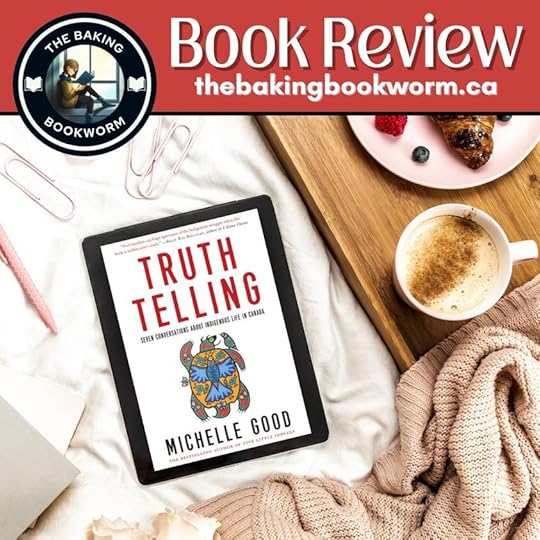
If you've read Five Little Indians by Michelle Good, then you already know that she is a fine writer and a compelling storyteller. Her new book is also compelling and pretty powerful.
Introduction: "Truth is more than fact."
We need to "move beyond...positional and confrontational relationships and into functional ones dedicated to functional change." She talks about the effects of colonization being economic exploitation, and she returns to this theme throughout the book. She challenges non-indigenous people to not only talk but to act.
Residential Schools: Taking of land by colonizers happened without consideration of the interests of Indigenous people. Broken treaties and the slaughter of buffalo was intentional starvation of Indigenous people, and that violence has extended to very recent history. First steps for the government were to civilize the savages through education and to transition them from hunter-gatherers to farmers. However, inadequate tools were provided to encourage farming. From 1885, potlatches were illegal since they were anti-Christian, and by 1920 indigenous children were required to attend residential schools as a further attempt to stomp out indigenous culture. Good calls this colonial violence genocide, and she expressed that apologies for this are inadequate.
Lucy & the Football: This is a reference to Lucy in the Charlie Brown comics promising not to pull the football away from Charlie Brown, and as he runs up to kick it, of course she pulls it away. She makes the point that Canadian promises are pulled away each time, and the Indigenous Charlie Browns are left with empty promises. She says that the promises of the Truth and Reconciliation Committee (TRC) have yet to be realized, and that reconciliation is "setting things right" with societal change at the roots. There must be truth, justice and healing to achieve reconciliation. We don't just want Lucy to hold the football as promised, but to actually set aside her need to control the ball.
Racism: Exorbitant rates of TB in the residential schools, generations of conditioning by non-indigenous people to believe that Indigenous people are less than human and can be disposable. Indigenous women who have been abused, raped, sold, and gone missing is proof of the disposable Indian. "Colonial archtypes...have become...normalized and form a Canadian 'common sense'" which is wildly inaccurate.
$13.69: Michelle Good spent 5 years in residential schools, and her "sixties sweep" compensation amounted to $13.69 per day for that time she spent being physically, emotionally and sexually abused. She asks us if that is adequate compensation.
Rise and Resistence of Indigenous Literature: Good writes that most of Canada's history is written by colonizers and descendants of non-indigenous people. The 1960's saw the Hawthorne report which provided a "lightning rod for change" which has not been realized yet. It was also the beginning of Indigenous literature, which grew slowly until about the 1990's when it began to expand more quickly. "Indigenous writers play such an important role in fostering non-indigenous understanding."
Cultural Pillagers: The legal definition of "Indian" comes from the Indian Act that was discriminatory. Bill C-35 in 1985 tried to correct this but ended up excluding others rather than addressing the problem completely. The U.S. uses a blood quantum system for measuring whether someone is an Indian, but this will never be used in Canada. Inevitably some non-indigenous people will try to pass themselves off as indigenous ("pretendians"), but Good describes these people as an invasive species that have a destructive influence. "Pretendians only pop up where lucrative opportunities await them."
Land Back: Good writes that "the government's intention is to terminate us Indians". She reports that the Supreme Court of Canada recognizes the "collective nature of land titles", but then they uphold fishing rights and mining rights of non-indigenous people. She said that Indigenous people agreed to share the land, not disinherit themselves. She concludes that "We must have the land back in order to return to a self-determining state." She makes the point that 89% of Canada is public land, and that Canada should begin returning it.