

What do you think?
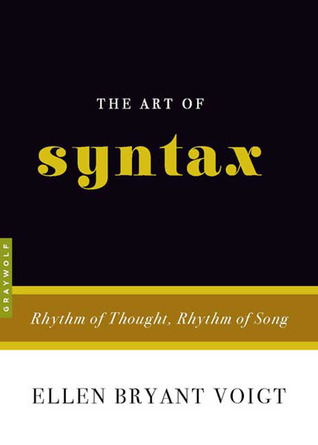
The Art of Syntax: Rhythm of Thought, Rhythm of Song
With intelligence and precision, Ellen Bryant Voigt parses out the deft and alluring shape of poetic language in The Art of Syntax. Through brilliant readings of poems by Bishop, Frost, Kunitz, Lawrence, and others, Voigt examines the signature musical scoring writers deploy to orchestrate meaning. "This structure—this architecture—is the essential drama of the poem's composition," she argues. The Art of Syntax is an indispensable book on the writer's craft by one of America's best and most influential poets and teachers.
176 pages, Paperback
First published June 23, 2009
Ratings & Reviews
Friends & Following
Create a free account to discover what your friends think of this book!
Community Reviews
Displaying 1 - 30 of 59 reviews

March 25, 2018
A very technical book (at least from a non-poets point of view) on syntax in poetry. As a writer of prose and not poetry, I felt out of my depth for much of the book but also felt that some elements were seating themselves in my brain and will likely help me improve my writing. If you are deeply into polishing your prose, you could do a lot worse than reading this book and gaining a cursory understanding of poetry. I hope to find a good book that covers the technical basics of poetry, read that and return to Ellen Voigt's excellent Syntax. She did generously include a glossary in the back of her book which I would have been lost without. But if you're expecting a quick and easy read about writing better sentences and you know nothing about poetry, Syntax is not what you want. To gain mastery of prose though, I think you'll eventually need a facility with all the elements Syntax covers.
It's an excellent book for a particular audience. If you think you might be in that audience, I highly recommend the book. Read it twice. I intend to.
It's an excellent book for a particular audience. If you think you might be in that audience, I highly recommend the book. Read it twice. I intend to.

April 13, 2017
Ellen Bryant Voigt is both an accomplished poet and a brilliant critic. She carefully examines a poem, in this work focusing on the use of syntax (along with lineation) to see how a poem achieves its effects.
Though dense, the book is a clear exposition of how poetic effects are rendered. I felt that I came away from this work empowered as a reader, better able to read and appreciate any poem.
There is also a helpful glossary of syntactical vocabulary at the end of the book (that I consulted frequently during my reading!)
This is a wonderful book for any lover of poetry looking to better understand how a poem is constructed and to increase their reading enjoyment.
Though dense, the book is a clear exposition of how poetic effects are rendered. I felt that I came away from this work empowered as a reader, better able to read and appreciate any poem.
There is also a helpful glossary of syntactical vocabulary at the end of the book (that I consulted frequently during my reading!)
This is a wonderful book for any lover of poetry looking to better understand how a poem is constructed and to increase their reading enjoyment.

July 19, 2021
Dense but thoughtful. I think I'll get more out of it later, when I'm a better poet.

March 20, 2013
I like this series and think a lot about syntax in my own work so was hopeful.
But no.
First, I was dismayed at her lack of inclusion of female poets. I think Bishop is the only one. Which is funny because Bishop once refused to be in an anthology that was otherwise all-male, and she fought against tokenism in similar ways.
Second, the book begins with--this is almost a caricature--talking about Chomsy and Piaget. Chomsky and Piaget! If you want to quote them in a book about syntax, fine. But this is a poetry book an ART OF book, not a deep language theory course. And for god's sake, if you want anybody to make it past the first few pages, don't open with your driest material.
But the biggest issue I have with this book is that while she's all about parsing the syntax of poetry, it never seems to be to any end. Like, she doesn't say "and doing the predicate this way makes for a suspenseful poem because..." It's just "here's how the predicate is done." The discussion feels lifeless to me, devoid of pathos, and I can't imagine anyone being a better poet for having read this book.
But no.
First, I was dismayed at her lack of inclusion of female poets. I think Bishop is the only one. Which is funny because Bishop once refused to be in an anthology that was otherwise all-male, and she fought against tokenism in similar ways.
Second, the book begins with--this is almost a caricature--talking about Chomsy and Piaget. Chomsky and Piaget! If you want to quote them in a book about syntax, fine. But this is a poetry book an ART OF book, not a deep language theory course. And for god's sake, if you want anybody to make it past the first few pages, don't open with your driest material.
But the biggest issue I have with this book is that while she's all about parsing the syntax of poetry, it never seems to be to any end. Like, she doesn't say "and doing the predicate this way makes for a suspenseful poem because..." It's just "here's how the predicate is done." The discussion feels lifeless to me, devoid of pathos, and I can't imagine anyone being a better poet for having read this book.

December 27, 2010
This was awesome. Voigt's prose is clear, lively, and specific. She basically does close readings of a handful of poems, and shows how these poems both establish some kind of structural grid (be it form, meter), etc., and also deviate from this grid. She early on has a useful jazz comparison, in that she discusses how many poems create a form only to improvise away from it and riff on it, and I think this analogy works to describe the book’s overall argument. The book also has a very helpful glossary that defines both standard poetry terms (like different types of meter) and those more general ones that I find super tricky to define (syntax! form! diction!). The poems she close-reads all knocked my socks off (I had never read "For The Suicides" by Donald Justice before. Best poem I've read in a really long time. She also gives a really mind-blowing, but totally practical, close reading of D.H. Lawrence's "Snake." I love that poem!). Also, throughout the book, she defines and employs some basic linguistics, which cast things in a new light. I especially found helpful her use of "hypotaxis," "parataxis," "chunking," and "right-branching syntax" as applied to reading and comprehending poetry.
Perhaps my only criticism of this book is that sometimes Voigt spends a long time recognizing a poem's techniques (this does this, this does that) without arguing for the effect of those techniques. I dunno, if I don't know what effect an elision or an enjambment HAS, then the discussion feel overly technical to me, and isn’t nearly so useful.
Oooh something I can take for myself--Voigt several times alludes to how shorter lines can aid the reader's understanding, can "let out" an image slowly. I should try this to try to make some of my images more reader-friendly.
I love this quote she uses by Stanley Kunitz: "You cannot write a poem until you hit upon its rhythm. That rhythm not only belongs to the subject matter, it belongs to your interior world, and the moment they hook up there's a quantum leap of energy. You can ride on that rhythm, it will carry you somewhere strange."
Towards the end of the book, she says something I found reassuring: “Different centuries, different aesthetics have worshipped one more fervently than the other, putting a premium on pattern over variation, or energy over order, or, currently, fragmentation and disjunction over unity and coherence.” This doesn’t really have anything to do with the rest of the book, but I just like how she describes today’s poetry and poetic preferences, and it’s a good reminder (to me!) that, hey, fragmentation could be just a passing trend, too!
I highly recommend this book as a rigorous and entertaining exploration of how poems work! I keep trying to build up my vocabulary for how to talk about poems (often such a frustrating and misty endeavor, as a poem can move you so much, but it can be so hard to articulate how and why) and I found this book really helpful in that endeavor.
Perhaps my only criticism of this book is that sometimes Voigt spends a long time recognizing a poem's techniques (this does this, this does that) without arguing for the effect of those techniques. I dunno, if I don't know what effect an elision or an enjambment HAS, then the discussion feel overly technical to me, and isn’t nearly so useful.
Oooh something I can take for myself--Voigt several times alludes to how shorter lines can aid the reader's understanding, can "let out" an image slowly. I should try this to try to make some of my images more reader-friendly.
I love this quote she uses by Stanley Kunitz: "You cannot write a poem until you hit upon its rhythm. That rhythm not only belongs to the subject matter, it belongs to your interior world, and the moment they hook up there's a quantum leap of energy. You can ride on that rhythm, it will carry you somewhere strange."
Towards the end of the book, she says something I found reassuring: “Different centuries, different aesthetics have worshipped one more fervently than the other, putting a premium on pattern over variation, or energy over order, or, currently, fragmentation and disjunction over unity and coherence.” This doesn’t really have anything to do with the rest of the book, but I just like how she describes today’s poetry and poetic preferences, and it’s a good reminder (to me!) that, hey, fragmentation could be just a passing trend, too!
I highly recommend this book as a rigorous and entertaining exploration of how poems work! I keep trying to build up my vocabulary for how to talk about poems (often such a frustrating and misty endeavor, as a poem can move you so much, but it can be so hard to articulate how and why) and I found this book really helpful in that endeavor.

June 8, 2024
A beautiful argument for how both formal and free-form poetry both depend on syntax to communicate. So they ought not be pitted against each other. This book changed my understanding of the English language in relation to poetry, I recommend it to any writer who wishes to strengthen their art.

August 1, 2015
I enjoyed this book and think I learned from it. The proof, I suppose, will be in how much of it finds its way from book to notebook.
December 30, 2025
probably the best resource on writing poetry I've ever had the pleasure of reading. Voigt makes the whole English language feel like it's shimmering; makes you want to pick it up and play with it.
August 23, 2026
i'm eating up this book series
August 30, 2018
Absolutely need to re read this later. Writing was amazing and incredibly insightful, but was very, very dense.
March 8, 2013
In The Art of Syntax, Ellen Bryant Voigt does not insist that poets study syntax and deliberately organize their poems around a consideration of sentence structure. She does argue, however, that syntax is as important as lineation and meter in driving the pace and mood of a poem. She goes into elaborate detail, mapping sentences and scrutinizing patterns of sonic and structural repetition, to show how various effects are achieved in a select handful of poems, including (to name the first poems she examines) Stanley Kunitz's "King of the River," D. H. Lawrence's "Song of a Man Who Has Come Through," Shakespeare's 29th sonnet ([When, in disgrace with fortune and men's eyes]), and Philip Larkin's "The Trees" and "Cut Grass."
Discussions of syntax (like discussions of meter) can be difficult to follow because the terminology tends toward the technical (participial phrases, appositives, parataxis, hypotaxis) even though anyone reading a poem can feel the difference between one phraseology and another. ("It rains every day" vs "Every day it rains.") For that reason, The Art of Syntax is sometimes difficult and requires a fair amount of flipping back and forth, to reread a poem in its entirety with an eye on described effects, and to reread earlier examples. I do recommend taking the time to do this; not only does it yield a stronger understanding of the terminology, but also it deepens an appreciation for the poems Voigt references--an appreciation extendable to any poem, though especially to poems of earlier ages. For example, her analysis of the play between syntax and meter in Shakespeare's 29th sonnet is a great reminder of the dramatic dimension to his poetry in general, and it gives a sense of what earlier audiences heard in poetry that we, perhaps, do not hear so well.
In short, this book is a useful tool for slowing down and looking closely at the mechanics of a poem. I highly recommend it to serious poets.
Discussions of syntax (like discussions of meter) can be difficult to follow because the terminology tends toward the technical (participial phrases, appositives, parataxis, hypotaxis) even though anyone reading a poem can feel the difference between one phraseology and another. ("It rains every day" vs "Every day it rains.") For that reason, The Art of Syntax is sometimes difficult and requires a fair amount of flipping back and forth, to reread a poem in its entirety with an eye on described effects, and to reread earlier examples. I do recommend taking the time to do this; not only does it yield a stronger understanding of the terminology, but also it deepens an appreciation for the poems Voigt references--an appreciation extendable to any poem, though especially to poems of earlier ages. For example, her analysis of the play between syntax and meter in Shakespeare's 29th sonnet is a great reminder of the dramatic dimension to his poetry in general, and it gives a sense of what earlier audiences heard in poetry that we, perhaps, do not hear so well.
In short, this book is a useful tool for slowing down and looking closely at the mechanics of a poem. I highly recommend it to serious poets.

January 15, 2016
Primarily concerned with the interplay of syntax, line, and meter. Astute and often insightful readings of well-selected (if not diverse) poems. On the whole, dense and tedious. Although Bryant Voigt organizes her material well, I needed to step back frequently so that I could see the forest/overall structure and not get lost in the trees. As other reviewers have commented, she does not always flesh out the implications of her close analysis, and her signposting could be stronger. Highly technical, about not only writing but also music, which I fear alienates and confuses many non-musician readers. (Plus, as a musician I didn't usually like what she drew on from Robert Jourdain's work.) Others have suggested this would be a good book for beginners, but I disagree; it would be overwhelming for most undergraduate students, except those truly enamored of language and literature.

May 1, 2025
IM FREE!!!!!!!! WORST EXPERIENCE OF MY FUCKING LIFE

September 27, 2019
Short book, and for the 'outsider' somewhat technical, but the clearest explanation of two things.
First: syntax itself. Academic study doesn't usually go into it as a subject, though the term comes up. Usually, prose style is handled at the 'clause' level, at the 'diction' level. And not for too long and not too deeply.
EBV deals with the artistry of sentence-making. She shows it at work. Not only does she tap into Chomsky's tree-structuring and its 'right-branching' outflow to show the rhythm of speech as it constitutes mentally-expected, -accepted, and -applauded style, but she likens it to the surges and hesitations of musical phrasing.
Second: syntax and poetics, a place we assume rhythm forms a kingly part. If teachers go into poetic prosody, they deal with 'meter' and 'variable feet'. The 'variability' seems to be the 'invisible' factor EBV is illumining.
Again, music. Poetic meter, in English, is a fixed syllable count with a few accentual options. English language poetry traditionally finds itself written-out in forms that come with suggested, if not pre-arranged, metrical schemes.
EBV compares poetic meter to orchestral/instrumental notation and syntax to musical phrasing, how a melodic phrase carries itself along the bars of notes over which it rides or flies.
She uses a range of highly-regarded poets to demonstrate just how varied end-poems may look while either staying close in spirit or 'look' to tradition or allowing expression to choke an ostensible meter tight or to open its corral gates to the prairie.
EBV admits the process by which the poets come to execute their art may be assigned to the trial-and-error of drafting and revision. Or to habituated language acquisition. Or to . . . other? . . . unconscious offering.
She does not, however, need to find similar humility in her own handling of this material. This is first-class analytical expertise.
First: syntax itself. Academic study doesn't usually go into it as a subject, though the term comes up. Usually, prose style is handled at the 'clause' level, at the 'diction' level. And not for too long and not too deeply.
EBV deals with the artistry of sentence-making. She shows it at work. Not only does she tap into Chomsky's tree-structuring and its 'right-branching' outflow to show the rhythm of speech as it constitutes mentally-expected, -accepted, and -applauded style, but she likens it to the surges and hesitations of musical phrasing.
Second: syntax and poetics, a place we assume rhythm forms a kingly part. If teachers go into poetic prosody, they deal with 'meter' and 'variable feet'. The 'variability' seems to be the 'invisible' factor EBV is illumining.
Again, music. Poetic meter, in English, is a fixed syllable count with a few accentual options. English language poetry traditionally finds itself written-out in forms that come with suggested, if not pre-arranged, metrical schemes.
EBV compares poetic meter to orchestral/instrumental notation and syntax to musical phrasing, how a melodic phrase carries itself along the bars of notes over which it rides or flies.
She uses a range of highly-regarded poets to demonstrate just how varied end-poems may look while either staying close in spirit or 'look' to tradition or allowing expression to choke an ostensible meter tight or to open its corral gates to the prairie.
EBV admits the process by which the poets come to execute their art may be assigned to the trial-and-error of drafting and revision. Or to habituated language acquisition. Or to . . . other? . . . unconscious offering.
She does not, however, need to find similar humility in her own handling of this material. This is first-class analytical expertise.

June 27, 2019
So far, I have really enjoyed "the art of..." series.
This one is highly academic and dense. With fascinating detailed analysis of several poems that show what is really going with the language, Voigt comes very close to answering the question I sometimes get from my students "I can tell that it's good, but WHY is it good?"
To anyone reading this, it is not a very practical entry in the "art of" series in terms of coming away with "ooh, I'm going to try this in my writing," rather it is an extremely effective model of what we can learn with exacting attention to all the elements of syntax.
For fun, here is a random quote: "Both sentences are unusual. In the first, the casual fundament (it's) is a fulcrum between the introductory restrictive clause (if we...) and the compound nominative, which contains two additional subordinate clauses, one extended and one compressed." If you are ready to read about poetry on that level, then "The art of syntax" is for you.
This one is highly academic and dense. With fascinating detailed analysis of several poems that show what is really going with the language, Voigt comes very close to answering the question I sometimes get from my students "I can tell that it's good, but WHY is it good?"
To anyone reading this, it is not a very practical entry in the "art of" series in terms of coming away with "ooh, I'm going to try this in my writing," rather it is an extremely effective model of what we can learn with exacting attention to all the elements of syntax.
For fun, here is a random quote: "Both sentences are unusual. In the first, the casual fundament (it's) is a fulcrum between the introductory restrictive clause (if we...) and the compound nominative, which contains two additional subordinate clauses, one extended and one compressed." If you are ready to read about poetry on that level, then "The art of syntax" is for you.

January 13, 2023
This was the selection for my editing book club this month. It contains in-depth analysis of poetry, which isn't actually very interesting to me, though I see that as a moral failing on my part. It's hard to know how I would ever use this in my editorial work, except the general observation that syntax and patterns are important in all kinds of writing. Last month, this group's reading (Revise by Pamela Haag) was so directly relevant that my Kindle copy is a disaster with all my highlighting.

March 10, 2021
Look, I have an MFA and either my degree is worthless (possible) or I'm an idiot (also possible) but I found this text so confounding it made me not really want to write or think about syntax at all. Though there were some beautiful example poems by white people in it so there's that--you know, a move that isn't made by 90% of all craft books out there. Sigh....

March 25, 2019
The only thing useful about this book is the chapter discussing connotation and sound of “stone” versus “rock”. It had been said that this book can be summarized into a single sentence: “if poetry is the music, syntax is the dance”.

June 6, 2019
What a nerdy book, but gave me a good understanding of syntax as basic structure underlying many poems. Voigt introduced me to some poets/poems that I now love, and a better appreciation for approaching a poem with syntax in mind.

June 1, 2025
So much to think about my brain hurts. I found seeing the changes to Bishop’s “The Moose” as she developed it most helpful. Despite my average rating this is a book I’ll likely return to when I feel capable of absorbing more.
July 2, 2026
as someone who primarily writes prose, this craft text was difficult to get through, and i know i will need to continue referencing it and rereading parts of it to fully understand and implement craft. but this is super helpful and technical.
January 29, 2017
I'll read this every year probably. It's tiny but dense and important to take in and understand in writing poetry.
Read
February 19, 2020Couldn’t quite make it through ALL the poetry, but I think I still got a lot out of it and will revisit the first couple chapters.

March 22, 2020
Challenging read, this book made me work. I will read it again
January 28, 2023
I bet this is brilliant if you’re well-studied in poetry and grammar. Most of this went over my head

July 24, 2023
Formerly didn't think much about syntax, mostly intuit it (in both reading and writing), but this book helped foreground it and has made my reading/writing more interesting as a result.

December 1, 2023
MFA text - the art of the sentence
April 6, 2024
I dont understand poetry

Did Not Finish
August 2, 2024Too tightly focused on poetry to be of any use to me. I don't have the technical knowledge or interest required to get anything out of it. dnf @ p. 43 after mostly skimming the previous chapter.
March 21, 2025
Miss Voigt was talking some crazy shit … but there is an art to syntax … i gotta say she helped me say that so maybe she’s onto something 🧐
Displaying 1 - 30 of 59 reviews