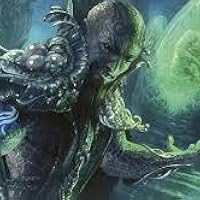
The emperor sets a nearly impossible task to decide which of his two sons should next rule Japan. Is Tozaemon brave enough to seize the five eternal elements from the demons that guard them -- and is Toemon wise enough to know how to use the elements once he has them?
David R. Wisniewski was an American writer and illustrator best known for children's books.
He attended the University of Maryland, College Park but quit after one semester to join the Ringling Brothers and Barnum & Bailey Clown College, graduating in 1973. He worked for several years as a clown before moving to Maryland and joining the Prince George's Country Puppet Theatre where he met his wife Donna Harris. In 1980, they started the Clarion Puppet Theatre (later known as the Clarion Shadow Theatre) which toured in schools, theaters and at the Smithsonian. After his children were born, he become a full-time author/ illustrator, using layers of cut paper to illustrate children's books. His book Golem, won the 1997 Caldecott Medal.
In his acceptance speech, he said of himself: "I am a self-taught artist and writer who depends on instincts developed through years of circus and puppet performance to guide a story's structure and look."
The emperor must choose a son to be the one to take over the throne and rule Japan. The emperor tells his sons that the world is made of five eternal elements and each element is guarded by a monster. The first son to bring all five elements to him will be the next emperor. The brothers go on the journey, but do it in very different ways. Who will be emperor?
Why I liked this book – This book has a great message about kindness is always better than violence. I love that message! I really like how the author sums up the moral of the story, saying that he wanted to “dramatize the contrast between two approaches to solving a problem, one relying on blind force and the other on reasoned action” I love how the illustrations are made – from paper and other flat materials! The author’s note at the end of the book is interesting too. It teaches a bit of history about Japan and its people (the warriors and monks). I like how the characters are portrayed. Toezaemon (Toe-ZAY-mon) and Toemon (Toe-AY-mon) are interesting brothers. Their names mean “left” and “right” in the Japanese language. I think that is a good way to define identical twin brothers who act differently, don’t you? I think kids 6+ would enjoy this story!
**NOTE My Karate instructor lent me her copy of this book to review.
Another book I purchased from my local library's used book store for my grandchildren. This book is set in ancient Japan, and illustrates a useful "life truth": though force may win the battle, wisdom wins the war.
This book is wonderfully illustrated and would make the kind of book I once read to my children as they sat on my lap. I'm hoping that my son will find it a good book for doing the same with my granddaughters. Having spent time in Japan, I enjoyed the oriental setting as well as the story itself, which matches nicely with my recollections of time spent there.
I have now spent an evening reading the latest round of books purchased for my grandchildren, which fill a good-size box to be sent off. Now back to some adult reading!
For a children's book, this feels rather like a wise ancient Japanese fable even though it was written in modern times. The story about the two twin brothers, one a warrior, one a wise man, about to accede to the 12thC Emperor's throne, is well-written, long enough without being verbose, brief enough for an entertaining bedtime story, without being preachy. The illustrations are made with cut-out paper and rather Japanese in style. In the Author's Notes at the back, Wisniewski explains how the various parts of the story and illustrations came about, having gone to some extensive efforts. My only gripe was some unwise black text on a dark red background. Very much recommended. 4.25/5
The illustrations in this book were amazing! The story was about two opposing ways of solving a problem - with brute force or with kindness. This book being set in Japan brings culture and a lesson to its readers.
Liked this one better than his award-winning Golem. Probably because I liked the (Japanese-based) story better, but I also liked the artwork better. Story with a "truth" message - "Strength, though vital, must always be in the service of wisdom" (last page). Cool paper-cut artwork.