Here are dinosaurs as you've never seen them before in a dramatically expanded new edition of the book that started the renaissance in dinosaur books. Here are dinosaurs that are swift, stunning, scary and stupendous., presented in a lavish format. Using the latest paleontological research, The New Dinosaurs presents a scientifically accurate look at the way dinosaurs how they moved, ate, dueled, drank and mated. From ten-ton brontosaurus to thirty-foot hadrosaurus, here is a story more fantastic than fantasy itself! "This book travels you wonderously in time and lands you where you've always wanted to cheek by jowl with the mighty samurai lizards..."--Ray Bradbury "Nothing changes like the past." No part of the past has changed more in the last few decades than our picture of the dinosaurs. When William Stout drew the pictures for the first edition of Dinosaurs , in 1981, the ancient reptiles were big, lumbering brutes, cold-blooded slowpokes driven to extinction by the wily mammals eating their eggs. Now they're still big, but that's almost the only point that hasn't changed. Warm-blooded, feathered, nest-building, under attack from outer space; what's not to like? No wonder dinosaurs have become so popular. Stout is a comic book and record album artist who has been a designer for movies such as Dinosaur! His dinosaur paintings have an Art Nouveau quality, with strong, flowing lines and glowing colors. Not hyper-naturalistic, they are beautiful and dramatic, like the highest-quality manga or illustrated novels. The book's text is in the present tense, and is vivid and Othnielia slowed down when he came to the bank of a wide creek. Near it, a neuropteran was perching in mid-air. The span of its wings was close to that of othnielia's fingered feet, which spread as he crept up on the dragonfly. The New Dinosaurs will fire the imaginations of dinosaur lovers of all ages. --Mary Ellen Curtin
This 2000 book is really just an updated reissue of Stout's 1981 semi-classic The Dinosaurs: A Fantastic New View of a Lost Era, as the only thing "new" about it are some 30+ pages of additional illustrations and a 10-page afterward which summarizes advances in paleontology in the intervening two decades, (so now this book is only 25 years out of date, rather than a full 45). As such, the bulk of the book (100-plus pages) is literally unchanged, and so we still see at least the Cretaceous and even some of the Jurassic monsters as scaly gray lizards, not the flamboyant, feathered drag queens we now believe that many of them were.
As in the original book (one of my sons' favorites — and mine — until dinosaurs were replaced literally overnight by their discovery of those %#$!-ing Pokemon), Stout's illustrations range back and forth between Alfons Mucha's deco stylings and Frank Frazetta's muscular realism, with more than a dash of Robert Crumb, (just search "William Stout dinosaurs" on Google Images and you'll see what I mean). And unlike most dino books which are just lists of "this is a T. rex; this is a stegosaurus," William Service's "narration" is divided more topically (and interestingly) into areas such as Community, Daily Life, Movement, The Dinosaur Body, Climates, Last Days of a Dinosaur, etc.
Inexplicably, the only thing removed from the original book is a 3-page conclusion on "Endangered Species," which neatly tied the dinosaurs' extinction to current trends in species eradication — not sure why they did that, but definite points off for that.
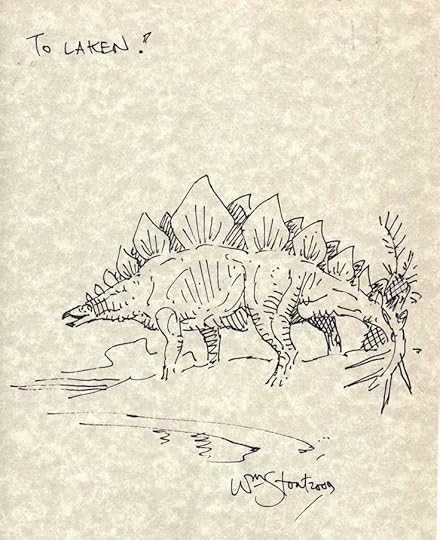
I recently found this beautifully-printed book at our used bookstore, which I'm only pointing out because it also includes an original hand-drawn stegosaurus hastily but beautifully sketched on the inside flyleaf, signed and dated with the note "To Laken!"
Why would anyone sell such a personal item — much less one that looks like it was never read in the first place?? Not cool, Laken…
A decent start for someone who is new to the old world and trying to learn more about the age of the dinosaurs.
I picked up the book because I loved the art. The first few chapters and the very last are fantastic. However, the in-between I could not get too involved with. I read a few of the chapters titled with words and phrases such as 'herd','the songs' and 'childhood'. There were just some things I could have lived without knowing (or without the detail), like mating, bathroom habits and etc. Those middle chapters lost me but I still managed to get through about half or a little more of the pages in this book. In part, it filled my want/need to learn more about dinosaurs because I didn't know much about them before this.
Gorgeous art illustrated book about what was know about dinosaurs at the time. I liked the way art nouveau design style was used to illustrate the cover book art & illustrations of dinosaurs featured in the book. Inspiring art work.
Short version: Stout's "The New Dinosaurs" (henceforth ND)/"The Dinosaurs: A Fantastic New View of a Lost Era" has been 1 of the best natural histories of dinos for adults since 1981. I recommend reading it in conjunction with other, more recent books (E.g. Naish/Barrett's "Dinosaurs: How They Lived and Evolved").
Long Version: Read on.
ND from 2000 is the revised edition of "The Dinosaurs: A Fantastic New View of a Lost Era" from 1981. While not as recent as Naish/Barrett's book, ND still deserves to be listed as 1 of the best natural histories of dinos for adults. In this review, I list the 3 main reasons for why I think that is.
1) ND is the closest thing we have to a completely dinosaurian version of Seton's "Wild Animals I Have Known" (I.e. After the introductory sections, it consists of a collection of short stories about the lives of dinos & other Mesozoic animals). In fact, in some ways, it's even better than Seton's book: For 1, ND tells many more stories representing many more species (48 representing 71 vs. 8 representing 7, respectively); For another, ND's stories are MUCH more varied, ranging from moments in time (E.g. The 1st 1 is about a hatchling Camarasaurus) to entire life histories (E.g. The last 1 is about an elderly Centrosaurus) & everything in between; Some of my favorites are almost essay-like (E.g. "Bathroom Habits", which features the pooping Riojasaurus in Vincent's ND review); For yet another, many of ND's stories flow into each other; This is especially apparent in the "Daily Life" section (I.e. There are 3 back-to-back stories about hadrosaurs from Late Cretaceous N.America mating/nesting/eating & growing, respectively).
2) To paraphrase Robot Chicken ( www.adultswim.com/videos/robot-chicke... ), Stout's comic book-style paleoart "ain't[...100%...]accurate, but it'll blow your [f***ing] mind". Vincent's ND review ( https://chasmosaurs.blogspot.com/2013... ) sums up what I mean. However, I still wanna add to that: -Just saying "comic book-style" doesn't do Stout's paleoart justice. To quote Kirkus Reviews (in reference to "Mighty Morphin Power Rangers: Lost Chronicles"), "The detailed and colorful artwork varies from hyper-realistic to cartoonish and everywhere in between." I wouldn't describe any of Stout's paleoart as "hyper-realistic" per se, but there IS a lot of stylistic variety. This is especially apparent when you compare different illustrations of the same species (E.g. The T. rex ones in Vincent's review). -Like Vincent, I too was originally turned off by Stout's "very skeletal" vision of dinos. However, while Vincent came around to Stout's paleoart despite said vision, I came around because of what said vision represents. To paraphrase Vincent, Stout "wanted [his dinos] to be really alive - fighting[...]with disease as well as each other, growing up in a hostile world". In other words, Stout's ND work isn't just "a product of the Dinosaur Renaissance," but the most extreme product. Therefore, said vision works well in the context of ND.
3) ND updated the 1981 edition for a new generation, combining classic day-in-the-life stories with "32 added pages of new pictures and information" (& thus, putting said stories in the context of then-current dino science: www.amazon.com/review/RAISBDJ8IU17X/r... ).* This is especially apparent in the maniraptorans: For 1, compare the appearance of Stout's 1981 Deinonychus (See Vincent's review) to that of his 2000 Oviraptor ( https://web.archive.org/web/202002190... ); For another, compare the more croc-like parental behavior described in the 1981 quote to the more bird-like parental behavior described in the 2000 quote.
*1 Amazon Reviewer apparently missed that fact when they gave their "Very Different Opinion" on ND (which is partly why I wrote this review, to help set the record straight).
From 1981: "When breeding season came again, they mated after an entanglement of hooks and bloodless clash of jaws. The ensuing clutch of eggs they guarded diligently enough to drive off marauders until the eggs hatched, whereupon they left the young to their own devices."
From 2000: "Recent discoveries of fossil Oviraptor skeletons lying directly on top of nests of Oviraptor eggs, with arms outspread, reveal hitherto hidden aspects of theropod nesting behavior. Imagine the winglike arms, with feathers extended to shade or shield the eggs, and you get exactly the pose the skeletons are found in. Is this what the mother (or father?) Oviraptor was doing when deadly disaster struck?"
This is a fantastic book, not just for the writing, which is a fresh and original way to convey information of prehistoric beasts, but for the incredible artwork that shares those pages.
From traditional paintings, to art nouveau-styled illustrations, William Stout really does reimagine the dinosaur.