Jump to ratings and reviews
Rate this book

Shaheen Bagh: A Graphic Recollection

Rate this book
Shaheen Bagh: A Graphic Recollection is a graphic account of the most famous political sit-in of recent times, which started on one side of a public thoroughfare in Delhi in December 2019 and continued till March 2020 when it was cleared by the police after the government declared a nationwide lockdown to contain the spread of COVID-19.

The book tells the story of the Muslim women who started the protest that became the catalyst for a pan-India political movement against the Citizenship (Amendment) Act (CAA) and the proposed National Register of Citizens (NRC). Based on conversations and interviews with the women who were part of the protest, Ita Mehrotra's graphic narrative archives moments from a movement that spread like wildfire through the length and breadth of the country and continues to inspire voices of dissent.

Through the portrayal of women’s stories in image and word, we re-enter some of the many poignant dialogues, debates and questions that were raised about citizenship, democracy and minority rights, over the course of the movement. Shaheen Bagh: A Graphic Recollection brings alive the protest that lasted 101 days and forever changed the way women's role in movements would be seen and understood.

127 pages, Paperback

First published January 1, 2021

3 people are currently reading
104 people want to read

About the author

Ita Mehrotra

2 books

Ratings & Reviews

What do you think?
Rate this book

Friends & Following

Create a free account to discover what your friends think of this book!

Community Reviews

5 stars
50 (42%)
4 stars
49 (41%)
3 stars
17 (14%)
2 stars
1 (<1%)
1 star
1 (<1%)
Displaying 1 - 17 of 17 reviews
Profile Image for Megha.
262 reviews150 followers
July 23, 2021
"Henceforth in India, every time a comment is made on how a government responded to a movement, the treatment meted out to the women protesters of Shaheen Bagh should prick the conscience of the commentator, if they have one." - Ghazala Jamil

This book is a powerful narrative of an even more powerful movement. It is laced with light humour at times through the witty placards that were displayed at the protests - but what it does best is put an end to the attempts at maligning the intent behind the protest. You just have to read the book to understand that Shaheen Bagh happened because the women of this country wanted to fight for their right to remain in the country. Oh, and I get goosebumps at the thought of the solidarity that reverberated for them throughout the country. Please read it!

Onto my personal dilemma:
I was putting off writing about this book because I wasn't sure how I felt. I think this is a very necessary piece of documentation for what has been one of the most important movements in India in recent times. A part of me was conflicted about the fact that this was a book written by a Hindu woman. I kept wondering if it would have been better if a Muslim woman had authored it since it would have been an #OwnVoice. I posed this question to the author yesterday during a virtual discussion, and I am here to write about it.

I may have been confused about my personal feelings, but I was always sure of the author's immense hard work and dedication that resulted in this book. Ita has respected the lived realities of these women throughout the book. She has tried to unravel the everyday reality of the women involved in one of the biggest women-led protests that this world has seen recently - and she succeeded in doing that. She does not usurp the narration, instead lends a platform to amplify the voices of the women who were involved in the movement. While answering my question yesterday, the author said (I am paraphrasing) that it is not always the responsibility of the oppressed to document their oppression. And I can't stop thinking about it!

The women who took part in this movement, they stormed the attention of this country and the world. They did it for their rights and their beliefs. They did it to preserve their past, present, and future. If Ita chose to hold the burden of documenting it for them, with them, her efforts should be acknowledged and validated. The author had been present at the protest, she witnessed it, she followed-up, she spoke to the people - all in the attempt to be able to do justice to her documentation. I also heard the woman on whom Shahana's character is based on, someone who was a part of the movement, speak about closely working with the author on the book. Furthermore, the author also acknowledged the importance of reflecting and identifying the issue of who gets to voice the narrative and where ethics and responsibilities lie. And I am thankful to her for her honesty and sincerity.

If nothing else, read the book to remember that this happened. We will not forget it, and will not let it be forgotten either. Hum dekhenge!
Profile Image for Saurabh Sharma.
133 reviews30 followers
August 12, 2021
First published on NewsClick.in.

A Graphic Book Rekindles Spirit of Anti-CAA Protests

In December 2019, to register their protest against the anti-citizenship laws and paramilitary crackdown on students in Jamia Millia Islamia, Muslim women occupied a stretch of road at Shaheen Bagh. Their 101-day sit-in protest ended only due to the nationwide lockdown to curb the COVID-19 outbreak. The eerie silence that engulfed the country presented a golden opportunity to the government, Delhi Police and paramilitary forces, who began ‘sanitising’ the Shaheen Bagh site—bringing down art installations, painting graffiti white.

But, by doing this, was the State able to eradicate the memories of Shaheen Bagh, too? No. Ita Mehrotra’s Shaheen Bagh: A Graphic Recollection (Yoda Press, 2021) is a testimony to the fact that, no matter what, memory shall remain the primary site where cultural citizenship gets constructed, and the state has little to no control over it.


CAN DISSENT BE WIPED OUT?
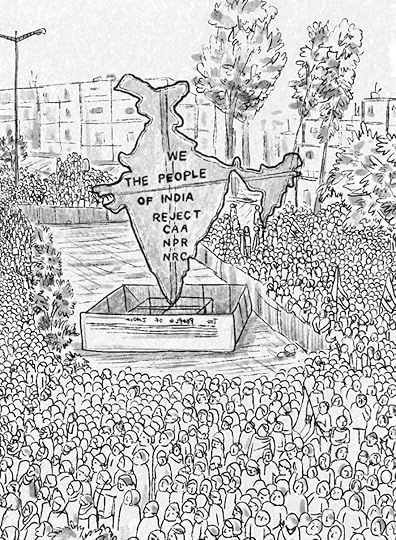
In the foreword, Ghazala Jamil submits that “nations are not born but are painstakingly and deliberately built”. From here on, four sections of the book exhibit the spirit of the nationwide protests that rejuvenated the soul of India, and the increasing number of threats that have marred its pluralism. Mehrotra’s sketches illustrate both why and how Shaheen Bagh occupies a permanent space in our collective memory.

Shaheen Bagh wasn’t “just an iconic sit-in,” as Jamil puts it. It was an “intervention”, in the words of Soumyabrata Choudhury from his book, Now it’s Come to Distances: Notes on Shaheen Bagh and Coronavirus, Association and Isolation (Navayana, 2020).

According to him, it engineered an atmosphere in which “wherever the thought of justice begins to exist, Shaheen Bagh will begin to exist.” As India witnesses injustices yet again, and in the absence of mobilised sit-in protest sites, Shaheen Bagh has re-emerged as a site of resistance and come alive—in the form of this book.


DEFTLY CAPTURING INDIA’S PULSE
Several stories run parallel in this book, each mimicking the protest sites that peppered the country in 2019, all demonstrating a different perspective from which to view such a protest.

For a family that has lived and worked in Shaheen Bagh for a long time, it was impossible to reconcile with what happened in December 2019, once the sit-in began. Several contributors to this book echo the sentiment that after the protests began, the privately nurtured bigotry against them started being celebrated by people in power and propagated by the television media. One of them says, “I used to be a friend and now you call me a traitor.”

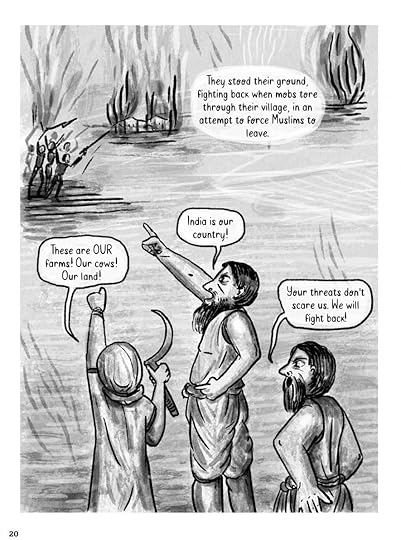
The government and other powerful actors and their support systems continue to brand anyone who raises their voice or dissents with their propositions as anti-national. They demand that Muslims prove their citizenship. But the people of India converted these state-sponsored threats into an opportunity to create art.

One hilarious poster finds space in the book: “Yahan pichle saal ki sardi ki topi nahi mil rahi. Inko 1970 ke papers chahiye?!” (We are unable to find winter cap from last year, and they want papers from 1970!)


BUSTING MYTHS AND RUMOURS

The book establishes that the ongoing “fight is about the poor, the homeless, the jobless, the voiceless—those who might not, for one reason or another, have the papers to prove their identity.” But this fight was dutifully misrepresented by large sections of the media—which radiated mixed signals everywhere. It happened because the movement was led by Muslim women, who, many feel, do not have any agency to organise and inspire nationwide protests.

There were rumours that women are getting paid to protest, or eating biryani at the sites, or, an extraordinary accusation, that children’s kidneys were sold there.

Commenting on these exceptional protests, Zoya Hasan writes in Shaheen Bagh and the Idea of India: Writings from a Movement for Liberty, Justice and Equality (Speaking Tiger, 2020), “We have never seen such a sustained and collective pan-Indian civil society mobilization dominated by women, not even during the freedom movement.”

DADIS AND NANIS OF SHAHEEN BAGH

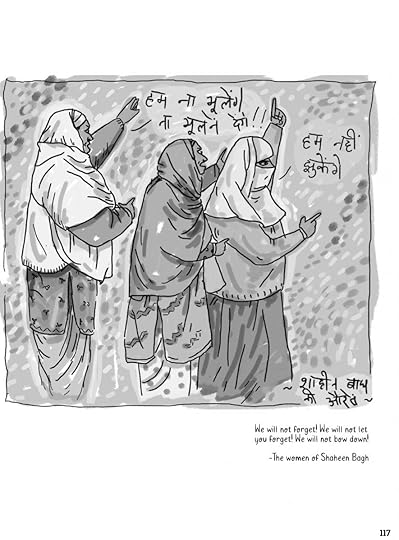
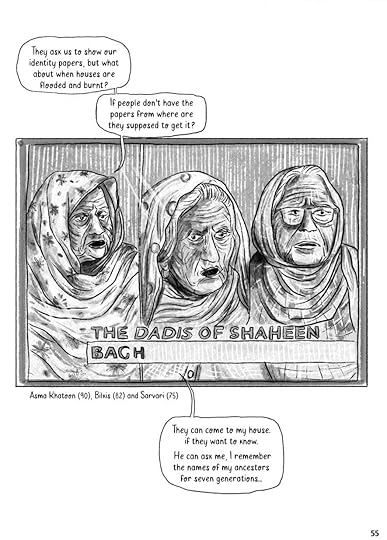
The attendance of the eighty- and ninety-year-old dadis and nanis of Shaheen Bagh through the brutal Delhi winter gave the sit-in momentum. Their unwavering commitment to the movement became clearly visible.


Bilkis (82) got included among the 100 most influential people of 2020 by Time Magazine. “He can ask me, I remember the names of my ancestors for seven generations…,” she challenged the prime minister. Somehow, the prevailing establishment does not find anything questionable in uprooting a woman in her late nineties, whose generations have lived in India, from a place that is rightfully hers.

Bilkis’s and others’ voices induce a sense of euphoria through the visual grammar that Ita deploys. It makes you want to keep turning the pages, and for anybody (like me) who visited the protest sites, the visual language can be overwhelmingly emotional.


WHY THIS BOOK MATTERS

An intervention like Shaheen Bagh must be preserved. For that, we not only need more empathetic researchers like Ita but also action.

Writer and critic Olivia Laing writes in Funny Weather: Art in an Emergency, “Empathy is not something that happens to us when we read Dickens. It’s work. What art does is provide material with which to think: new registers, new spaces. After that, friend, it’s up to you.”

This book is that “work”.
Profile Image for Natasha.
Author 3 books88 followers
September 18, 2025
Shaheen Bagh was a landmark moment in the history of modern India for many reasons. Women are grossly underrepresented in politics, and this was one of the few times where women were at the forefront of a political protest. This was also a unique case of Muslim women simultaneously flaunting their religious identity and their allegiance to the Constitution of India.
In this graphic recollection, the author captures the essence of the Shaheen Bagh protest through the eyes of an educated Muslim woman who went to the protest site often, without directly identifying as one of the women protesting through the cold Delhi winter. The book is both intensely personal, and also puts the protest in a larger national context.
I particularly love the style of the illustrations- they have the look of quick pencil sketches, but the level of detailing shows how much effort went into each frame. It is a book I know I will flip through often.
Profile Image for Tantravahi.
Author 1 book29 followers
September 1, 2022
What was I looking for when I picked this one up? A quick read? A way to add to my numbers on GR? I learn something new about a cause that wasn't/ isn't mine? I'm not sure. I've been reading graphic novels for about two years now, and I can only tell them apart/ rank them for the way the scenes have been drawn, and the story's written. Shaheen Bagh had neither to rely on, inspite of the cause being worthy. The book reads like a newspaper article that isn't well written. Or a... catalogue of the various events that took place, marked by dates and bullet points. I felt... nothing, reading it. It didn't... inspire me (was it supposed to?) or leave any impression about what went on. For starters, it never spoke of the law itself. The book goes on and on about the women from Shaheen Bagh defying their physical and emotional constraints and sitting in protest against the CAA and NRC, without actually talking about what those laws are and why they cannot absolutely sit around while those laws still exist. Second, the writing itself failed to evoke any relatability or sense of solidarity, except in the odd panel: 'Dadis of Shaheen Bagh' or the one where they speak about women losing a lot more than notes during demonetization. Third, the drawing did not catch my eye. There were no panels that made me take a step back and gape at what was in front of me. Five minutes in, my eyes started glazing over every panel and stuck to reading the speech bubbles. Would I recommend this book to someone who's trying to understand the impact of the CAA-NRC on the psyche of the Indian Muslim? No. 3 stars for attempting to cover a sensitive subject. It may be that Ita Mehrotra got to writing it too late. A little too late.
Profile Image for Radhika Saxena.
15 reviews2 followers
July 5, 2021
Not sure how to feel about this one. It’s a decent attempt at documenting such a pivotal moment in Indian history. Yet, it is very simplistic in that it doesn’t provide much context to everything that led to Shaheen Bagh and beyond. I’m also very uncomfortable with the fact that the graphic novel has been authored by a Hindu woman using the experiences and narratives of Muslim women (though with due credit). I wonder how much of the profits from this book are going to Muslim women/families that lost everything during the Delhi riots and the community in general.
Profile Image for Ambar Sahil Chatterjee.
187 reviews1 follower
March 14, 2022
‘We want to tell our future generations that we fought for their rights…’

An evocative, moving tribute to the women of Shaheen Bagh and the dignity and resolve with which they launched and sustained one of the most important peoples’ movements in recent memory.

With simplicity and depth, Ita Mehrotra looks back on this momentous protest movement and captures what it has come to symbolize in the popular imagination. As a book that compels us to think about our responsibility towards keeping the spirit of a democracy alive, this is essential reading. And it is as timely a reminder as ever of how we must never confuse dissent with disloyalty.
Profile Image for Aditya.
54 reviews4 followers
March 6, 2022
Bought this only because i saw Joe Sacco quoted on the back cover as someone who appreciated the book.

As someone whose politics is pretty much liberal, and not very much in favour of the ruling ideology at the Centre in India today, i quite enjoyed this book.

Its a brief, sparsely illustrated graphic novel, emphasising the perspectives of those protesting with brief snippets of what prompted them to join the protest. Its not meant to visually impress, but the soul of the protest does come through its pages and overall, it packs a punch.
Profile Image for Tanvi Hussain .
66 reviews
September 14, 2022
Shaheen Bagh till date is the biggest democratic protest in India wherein the women of Shaheen Bagh and subsequently other parts of the country became the face of the voice of dissent. Those who have witnessed how the voice of these women brought together India in a pinpoint location, needs no word to express the solidarity and the graphic novel of Ita Mehrotra has served that purpose only. The sketches afloat memories of the nation which stood together to save the values upon which the founding fathers of Constitution of India and freedom struggle have laid the foundation of India.
Profile Image for Rishika Kaushik.
5 reviews
September 4, 2021
My heart is so full. Heavy. Light. Being a small part of this movement, seeing it through, and now reading this recollection, gazing into the graphics till my eyes got blurry with tears, Shaheen Bagh has metamorphosed into so many things. For me, it is a feeling. A feeling of resilience, collective struggles, a feeling that creates space for everyone, a feeling strong enough to challenge the strongholds of patriarchy, communalism and nationalism, a feeling of liberation, of azaadi.
Profile Image for AMIR.
140 reviews3 followers
August 9, 2021
A brief graphic recollection of the ground breaking protests at Shaheen Bagh in Delhi which rocked India in 2019-2020
The illustrator started sketching during her frequents visits to the protest site, interacted actively with the participants to understand their perspective and it all shows in the finished book.
The book has an endorsement by none other than Joe Sacco!
Profile Image for Nikita.
15 reviews22 followers
October 15, 2023
A humane, empathetic and hopeful recollection of the Protests. Depictions of on ground realities counter the larger demonic representation of the Protests by media. The book has a hopeful outlook towards the power of dissent and the power of ordinary people, just like the protests. A loving tribute to women of Shaeen Bagh.
Profile Image for A Few Good.
147 reviews3 followers
January 22, 2025
Remarkable historical documentation of the incredibly resilient efforts made by women of Shaheen Bagh to protect their identity and future of their children along with the pretence of secularism and democracy alive.
6 reviews1 follower
May 6, 2023
A poignant graphic chronicle of a pivotal movement in India led by women against fascism, that still lives and fuels dissent against oppression.
Profile Image for Amit Kurien.
58 reviews
January 1, 2022
This is a book of courage. And one that recreates the mood of courageous story of resistance when authority is imposed on people centered around the CAA and NCR issues. Even in the apparently most diverse and fragmented societies such a India along so many dimensions, it is an affirmation that standing together is important to ensure we don't lose the rights we have. That it was led by women forms a very significant part of the history of resistance movements in the world.
Profile Image for Anurag.
179 reviews1 follower
January 8, 2023
When I picked up this book, I had high expectations. Unfortunately, it fails to impress.
It reads like a newspaper article instead of a sequential story. Therefore, the purpose of publishing it in a graphic novel format is unclear.

The background of the protest's cause should have been explained in enough detail. At times, you wonder if the government is shown to be the real victim.
Displaying 1 - 17 of 17 reviews

Can't find what you're looking for?

Get help and learn more about the design.