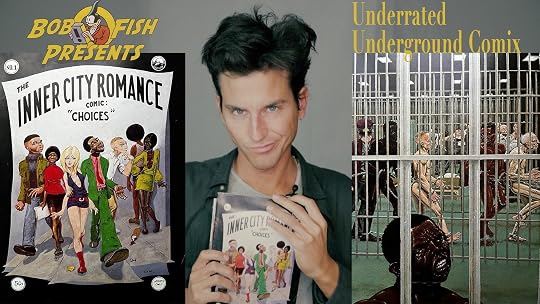
Guy Colwell’s 1970s underground comic book series Inner City Romance tread new territory: it was filled with stories about prison, black culture, ghetto life, the sex trade, and radical activism. It portrayed the unpleasant realities of life in the inner city, where opportunities were limited and being on the lowest end of the economic ladder meant that one’s vision of the American dream was more about survival than lifestyle choices. Every issue of Inner City Romance is included in this collection, as well as many of the highly detailed paintings Colwell created at the time. In an accompanying text piece, Colwell provides context for the material.
Guy Colwell is an American painter, illustrator, cartoonist and social activist. Colwell was born and raised in California, where he studied fine arts. Painting is usually his main form of expression. His art often reflects his political views and activism, tackling themes of social inequality and oppression. When not painting or travelling around the world for environmental research, Colwell has done occasional work in comics. As a cartoonist, he is best known for his 70's underground comix series Inner City Romance. Colwell also worked as colour artist for underground newspapers and publishers from the 70s into the 90s. His other books include Doll (1989), In Fox's Forest (2016) and Delights: A Story of Hieronymus Bosch (2024).
This book collects the five issues of Guy Colwell’s titular ‘70’s Underground Comix series, a series that was notable for its commitment to racial, political and social justice issues. Like other UG creators, Colwell fearlessly depicted sex and violence, but always with meaning and never just for their own sake. The text by Patrick Rosenkranz makes it clear that Colwell is a fine artist first, who drew comics on the side for money–yes, back in the 70’s you could make actual money drawing actual UG comix–and to create narratives about the issues that he was passionate about. I really enjoyed this slab of 70’s agitprop, and lament that the racial and class injustices depicted in these stories have improved not a jot–and are arguably even worse in the new millennium. There are a number of Colwell’s paintings reproduced here, and they are wonderful to see, but unfortunately reprinted at the merest fraction of their actual dimensions, which greatly diminishes their impact. Clearly, a handsome volume of his fine art would be in order someday, hopefully soon. Four out of 5 stars.
Story: ***** First, as a warning, I'll mention the salacious sex which is frequent, gratuitous and hides nothing. You better be ready for a heaping helping of highly original sex architecture and realistic action that's an integral part of the plot- it's may often seem like "porn" but remains "erotica" because it is vital to the message of the serious and real-life stories.
Before, in-between and after the issues that are collected from the early 1970s comic books that make up this collection are Guy's many and highly varying paintings and commentary that sets you in the time and place in which they were modeled after. You get the politics and atrocities of the time while learning how Guy was tackling these projects and how he knew so much about prison and the state of the poor minority. Interestingly, these were his first comics and a huge percentage of the readers at the time who only knew him by his printed name were positive that he was black until they were told otherwise.
The first issue deals with the trio that were just let out of prison and the difference between how they see and what they do in the world on the outside. It's quite a fun read with a hell of an orgy while also diagnosing the black power aspect through the one who opted out of the wild party.
The second issue is about a concert to raise money for bail for unjustly jailed friends. The way the police deal with it and how the people retaliate is some deep stuff with death and violence in major doses. It's harsh realism that gives you pause but gets the message across perfectly.
The third issue is about the desperate dreams of prisoners and it's wild surrealism that really entertains while giving you a genuine look at life "on the inside".
The fourth issue is about crisis and tragedy at a housing project which has a strong human element and tells how truly unfair the system can be in regards to those who live in assisted housing. It is based on real circumstances of a building in Sam Francisco in the early 1970s.
The fifth issue consists of five short stories that include a sex scene from a main couple in the last issue using that to combat their poor state of living, the difficulty of being a child in the ghetto, the tragic irony of a sex crime, the sexual pining of two junkies and a trippy encounter in the clover field outside of the menacing city.
Art: ***** The cast is rendered with a great sense of diversity that makes great choices from a multitude of cultures/races. His people come alive as very convincing individuals.
Be prepared for some seriously good paintings that I mentioned above that buffer all the issues collected. It's really top-tier brush work in living color and that brings you places that you've never been without any limitations of content. There is a distinct ethos to his canvas work at an even higher level than his masterful sequential story rendering.
A hard-hitting look at racism, poverty, police brutality, and other social justice issues through the lens of a 70s underground comic.
Colwell didn't consider himself a comics person. He was more focused on his paintings and prints, but a stint in prison for draft dodging exposed him to realities of which he was unaware. He became politically aware and active while still in prison, and after his release, expressed his new awareness in the short-run, irregularly issued Inner City Romance (5 issues total), feeling that a comic was the best way to get word of these issues out to the common person.
This is definitely a comic for adults, filled with mature sexual situations depicted in very realistic detail...except for one fascinating sequence that asks the reader to imagine (or, perhaps, remember) what sex might be like while on LSD. Colwell's stories also tackle drug use, environmental concerns, the Black Power movement, citizen uprisings / actions, poverty, and violence. If you thought the 70s were just a time of disco and bell-bottoms, these comics are your rude awakening.
A gallery of Colwell's other work, which is incredibly stunning and uncomfortably perceptive, is also included. There's also an introduction and epilogue that tell you a bit more about Colwell's life and work. Skip this one, though, if sex and nudity offend you easily - it's hard to surprise me, but Colwell did, and since folks have a bad habit of shelving ALL GRAPHIC NOVELS in YA/children's, I feel the need to stress that that is NOT a thing you want to do. Definitely a great, albeit possibly controversial, addition to an adult GN collection, especially in large metropolitan areas.
I never have quite grasped most underground comics, other than just as a snapshot of counter culture of the times. This comic collection reprints the comic series of the same name published by Last Gasp in the 70s. There's a ton of sex and drugs, along with plenty of social commentary. I think the sex tends to distract from what the artist is trying to accomplish, but even the artist agreed that sex sells, and he put the sex in partially just to be sure he got published. Basically he used the sex as a hook to tell the more serious stories he wanted to tell.
Colwell's art did go through an evolution as the series progressed, which was interesting to watch. He also was quite an accomplished painter, and really, his paintings seemed to work better than this comic work at getting his commentary across.
Overall a good snapshot of underground comics at the time, but really it's not my cup of tea. If you're into sixties and seventies underground comics, you'll probably dig it.
Cool collection of underground comics from the 1970s, addressing many of the same issues still seen in San Francisco today: racism, police violence and resistance; incarceration; drug use; gentrification; and love. Great illustrations.
The five issues of Inner City Romance present some of the hardest hitting political comics ever made. These comics were written after Colwell served a two year prison sentence for his objection towards enlisting for Vietnam. It's easy to spot how his experiences shaped his artwork and his outlook, since Inner City Romance does spend a significant amount of time dedicated to the American prison system. Each issue takes on different social and political issues, ranging from race, drugs, sexual violence and the prison system.
Colwell is a trained painter (his talent is evident from the beautiful covers to each issue), but he employs a harsher black & white artstyle for his Inner City Romance comics. The artwork is pretty loose at times, allowing for him to flit between realism and more psychedelic scenes. There are some dated aspects to his comics, particularly since some characters present some ugly racial caricatures, but based off the actual stories being presented I don't think Colwell's depiction is malicious in nature. It's not an easy read, but definitely a very worthwhile experience.
A piece of comic book history more than a work of art, this is nonetheless a well-presented snapshot of being poor, black or both in 70s San Francisco, with sympathetic portraits of drug addicts, ex-convicts and sex workers. Cowell is at his best when dipping into surrealism and psychedelia, and I personally find his realist fine art (many examples of which are reproduced in this volume) a bit underwhelming. Explicit sex is a feature of underground comics of the time, here it's presented mostly in a positive and liberatory way, reflecting the 'free love' period between the invention of the contraceptive pill in the 60s and the Aids crisis in the 80s.
This was an uncomfortably captivating adult comic that depicted urban life in the 70s. The art was filthy, obscene, and genuine; the writing was erratic, confusing, and ghetto. The social commentary presented in this piece originate from the civil rights and political issues of the time and from Guy Colwell's unique perspective which was fomented by a stay in prison and a life observing the dynamics of the street.
Honestly, this underground comic was interesting and I'm not sure if it went far enough. I think the world deserves a project similar to was Colwell started.
Great collection of a comix series I was unaware of until I picked up this volume during a Fantagraphics sale. I am now a Guy Colwell fan and want to seek out more of his artwork—especially his paintings regarding the alienation of humans from nature.
This comic series is definitely not for everyone, but the artwork is fantastic and it is endlessly interesting as a historical document of inner city life, poverty, racism, and radicalism of the 1970s.
I give the art 2.5, the storyline 3.5, for an average of 3. The art does seem to improve towards the end of the book. In the introduction, he talks about how much he draws and paints: one would think the end product would be better.
I was very excited to read this collection, and once again, Fantagraphics is doing a great job of finding and making available important alternative comics history. This is interesting because, within the world of "Underground Comix" this author is dealing with more social issues and less fantasy. However, I later found myself somewhat bored with it, especially as it becomes more sexual and less social. Really important that it's put out and great context that they put it in!
This is the reality show of graphic novels. Also, a classic. Sex, drugs and deprivation. To be honest, I couldn't finish it but I got the gist. Not my cuppa, but I appreciate what it represents in the genre (African Americans portrayal, originally published as shorter works between 1972 and 1978, these are classics). Important to have in any serious collection.
Raccolta dei lavori di Colwell, offre la possibilità di osservarne l'evoluzione artistica (soprattutto come espressione delle sue idee politiche durante e dopo gli anni di prigionia).