Tricycle Press is proud to present a new Spanish edition of the critically acclaimed PUMPKIN CIRCLE. Pumpkin seedlings grow, sprout, bud, and bloom, offering up their golden fruit, then break down into rich soil from which seeds sprout again-a circle without end. The skillfully translated Spanish language edition is sure to create a whole new crop of pumpkin lovers. Pumpkin Circle: The Video, narrated by Danny Glover, is available through www.pumpkincircle.com.
Brilliant photos by Shmuel Taylor compliment this wonderful essay, told in rhyme, about the pumpkin's life cycle.
The pictures are gorgeous, and the rhyme reads well. We start with the seed being planted, and end with a rotting jack-o-lantern, which in turn, plants a seed.
Vibrant color photos and delightfully musical text pepper this scientifically based lifecycle of pumpkins. A great disservice will be done to the effort of the author and photographer if one might only crack this book in autumn. A “great” pumpkin begins in the warm, loamy soil of spring. The intense photographic concentration on the specific elements of the lifecycle (seed leaves fat & green, twisty tendrils stretching out to cling, flower buds appear-brilliant sunlit bowls, finished fruit ripe & fully grown, sinking & shrinking back to the earth you go) lead the reader naturally along. By the end, the reader can almost taste the pungent fruit.
Using interesting photography and clever rhyme, this book describes the "circle of life" of a pumpkin. Such a fun book to check-out from the library this time of year.
Beautiful photo essay on the life cycle of a pumpkin. The highly detailed photos from many different perspectives enhance the science lesson of growing pumpkins that we usually discuss in the fall.
Pumpkin Circle shows the life cycle of a pumpkin, from the time the seed is collected from a pumpkin in the fall, through its planting and growing, and finally to its harvesting, just in time to carve into Halloween jack-o-lanterns. Brief, simple text accompanies color photographs of children in the garden planting and taking care of the pumpkins as they grow. The candid photos will draw young readers into the story, and there are some good opportunities to talk about gardening, plants, and the life cycle- Pumpkin Circle is about much more than Halloween. Young readers may just love the pictures, though, especially in the last few pages, which show creatively carved jack-o-lanterns glowing in the darkness-a wonderful finish for the life of a pumpkin, as the cycle starts over again. This is a perfect preschool read aloud that can also be enjoyed independently by children in the early elementary grades. It’s not frightening, which makes it a good choice for children who are easily frightened at a time of year where scary stories rule. Note: Since it focuses on the life cycle of plants, it might be shelved in nonfiction, so librarians should take note to seek it out and promote it with the Halloween books Highly recommended for public library children’s collections and elementary school library media centers.
Not the ordinary illustrated picture book, this nonfiction book uses photographs in a very unusual way to tell the story of how a pumpkin grows from seed to rotting jack-o-lantern. The text beginning with the book cover tells the story of germination where the title is a swirling tendril of words on an orange background. The photographs throughout are amazing from a mountain of pumpkins to a close-up of the guts embedded with seeds. More photos than text. Dramatic contrasts, both in color and size of photo. Almost poetic language, very onomatopoetic in places and strategically placed on every page, the language is as stimulating as the pictures. The life cycle of a pumpkin is circular. This is a most extraordinary nonfiction picture book!
Seeing the connection between form and content Agriculture studies/science Wonder of nature Onomatopoeia, alliteration and rhyme
I love this book! It's another one discovered while student teaching in kindergarten. It has real-life vivid photographs that are very well done. I absolutely enjoy reading it every year to my class after we do our pumpkin math carving activity so that my kids can see how pumpkins grow from the seed and how they change throughout the growing season...and then of course it dies and starts all over again.
I don't really have much to say about this book about pumpkins. It is all about pumpkins, from the seed to the plant to the seed again. It would be good to use in the classroom during fall and harvest season.
This book is all about pumpkins. The pumpkin seed makes the pumpkin plant, and the pumpkin plant makes pumpkins. Every passing minute awakens each new plant, reaching down with silky roots, reaching up to dance. Huge green leaves grow toward the sky, prickly, lush, and wide. Next they are plants. Before you know it a hundred days of weather a hundred days of care and pumpkins are everywhere. Its important to help the pumpkins sit up straight so they grow up round and proud. Fall time brings the pumpkins you can carve into jack-o-lauterns. There is a life cycle of a pumpkin its seeds, to pumpkins to seeds again. This is a great book to use in the classroom in the fall months to teach the children the life cycle of a pumpkin.
This book uses real pictures to describe the life cycle of a pumpkin while telling a simple story. Because of the photographs, it provides information that more traditional books cannot. For children who aren’t accustomed to this style, it may be a good compliment to the more fictionalized portrayals is the same cycle, such as Sophie’s squash or Pumpkin Jack. For very sensitive children, this one might actually be easier to take (the part where the pumpkin rots and refertilizes the soil). The book would be an excellent complement to growing a pumpkin plant.
This is a straight-up fantastic read-aloud. It is so difficult to find great nonfiction read-alouds for storytime, but the rhyming and pictures were absolutely sublime. The preschool kids that I read this to were engaged and learned a lot about pumpkins (and their parents wanted to go home and plant some). Definitely recommend to storytime librarians and teachers to read aloud during the fall season and to parents looking for great informational texts to read to/with their kids.
While there is a lot I really like about this book, I don't think it will fit my needs for a Story Walk. I do like the photographs and the overall story. The writing has good rhythm and rhyme, although some language I think is a bit too flowery/advanced for the intended audience.
With large, colorful photographs and rollicking, rhyming text, this fun picture book helps young readers understand the process a seed grows into a pumpkin. This would also be a good book to share as part of a lesson on growing seeds or just a nice way to enjoy the fall season.
A great informational title. It goes through how a pumpkin starts from a seed and then eventually becomes a pumpkin, jack o'lantern and back to pumpkin seeds again. It's simple enough to share with a class or a slightly older preK group.
My students loved this book. They especially liked the close-up pictures of the pumpkin pulp which they found both gross and fascinating. I used this in conjunction with a couple of other books for a pumpkin week before Halloween.
I really enjoyed reading this book. It shows children the life cycle of a pumpkin and how it keeps going in a circle to create more and more pumpkins! This would be awesome to read to children around halloween time, to get to know how pumpkins are grown!
This entire review has been hidden because of spoilers.
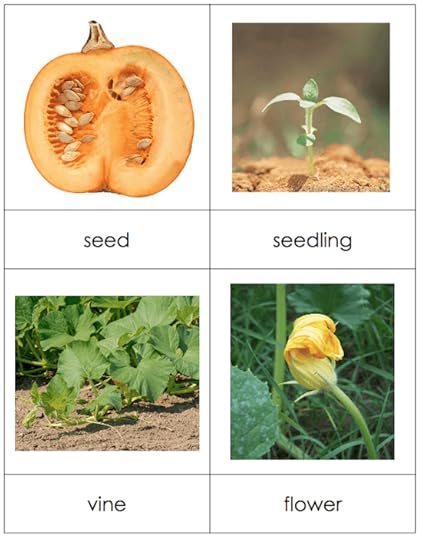
There are many things I liked about this book, which follows the life cycle of a pumpkin. I loved the photographs and the starting point of a huge stack of pumpkins instead of a single seed. I loved photos of the seeds inside the squash, seedlings in a garden patch, huge leaves, and a pumpkin patch overflowing with viney plants! The short book introduced many new and important vocabulary words - my class focused on seed. However in my opinion the prose tried a little too hard to be dramatic, and for young children ended up being too abstract instead. I would have appreciated a more simplistic and direct explanation of the pumpkin life cycle. Nevertheless, this book worked well in my preschool classroom to accompany other books we read about pumpkins without too much detail and with more realistic illustrations, so it is worthy of a higher rating in my opinion!