Jump to ratings and reviews
Rate this book

Line

Rate this book
Willard, his mother and his girlfriend Nyla have spent their entire lives in an endless journey where daily survival is dictated by the ultimate imperative: obey the rules, or you will lose your place in the Line. Everything changes the day Willards mother dies and he finds an incomprehensible book hidden among her few belongings... In its Beckettian sparseness, Line pushes the boundaries of speculative, high concept fiction. Deeply moving, it also touches on many of the pressing issues of our turbulent world: migration and the refugee crisis, big data and the erosion of democracy, climate change, colonialism, economic exploitation, social conformity and religious fanaticism. A stunning debut from a major new voice in Irish literature.

184 pages, Paperback

First published January 1, 2020

5 people are currently reading
258 people want to read

About the author

Niall Bourke

2 books8 followers

Ratings & Reviews

What do you think?
Rate this book

Friends & Following

Create a free account to discover what your friends think of this book!

Community Reviews

5 stars
64 (29%)
4 stars
90 (40%)
3 stars
46 (20%)
2 stars
14 (6%)
1 star
6 (2%)
Displaying 1 - 30 of 61 reviews
Profile Image for Paul Fulcher.
Author 2 books1,963 followers
December 12, 2022
– Offices, Willard says, ships and engines. Cities, corporations, contracts: I can say all these things now, make the noises, but they come out of me empty. The words aren’t mine– this whole place is impenetrable.
– We can learn new words, says Nyla.
– Only if we become new people.
– Then that’s what we’ll do. But let’s keep our old ones, hide them somewhere, our bindles and scroggins and tarps. I like them too.


Niall Bourke's dystopian Line starts-off firmly in The Road territory. Willard and his elderly mother begin another day:

Dirtandshitandroutine. Put on his jeans before the cold can cut strips off him, hopping from leg to leg to spare his feet. Throw on his other shirt and then grab his boots, making sure he undoes the laces rather than standing his feet into them because he knows the back and forth of his heel causes the leather to pull away from the sole. Last time Willard’s boots fell asunder he was barefoot for near on two weeks. Break the skin of ice on the water bowl– four below for it to form this thick– and brush his teeth with a finger. Catch a nut of water between cupped hands and douse his face, the trickles running down his neck until his chest clamps and forces out his breath like a clouded ghost. Dust off his burlap mattress- sack, roll it into a tight cylinder around the blanket and tie both in place with the frayed length of blue twine. Stack it all in the corner of the tent with the water bowl so everything is ready. Just in case.
Just in case the Line moves.
Just in case It moves.
Just in case It ever moves.


They live their life in the Line, a queue that often fails to move for days, months, years but which can suddenly advance - Willard was born there and his mother expects to die there, but content in the knowledge that she has helped her son get nearer the front. No one knows what they are queuing for, other than it must be something very special. What they do know is that beyond the line there is nothing, only wilderness and rock bears. And skipping the line to gain a place is the ultimate crime, punished by the community in a brutal fashion, rules those born in the Line learn as children.

1. No one hast ever left the Line, nor shalt thou. To do so wouldst dishonour the sacrifices of all those gone before.
2. No one hast ever left the Line, nor shalt thou. To do so wouldst mean thy family must pay your penance.
3. And, anyway, there is nothing out there but rock-bears.
4. And thou wouldst most certainly be eaten by rock-bears.
5. Thou mayst wander until dawn and thy things shall not be stolen. (But thou shouldst probably pay someone to watch them, just in case. The Emperors are bountiful and the Emperors are fair, but let us not make their jobs more difficult.)
6. Thou mayst wander until dawn – but shouldst thou not be back come sun-up then thy place shall be the forfeit.
7. Thou mayst leave thy place in the Line but only once – when thou dost marry. But thou can only move down the Line, never up. For that is how thou will know it is true love.
8. And because moving up would be skipping.
9. And that is the most important rule of all.
10. Thou Shalt Not Skip The Line.
11. Thou Shalt Not Skip The Line.


For those that violate rules 10 and 11:

They are a thief. Nothing more, nothing less. A thief. They steal your life from you, one second at a time. When they cut the Line they are really cutting you; they are saying that your time, the time you have waited, is not important; that your life is not so important as theirs, so they will take it from you because they’ve decided their life means more. When they skip the Line, every extra second they force you to wait cuts your skin away from your bones, sliver by sliver. And this is why we all must take our knives to him. Because he has already taken his to each and every one of us.

Willard is engaged to Nyla, although as her family live up the Line, marrying Willard will require her to move back down. But when Willard's mother dies, the two take a drastic step, and this leads us in to the very different second half of the novel, where Willard and Nyla discover the reason for the Line and the world that lies beyond it.

This is a world which satirises our current situation and turns it upside down, with London having, post 'independence' become the financial capital Nodnol, Singapore-on-Thames taken to a new level. Generally the financialisaton of major Western cities, due to 'data finance' has left them so hollowed out, with the bulk of the populace desperate for economic aslyum elsewhere, that Mexico wants to build a wall, and:

Earlier this month, a Syrian army chief warned that the risk of social unrest in the Middle East would intensify if something was not done to stem the flows of immigrants from Frankfurt and Paris in the wake of the the spectacular collapse of the cities’ economies after what he called ‘flagrant overexposure to a short-sighted and chronically ill model which relied on rapacious foreign investment’. He added, ‘We assumed European cities were rational actors with an eye on their own long-term interests. Unfortunately, this assumption was wrong’ and he urged Syrian citizens to now consider arming themselves.

And the trigger for what was to become the Line, and the Corporation behind it, comes from an insurance dispute resulting from building-created fires.

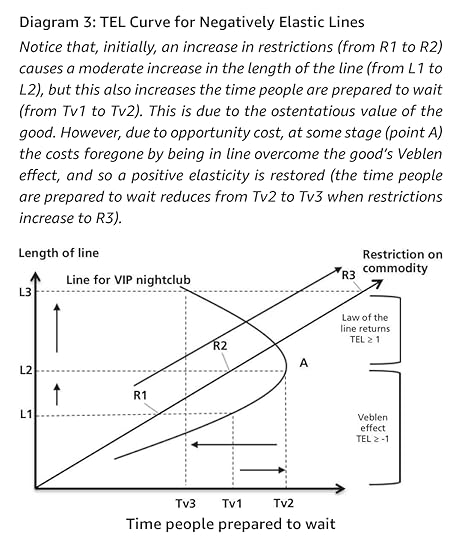
Much of this is explained in the novel via excerpts from academic textbooks and Handbooks to orientate former Line queuers. For example this description of a Veblen good:

description

The fictional references give a flavour - I've added links to some of the real references drawn on or satirised (and I'm sure I've missed some):

Ben-Orkul, A. Raising Capital – Razing Capitals. Invisible Hand Publishing.
Bullough, O. The Real Goldfinger: The Man Who Bankrupted Nodnol. Article.
Brautigan, R. https://en.wikipedia.org/wiki/Willard_and_His_Bowling_Trophies. Sunspot.
Choon, K. 23 Things They Don’t Tell You about Data-Finance. Smith & Ricardo.
Egaraf, N. Lines: What Are They and Why Do We Bother?
Bell. Keboun, R. The Warp Spasm. Sky Hooks #212.
Grogan, K., Lowry, A. and Brett, J. Pretty Shitty Cities. Comparative Advantage Publishing.
Grosney, Z. Ben-Orkul – The Man Behind the Myth. Article.
Malchevska, O. The Killer Lines of the Ukraine. Article.
Ohm, K. An Introduction to Modern Data Finance. Liquidity Press.
Oni, A. and Vaughan, T. Enter the Thunder-Hawk. Lorenz-Curve.
Stevens, W. The Emperor of Ice-Cream, Harmonium. Knopf.
Stiglitz, J. Micro-Economics for the Mildly Nefarious: Ceteris Paribus and other Convenient Qualifiers. Multiplier Books.


Great fun and very well done. This might have been a strong Goldsmiths contender in 2021, but was ineligible as Bourke studied at the University. But a possibilty for the 2022 Republic of Consciousness Prize. 4.5 stars.
Profile Image for Marc Nash.
Author 18 books477 followers
July 11, 2021
An unexpected treat. Starts off in a dystopian world, where all that exists is an unending line of people waiting to move up to some sort of mythologised liberation. It has a tone of Samuel Beckett's "Endgame" and "Waiting For Godot" meets Kafka's "The Castle". Willard and his girlfriend want to quit the line for good, even though there is nothing either side of the line and those who give up and come back are brutally punished. But they take their chances and I can say no more for spoilers. But the second part of the book is a fascinating treatise on how the world of the Line came about, touching on issues of Brexit, migration, data and big finance, environmentalism and an ingenious and delicious reversal of geopolitics. So skilfully blended in, since often to make such political points usually stops the action of any book to preach.

The ending didn't quit make sense, given the knowledge that the characters had accumulated, but who cares about endings anyway right?

Video review https://youtu.be/auCn4mmpkcQ
Profile Image for Ben Clifford.
1 review
April 9, 2021
Unlike most dystopian novels I have read, this story is far more realistic in its portrayal of the near future. The story is engaging from start to finish and I found myself finishing it in 2 days. A very barren writing style that perfectly matches the bleakness of this story.
Profile Image for Ryan Dennis.
Author 2 books27 followers
April 11, 2021
The books is fast to read, but stays with you a long time. The concept of Line is brilliant in that it seems so simply and universal, and yet incredibly original. And, it's an important and timely book to boot.
Profile Image for Tom Mooney.
917 reviews409 followers
May 4, 2021
This started out pretty good but completely disintegrated by the end.

Great dystopias combine good characters with original ideas and require the fleshing out of both. Sometimes you can get away with one or the other (The Road or The Circle, the former makes you feel for its characters, the latter packed with thrilling ideas) but they need development. I suppose what I'm saying is that surface dystopias don't work. Can't work. And that's the issue here.

Line starts with a young man, Willard, and his mother in a line. They live in a tent, cook over a dangerously simple fire and shit in a hole dug away from the living quarters. So does everyone else in their world. They are all born, live and die in The Line. Rarely, The Line moves and they pack up, hike awhile and set up camp again. No one speaks of why they're there. They just are. And there's nothing else out there.

It's an original set-up and I had started to connect with Willard, his mother and his girlfriend Nyla. But when the wider truths around their existence come to the fore, Bourke completely lost me. Fearful of spoilers, I'll not say too much, only that the reality he has built is incredibly complex and philosophical - way, way too complicated to be handled in such a short book, despite them being really interesting. Any connection I had with the characters was crumbled away by the structure of the second half of the book and there were so many damn holes in the story by the end.

I could count on one hand the number of books I've finished and thought "that could have been longer," but you can add Line to the list. It could have done with double the pages.

Disappointing.
Profile Image for Oscar.
1 review
May 4, 2021
I started to write my own review - but this review from Aoife Barry sums it up better than I could!

QUEUES are a necessity; more often than not they’re a bore to be endured at the post office or bank or customer service desk, yet sometimes they facilitate anticipation, to get into a gig or a nightclub, or on to a fairground ride.
But surely no one would choose to live their life ‘lining up’, spend day and night protecting their space, waiting for weeks or more for the queue to move again to
get to the destination. No one, not even those who willingly wait overnight for concert tickets or the start of the St Stephen’s Day sales. Surely?
Well, given enough hope in an otherwise hopeless situation, maybe you’d think again. Willard and his mother have been in a queue, the Line, all his life and hers. They don’t even question it any more, it’s just how it is. In front of them is Mr Hummel, a teacher and spiritual leader, behind a family called The Andersons.
It’s a life of drudgery, their only goal being to survive long enough to reach the end of the line, where something glorious awaits them. They’re not hunters or scavengers, but barterers, of the packages that are delivered monthly or so by an unknown benefactor. In any case, there’s nothing to hunt or scavenge; on either side of them is veritable wasteland.
It’s forbidden to leave the Line, and those who do always come back, to a terrible fate. They’re looked on as queue skippers, time thieves, and their punishment is brutal and absolute. Still, Willard is tempted. He knows what potentially awaits him and yet the urge to leave, as, it turns out, his father once did, is increasing by the day.
When opportunity arises, he and his girlfriend Nyla are confronted with the decision; to stay or to go. What happens next escalates the story from fable to quest, and then something else entirely, something spectacularly unexpected. Line is not so much genre defying, but genre expanding.
The descriptive language debut author Niall Bourke uses is pivotal in setting the scene, and is executed with considerable skill. The compact lives of the Line, the humdrum existence of its inhabitants, call for slow and steady world building.
The reader needs to know how the Line works, what it might look like and feel like to live in it, in order to wrap their mind around what comes after Willard and Nyla leave camp, with only the supplies they can carry and a mysterious handbook.
Line would probably fall into the speculative fiction camp, rather than sci-fi. Later elements reminded me of the Southern Reach trilogy by Jeff VanderMeer, which itself is a noted example of “weird fiction”, a sub-genre of speculative fiction.
Weird fiction is exactly what it says on the tin, encompassing elements of supernatural fantasy and horror, and while Line touches briefly on it, doesn’t go full-on inaccessible to the casual reader. Rather, it takes you on a journey to the unknown but strangely familiar, broadening the story exponentially from the confines of the camp to the reality of the rest of the world, taking in (alternative)history, socio-economic theory and politics along the way.
Bourke is also a poet, accounting for the lyrical qualities of the prose that shine through, particularly in the earlier part of the novel. As the story grows, so does its structure; it begins with short chapters of two or three pages that are quite self-contained, increasing to longer passages as the tale unfolds.
To say any more would be to spoil the experience, and Line is nothing if not a curious and experimental, relatively short read for someone looking for something a little out of the ordinary. Published by Tramp Press, it’s new Irish writing that subverts what has been heralded recently, the likes of Normal People and Exciting Times, for instance, that have set Irish writing out as sparse and raw, real and unfailingly honest.
Line is different, and because of that is refreshing. It’s
fiction of the unfurling kind, with a fireside story-telling quality. It’s unflinching in its descriptions of Line life and beyond, and doesn’t hold back from ferocious human emotion.
Imaginative, gripping and compelling, you’ll never again complain about being stuck in a queue when you’ve finished this.

1 review
May 7, 2021
I was excited to pick up this book after what I had heard from word of mouth and read from snippets of reviews and publicists blurbs. Happily, I was not disappointed.

Line is an exceptional, cautionary tale for modern society in which Bourke confronts readers with a number of burning issues facing us all as we struggle to deal with very human crises in an age of digitisation.

Willard, Nyla, Willard's mother and countless others have been waiting in 'The Line' for longer than anyone can remember - for generations, for so long in fact, that nobody remembers what awaits them at the top. All that they know is that it must be massively important and that, as their ancestors gave their lives to keep their places, then to abandon them would be heresy of the utmost and punishable by a communal ritual which wouldn't seem out of place in an Hieronymus Bosch painting.

Brutal as life and punishment in The Line may seem, it is nothing compared to the real horrors which lie at the heart of the book.

In the early parts of the novel, as the scene was set, I was instantly reminded of 'The Road' by Cormac McCarthy but as I read on, those similarities vanished with a hammer blow.

Whereas McCarthy explored what horrors may await us when societal structures break down, Bourke instead confronts the reader with a far more unsettling picture of what might happen when those very structures (which were put in place to benefit society) become an end in their own right - when the mask wears the face.

On a cursory read or, by skimming some reviews, you would be forgiven for thinking that Line is a dystopian Sci-fi work. Let me assure you, it is not - it is something far smarter, darker and closer to reality.

Bourke draws on his academic background, and takes central tenets of modern economic theory woven into the loom of big data and produces a nightmare for the FAANG generation. When the rules become greater than the game, it is inevitably the players who pay the price.

The premise of the book is unique, unsettling and extraordinary. Hugely intelligent and uncompromising in how it confronts the reader with the fact that, if we don't regularly check the boundaries of our institutions, we quickly risk becoming the 'unexpected item in the baggage area' - an area whose raison d'etre is to expect items but, at the same time, can only functio if those items are ones which it has been programmed to accept.

Non-standard items will be harshly dealt with - you have been warned.


Profile Image for Anna.
2,125 reviews1,025 followers
December 16, 2024
I discovered Line back in 2021 at a thought-provoking book festival event about climate fiction. It has taken me a while to get hold of a copy, though. The concept is simple and clever: the protagonist lives with his mother in a seemingly endless queue, which moves intermittently towards an unknown destination. This setup reminded me of Snowpiercer (the movie, as it's a rare case where this surpasses the original graphic novels - but don't bother with the TV series, which attempts to turn an apocalyptic satire into a police procedural!) Like Line, Snowpiercer demonstrates how structures of ceremony and mythology develop in order to make extreme, seemingly unbearable living conditions endurable. I appreciated turns of phrase like this:

That's the problem, thinks Willard; in the Line the dead still have a say and their say counts for double. It's a necrocracy and so everyone left alive walks into tomorrow facing backwards.


However, I think Line falls into a trap of over-explaining the setup, going so far as to include citations and footnotes. In my view it would have been more powerful as an allegorical fable, with a bit more mystery remaining. Admittedly this is a tricky balance to strike. By the halfway mark, Line has become quite a heavy-handed dystopia. The critique of economics, technology, and the housing market is very reasonable, but could have been conveyed more subtly. And the extended anecdote about a supermarket self-checkout was given more narrative weight than I think it deserved. Nonetheless, the ending is quite strikingly done - and notably the opposite of Snowpiercer's.
Profile Image for Elaine.
60 reviews7 followers
August 10, 2021
Line is an impressive debut novel by Irish author Niall Bourke.

I received an ARC of this novel in return for an honest review.

I was anticipating an enjoyable read as I knew the novel was published by the highly regarded Tramp Press. However, this novel turned out to be beyond my greatest expectation. It is unlike any other dystopian fiction I’ve read, yet it conjures up recollections of other literary works, but perhaps in an antithetical manner. I also glimpsed similarities with Station Eleven, where Mandel depicts a post-apocalyptic world, creating a disorientated reality.

Line is a remarkable, thought provoking, speculative fiction of an imaginary world. Yet it explores real world social and political issues by critiquing a fictionalised society through socio-political satire.

I imagine in years to come this novel will be on the school Leaving Certificate curriculum or perhaps make an appearance on a reading list for third level English literature or Sociology. I for one would love to be writing my dissertation on a book such as this. The layering is clever and deep. Hemingway’s iceberg theory is indubitably utilised throughout.

As I read the novel, I was reminded of Thomas More’s Utopia which was written over five hundred years ago. It was radical dystopian fiction and way ahead of its time. More explored the premise of a perfect world, a fairer society which did not benefit only the rich. It was a classless society, ruled by an ideal mode of governance, but it also had communist elements to it. Line does something comparable in that it has a corporation handbook and a treatise for a new world order that is not unlike The Communist Manifesto.

The word Utopia means ‘no place’ in Greek, but it is also considered a pun, exploiting a different meaning such as ‘happy place’. Similarly, Bourke teases the reader with the name of his promised land, Nodnol. The word meaning inspire, faithfulness, optimism, which the people in the line seem to have in abundance. Without delivering a spoiler, readers will recognise the name ‘Nodnol’ to be a semordnilap – in that it spells a different word in reverse. It is a familiar city of world-wide data gathering, a polluted city, with tunnels connecting the high-rise buildings.

Bourke created a world that doesn’t exist. However, it is the desire for a better world that drives his characters forward. The line moves slowly but in a controlled manner. It crosses mountains, rivers and streams, ebbing and flowing, like life. Each section of the line is governed by an Elder and the consequences of disobeying the Elder’s rules results in torturous punishment meted out to the violator. Bourke doesn’t hold back in choosing his words appropriately to describe the brutal abuse.

Willard is the main protagonist, who lives in a tent with his mother in this imaginative, elegant story. He attended school with Mr. Hummel, the Elder, who oversees his section of the line and who lives in a tent in front of Willard and his mother. Willard’s girlfriend, Nyla, lives further up the line and if they marry, she will move backwards to Willard’s tent as nobody gets to skip the line. People live and die within the line, which stretches out longer than anyone knows. (I did note that Nyla spelt backwards has an enunciation not unlike alien, suggesting Other or dislocated being – but maybe that is my excessive analysing of the story!)

Bourke’s evocative prose depicting lines of people moving forward to a better world will resonate amongst many – of the refugee crisis – in our contemporary world. The images of people fleeing their country, walking towards a better life filled with hope and desire is deeply symbolic.

This novel is a skilful political satire. Its subject matter holds up human vices to ridicule. The harsh and authoritarian ruling of oppressed people being managed and the systems in place that support and control it. There is a whole section given to explanation of the line and there are diagrams that I must admit went over my head – even after the second reading! Although Bourke attempts to offer “An Elegant Solution” near the end of the novel, this jolted me as the wording alludes to similarities from the Holocausts ‘Final Solution’ and I felt it too cunning to be considered a coincidence. Bourke is an intelligent writer and his shrewd placement of satire is subtle, yet courageous.

Bourke states, “a line has power” and “an ordered line has the power to civilise” us. In those statements alone I wonder if he is reaching for an axiom of something that is accepted and evident or ought we delve deeper yet again, into the silent space of words left unsaid?

Is there an overarching principle to present an allegory in the same way The Canterbury Tales offers moral values through social satire of the individual pilgrim journey?

Further ambiguities about this novel that overwhelm my brain question if it is a symbolic fictional narrative that is perhaps a type of parable in the spiritual journey sense. Stories such as Noah’s Ark have similar outcomes in that Willard and Nyla on the ship escape the moles and are spared. Paradigms of evolution, assumptions about society and its values are experimental observations in a dystopian world. That is what sets this novel apart and gives it uniqueness. It is truly an outstanding read and one which I can highly recommend.
120 reviews12 followers
July 3, 2021
I thought this book was utterly brilliant. Unfortunately, I have absolutely no idea how to write a review of it, because the danger of spoilers is ever-present. I am going to have to keep this much briefer than I would like, and implore you to trust me, read it, and then find someone who has read it to talk to about it. I’ve already pressed it on my husband and said he’s got a week before Line: The Book Club.

Here is the little that I can say: as I stated on Twitter, this book is like steampunk Cormac McCarthy. It has echoes of The Road, and the same McCarthy-esque blend of beauty and violence. From the start, it grabs you and throws you into the dystopian world of the novel, a future which gradually becomes more terrifyingly plausible as the driving forces are revealed.

I read Line in one sitting, completely captivated by Bourke’s vision. There were three or four points where I had to close the book and take deep breaths, so shocking and emotional were the revelations laid out on the page. But as well as being an incredibly powerful, intelligent novel, it is also sharp-witted, full of a dark humour and a sense of knowingness that adds a real frisson to the unfolding narrative. It isn’t exactly parody – it’s something more complex – a sly, wry turning inside-out of our own stark reality, and yet there is love at its centre, there are characters to root for, and the experience of reading is not entirely bleak.

I wish I could say more, I really do, but I can feel myself teetering close to spoilers as it is, so I will stop there. If you enjoy speculative fiction, I think you’d be hard-pressed to find a better example of the genre. And when you’ve finished, you’ll understand exactly why I am I so desperate to talk about this sharp, clever, original, terrifying novel.
Profile Image for Kieran Fanning.
Author 11 books44 followers
April 10, 2021
If you've ever stood in a line for hours (like I did to get into the Louvre) and wondered why it was so orderly, or stood in a line and wondered why it disintegrated into free-for-all chaos (like I did at a Jacqueline Wilson book signing) then this is the book for you.

Imagine being born in a line and spending your whole life in the same line that your parents and their parents had waited in. Such is the plight of the main characters Willard and Nyla.

I found the premise to be brilliantly original, compelling to read and clever. The writing is beautiful, if sparse, perhaps reflecting the environment of the Line. This is a thought-provoking read, with interesting takes on globalization, data mining, immigration and yes... queuing.

I loved the first half of the book the most. It reminded me of Hugh Howey's 'Wool' and I guess I would have liked to explore more of the world of the Line - the characters that inhabited it, the Elders, the different arcs etc because the world building was so good. This part was bleak, horrific, frightening and compelling to read. When I wasn't reading it, I was thinking about it.

The second half of the book moved in a surprising direction, and the Nodnol scenes were less successful, in my opinion, veering into a more sci-fi genre. This half of the book was also interspersed with non-fiction/academic articles and essays which shed more light on the backstory. Some of these pieces were very entertaining and believable, but I found some of them to be too long - they pulled me out of the story.

But overall, this was a thought-provoking, beautifully written dystopian which stayed with me long after reading it.

4.5 stars.
1 review
April 11, 2021
I've just finished devouring LINE by Niall Bourke. Words like visionary, brilliant, tongue in cheek, funny, macabre come to mind. I can't put LINE into a 'genre' because Bourke has created a 'genre' all of his own. LINE is unique, revolutionary. LINE is painfully honest and relevant. A beautifully written story of our time that made me laugh and cry. It's 21st-century literature at it's finest. A powerful, lasting work. I'll read it again and again and again.
Profile Image for Sophie Narey (Bookreview- aholic) .
1,062 reviews128 followers
August 12, 2021
I haven't read many dystopia type novels but I think this a good one to read , the only reason I didn't give it 5stars is because of the ending it wasn't quite my cup of tea for it but I really enjoyed reading the book.

It is a book where it is quite easy to read quickly , it does stretch your mind , and tests your mind making you think outside of the box . I've not seen another book quite like this , the storyline is very unique and the way the book is written does seem like it could actually be real in parts unlike a lot of dystopia novels that are so far from any part of reality. I would recommend this book if you like this genre.
Profile Image for Terry Tyler.
Author 34 books584 followers
October 12, 2021
Bought after reading a review on Swirl and Thread book blog.

At some unspecified time in the future, Willard lives on the Line - a constantly moving tented community that stretches as far as the eye can see in either direction. Line dwellers subsist on the bare essentials, their faith that what lies at the end is worthy waiting for, and the fear of consequences should they dare to leave; away from the Line there is nothing. A failed attempt to escape means a fate worse than death, as is attempting to skip one's place. It has existed for generations, and children know of the sacrifice made by their parents and their grandparents to afford them their current place. Nobody knows why it began or where it goes, just that they are heading towards some better unknown.

I loved the first part, with a restless Willard questioning his life. The writing was great, most absorbing; I was so impressed by the whole concept of the Line and looked forward to finding out how the people had been coerced into living according to its rules, believing in the myth of the end, and how the Line had developed its own code of law and become its own society.

Around half way through, we leave the Line and surrounding nothingness, and are presented with what feels like a different book, detailing the wider truths about the world. Much of it appears in the form of a printed handbook, about the current economic situation, about technological progress and philosophy. It's extremely dense and complex, and rather dull; you know when you read a text book because you need to learn about something, but the way in which it is written makes your brain shake its head and say, 'Nuh-uh, not storing all these words'? That was how this was. I kept trying to take it in but it didn't want to stay. I felt as though the ideas had not been developed enough; the whole middle section about the new London seemed disjointed, and I just didn't buy it.

During the last one fifth of the book we come to the whys and hows of the Line: the psychology of how and why people queue and wait, of hope, faith, religion, generational beliefs passed down, of the vision behind the line and the whole truth about it—so up my street I welcomed it in with coffee and cake, and loved it all over again. Fascinating. The end was sad and bleak, but right for the story. I like those sort of endings.

To sum up: a first class idea and I'm glad I read it, but I felt there needed to be more. More background, more detail, more attention to 'readability', more character-based narrative and fewer pages out of the handbook. And thanks again to Mairéad for introducing me to it :)


Profile Image for Phil James.
419 reviews3 followers
May 29, 2021
This was an interesting book about people waiting in a line, around the world for generations - think dystopian future. It tells the story of one guy and his girlfriend who look to break out of it. It's a short novel at least than 200 pages. One of the things I didn't like about it is that the book contains reprints of pamphlets the characters read that explain the world. It just seemed like a rather lazy way of explaining the plot or expository dialogue. I don't read fiction to read pamphlets. An interesting story and idea though.
Profile Image for Patrick Doherty.
Author 1 book1 follower
April 23, 2021
Line is a book about people waking up to the oppressive system in which they live and finding the courage to break free, coming to terms with the alternative, and agonizing over whether it's all worth it. Nyla and Willard reminded me of Winston and Julia from 1984. The shift into the theoretical was very interesting and overall I just really liked the Line as a metaphor. Certainly feels that way at times. Highly recommend this.
Profile Image for LeastTorque.
957 reviews18 followers
October 7, 2025
Well, this was an interesting way to make some good but unsubtle points. I was fascinated most of the way until the world I’d immersed myself in became a very different kind of weird that failed to immerse me. Then the ending threw me off.

I did love many parts of this book, just not quite the whole of it. The early chapters, the short story, and the ending (up to the last paragraph) all good.
Profile Image for Lauren O'halleron.
50 reviews1 follower
November 3, 2022
This book started out really promising and carried a curiosity of what the Line was and why people were queuing for so long. Then about halfway through it became unnecessarily complicated and felt like the author tried to cram in as much as he could with a limited word count. I feel this could’ve been a series and perhaps it would not have felt so daunting.
Profile Image for Mairead Hearne (swirlandthread.com).
1,195 reviews97 followers
October 7, 2021
LINE by Niall Bourke was published April 8th with Tramp Press and is described as ‘a stunning debut from a major new voice in Irish literature.’ Termed speculative fiction, I knew on picking up LINE that I was entering a world unrecognisable from what I know today, yet with elements of our society still present, albeit in a rather bizarre setting. So what is speculative fiction? Originally a term generated in the 1940s, over the years there have been many who argue the meaning of the term. In January 2020, Lyndsie Manusos wrote a fascinating article for BookRiot stating that she would ‘like to think of speculative fiction as a mix of the what-if scenario interacting with a basis in our world.’

Niall Bourke takes this concept of the ‘what-if’ and transports the reader into a very grim society where the populace are all living in a Line. This Line remains static for days on end and then suddenly it starts to move, always driving forward. But here’s the thing – no one knows where the end of the Line is. Generations have been born, lived and died on the Line, holding their place always for their children and grandchildren to come. To leave the Line has a shocking and very disconcerting penalty, one that drives fear into all who consider it.

‘The Line has existed longer than anyone knows. Our parents before us, and our parents’ parents before them have sacrificed everything so that we may be where we are today. We owe it to them all to get to the end. Or at least to get closer; then may it be our children who continue our journey.’

Willard and his mother live on the Line with a tarp cover and a few meagre possessions to just about survive. On the days when the Line remains still, they have an established routine from dawn until dusk with rules for movement that must be obeyed. Willard knows little about his father and over the years they have been assisted by Mr Hummel, their neighbour on the Line. Willard has a girlfriend, Nyla, and their plan is to marry and continue this procession of human life along this seemingly endless journey. Willard’s life is shaken when he discovers his mother tragically dead one morning. On sorting through her few bits, he discovers a book, hidden away in the seams of an item of clothing. Willard knows this book was hidden for a reason and his curiosity is piqued. With no one to openly ask, he turns to Nyla and together they start on a quest, a harrowing journey that will discombobulate and enthrall every reader.

The establishment of the Line is fascinating, providing a real insight into the study of the queue and how we as human beings react in certain situations. In recent times we have all been in various long queues due to Covid restrictions and, in most cases, these have been very orderly queues. Now, thankfully, the queuing, in the main, has reduced but we all did it when necessary. We all formed into a line. Now just imagine that being your life, all day and every day in the hope of reaching the end for some unexplained goal, yet one you know you need to strive for.

LINE is a combination of dystopian fiction and science fiction. A book that would certainly not be to everyone’s taste, it contains many stomach-churning and harrowing scenes, with sections of the second half giving me flashbacks to the flare-infected Cranks of The Maze Runner series. The descriptions of life on the Line are incredibly depicted by Niall Bourke, with very strong visuals, as the bleakness of life jumps off the pages. Although very much out-there, LINE offers the reader much food for thought. A satirical look at our society, it suggests an alternative world if we continue to live as we currently do. Migration is a very central theme, with world economics, data centres, conformity and greed also playing very important roles. LINE is an unnerving, yet compelling, tale of a society that has imploded. A powerful work of imagination LINE is an extraordinary and complex novel of a speculative nature that will both frighten and challenge all readers.
Profile Image for Staceywh_17.
3,699 reviews12 followers
August 16, 2021
As debut novels go, this was pretty damn awesome. An amazing dystopian novel, with a totally original plotline & an insight into our future earth....who knows?

I found Line engaging, thought provoking & powerful. Its one of those reads that will stay with you long after you've finished turning the pages.

Have you ever found yourself in a queue, be it at a supermarket or the cinema & wondered whether the time you've spent in the line has been worth it?

Many thanks to @randomthingstours for allowing me to take part in the tour & for my gifted copy.
Profile Image for A Haussmann .
1 review
May 2, 2021
I really, really liked this.

It’s very original - it is probably broadly described as Speculative Fiction, but I think that title doesn’t really cover it and - particularly the second half - is wildly original, unlike much of anything I’ve read before. I think people who might avoid it because of the genre i
of speculative or dystopian fiction would really be missing out because it is also (or maybe even more do) a sharp and quite funny (if very bleak at times) political/social satire.

It tells the story of Willard and his girlfriend Nyla, who have lived their entire life in an endless queue. No one can remember why they joined - but after waiting so long everyone is too scared to leave.

The writing is very good, really pared back and clear and kind of poetic, and I found with the short chapters it was a real page turner. I read it in two days.

Also I found the sections of philosophical and economic theory not only very funny but also very thought provoking and intellectually engaging.

Overall a big recommend from me.
Profile Image for Rosie Martin.
15 reviews4 followers
December 8, 2021
Some of this book is really really good - the bits in the line! But some of it I really wanted to be better. I think the main idea behind this story is original, fresh and fantastic Sci fi. If I was reviewing the first 20% of the book I would give it 5 stars. I don't want to mention what happens as don't want to ruin surprises for anyone, but some of the world visioned towards the middle of the book seems pretty childish and one dimensional. By the end, when more details of the original concept are revealed, I am left with a lot of questions that make the concept seem implausible. I think the book would have been better if it had focused more on the line itself and the characters lives in the line, using them to explore and push at the concept. Speaking of the characters, they don't feel wholly developed - I don't feel an inner world from them, they seem more like tools used to tell a wild tale, which ultimately made it hard to feel for anyone in the book. Still, it's a quick read, and the refreshingly original elements make it worthwhile reading!
Profile Image for Jack Kennedy.
53 reviews1 follower
April 9, 2023
Dizzying dystopian tale, high concept and continually imaginative. Unfairly overlooked in my opinion. It deserves a place in the classics of dystopian literature.
Bourke successfully creates a vivid and convincing world in very few pages. You could belt through it in a single sitting, but if you're anything like me you'll pour over certain sections slowly and deliberately. It's lean, yes, but it's dense. In this sense, it evokes Kevin Barry's economy of language. Bourke is quiet verbally inventive too, though not to the level of Barry's linguistic gymnastics.
Yet the novel's short length made me want more. The concept of Line is so irresistibly inventive that I would've happily trudged through its bleak world for longer. The ending is very abrupt too, underdeveloped and unsatisfying.
Regardless, Line is a must read for fans of dystopian literature. I can easily overlook it's flaws due to Bourkes vivid vision.
Profile Image for Rebecca (Bex the Bibliophile).
87 reviews15 followers
August 4, 2021
Thank you so much to RandomThingsTours for including me in their book tour for Line, and the publisher Tramp Press and the author Niall Bourke for my review copy. This in no way affects my opinion.

I wasn't sure what to expect from Line as the blurb describes it like nothing I have ever read before. And while I enjoyed my time reading Line, I just wanted a little bit more from it.

When it comes to the characters, I liked what we got from them, but I would have loved to learn more about some of them, as some were more developed than others. I think Willard was a fascinating main character, and it was great to get an insight into his thoughts surrounding the line. I would have loved to know more about Nyla as while we got to see quite a bit of her, I don't think we really got to know her.

I was really intrigued about the plot of Line, and while I liked it, some of it felt quite disconnected from each other. It felt as if it wasn't going anywhere for a long time, and when it started to move, it was all over very quickly. I would have loved for the book to have been a little longer as I feel there was quite a bit that Niall Bourke could have explored, especially when it comes to the ending. I also wasn't a massive fan of the breaks in the plot, as I felt that it pulled me out of the story; this is mainly down to the fact that they occurred quite abruptly and in the middle of an important plot point, so I would have much rather that they occurred a little later than they did.

I have to admit that I am a reader who very much likes answers to the questions that I have, and while we got a few, I would have loved to have got some more. I think there were quite a few things that could have been answered while still keeping the story's mystery, especially towards the end of the book. I also feel like Line is a book that certainly the technical points are not meant to be understood entirely. I read them and embraced them but didn't understand them the first time around, so I definitely think that Line could be a better book for rereading.

I am looking forward to seeing what Niall Bourke is going to write next, as it will be intriguing to see where he goes from Line. If you like speculative dystopian, I definitely suggest that you give Line a go.

Profile Image for JL Dixon.
338 reviews9 followers
August 9, 2021
𝗦𝘆𝗻𝗼𝗽𝘀𝗶𝘀
No one hast ever left the Line, nor shalt thou. To do so
wouldst dishonour the sacrifices of all those gone
before.
No one hast ever left the Line, nor shalt thou. To do so
wouldst mean thy family must pay your penance.
Thou mayst leave thy place in the Line but only once –
when thou dost marry.
But thou can only move down the Line, never up. For
that is how thou will know it is true love.
And because moving up would be skipping.
And that is the most important rule of all.
Thou Shalt Not Skip The Line.
Thou Shalt Not Skip The Line

𝗠𝘆 𝗥𝗲𝘃𝗶𝗲𝘄
I wasn’t completely sure I would like LINE. Then before I knew it, I’d finished the book in one sitting.
The concept was so simple. Generations of families have spent their entire lives on the line. Sometimes stuck in one location for several weeks, sometimes carrying everything you own, advancing forward for days or even weeks at a time, always hoping the next move would be the one that takes them to a better life beyond the line.
The book is broken into sections as the story switches between the life of Willard and his mother, and then girlfriend Nyla, and the backstory of the line. I must admit I found the progress towards the truth a little disturbing. I’ve read some dark stories about dystopian futures for humanity. Most can’t hold a candle to LINE.
There were parts of the book which I felt broke the flow of the compelling story, although in reading these sections, the comprehensive and worrying reason for the line’s existence becomes clear.
I liked most of the characters who lived on the line and at times felt genuinely invested in their journey. The situations that Willard and Nyla found themselves in went from bleak, to exciting, to terrifying, and back again.
Overall, LINE is a well thought out, compelling book which I’m glad I have read and which I am happy to recommend. I gave LINE four stars.

My thanks to Random Things Tours and Tramp Press for my copy of the book in exchange for my honest review.

My full blog including author, publisher info, and buying links is at: johnsbookshelfsite.wordpress.com/home...
Profile Image for ChaoticReaderLife.
107 reviews7 followers
August 11, 2021
'Line' is a great fictional novel. It gave me Maze Runner / Divergent vibes. I loved the whole concept of Line, and how it's not actually a line (SShh....!). The book kept me hooked and I read it in a single day. It was engaging and smoothly written. Never felt bored on a single page.

The world-building is extraordinary. The people living in tents, getting scheduled rations, and waiting for the line to move is such a brilliant setting. The 'Corporation' is like a whole different world within itself. The second part of the story was really unique and fascinating.

Talking about the characters, the character of Nyla was much more stronger than Willard himself. Although the book is based on the story of Willard, I liked Nyla much better. I would love to see more of Nyla in the next book (hopefully there's a next). She was smart and confident, whereas Willard was a bit weaker. I found Willard a bit cold-hearted. His reaction when his mother was dying, and how easily he moved-on (he kind of felt relieved), and his behavior towards Nyla was a bit hard-hearted. But there's also the fact that that's how they survive in Line.

There are a few concepts regarding some high financial terms, which were really important for the story, but I got a bit lost in it. The paper explaining the reason and concept around 'The Line' was a bit too heavy (for me... I am not good at financial stuff .... Yeek.!). But when the real reason and concepts around the creation of 'Line' come along, it was easier to follow. I just didn't understand the historic data research and data-specific part (bad thing considering I do data analysis and machine learning myself.... Ooops.! But I do just the technical part.)

The story ended on quite a suspenseful note. We see years into the future, and the mystery of how we came here is left hanging in the air. I am really interested to read the next book, which I know is going to be amazing and more adventurous.

Needless to say, I really loved this book and can't wait to read more from Bourke.

Full review here: https://divyakaushik1010.wixsite.com/...
Author 1 book11 followers
May 6, 2021
An infinite line where people live in tents, with only a few belongings and food rationed, ready to move at the least sign of movement. Winding through a barren landscape, the line slowly progresses toward an unknown destination. If you lose your place you are left behind and the consequences for those who try to skip are dire. Memories of a different world seem to have been lost: Is there really nothing else beyond the barren land?

This is a story tinged with Beckettian absurdist moments and existentialist overtones, a slim novel that explores the possibility of freedom and reads like a parable of human existence in a capitalist society, albeit with rarefied atmospheres and characters that seem flat because they are a sort of Everyman exemplifying human destiny in this world.

One of the elements that make the novel stand out is the use of language: metaphors become reality and are taken at face value in order to reveal the brutality of the system (going around in circles, to be skinned or eaten alive). There are some surreal moments when even the surroundings become animated and participate to build up this effect (saying more would be a spoiler). Another interesting aspect is the addition of documents by pseudo-social scientists who explain and justify what is going on, a nod to Swiftian scientists who articulate their absurdities in technical language and official documents.

A bleak, claustrophobic, tale and chilling picture of Capitalocene, dealing with themes of social control, finite resources and infinite growth. It such a joyless, dark world, with no uplifiting moments and reading is no party, though I am glad I did.

An original, new voice in Irish literature from the great independent publisher Tramp Press.
Profile Image for Juliano.
Author 2 books40 followers
January 20, 2025
“And under such a stillness things come up and peck at them, things from their insides that were kept at bay in the Line by the noise and distraction of the running of an ordered world.” Line, the debut novel by Niall Bourke, is a glorious work of speculative fiction toeing the hard line between high concept and easy-to-follow plotting and narrative. At no point does the strange world of the Line become a source of confusion, detail always meted out with a steady hand, yet never once stalling the break-neck pace. There’s a cinematic sweep to the novel’s landscape, images, pace — the very movement of it, the footsteps of Willard and Nyla against the creep of the Line itself. It’s hard to say anything particularly insightful without spoiling the book, so consider this a vague-spoiler warning — what I particularly love about Line is how it deploys a total mind-blower of a twist, and a while later, its bleak, clever, inevitable ending — although neither should have been that unexpected, somehow they creep up on the reader, eliciting some of the most dramatic gasping yelps imaginable. With many elements emulating a core image of existing “on and on like the never-ending branches of a fractal”, the dystopian future of the Line is deeply concerned with our times, from the darkly hilarious “warbling barcode automaton, a salsa-smeared robot of despair” to an outer-narrative with all the answers we’d be a lot happier never having read...
1 review
June 1, 2021
I thoroughly recommend Line by Niall Bourke. Having loved his earlier poetry collection (Did You Put the Weasels Out?), I was equally taken by his bold new book.

Aptly described elsewhere as Dystopian Econo-fi, I was absorbed by a world in which people have been lining up across multiple generations in the hope and promise of a better life. In this world, the economy no longer subserves even the basic needs of the individuals of society; rather these are subverted to serve the "greater good" (monstrous, faceless corporations and Big Data).

One of the reasons I love the book is that it evoked an array of emotions: despair at the abject misery and misplaced hope of life in the Line; shock at the gruesome punishments for non-compliance; and at other times I was in stitches. For macabre excitement it's hard to beat Willard and Nyla's bloody battle with the Moles en route to Nodnol.

To simply describe Line as a cracking read and unlike any other book I've read doesn't do it justice. Laced with irony, humour and the absurd, Niall Bourke's book also asks of us pertinent questions about the role of Big Data and what sort of society (and world) we wish to live in.

I'll be reading Line again before too long - the highest praise on offer.
Profile Image for Mary Conroy.
14 reviews
August 5, 2022
I'm not sure it's fair to say I 'enjoyed' this book, but it was certainly thought-provoking. Bourke ably sketches out a dystopian world order which has chilling echoes of our own contemporary lives. Because I don't read much sci-fi, as ever, I found the process of establishing this fictional world the most compelling part of the book. Willard, the central character, lives with his mother in a makeshift camp on a barren landscape, part of a queue that leads to...well, nobody knows where. All Willard and his neighbours know for sure is their own particular place in the queue - who is ahead of them, who is behind them - and that from time to time, the line will lurch forward, requiring everybody to bundle up their belongings and move in sequence towards the top of the queue. Wherever, whatever that is. No spoilers, but the second half of the book becomes more overtly political, with less ambiguous commentary on modern culture. I missed the craft of the earlier section when the plot inevitably took precedence (though the footnotes and pseudo-academic references were a delight) but taken as a whole, Line is an impressive debut.
Displaying 1 - 30 of 61 reviews

Can't find what you're looking for?

Get help and learn more about the design.