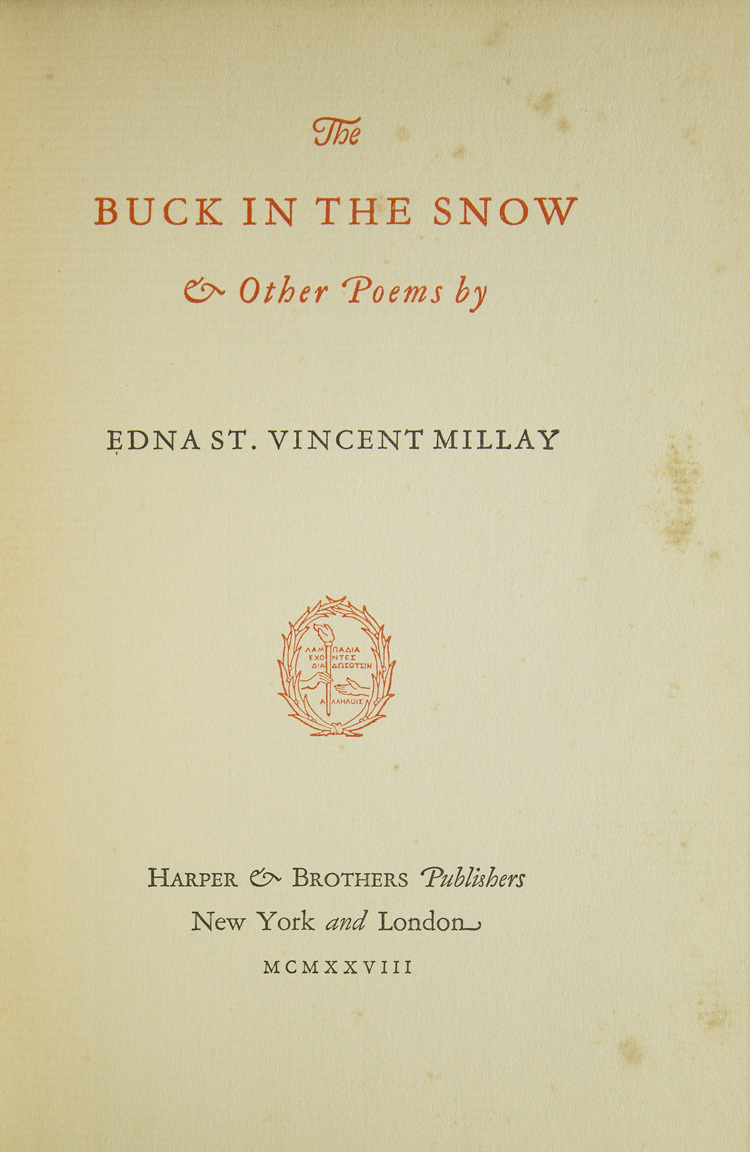
Defiance of Death was a recurring theme all throughout Millay’s career, and no poet ever wrote on that topic more eloquently or with greater passion. Two of her most impassioned poems of Death defied are here in The Buck In The Snow, Moriturus, and Dirge Without Music.
In Moriturus, Millay first considers the peace of the grave, and ponders on terms of a truce with death. But upon further consideration of death’s true cost, she declares:
Withstanding Death
Till Life be gone,
I shall treasure my breath,
I shall linger on.
With all my might
My door shall be barred.
I shall put up a fight,
I shall take it hard.
With his hand on my mouth
He shall drag me forth,
Shrieking to the south
And clutching at the north.
Dirge Without Music is a quieter, more refined defiance, but defiance still:
I am not resigned to the shutting away of loving
hearts in the hard ground.
So it is, and so it will be, for so it has been, time
out of mind:
Into the darkness they go, the wise and the lovely.
Crowned
With lilies and with laurel they go, but I am not
resigned.
Down, down, down into the darkness of the grave
Gently they go, the beautiful, the tender, the kind;
Quietly they go, the intelligent, the witty, the brave.
I know. But I do not approve. And I am not resigned.
If you have a heart to crush with beauty and sadness, this poem will do it.
Yet this small volume is not all given over to poems of death. Millay expressed in poetry both her social conscious and her social criticism. Justice Denied In Massachusetts is the poem she wrote in protest of the executions of Sacco and Vanzetti, the cause celebre of the 1920s. And in her sonnet, To Jesus On His Birthday, her critique of American culture is bitingly clear:
For this your mother sweated in the cold,
For this you bled upon the bitter tree:
A yard of tinsel ribbon bought and sold;
A paper wreath; a day at home for me.
The remainder of the volume has numerous poems to note; Being Young and Green, The Anguish, To Those Without Pity and Evening On Lesbos are among my favorites. I will leave you with a portion of Winter Night, a poem of hearth and comfort agains the cold:
The day has gone in hewing and felling,
Sawing and drawing wood to the dwelling
For the night of talk and story- telling.