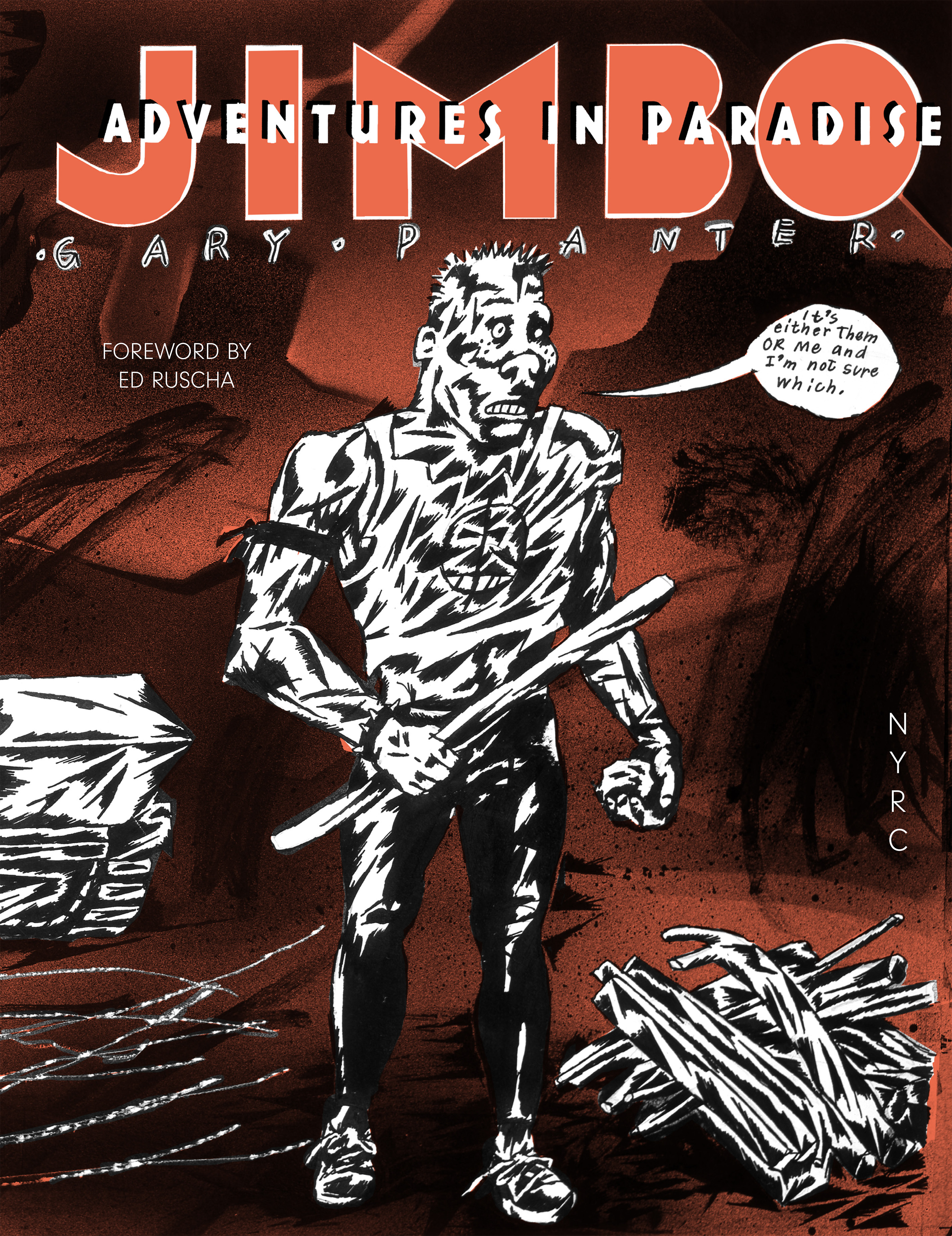
Gary Panter is one of America’s great creative forces: the illustrator for the trailblazing punk magazine Slash, set designer for the legendary TV show Pee-wee’s Playhouse, and one of the wildest, most innovative comics artists of all time. Jimbo: Adventures in Paradise is a leap into the uproarious life of Panter’s ever-cheerful punk everyman, Jimbo, and a perfect introduction to Panter’s ever-shifting style. Amid a jumbled cityscape of rundown New York City streets and futuristic Los Angeles freeways, Jimbo crowd-surfs at a riot, makes amends with Ernie Bushmiller’s Nancy, and rescues his pal Smoggo’s sister from giant cockroaches, all while the world teeters between extravagance and apocalypse.
Veering from the crude to the elegant, the wise to the funny, Jimbo: Adventures in Paradise proves Panter is a master of cartooning, and still way ahead of the rest of us.
Gary Panter is an American cartoonist, illustrator, painter, designer, and part-time musician, widely regarded as a leading figure in the post-underground, new wave comics movement. His work, described by The Comics Journal as defining him the "Greatest Living Cartoonist," has influenced alternative comics and visual culture for decades. Panter grew up in Texas, studying at East Texas State University under Jack Unruh and Lee Baxter Davis. In the 1970s, he became a key participant in the Los Angeles punk scene, producing gritty, expressive art for the fanzine Slash and numerous record covers. This period saw the creation of Jimbo, Panter’s punk everyman, who combines influences from Jack Kirby, Picasso, and underground comics, appearing in Raw, Slash, and Panter’s own graphic novels, including Jimbo in Purgatory and Jimbo’s Inferno. These works blend classical literature, particularly Dante’s Divine Comedy, with punk sensibilities, and Jimbo’s Inferno won an American Book Award. Panter’s influence extended to television as the set designer for Pee-wee’s Playhouse, where his densely layered, chaotic designs earned him two Daytime Emmy Awards. He also created online comics like Pink Donkey and published retrospectives such as the two-volume Gary Panter. He contributed album cover art for Frank Zappa and Yo La Tengo, bridging the worlds of comics, music, and fine art. His style is expressionistic and fast, balancing painting, commercial art, illustration, cartoons, and alternative comix. Exhibitions of his work include the Phoenix Art Museum, Dunn and Brown Contemporary Gallery, and the "Masters of American Comics" show at New York’s Jewish Museum. In 2012, Panter received the Klein Award from the Museum of Comic and Cartoon Art, recognizing his enduring contributions to the field.
I couldn't make it past the first 20 pages or so. The line work is so busy and overwhelming. That added to the terrible hand lettering and stream of consciousness story was a no for me.
This is a collection of stories and one page narrative comics revolving around Panter's character Jimbo, who originated as a strip in Slash, a punk prozine produced in the late 70s that eventually led to the record label. Some of these date back to the Slash years, others to the original run of RAW, the anthology comic that originally co-published this collection in the late 80s. If I'm not mistaken, these do not include the earliest Jimbo strips, which are reprinted in RAW's earlier collection just called Jimbo.
Not that ANY of that matters--in fact, the earlier strips in this volume follow the stories published later--but if you end up liking Gary Panter's work, you'll probably want to read as much as you can, and a fair amount of it, including all three of his collections published by RAW, is out of print. Whether his work is likable or impressive to you is a different question.
Panter has a shaky line style that's an acquired taste for most graphic novel enthusiasts but is pretty astounding when a reader gives it the close focus it deserves. His layouts and design are truly amazing and his storytelling consistently works on multiple levels. Jimbo, his 80s-alt everyman, adventures through sci-fi landscapes influenced by then-contemporary near-future dystopias, but with a filthy absurdist take on "adventure" that reads closer to Camus than cyberpunk, despite the geegaws on display. This is indispensable early work of a master.
EDIT: This is back in print, brought out by NYRB Graphic Novels, so I should clarify that this is for the original edition from Raw Books.
Is this a collection of amateurish, low-brow, throwaway punk comics? Or is it a boundary-pushing work of high art? This question was constantly at the back of my mind as I read Adventures in Paradise, my first Gary Panter comic. There are some parts that clearly fall into the former category, and others that definitively fall into the latter, but a lot of it's hard to categorize. That isn't to say that it ever occupies any kind of middle ground; it's definitely either slapdash trash or next-level avant-garde art, maybe sometimes both simultaneously, but never anything in between.
There's a distinctly punk aesthetic – especially in the middle section, which contains material originally published as a series of one-pagers in a magazine called Slash. Sometimes Panter's cartooning is so crude that it looks like something a kid might have doodled on a napkin. The lettering is mostly rough as hell, too: childlike scrawl with occasional words scribbled out, giving the impression that Panter must be only semi-literate (especially considering the frequent spelling mistakes). This general style carries over into the story, which for the most part is disjointed, incoherent and anarchic. It's full of non-sequiturs and bizarre tangents, and I think Panter probably made most of it up as he was going along. For the most part, the tone is humorous, combining absurdly wacky antics with nuggets of social satire.
So far, so punk. And yet, alongside drawings that look rushed and sketchy, there are frequently images that reveal jaw-dropping artistic skill. Panter repeatedly switches the visual style entirely, for example incorporating collage, employing intricate hatching to create a 3D effect, or using a bold, clean style reminiscent of José Muñoz. Indeed, Panter's art is relentlessly experimental, switching things up more often in this short work than most comic artists do in their whole career. Sometimes the result's a chaotic mess, but sometimes that mess transcends into ambitious abstraction. Most markedly, the comic's last 31 pages stand out from the rest: here the amateurish aspects of the aesthetic are all but gone, and instead the visuals are consistently impressive. Moreover, this closing segment sees the dumb humour dropped in favour of something dark, powerful and almost poetic.
I guess if I were to sum up this comic in a single word, it would be "raw" – not because that's the title of the publication in which some of it first appeared, but because it feels totally unfiltered and uncompromising. That means we get stupid stories, incomprehensible dialogue, hideous lettering, and some pretty damn rough drawings, but it also means we get mind-blowing experimentation and flashes of true, unbridled greatness.
It's a comic by the set designer for Pee-Wee's Playhouse. Jimbo's various adventures are borderline incomprehensible for about 80% of the time, with the art often looking like it was scrawled on restaurant napkins during a hurricane, with some incredibly freehanded lettering which is sometimes not worth the hassle it takes to decipher. All of this makes the process of reading it kind of difficult/headache-inducing, but it also serves to enhance the punk-rock spirit of the work, so I'm cool with it.
I already gave Panter a positive review for "Jimbo". I reckon this is the sequel. It wd appear that the RAW publishers (deservedly) had more money by now. This has a little color in it & it's thicker than the earlier one. All in all, I'd say that Panter's graphic sense is even more.. GRAPHIC here. One cd say he outdid himself. Different levels of drawing detail on the same page help keep things lively. If you like drawing (wch most of the time I don't actually care that much about but I make an exception here) this is for you. C. Carr of the Village Voice sums it up nicely in a promo blurb on the back:
"If punk America-style was like a baby dropped in a shopping mall at birth and left to grow up as best it could - Jimbo's been there, innocent and outraged."
This reissued collection of Panter’s work with this punk-rock/sci-fi character, collecting one-pagers from punk magazines as well as more ambitious work of later years, is a mixed bag, but it’s unfortunately somewhat less than the sum of its parts—with the caveat that some of those parts are phenomenal. Most of this book is made up of uneven material that tries to straddle the line between gag strip and fine art but never really finds purchase in either realm, so you end up with raw looking pages that aren’t particularly funny. The last stories in the book, though, are a searing indictment of nuclear weapons, climaxing with an extraordinary sequence that’s essentially a punk-rock comix version of Guernica. Here, Panter’s comix/high-art hybrid works amazingly well. Alas, it’s only a few pages in this collection, but it definitely makes the book worth a look and nearly justifies the full cover price on its own.
Like a lot of Panter’s work, this is easier to admire than to outright enjoy. Still, I’m grateful to NYRB Comics for reissuing it with Nicole Rudick’s afterword which puts the somewhat befuddling preceding pages into context.
Ok, so, wow, that was intense. I'm not really sure what I just read, but it kinda made me feel like I was on drugs. This seems to be some sort of L.A. punk rock dystopian wackiness, and it's totally gonna appeal to certain people, and it's totally not gonna appeal to others. It's very much of its time (lates'70s-early '80s), but manages to feel modern at the same time. Dive into this when you want to hurt your head a bit- it can be hard to read in a literal sense, the lettering can get cramped and weird- not necessarily in a bad way, but it will likely make you say "WTF" a few times, and when you want some strange and not particularly comprehensible as a palette cleanser between things that make sense. Definitely check this out is you're a fan of R. Crumb, pre-Simpsons Matt Groenig, Harvey Pekar, Ed Roth, and others of that ilk.
Really great to see a cartoonist just unleashed like this and doing whatever he wants. Gary doesn't concern himself with a consistent style, or appealing to a reader. He is just doing whatever he wants. I also really enjoyed the downer ending. It seems so appropriate to the Jimbo character, and the world Gary created for him. My one complaint is that, along with the freedom Gary is enjoying, he is also sacrificing the clarity of the story, and it's readability. There are some parts that you have to really work to read what was written. Nothing takes you out of a story faster than the act of having to work at what you are reading.
One of the best comics I’ve read. It’s visually and formally inventive and genuinely affecting; the art style is always changing and the story propels from humor to discomfort to tragedy with beautiful momentum. Gary Panter is truly innovative New York Review Comics did a beautiful job with this edition: oversized pages, well-printed, and with an informative Afterward that includes some cool archival images.
No one mashes up high and low, punk and pop, quite like Gary Panter. At first glance these sweeping, stream-of-consciousness pages might seem like so much scribbling, but with a closer look you see the improvisatory genius animating the lines, and you surf on the weird ideas and intricate visuals and go wherever he takes you. Most of these were made more than 40 years ago, but they still somehow feel like the future.
This isn't the sort of book where you sit down and just read. This is an explosion of imagery and sensations. Plot is unimportant. Think of it as a nightmare scape where the characters shifts from place to place, as one does in a dream, and becomes involved in obtuse scenarios. It's best to let the experience just wash over you, rather than puzzle out what's happening. I can see how this would not be to everyone's taste. But I rather enjoyed it.
fun and witty mad magazine style antics suddenly turn into a vivid nightmare. Panter’s playing with some insane stylistic cocktail of schenkel, otto dix, the hairy who, and your local punk zine maker all to create his own guernica. a new favorite
Lots of fun until the end when it turns into a vision of absolute Hell. Panter gets comics, he knows how to let chaos blow through and destroy everything.
“If goodness resides only in the sentient and not in the inanimate , for which goodness has no meaning, then goodness is tiny and nothingness is gigantic!!”
“…nothing happens because I don’t do anything, my problem is I learned how to think. It takes up all my time. No my problem is everybody wants me to join their club. New wave! New wave! Punk! What a bunch of fucking hippies! That’s their problem not mine!!! My problem is loud neighbors!!! Now there’s a problem, no I think it’s my lack of spontaneity!”
Crazy hallucinatory frantic trip of our hero Jimbo the punk Everyman through futuristic Dal Tokyo in search of fulfillment or peace or something else. Philosophical and strange and just extremely cool. The blue chunk in the center was especially great.