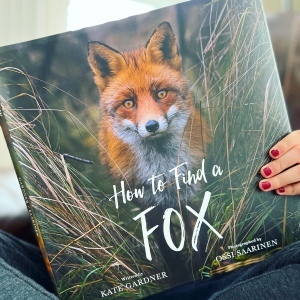
Look for tracks. Listen for yips. Be as still as a pebble.
Taking kids on an imaginary trek through different landscapes and seasons, How to Find a Fox celebrates one of our planet's most graceful and enchanting the red fox. Ossi Saarinen's stunning wildlife photos and Kate Gardner's lively and informative words capture the magical and profound connection between animals and humans. Readers will be inspired to get outside and make their own discoveries--maybe with a camera in-hand, just like Ossi.
Great nature photography, like any art, is wasted on adults. Unfortunately, adults have a tendency to rule the world, so this situation is unlikely to change anytime soon. I have noticed, over the years, that when a book for adults is popular and involves photos in some way, a watered down, half-hearted children’s book version of that title is inevitably released a year later. I don’t think that adults know what they’re doing when they hand kids the dregs, of course. I suspect that were one to ask them they’d say they were being generous. Yet considering how influential children’s books can be on young growing brains, and how they have the potential to shape entire lives, shouldn’t children be given top-notch photographic works all the time? Shouldn’t they also be given original books with original photography that’s so splendid and awe-inspiring that it takes their breath away? Shouldn’t they, in other words, see more books like Gardner and Saarinen’s How to Find a Fox? Deftly capturing the majesty, mystery, and downright good looks of foxes, this book is the rarity that proves the rule. Kids don’t get enough truly great photography on their shelves. All the more reason to hand them this, if only to watch their eyes pop right out of their little heads.
“If you want to find a fox, you can look in the forest... or the meadow.” Sumptuous photography accompanies a text that explains the finer ins and outs of spotting a fox in the wild. Avoid the rain. Try the early morning or somewhere around twilight. You can look any time of the year, but avoid the sky, the trees, or the river since you won’t find them in any of those places. But if you are calm and quiet, like the photographer of this book, then maybe, just maybe, you’ll be lucky someday and a fox will come to you. Backmatter includes a note from the photographer and a small Bibliography of sources.
Full disclosure, when I was a kid, I went through a bit of a fox phase. It only stands to reason. More beautiful than coyotes or accessible than wolves, foxes always struck me as the perfect mix of dog and cat elements. Not that they have any true connection to felines, but there’s more than a hint of a cat’s personality in your average fox. Had I seen this book back then, I would have been thoroughly enthralled. Finnish photographer Ossi Saarinen does not merely capture a fox’s form but its essence. Its soul. That shot on the cover is quite good, and if every image inside the picture book were less than that, it would still mean the book was worth reading. But what’s so impressive about this title is that it improves upon and exceeds itself consistently. Saarinen has managed to come up with a wide range of different kinds of shots of foxes. From rollicking cubs, to extreme close-ups, to landscape shots where the fox is simply a small figure against a sweeping autumnal background, the variety of images is part of the book’s unique lure. You’re simply not going to find a book with photographs of foxes quite as good as this one for kids out there. So when I spoke earlier about how kids aren’t often given great works of photography for fun, that may have more to do with the lack of books in the market than with a young person’s predilection towards realism or not.
Though the bulk of the charm of this book rests on Mr. Saarinen’s shoulders, a truly good picture book for kids needs at least a little talent on the part of its author. This is where How to Find a Fox lucks out. As it just so happens, Kate Gardner knows how to write. Truly great picture books consist of above average writing and illustration. In this case, rather than illustration we have photographs, and they do a job that is only heightened by the work put into the text. I admit that I do wish that I knew how this book came to be. Did the text come first and then Mr. Saarinen adapted his photos? Did the photographs come first and then Ms. Gardner wrote her text? It’s impossible to say. What we do know is that with this title Ms. Gardner’s words melt into the images. When she discusses the different kinds of footprints you might see in the snow or alludes to the skies, the trees, and the river, perhaps she had no idea what images might accompany these sequences. Even more interesting to me is how she sets up this book. She writes it as a kind of instructional guide. If you follow the rules she lays out for you, you may still never see a fox, but at least you have a chance. Under the hand of Ms. Gardner then, this is a book brimming with that possibility.
Naturally whenever I’ve encountered a nonfiction picture book for kids, I want to know what it all means. If this book is as excellent as I think it is, does that mean that we’ll be seeing more photography-illustrated books for kids in the future? The answer is probably no. Though costs of development and printing have fallen over the years, industry prejudice against picture books that meld photography and text remains high. This is a bit of spillover from the adult art world, where photography never quite managed to establish itself as one of the finer arts. The advantage of How to Find a Fox, however, is that it technically falls into the nonfiction picture book category. With that, I’m hoping that it gets properly elevated by the nonfiction loving teachers and librarians of the world. And until that happy day arrives, I’ll just hug my own copy tight and then tell every last soul I know about it. Like you. And you. And you over there. And especially you.
Attention fox lovers! You'll want to check out How to Find a Fox, which combines lovely photographs with a simple text and some interesting facts about our vulpine friends.
If I have any complaints, it's with some of the landscape photographs. I'm not sure if we're supposed to find foxes within them or not. I spent quite a while trying to find the critters, Where's Waldo? style, and couldn't really see any in most of the landscapes. (I did spot a fox in one, which made me think there might've been a fox in all of them.) So, either there are no foxes and it's all a bit misleading... or there are foxes and it's way too difficult to find them!
Other than that, though, the photos of the actual foxes are lovely. I even learned a few things I didn't know before.
Highly recommended to readers who enjoy books about foxes and wildlife, or who like picture books illustrated with gorgeous photos.
If you love foxes, you definitely want to read this book! This is a good story that is straightforward and cute. Every couple of pages there are small paragraphs that include insightful information about the lives of foxes. The real star of the book, however, are the photographs from nature photographer Ossi Saarinen. You will be amazed at the beauty of the photos of the red foxes found throughout the pages of the book. Altogether, this book is fantastic!
This review was originally written for The Baby Bookworm. Visit us for new picture books reviews daily!
Hello, friends! Our book today is How to Find a Fox, written by Kate Gardner and photography by Ossi Saarinen, a gorgeous look at a popular species.
There a lots of places to find a fox: in the forest, in the meadow, and even in the city! You can look in the morning and the afternoon, but the best times are dusk and dawn. You can look year round, since foxes don’t hibernate, but don’t look in the rain – foxes stay out of bad weather! In order to find a fox, look for fast feet, fluffy tail, and amber eyes; be quiet and patient, and with a little luck, you can find a fox!
An exciting visual treat. Saarinen’s stunning wildlife photography sets a beautiful scene for a simplified lesson on vulpes vulpes; information is covered in short lines and conversational paragraphs. Some landscape photographs without fauna and pictures of other wildlife can feel a little extraneous, and occasionally confusing, particularly two that feature unidentified animals tracks after a spread on identifying a fox’s. Still, the eye-catching photos and easy-to-read text make this a fun way to explore a popular species. The length is fine for elementary readers, and JJ loved the pictures. For fans of foxes, a lovely way to learn and explore from a fox-eye-view, and we liked it. Baby Bookworm approved!
(A copy of this book was provided to The Baby Bookworm by the publisher in exchange for an honest review.)
This book has amazing photography, as well as information on foxes that is presented in an interesting manner that is not boring or dry. It's cute without being cheesy or baby-ish. I thoroughly enjoyed reading it and think anyone who likes foxes would feel the same!
I was unfamiliar with either the author or the photographer, but oh, am I a fan of foxes. I learned that the photographer's nature images were the start of this story, and i can see why they inspired. The fact that such elusive, even skittish wild critters could be captured in these intense, spontaneous, and natural poses invites celebration and elaboration in text. The author, like Stewart, provides parallel text, combining several short lines that speak simply and directly to readers, indicating how they, too, just might find a fox. Then a short passage of small font text appears, unobtrusively, to provide more detailed understanding of the ways of foxes. Facts are reflected within the context of the photographic images, and that makes every bit of information cling in our thoughts, almost as if tied to a personal memory.
Combining stunning photographs of foxes with meticulously paced text, this picture book brings the reader right into the fox's world. I could not believe how neatly the photographs and text went together: this would be perfect for a storytime. Each page spread has a short and sweet thread of text, and every few pages are punctuated with a slightly longer fox fact paragraph.
A Photographer's Note and Sources are included in the back.
This nonfiction picture book explores the world of the fox in beautiful photographs. The text is a mixture of a very simple storyline of finding a fox combined with detailed facts about foxes and their adaptability in a changing world. The book looks at when it is best to find a fox, such as time of day or season. It goes on to describe what a fox looks like and what to look for when finding their tracks. You can also listen for yips or other noises. But most importantly, you must try to be very quiet and hope that a fox might just find you!
The text of the book is well-written and full of interesting foxy facts. Children will want not only the simple story but to hear about the details of the fox’s life and how to find one themselves. The premise of the book alone is an invitation that is almost impossible to turn away from.
From the cover and through the entire book, the photographs are the focus. They marvelously capture the fox with clarity and a real feeling for their character. There are images where the fox is lit by the sun where you can almost sink your fingers into their fur. Other pages have the fox looking right at the reader with undeniable intelligence. Simply beautiful.
One of the most enticing and gorgeous animal books of the year. Appropriate for ages 3-6.
How to Find a Fox by Kate Gardner, with gorgeous photos by Ossi Saarinen, is reminiscent of the work of the recently deceased April Pulley Sayre. Taking readers through the seasons and different places, Gardner shares with readers how to find a fox. Look at dawn or dusk but not by the water, look on mossy rocks in the summer and look for their tracks in the winter using only the words needed. Then in a smaller font, we learn more details about foxes, where they live, why there are only two footprints side by side. The photos are a story themselves, showing the beauty and the many character traits of a fox, capturing other animals, and the sereness of the habitat in which the fox lives. A beautiful book that will be loved everywhere.
Spectacular photographs of incredibly adorable and alert foxes paired with brief text will engage the youngest animal fans. Through focusing on how to find a fox the author conveys where and how foxes live. My only quibble is this is really a book exclusively about red foxes and while there is one mention of grey foxes (after the author instructs readers NOT to look for foxes in trees) it is just to say that while grey foxes climb trees, you'll be more likely to find red foxes other places. Happily there are several good sources listed so that adults and kids will know where to look for more complete information.
Nonfiction picture book. Wild forest animals have a bit of mystique to them-- known to exist but not always readily found. This book shares stunning photographs of foxes (and a few other animals) along with a text on how to find a fox. The text is simple but still informative. Foxes are most likely to be found at dawn or dusk, any time of the year. They leave tidy tracks in a single line. A few pages have longer paragraphs of text to give more context, but those can be left out for the youngest of readers. A note from the photographer and a brief bibliography make up the back matter.
If you love foxes, you definitely want to read this book! This is a good story that is straightforward and cute. Every couple of pages there are small paragraphs that include insightful information about the lives of foxes. The real star of the book, however, are the photographs from nature photographer Ossi Saarinen. You will be amazed at the beauty of the photos of the red foxes found throughout the pages of the book. Altogether, this book is fantastic!
Where to look, when to search, what to expect and how to behave, all simply put for the very young readers. Additional information on fox behavior, what they eat, along with the furry coat changes throughout the seasons satisfies every reader. Incredible photographs by Ossi Saarinen complete the package and place it at the top of any list of animal-habitat non-fiction. And who knows - if you're patient enough, a fox may even find you!
This book is nothing remarkable in terms of content, but it does contain good, common knowledge about foxes.
The photography on the other hand is stunning! That the photographer was able to get so many close up shots of foxes, considering their speed and fear of humans, is remarkable.
This would be great for a general lesson in school on foxes and for children to just enjoying browsing the pictures.
Wow, the photography in this book is stunning. It matches the words perfectly. The words give simple advice on how to find a fox, followed by a paragraph explaining the advice more throughouly. I didn't even know I wanted/needed to learn about foxes until I read this book. My favorite fact was about the tracks...who knew?
Absolutely beautiful photographs of red foxes stand out in this picture book that includes some facts as well. It can be used in storytime as the audience is engaged with learning how best to find a fox.
A beautiful book about foxes. A great read-aloud for younger kids with it's clear and crisp photographs and easy narrative. For those wishing to know more, Kate Gardner includes more information on a few pages of the book about fox habits and traits.
Beautiful wildlife photography of red foxes in their natural environments and simple words combine to show the reader how they might find foxes in the wild. A brief bibliography and informative note by the photographer are included.
My five year old grandson is enamored of foxes and so I got him this beautifully photographed picture book for Christmas. Along with the pictures, the writing gives ideas of where to spot foxes as well as information about them. I think he will like it and I look forward to reading it to him.
This book is gorgeous! You feel like you could reach out and touch the adorable little foxes and other animals. I like how this book is written for the photographs. I will definitely be sharing this with my 1st graders!
Go around and look for a fox in different places! Kinda reminds me of a We're Going on a Bear Hunt. A great non-fiction book that can be trimmed down for a toddler storytime or read in its entirety for elementary school kids. These are great photos of young foxes out in the wild!
An amazing book of close-up photographs of foxes. Amazing action shots juxtaposed against landscapes on opposite pages make the story exciting. The main narrative is perfect for very young children, but additional details at the bottom of some pages allow for older readers to learn more.
Such a cute book with simple, easy phrases for children to read interspersed with longer facts that an adult could read to the child. A great book for reading together. The pictures in the book are too cute - especially since cute baby foxes are used a lot. I really liked this cute book.
Very cool nonfiction book about foxes. My class lovedddd the fact that there was a photographer instead of an illustrator and we all loved the photos. I would love it if this won the Monarch, but even if it doesn’t, I’m glad I got to read it. A definite future re-read.