

What do you think?

Old Ireland in Colour #1
Old Ireland in Colour
Old Ireland in Colour brings to life the rich history of Ireland and the Irish through the colour restoration of these stunning images of all walks of Irish life throughout nineteenth and twentieth century. From the chaos of the Civil War to the simple beauty of the islands; from legendary revolutionaries to modest fisherfolk, every image has been exquisitely transformed and every page bursting with life. Using a combination of cutting-edge artificial intelligence technology and his own historical research, John Breslin has meticulously colourised these pictures with breath-taking attention to detail and authenticity. With over 250 photographs from all four provinces, and accompanied by fascinating captions by historian Sarah-Anne Buckley, Old Ireland in Colour breathes new life into the scenes we thought we knew, and brings our ancestors back to life before our eyes.
198 pages, Kindle Edition
Published October 4, 2020
Ratings & Reviews
Friends & Following
Create a free account to discover what your friends think of this book!
Community Reviews
Displaying 1 - 20 of 20 reviews

January 12, 2021
I loved this book. I read from cover to cover in 2 nights but I know its a book I will return to again and again. Perfect for anyone with an interest in Ireland and/or Irish history. A fresh perspective on how much life has changed in the last 150 years.

March 17, 2021
Old Ireland in Colour is an ongoing
project
of colourising black and white images by photographers in Ireland in the late 19th to early 20th century. The catalyst was
John Breslin
working on
colourising some photos of his grandparents
, when he discovered an automated system called
DeOldify
. He looked for
more images to colourise
, starting with old photographs of NUI Galway, then the Galway/Connemara area, and then of Ireland as a whole.
Breslin tries to use either public domain or Creative Commons images as much as possible. Resources include the National Folklore Collection (Cúchas), the National Library of Ireland, the Public Record Office of Northern Ireland, the Library of Congress, and Wikimedia Commons.
Essentially, the process of colourisation works by the computer applying colour based on a bank of millions of colour images. Accuracy depends on what is in the bank, so common items such as grass, trees, and the sea come out well; inaccurate colours or hues for clothes or skin need to be adjusted in human post-production.
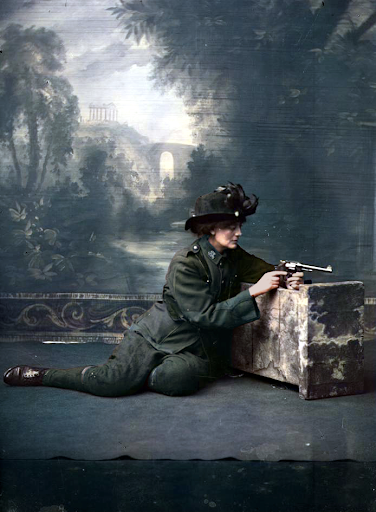
An example of this is an image of Countess Markiewicz’s uniform, from an automatically applied purple to a manually adjusted bottle green.
The project became popular on dedicated social media platforms Twitter, Facebook, Instagram, and YouTube. It was then suggested to Breslin to consider creating a book version. In early 2020, Sarah-Anne Beckley joined Breslin, to advise on the historical context for the book. He described it as “a Covid book”, as the authors, designers, and publishers never met each other in person during the process.
Old Ireland in Colour , the book, was published by Merrion Press in September 2020, in a hardback format of 304 pages, measuring 19 by 24 cms. There are over 170 images covering all four provinces of Ireland, spanning the period from just before the Great Famine to the outbreak of The Troubles. The images are grouped thematically: the Irish Revolution, society and culture, women and children, the Irish abroad, and scenic Ireland.
The physical production of the book is very good quality. The paper has a good thickness and touch, and the colour reproduction appears accurate (indeed, Breslin remarked that the print versions of the colourised images appear more forgiving than the screen versions). The saddle stitching is welcomed, as it allows the occasional double-spread image to lie flatter. The concise image annotations provide essential information, to help the reader place the image in context.
There is no faulting the attention to detail that Breslin gave to every single image in the book. It must have helped that many of the images would be obtained from high resolution original photographs, such as large format cameras of the day. This would have enhanced the colourisation effect, so that we are presented with high resolution colour images, akin to what we are familiar with seeing in contemporary magazines. Remember, in many cases the detail was already in the black and white photograph; but instead of 256 shades of grey, your eye and brain are now processing it in millions of colours.
Thanks to Breslin’s meticulousness, the result for the reader is a believable, literally colourful survey of Ireland and its people over a particular period of time. There is a good mixture of the notable, the landscapes, and the everyday lives of many.
A summary of photographic sources is listed at the end, as well as a detailed archive reference for every image. As the authors explain, “We acknowledge fully the ethical concerns that arise from altering these primary documents and hope that the book leads the reader to the original source, as opposed to offering a replacement for these records.”
The authors offer Old Ireland in Colour as “an illuminating look at Irish life, Irish people and the dramatic transformation and change that has occurred over the 125 years covered in this collection.” Breslin told Allan Preston at the Belfast Telegraph that he hoped it would help to spark conversations between different generations.
Old Ireland in Colour is successful, not because of the technical feat of artificial intelligence modifying original work, but perhaps because it offers us a new glimpse — even if an imagined glimpse — of what the original photographers saw when they captured the light onto their analogue films and papers. It remains to us to derive meaning from Breslin and Buckley’s compendium.
Originally published at Mr Ulster.
Breslin tries to use either public domain or Creative Commons images as much as possible. Resources include the National Folklore Collection (Cúchas), the National Library of Ireland, the Public Record Office of Northern Ireland, the Library of Congress, and Wikimedia Commons.
Essentially, the process of colourisation works by the computer applying colour based on a bank of millions of colour images. Accuracy depends on what is in the bank, so common items such as grass, trees, and the sea come out well; inaccurate colours or hues for clothes or skin need to be adjusted in human post-production.
An example of this is an image of Countess Markiewicz’s uniform, from an automatically applied purple to a manually adjusted bottle green.
The project became popular on dedicated social media platforms Twitter, Facebook, Instagram, and YouTube. It was then suggested to Breslin to consider creating a book version. In early 2020, Sarah-Anne Beckley joined Breslin, to advise on the historical context for the book. He described it as “a Covid book”, as the authors, designers, and publishers never met each other in person during the process.
Old Ireland in Colour , the book, was published by Merrion Press in September 2020, in a hardback format of 304 pages, measuring 19 by 24 cms. There are over 170 images covering all four provinces of Ireland, spanning the period from just before the Great Famine to the outbreak of The Troubles. The images are grouped thematically: the Irish Revolution, society and culture, women and children, the Irish abroad, and scenic Ireland.
The physical production of the book is very good quality. The paper has a good thickness and touch, and the colour reproduction appears accurate (indeed, Breslin remarked that the print versions of the colourised images appear more forgiving than the screen versions). The saddle stitching is welcomed, as it allows the occasional double-spread image to lie flatter. The concise image annotations provide essential information, to help the reader place the image in context.
There is no faulting the attention to detail that Breslin gave to every single image in the book. It must have helped that many of the images would be obtained from high resolution original photographs, such as large format cameras of the day. This would have enhanced the colourisation effect, so that we are presented with high resolution colour images, akin to what we are familiar with seeing in contemporary magazines. Remember, in many cases the detail was already in the black and white photograph; but instead of 256 shades of grey, your eye and brain are now processing it in millions of colours.
Thanks to Breslin’s meticulousness, the result for the reader is a believable, literally colourful survey of Ireland and its people over a particular period of time. There is a good mixture of the notable, the landscapes, and the everyday lives of many.
A summary of photographic sources is listed at the end, as well as a detailed archive reference for every image. As the authors explain, “We acknowledge fully the ethical concerns that arise from altering these primary documents and hope that the book leads the reader to the original source, as opposed to offering a replacement for these records.”
The authors offer Old Ireland in Colour as “an illuminating look at Irish life, Irish people and the dramatic transformation and change that has occurred over the 125 years covered in this collection.” Breslin told Allan Preston at the Belfast Telegraph that he hoped it would help to spark conversations between different generations.
Old Ireland in Colour is successful, not because of the technical feat of artificial intelligence modifying original work, but perhaps because it offers us a new glimpse — even if an imagined glimpse — of what the original photographers saw when they captured the light onto their analogue films and papers. It remains to us to derive meaning from Breslin and Buckley’s compendium.
Originally published at Mr Ulster.

December 20, 2021
Amazing and eye-opening - seeing people in colour removes the emotional distance of black and white. Such a shame quite a few of the photos are awkwardly positioned with people's faces or other important focal points obscured in the central gutter.

January 6, 2022
As the world progresses into the future there are newer and newer sources to record the past. And fortunately or unfortunately as one may see it we are able to use the developments of technology to improve these old records. And in the case of this book it is the taking of historical photographs and adding color to not only the local face of Ireland but also to some famous Irish people and places that so many of us may have heard about.
I love the concept for this collection of photos, the inserting of color to bring them to life and the informative captions. These captions provide the reader with not only the date of the photograph but also information about the people or events covered, the place it was snapped at as well as some additional information relating to the Irish culture. It is rather renewing to definitely see how much Ireland has shaped the world around itself.
Unfortunately since it is a book of restored photographs and the captions for them if you are lacking a degree of Irish history then certain events suggested won't make much sense. Instead you will be left wanting to know more about the information you don't know about and in the end that may not be a bad thing.
All in all it was a decently quick and informative read otherwise while one that will make you wonder about just what else we could uncover if we could see everything else in color.
I love the concept for this collection of photos, the inserting of color to bring them to life and the informative captions. These captions provide the reader with not only the date of the photograph but also information about the people or events covered, the place it was snapped at as well as some additional information relating to the Irish culture. It is rather renewing to definitely see how much Ireland has shaped the world around itself.
Unfortunately since it is a book of restored photographs and the captions for them if you are lacking a degree of Irish history then certain events suggested won't make much sense. Instead you will be left wanting to know more about the information you don't know about and in the end that may not be a bad thing.
All in all it was a decently quick and informative read otherwise while one that will make you wonder about just what else we could uncover if we could see everything else in color.

March 2, 2022
I loved the intent of this volume, and I very much wanted to love the final product. Unfortunately, too many photos are ruined by layout choices and lost inside the binding. Additionally there is an inconsistent tone to the captioning—serious or straightforward and then, suddenly, sarcasm or jest. I loved getting a realistic glimpse of my family’s history, but I’m disappointed by what this book could have been—with more editorial care—and isn’t.

August 22, 2021
A fascinating book with an incredible look into the past. I feel like the photo of the burning of the Custom House is a way to sum up how valuable and treasured something like this is when so much of Ireland's written historical record was destroyed, or just too poor to be relevant.

January 9, 2021
This is a great book for your coffee table. It is the sort of book you can dip in and out of. Most of the photos are fabulous, really bringing the past to life and some look like they were only taken yesterday. Many of the photos will be familiar from other publications. It would have been good to have some of the originals included to highlight the transformation.

May 4, 2021
Advances in colorizing old black-and-white photographs have resulted in some eye-opening moments for me. When I look at the originals, without any color, I feel like an outsider looking in at some time when people were different than now, when the world was flattened out, two-dimensional. But when I look at the photos in the marvelous book Old Ireland in Colour I realize how very much we are the same as those folks more than a century ago.
I want to be clear that I think black-and-white photography has a significant place in art, and I have sometimes shot pictures that way on purpose. But I am talking about the historical significance of giving us now a chance to step into the world of the late 19th and early 20th centuries and getting to know the people and the setting on a more personal, more poignant, more visceral level.
I think there is a place for both the historic photos and the enhanced ones as we study the past and look to the future.
On the pages of Old Ireland in Colour are pictures of people whose names are lost to time and those who remain famous. There are laborers, revolutionaries, barefoot children, as well as politicians, poets, actors.
John Breslin, a professor at NUI Galway, began this project when he became interested in colorizing his own family's old photos. He not only uses modern technology in this work, he researched what the color of fabrics would be, what a person's eyes were reported to look like, and such details to make the result as close to accurate as possible.
The photos in the book are accompanied by text from historian Sarah-Anne Buckley.
I want to be clear that I think black-and-white photography has a significant place in art, and I have sometimes shot pictures that way on purpose. But I am talking about the historical significance of giving us now a chance to step into the world of the late 19th and early 20th centuries and getting to know the people and the setting on a more personal, more poignant, more visceral level.
I think there is a place for both the historic photos and the enhanced ones as we study the past and look to the future.
On the pages of Old Ireland in Colour are pictures of people whose names are lost to time and those who remain famous. There are laborers, revolutionaries, barefoot children, as well as politicians, poets, actors.
John Breslin, a professor at NUI Galway, began this project when he became interested in colorizing his own family's old photos. He not only uses modern technology in this work, he researched what the color of fabrics would be, what a person's eyes were reported to look like, and such details to make the result as close to accurate as possible.
The photos in the book are accompanied by text from historian Sarah-Anne Buckley.

June 21, 2021
A quirky book. The colourisation of old familiar images promts the viewer to look at them in a new way. This process was done with greatly subtlety. The accompanying text was good. However, the range of dates covered seems odd with the book going right up to the visit of President Kennedy.
December 26, 2020
Very interesting and informative however, images often feel misplaced and can stray from the point it is trying to make. Otherwise, a very interesting read.
March 14, 2021
A beautiful collection of colourised photos of a long gone Ireland. A great coffee table book.

June 15, 2021
This is a great collection of images that highlight much of Irish society and politics in the early twentieth century. A very easy book to pick up at your leisure.

July 18, 2021
A lovely book of colorized photos, with lots of info and plenty to make one want to learn more of Irish history!

November 29, 2021
Amazing coffee table book.
December 17, 2021
I wish I could have gone
I really enjoyed this book. My relatives were Irish. I grew up hearing stories from my paternal grandfather. The problem is they weren’t true
I really enjoyed this book. My relatives were Irish. I grew up hearing stories from my paternal grandfather. The problem is they weren’t true
December 30, 2021
Excellent photographic collection with some impressive narrative on history

January 15, 2023
Perhaps best viewed on a large-screen iPad.
December 31, 2023
Very nice photos of Ireland in yesteryear 👍


May 3, 2024
Wonderful photos and interesting narrative on some of the back stories
November 6, 2025
Beautiful book.
Displaying 1 - 20 of 20 reviews