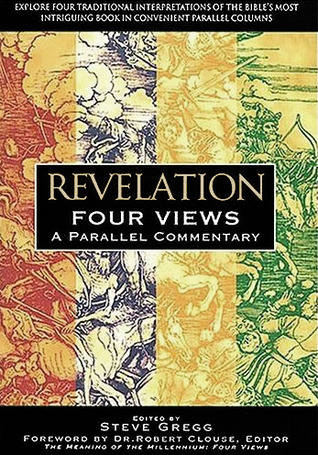
How can we understand the book of Revelation and its many interpretations? Four Views of A Parallel Commentary covers the traditional views in an even-handed fashion. Four parallel columns present the information you need on these key views, and inform you about outstanding commentators on the book of Revelation. No other book gives such extensive coverage of how the church has understood Revelation over the centuries. The four-column format makes this an easy read for lay people, pastors, and scholars alike. This is a wonderful addition to any Bible study resource library. Features
Steve Gregg has filled a large hole in apocalyptic scholarship with this remarkably helpful commentary. As someone who has been very confused by the different understandings and interpretations of Revelation (and having grown up only knowing of a futurist, pre-trib, pre-millennial understanding), when my pastor recommended this resource by Steve Gregg I was excited to get into it. Gregg has provided a thoroughly excellent resource for anyone to better understand the four main views of interpreting the book of Revelation. The book is balanced and even-handed with each view, and by the end of the book I have found myself becoming more understanding of why exactly people would hold each of the different views. I also learned a massive amount over my year and a half read through, foremost being that not everyone sees the new earth to be a literal and tangible reality (this wasn’t fun to discover). While those who want more specifics about each view should jump from this to specific commentaries by theologians with specific views, this is a thoroughly helpful summary of the broad beliefs held by each of the four views. Bravo, Steve Gregg.
Not exhaustive but short and concise. Each column on the page summarizes one of the four views, and Gregg stays informative and unbiased. My disdain for dispensationalism has grown since reading this. I think the Preterist (Israel version) is probably the most accurate take on the book. The Rome version of Preterism seems to deviate from John’s writing. Idealism is inconsistent. And Historicism is just an older newspaper exegesis.
While I definitely recognize that most people will use this book as an occasional reference when studying certain sections of Revelation, I read it from cover to cover in an attempt to better understand the various ways that the book of Revelation has been interpreted over the course of church history.
I had read Revelation once or twice before in the past, but never at a very in-depth level prior to now. Going into this book, I had a basic understanding of the views concerning the millennium, but I knew very little about the various ways that the rest of Revelation have historically been interpreted.
At various points while reading Revelation and this commentary book, I felt like I needed to take a few moments to simply stand in awe of God’s glory, majesty, and power.
I am making the following notes for future reference so I can see if my thoughts change over the course of the next 10, 20, 30+ years:
At this moment, I would rank the 4 primary interpretative positions for Revelation as follows: 1. Preterist 2. Tie: Idealist / Futurist 3. Historicist
Also, I would rank the 3 primary millennial positions as follows: 1. Amillennialism 2. Pre-millennialism 3. Post-millennialism
Extra Notes:
Page 10 - “In addition to presenting the three main views on the Millennium, the author devotes the majority of the commentary to presenting the four ways in which interpreters have approached the main sections of Revelation: the preterist, historicist, futurist, and idealist approaches. A preterist is one who believes that most of the prophecies of the Apocalypse have been fulfilled in the past. The historicist (or pre-sentist) considers the events of Revelation now in the process of fulfillment, while the futurist believes that the bulk of the book refers to the events to come. The idealist views the Revelation as a great drama involving transcendent truths such as the conflict between righteousness and unrighteousness or the victory over Satan.”
Page 15 - “The book's very name in the Greek New Testament is The Apocalypse, which means the "unveiling" or "uncovering" —though many seem to have found it to be more of an "obscuring." Was it this difficult to the original readers? We may never know, but it is likely that they understood it better and with less difficulty than we do. They shared the Revelation author's knowledge of the culture and of the kind of literature that Revelation is. This knowledge, like that of the original languages, is something that we, who are two thousand years removed from the original audience, must learn through specialized study. It is my hope that this commentary will be an effective tool in helping readers gain some of this knowledge-after, perhaps, shaking up much of what they think they already know.”
Page 25 - “A principal reason given for doubting the apostolic authorship is that the Greek style and grammar of Revelation are greatly inferior to that of the fourth Gospel and three epistles, which are also traditionally attributed to the apostle John. On this basis, some have asserted dogmatically that the same author certainly could not have written Revelation and the other books attributed to John. The gospel and epistles of John are written in a good literary Greek style, whereas Revelation's "grammar is perpetually stumbling, its idiom is that of a foreign language, its whole style that of a writer who neither knows nor cares for literary form."' A. T. Robertson puts it more delicately, writing that "there are numerous grammatical laxities in the Apocalypse, termed by Charles a veritable grammar of its own." But Radermacher described the book as "the most uncultured literary production that has come down to us from antiquity"
Page 25 - “In answer to these things, defenders of the apostolic authorship point out that John is described, in Acts 4:13, as "unschooled" and may have been incapable of writing cultured Greek. His other writings, having been written from Ephesus, may owe their polished style to the use of an amanuensis (a kind of secretary) not available on Patmos, where Revelation was written. Alternatively, Revelation may not reflect John's characteristic style, and its sloppiness may be accounted for by the haste with which he sought to write down visions as they occurred or by his excited mental state.”
Page 35 - “A certain amount of parallelism is to be observed in Revelation, regardless of which of the four approaches one takes. That is, some portions double back to cover the same ground as was covered in previous sections. Scholars do not agree as to how many parallel sections are present. Some futurists identify two parallel sec-tions, seeing chapters 4 through 11 as a complete description of the Tribulation, and chapters 12 through 19 as another description of the same period. Those who take the idealist approach usually identify as many as seven parallel segments in the book. The first segment (chaps. 1-3) is concerned with the seven letters to the seven churches, and has application to the entire church age. The second segment (chaps. 4-7) deals with the same period under the figure of the breaking of seven seals. The third section (chaps.8-11) covers the same period by employing the symbols of seven trumpet judgments. Chapters 12 through 14, chapters 15 and 16, chapters 17 through 19, and chapters 20 through 22 present four additional views of the church age (with the exception of the last, which extends beyond the present age), making seven altogether. Some authorities point out that each segment contains a reference to the Second Coming of Christ as its culmination (e.g., 1:7; 6:14-17; 11:18; 14:14-20; 16:20-21; 19:11; 20:9).”
Page 36 - “A correlation between the seven trumpet judgments and the seven bowl judgments has often been observed, suggesting the possibility of parallelism between the sections: A. The first of each affects the earth (8:7; 16:2). B. The second of each affects the sea (8:8; 16:3). C. The third of each affects the rivers (8:10; 16:4). D. The fourth of each affects heavenly bodies (8:12; 16:8). E. The fifth of each affects men (9:1; 16:10). F. The sixth of each affects the Euphrates (9:13; 16:12). G. The seventh of each is the end (11:15; 16:17).”
Page 37 - “Unlike most other books of the New Testament, Revelation does not contain even one direct quotation from the Old Testament. However, there are hundreds of allusions to images and expressions from the Old Testament, and from the New Testament as well (especially the other writings of John). It has been calculated that Revelation draws upon concepts and imagery from Isaiah (79 times), Daniel (53 times), Ezekiel (48 times), Psalms (43 times), Exodus (27 times), Jeremiah (22 times), Zechariah (15 times), Amos (9 times), and Joel (8 times). The principal historical matrices from which the images frequently are taken are: a) the Exodus, b) the end of the Babylonian exile, and c) the life of Jesus.”
Page 56 - “In our time, historicism is clearly not in vogue. My reason for including it in this volume alongside the other approaches is that it survives in most of the classic commentaries of the past few centuries, which are still published and used today. It is too early to pronounce as finally deceased a view whose advocates continue to speak in print to modern readers of their works. Modern Seventh-Day Adventists also, with their widely promoted "Revelation Seminars," present their own version of this approach, connecting at many points with the views of the historic Protestant commentators. In addition, I have heard of a small movement of evangelicals who are trying to revive respect for this view as the true understanding of the book of Revelation.”
Page 64 - “The Futurist approach is held by the majority of the most-popular, contemporary evangelical writers and Bible teachers. It has so dominated the Christian media, in fact, that many Christians (and virtually all non-Christians) are unaware even of the existence of other approaches. The best-known variety of futurism today is that taught by dispensational teachers. This is the camp of J. N. Darby, C. I. Scofield, Clarence Larkin, Charles Ryrie, John Walvoord, Hal Lindsey, Jack Van Impe, J. Vernon McGee, Chuck Swindoll, David Jeremiah, most Baptists, most Pentecostals, the Calvary Chapel Movement, the Plymouth Brethren, Evangelical Free Churches, and most nondenominational, evangelical churches.”
Page 67 - “It is not surprising that the futurist approach, more than any of the others, has appealed to popular sentiments. However, some biblical scholars have complained that futurism, like historicism, renders the book of Revelation about 90 percent irrelevant to the original readers, since, on this view, they lived nearly two thousand years prior to its fulfillment (despite the book's repeated affirmations of the near fulfillment of the prophecies). If we go along with dispensational interpreters in finding the Rapture of the church at Revelation 4:1, then the book becomes largely irrelevant, not only to the original readers, but also to all Christians of any age. This is because the church will be in heaven before the majority of the prophecies begin to unfold, neither experiencing nor witnessing their fulfillment. This leaves it far from obvious why Christians should take an interest in such events—or why God should wish to reveal them to us.”
This entire review has been hidden because of spoilers.
Medium: Physical 📚 (Second edition, though. First edition pictured).
🎧 Audiobook Friendly: There is an audiobook, but I don't know how well the format would translate. The book is in four (or three) parallel collums juxtaposing competing views.
Reading Level: 2.5/5; Accessible. Purpose is to be helpful and clarifying, not confusing or jargon-y. At times, you may want more discussion or deep argumentation, but that's beyond the purpose of this volume. The point is to get the thrust of differing view of John's Apacalypse by hearing from advocates themselves via extensive in-text citations/quotes. The book opts for endnotes rather than footnotes.
Review: A Uniquely Helpful Resource
An incredibly helpful introduction to differing views of Revelation. The first 75 pages or so are a superb introduction. The inroduction alone, makes the book worth its weight in gold. This section introduces you to key debates, histories and terminological distinctions. This section alone is enough to make you reconsider what you thought you knew. Revelation 1-3 is set in single column format but beginning in Revelation 4, the book breaks into four parallel collumns, each representing a differing interpretive approach toward the book of Revelation (Histoicism, Preterism, Futurism, & Idealism). In chapter 20, through to the end, the book moves to a three collumn format representing major approaches to the millennium (Premillenialism Postmillenialism, & Amillenialism). The book will serve as a resource for me for years to come. The author does a phenomenal job of quote-mining (not a negative, in this case) representatives for each position. The author consulted over 50 commentaries in composing this unique volume. The author's own views are not represented in the commentary, but I know from outside homework he takes an eclectic, but mostly partial preterist, approach to Revelation and is Amillenial with respect to the millennium. The Forward to the book is written by Dr. Robert G. Clouse (Futurist & Premillenial). This endorsement is important to demonstrate the fairness Gregg strikes in this work despite his own views. His own views really aren't given favorable treatment. Each view is usually resourced from the aforementioned commentaries, and Gregg only introduces or summarizes their views. My only negative is that sometimes he doesn't represent the full range of possibilities within a view. I found some of my own views lacking at certain points, but I understand that this book was already dauntingly large to most at about 600 pages. It's an ambitious project, to say the least, and I completely understand why not everything could be said. That being said, Steve Gregg is a phenomenal teacher and gift to the Church. This book increased my knowledge of the various theological camps immensely. I'd recommend this book to just about anyone who is looking to learn more about eschatology.
Note: I struggled a lot with what to rate this book as it is a reference work, and I certainly did not read every single word. But I have read a majority of it and was very impressed. I challenge you to at least read the introduction, and you'll soon be consulting the rest for 'what-abouts'. This book pulls you in, unlike most reference works, and is very readable.
***As the Middle East prepares for war is it time to refresh what you know about Bible prophecy?***
Steve Gregg compares “four traditional views” of the Rapture using a verse-by-verse, parallel format in Revelation: Four Views that is sure to become a useful tool for students of prophecy. The easy-to-use format is especially useful for those without a background in Revelation’s prophecies.
Gregg said he didn’t expect to write such a commentary until he couldn’t find one that compared different perspectives from the Book of Revelation for class use. Inspired, he then wrote this easy-to-understand commentary for students at Youth with a Mission, Oregon’s Good News Underground and Great Commission School.
If you’re inclined to skip the “Foreword” and “Introduction” like I sometimes do, reconsider for this commentary. One reviewer wrote: "The Introduction alone in Gregg's book is definitely worth the price of the book.” And the foreword is the same.
In the Foreword, Gregg defines and explores the differences between three traditional Millennium views of the rapture, “premillennial, amillennial and postmillennial.” He uses Revelation, chapter twenty as the foundation chapter to describe these views also known as pre-tribulation, mid-tribulation and post-tribulation…Full Review: http://tinyurl.com/c2nmw4e
What an amazing book! There is no way the author could be paid enough for how great a service this book is for those who want to study completely the book of Revelation. I highly recommend it
Revelation is a complex book of Scripture, containing visions and prophecies that are very difficult to understand and to correctly interpret. However, it is important to note that if you are looking for a book to simplify or make sense of Revelation’s complexity, this is not the book for you. Instead, this book seems to add to the complexity and misunderstandings about Revelation, not to simplify them. However, in fairness to the author, it was never his intent to simplify Revelation. Instead, his goal was to walk through the verses of Revelation and show how the leading evangelical scholars have interpreted the text. His goal is to present the controversies, not to solve them.
This book is especially useful in understanding the arguments and the basis for the different interpretations of passages in Revelation. He has avoided liberal scholars and others who would reduce Revelation to something less than God’s inspired Word. For these points, the author is to be commended.
For most of the book, the author presents four leading views on how to interpret the prophecies of Revelation. The four views are: Preterist — the prophecies of this book have been fulfilled in the first century: usually through the fall of Jerusalem in A.D. 70 or the fall of the Roman empire. Historicist — the prophecies of this book are currently being fulfilled through history. Futurist — the prophecies of this book will be fulfilled in the future. Idealist (spiritualist) — the prophecies of this book represent an allegorical conflict between good and evil.
In the lengthy introduction, the author concedes that if you approach Revelation consistently as you would the other books of Scripture (i.e. a consistent hermeneutic), you would have no choice but to interpret the prophecies of Revelation as literal and future. However, the author does not necessarily endorse this view, and presents a literal and future prophecy as only one of the many views of the text in Revelation.
But in the words of Revelation 2:14, “I have a few things against you”. There are some major problems that prevent me from recommending this book. They are the following issues: - While giving lip service to multiple interpretations of Revelation’s prophecies, the author often scoffs at those who would believe the events in Revelation as happening in the future. For example, he has ridiculed and misrepresented many “future” commentators in their understanding of the woman’s flight to the wilderness in Revelation 12. - Whether intentionally or not, the author is presenting a case that the Book of Revelation has multiple valid interpretations. But this cannot be true. A statement in Scripture cannot have four valid meanings (many of which conflict with each other). We may not fully understand it, but there can only be one correct answer. - The author is taking the perspective that your theology should drive your interpretation, not the other way around. This is an important distinction, as it means that your authority of truth is based on your theology and not on your reading of God’s Word. Instead, you need to first seek to understand God’s Word, and then let that understanding influence your theology. This goes for all Scripture, and not just Revelation.
This volume is a running commentary on the book of Revelation from four entirely different perspectives. The historical view sees the Revelation as something akin to a church history culminating in the second coming of Christ. This view has fallen out of favor but was held in high regard by many historical expositors including the Reformers. The partial preterist view sees much of the contents of Revelation as having been fulfilled in the destruction of Jerusalem in 70 AD. This interpretation is especially concerned with interpreting the book in light of Christianity's relationship and struggle with first century Judaism. The futurist interpretation holds that nearly the entire book takes place during a seven year period called "the Great Tribulation." This has been the predominant understanding of Revelation by evangelicals in the last hundred years and obviously popular throughout history. The spiritual interpretation understands Revelation less about detailed prophecies of the future and more truths about sin, earthly power, and divine sovereignty which are applicable in every generation but that ultimately are fulfilled in the second coming. Whatever view one holds, the latter interpretation can be helpful in applying Revelation to any generation in history.
The book is poorly bound and the hardback cover fell off pretty soon after I began reading it. But the layout is very handy, each page has four columns representing each view. Greg has a valuable introduction to the Book or Revelation that gives a history of interpretation and how different variations of the four views relate to one another. While there are much more detailed exegetical commentaries dealing with symbols, vocabulary and grammar (including Beale's The Book of Revelation: A Commentary on the Greek Text) this book may be one of the most helpful volumes available to the average reader.
This book does what most eschatology books don't, which is to represent all the main views without straw-manning them. it doesn't claim to go into every bit of detail as a consequence. but it does show you the main areas you need to follow-up on.
Am reviewing this as a man in his mid 30's. i had only heard one view all my life before i came across Steve Gregg's videos on thenarrowpath.com, who i found from the amillenial.org site when trying to figure out why anyone would believe in that stuff. i started out as a premil dispensationalist zionist as most Christians in the US are. there are legitimate questions that pastors and teachers alike are either not allowing to be asked or are giving self-contradictory answers about.
this book should help you see how many vastly wide views folks hold on Revelation. from there, do your own research as your dive in deep. find teachers who disagree with your current view to see if your view holds up. ask the AI questions about what opposing views have to say about your view.
Others may seem confident of their view, but you have to do the work on your own before you can see if such confidence is unfounded or not. fair winds to all who endeavor to seek truth.
This was a very informative book about interpretations on the book of Revelation. Who knew there were four?! It's easy to read, and you don't need a theological degree to understand it. The author does not use deep theological or religious words, just plain language. You can tell this is a thoroughly researched work, almost like a thesis, because of all the references and resources he used and people he interviewed in writing this book. Reading it is very illuminating and widens the reader's theological viewpoint on the controversial and much-debated book of Revelation. If you're a believer, you can actually see which of the four views you fall into just by reading each interpretation. The chapters follow each chapter of Revelation, and interpretations are grouped per significant entry that may consist of a few verses or a long passage. Then each of the 4 views are presented in 4 different columns underneath those verses. Highly recommended for believers and students of the Bible alike.
Steve Gregg does an excellent job presenting the four views on the Book of Revelation held down through church history. It is likely most Christians in America today are only aware of one view, "The Futurist View." Gregg gives an unbiased treaty on each view explaining the strong and weak points of each view.
1. PRETERIST. MOST PROPHECIES IN THE BOOK OF REVELATION WERE FULFILLED DURING THE TIME OF THE ROMAN EMPIRE.
2. HISTORICIST. THE PROPHECIES HAVE BEEN FULFILLED THROUGHOUT HISTORY AND ARE STILL BEING FULFILLED TODAY.
3. FUTURIST. MOST PROPHECIES BEYOND REVELATION 3 ARE YET TO BE FULFILLED.
4. SPIRITUAL (OR SYMBOLIC OR IDEALIST). MOST PROPHECIES PORTRAY THE ONGOING COSMIC CONFLICT OF SPIRITUAL REALITIES AND MAY HAVE MANY FULFILLMENTS THROUGHOUT HISTORY.
The book of Revelation is a complex book. Because it is part of the Holy Scripture, we can trust that it has value for all Christians. Those who seek to understand it would do well to learn from a variety of sources and familiarize themselves with the strengths and weaknesses of the different views.
Gregg's book is an extremely helpful introduction and overview of 4 primary views on the book of Revelation. In it he covers the Historicist, Preterist, Futurist, and Spiritual readings of the book, and adequately cites and represents each view (except perhaps for the Historicist view which I can easily summarize as "Pope/Catholicism Bad." I would love to hear a more robust defence of this view if one exists.) Looking back there are a few things I want from this book that I don't think would be fair to ask of it, but here it is anyways; I would love for the author to give clearer and more concrete answers as far as which interpretation is the best argued. I would also like for the author to explore more views/readings, like the the Dramatic view which is mentioned initially but not further explored. All in all, I highly reccomend this text as an initial forey into Revelation.
This book is really helpful - it explains four main perspectives on revelation, just giving you key quotes from different authors in each stream as you go through revelation. It's like a synopsis of 20 different commentaries in one hit - and explains how it can be that someone can read the bible amd conclude that Jesus isn't coming back.
If there is a particular section that you are interested in, you can jump straighht to it and the relevant quotes and summary are all side by side in one place, as with all good commentaries.
It is a very readable book - things are expressed in words, not tables of cross references - which is partly why it's two inches thick! It's worth the time to read over if you're interested in the details of different interpretations. This helps you clarify your own position too.
Finally finished after several years of picking it up and putting it down. Before I read it, I had somewhat of a leaning towards one of the 4 interpretations, but after reading this book I came away with a much less certain, more confused, but also more respectful view of the 4 interpretations...except for the futurist one - that one stood out to me as being ridiculous and sensational. Which unfortunately seems to be the popular view among evangelicals today.
Correct me if I'm wrong but it seems like one could benefit from the Idealist interpretation while also holding one of the other views?
I greatly appreciated this balanced, organized way of reading about the book of Revelation, and even though it took so long for me to finish, I am eager to read it again.
Alongside Beale's monumental contribution in the CNTUOT; Gregg's book has been a phenomenal partner in preaching through Revelation. Gregg's respectful take on contrary positions helps the exegete see in short form how each of the major competing views understand each text of scripture. I no way can I fully communicate how useful this has been, not only this year but in past times as I wrestled with competing views of my own to come to my present understanding. Thank you Steve Gregg for your contribution.
The book of Revelation, as well as many parts of the Bible, is beyond our comprehension. Literal, symbolic and just plan crazy interpretations have come out of studying this eschatological book. This book does well to provide multiple viewpoints as well as arguments for those views. It is well written and well organized. While I don't expect to have the answers untill the other side of heaven, this book gave me great good for thought. So, all in all, good stuff!
This book is amazing. I had no idea that these views even existed Since Eschatology is not essential either to Salvation nor Sanctification, I suggest that a mature believer can come to this with an open mind.. It certainly set me free from a fatalistic concept that had kept me looking to be taken out of this world; rather than to serve my King and His commands in this world...
I technically did not finish this book. It was for my last seminary class on Revelation, also taught by the author of this book. He went into way too much detail for me and I have no desire to officially finish it after the class. However, if you want a verse-by-verse commentary with WAY too much information on a book we know not much about, then it's for you.
This commentary contains parallel columns of how the four major positions would exposit the book of Revelation verse by verse. Although the author does not hold the position of many reformed theologians, he does a wonderful job selecting key theologians from each of the positions to reflect an accurate reflection of the way each view approaches a section in the book of Revelation.
If you are into this kind of thing (interpretations of Biblical prophecy) then this book is a very nice summary of the main views that have been held by Protestants.
The typesetting (not the author's fault) was pretty bad in the copy I read -- changing "burns" to "bums" and "Second Coming" to "Second Corning" and "modern translations" to "modem translations."
If you want to study the Book of Revelation and understand how it has been viewed since it was written, then this is the book for you. I highly recommend doing this with a group so that you can share ideas and discuss.
I was very impressed with the neutrality of the editor/author. He presented a very even-handed overview of the various mainstream interpretations.
Steve Gregg weighs each position equally without seeking to establish one over the other, rather letting the reader come to their own conclusions based off of the presented interpretations. Pretty dry, but what do you expect from something like this? Probably better off used as a reference than reading it straight through like I did.
I used this book to preach through the entire book of Revelation and to represent each of the four views considered the predominant views when interpreting Revelation. Better used as a commentary (as it was meant to be) rather than reading all of the way through like you would a good fiction.
An excellent, thorough, and seemingly objective introduction to the most popular four interpretive views, the three millennial views, as well as the literal, symbolic, and spiritual debate within Revelation
The book of Revelation is probably the hardest to understand and scholars disagree. This is a great resource going verse by verse and showing the four primary views of each. It does not go deep on any view but provides a great intro.
Great synopsis of the four historic views the church has taken to understand the book of Revelation. A thoughtful reading will lead to a greater appreciation for the varying positions and grace for those who hold a different position.
I thought this an incisive commentary that gives equal weight to and description of the four main interpretations of Revelation. This commentary expanded my understanding of apocalyptic symbolism and connections within the Biblical canon. Not to be read in an afternoon!