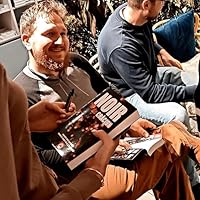
Wow! This is a new favorite book for me. I liked it better than NewJack, which is technically Ted Conover's most "critically acclaimed" book. I guess that might sound odd, since Rolling Nowhere was Conover's first book that he published when he was like 24, still very much a newbie. He even criticizes his younger self in the forward to the new edition 20 years later, using the word "callow" (a new vocab word for me. Conover is big on those) and expressing horror at how "candid" he was back then. I guess it's tempting for anyone to criticize their younger, less inhibited self. I personally enjoyed his "candor"-- it made his writing feel even more alive-- and I think his "callowness" (you can't see the red squiggly line but apparently "callowness" isn't a word) resulted in a work of unrestrained brilliance.
To think that I almost skipped Rolling Nowhere after I saw others online criticize it! There's a reddit post on r/vagabond (there's a reddit group for literally everything, isn't there?) for modern-day, apparently *very* self-aware hoboes with Wi-Fi connections (it's... pretty hard to imagine the hard-drinking, hard-living guys Conover spent time with having the time to do this, but I'll take the Reddit hoboes' word for it) devoted to trashing the book and its author. I can't help thinking of the way the subjects of the highly regarded LGBT documentary "Paris is Burning" reacted negatively after their documentary premiered. I have wondered for years if they were legitimately misrepresented (I thought the documentary was quite sympathetic, and the subjects were downright iconic) or if human beings are just naturally sensitive to seeing ourselves through someone else's eyes-- kind of like the way we cringe when we hear recordings of our own voice.
Anyway, about Rolling Nowhere: Conover's books aren't super dramatic or action-packed (at least not the two I've read so far), but why would they be? They are real-life portraits of real people whose stories (even the dull, every day parts) sometimes reveal profound things about the human experience. It's actually astounding what a great eye Conover had for these details at such a young age. I'm still processing what I've read, but I'll share some moments/observations that stood out to me:
- Early into his experience living as a railroad tramp, Conover befriend a hobo named Lenny ("tramp" and "hobo" were the common parlance at the time). Famished, they searched a nearby dumpster and found a bag of old potatoes, an onion and a few apples. They returned to their campsite, found a large can to boil water in over a fire and Conover managed to "borrow" salt by knocking on the door of a random house. At this point in his adventure, Conover was still pretty squeamish about eating dumpster food, but that day he learned an important life lesson. In his words: "thinking back on the simplicity of its ingredients and the crude preparation, the stew doesn't sound very tasty at all-- but that morning, in the cool of the hobo tree, enjoying the company of a friendly, professional urban camper and ravenous, it was delicious. We scraped the can clean."
- A common but sometimes degrading experience for railroad tramps was relying on churches and rescue missions, where they were often forced to participate in worship services, treated like pests and even overtly berated (in one passage, by a recovering-alcoholic-turned-preacher who, if I had to guess, still hadn't forgiven *himself* yet). But one of the missions, ran by monks, stood out to me. The monks assured the hoboes "we're not interested in converting you. If you become interested in our way, that's terrific, but we're not pushing anything down your throats." I jotted my thoughts down next to this paragraph: "soft recruitment? Suffering can lead to enlightenment/interest in spirituality" down the line. Perhaps the monks had a wiser approach and a more genuine interest in reaching people than the other missions?
- Later while hitchhiking, Conover was picked up by a wealthy couple in a luxurious van (I didn't know anyone made luxury vans, but then again the book was published in 1980, and the early 80s were just the 70s still clinging on for dear life.) He was disturbed to realize the two were drunk. Here's what he wrote about the experience: "... the poor operated under misconceptions of the rich as well... the idea that wealthier classes were somehow 'better' classes, filled with a finer grade of people. The evidence to the contrary was seated five feet in front of me. Though the driver of the van had been wealthy enough to surround himself in mobile luxury, he was endangering the lives of innocent people, including me.... Were hoboes better people for not having the opportunity to do such harm? Probably not, but they certainly were no worse."
- That said, he doesn't present the hoboes as perfect, noble, suffering heroes (which would arguably be just as insulting as defining them by the worst traits of their group). He presents them as they are-- just as morally gray as everyone else. It really struck me how transactional and fleeting a lot of friendships among hoboes were: he befriended two hoboes, one much older and in bad shape. Eventually he realized their friendship wasn't based in mutual affection, but rather that the old guy needed someone to help him around and the younger guy needed resources. There seemed to be a general fear of getting close to others among most hoboes which, to be fair, often stemmed from their own traumas. But manipulative tendencies are also common, and tensions frequently turned into drunken fist fights: towards the end of the book, Conover stops in to visit some college buddies and one of his friends, Doug, volunteers to tag along and a live as a hobo with Conover. From a story-telling perspective, this was a brilliant move for the book. Doug is a mirror of the naive idealist Conover had been at the start of the book, believing that if he presented his kindest, most genuine self the hoboes would feel comfortable doing the same. The now wiser Conover tried to help him see reality: a lot of these guys would stab you in the back in a heartbeat.
-By the end, Conover was quite disillusioned- he'd had enough and was set on convincing himself he wasn't like the other hobos. "Duh," I thought. "You're a pampered college kid from the suburbs pretending to be a hobo for your anthropology class. You can go home at any time!" But then I thought about it more and I realized where he was coming from. Having experienced my own degradation in life, my own rock bottom, there is an endpoint some of us reach. We realize "this isn't really who I am. I'm better than this," and we find a way to move on.
There's a ton more that I noticed and loved in this book, but my fingers hurt from typing 😂 If I think of something else important I will add more!