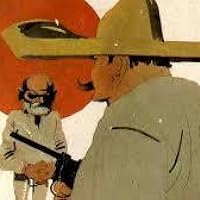
Convinced of Oliver's innocence, Simon Barnett investigates his brother's murder, which was carefully designed to make its victim appear to be a blackmailer
One star off for the slightly misleading blurb on the front cover of my edition - ‘Judged Best Detective Novel By Agatha Christie’; this, apparently, refers to her picking it ahead of other entries, in a particular writing contest, and is not so all-encompassing as it sounds. Nevertheless, I can certainly understand why Agatha Christie would enjoy this book…great book for fans of Death on the Nile, or Evil Under the Sun, though it’s not quite as brilliant. Or maybe a bit easier to intuit parts of the truth, or where the trail is leading, without actually tracking clues and breaking down tricks pointing at wrong solutions. Still, I got pulled off something I was pretty sure of right near the end, instead of sticking with my gut, and so kudos to the way the finale was handled.
Fun murder mystery by an author who was quite successful during his life time, but has been sadly forgotten since. Agatha Christie considered My Brother's Killer to be the best crime mystery of the 20th century.
I personally enjoyed it and look forward to reading more of Devine.
Another first person narrative, another dictaphone confusing the time of death and upsetting a lot of careful alibis. But there are no other similarities with a famous GA novel which shall not be named! We have a master criminal under an assumed name, a carefully planned murder to cover up another crime and a clumsy murder to offer a conveniently dead scapegoat to the police.
The amateur sleuth is the brother of the first victim, a solicitor who sees that the police are on the wrong track and decides to investigate himself. The plotting is excellent as his discoveries all lead logically from one relevant fact to the next, and gradually, after a slight detour, he arrives at the only conclusion. The reader is offered all the relevant clues but even as the net tightens around the criminal, the denouement still manages to spring a surprise.
This novel is very well written with clear and credible motivations for all the characters. A satisfying read and an author I will seek out again.
This started off well--an intriguing puzzle with interesting characters, and well-written--but it gradually became too complex for my tastes. I had trouble keeping characters straight. The culprit was not such a surprise, and the clues were laid well, but the beginning raised hopes that the resolution didn't satisfy.
I just finished this thight little mystery by D. M. Devine; and divine it was. Let me begin by saying Devine was Agatha Christie's favorite author, and I can see why.
As you can guess by the title it is told in the first person by Simon, the brother of the dead Oliver Barnett, both of whom are Solicitors in their well known family firm. Oliver has been murdered in such a way as to be made to look like a suicide. Both Simon and the Superintendent in charge of the investigation come to the speedy conclusion it was murder.
Simon feels compelled to discover the murderer and therein lies the story, full of twists, turns, and misdirection. With the help of two trusted members of the firm he goes about unpeeling the mystery like layers of an onion, and there are so many layers.
Much to Simon's dismay there is an ever growing number of suspects who might have wanted Oliver dead, including himself. Oliver was a blackmailer, a cad, and a roue of the first order. When the killer is finally revealed it is a shock and an entire surprise.
Let me say a few things about the construction of the novel. In most crime novels the reason for a lay person to investigate is the that the police are total incompetents or the character is under suspicion. That is not the case in this one.
Superintendent Garland, the lead detective, though not much talked about, is every bit as clever as Simon but we don't know about it except in small bits that Simon reveals. He does take center stage at the big reveal in the last chapter. I am not going to say more because I want you all to read this without any notion of who the murderer might be.
The book is a mere 255 pages, easy to read and tight as a drum. There is no need for exaggerated writing; none of the sometimes tedious, overly descriptive language of modern novels which drives me crazy.
Devine wrote 13 crime novels while working as the Secretary and Registrar of the University of St. Andrew's. I haven't seen a list, but I'll do a little research and see if others are in print and available. My Scots friends might be able to help me out on this quest.
If you like a tight plot, with plenty of twists and turns you'll love this. Why it was never made into a movie I'll never know except that Hollywood is full of blithering idiots.
I picked this up, as I do so many other mysteries, on the recommendation of Wendell Hertig Taylor and Jacques Barzun in their superb Catalog of Crime, and agree with their estimation of it is "a truly splendid piece of plotting and reading." I was riveted by narrative's brisk pacing and the ingenious unfolding of the solution by the brother of the victim. It narrowly missed five starts because the characters, while not one-dimensional, fall short of the believability of thoroughly imagined people (as inhabit, for instance, Agatha Christie's The Hollow . . . or War and Peace).
A really complex chain of evidence and discoveries. Characters are developed enough to take an interest in them, but not become endeared.
The protagonist's brother is shot at his desk. There is evidence that the dead brother was blackmailing a few people. The brother and the police sort it out eventually. The solution is plausible enough to be satisfying but the trail is so tedious by the end that I was tired of it all.
I'll keep D. M. Devine in mind as a good writer, but I didn't think this book was entertaining enough to motivate me search out another by him right away.
So lame. Very flat and unbelievable writing. Agatha Christies favorite detective novel? Nah. Go pick up anyone of Simenon's books and steer clear of Devine.
I only picked this book because there was "Judged best detective novel by Agatha Christie" on the cover. Turned out this first book by DM Devine was actually nominated by Christie as winner of the Don's Detective Novel Competition held by Collins Crime Club in 1961. So that was pretty misleading in my opinion.
Regardless, the book did deliver, I found myself liking it more than I thought I would. That being said though, there was a part that I enjoyed less than I'd prefer, but only because of my personal bias.
I liked how the protagonist kept having all sorts of theories, and didn't get it all right on the first try (him being an amateur, after all). But Scotland Yard was as good as not being there. I enjoy Christie's because the police actually help Poirot, Marple and others in some way, even though they're obviously not as efficient and smart as the sleuths. So for this one, I don't really know why they were even in the picture...
Overall, I'd recommend this to anyone who likes mystery novels and would like to try "classics". Just bear in mind that the situation occurred way back in the day, which means, a lot of the technology mentioned were ones relevant back then.
Another "Bas Bleu" purchase, this classic mystery was originally published in 1961 and was judged "Best Detective Novel" by Agatha Christie. The publisher, Arcturus Publishing Limited, call Devine "a hugely underrated and unjustly neglected writer.." Oliver Barnett is found murdered in his office by his brother Simon. During the course of the investigation, Simon finds that Oliver was not the man he thought he knew. I enjoyed this book; I kept wondering if Simon was an untrustworthy narrator. Good book, good characters; I'll look for more by Devine.
I bought this book mostly because I was intrigued by the fact that it was “judged best detective novel by Agatha Christie.” I really enjoy Christie’s mysteries so I was eager to see what she considered good.
The story starts when Simon stumbles across his brother, Oliver’s, body in his office. You might think this makes Simon the main suspect, and it briefly does, but things soon move towards an old friend of Simon’s, one that he’s sure is not the killer. And so he tries to discover who his brother’s killer is.
As expected, this was an interesting read. The detective and narrator is Simon, and so Devine gets around the problem of having the solution be revealed too early by… just not telling us the details. All we know, at the climactic moment, is that there is one theory that when tested against the facts stands up to scrutiny and thus leads Simon to the murderer.
While the plot was interesting, I thought the main weakness of the book was its characters. I didn’t dislike any of them, but I didn’t like them either. Simon was a puzzle – he didn’t come across as particularly charming but at least two women are in love with him. His relationship with his ex-wife, Linda, was a bit odd as well; Simon spoke of being able to mentor his wife in everything, even her hair, makeup and style. Essentially, he turned her from a complete daddy���s girl into the perfect wife, and even though he told her not to put him up on a pedestal, the fact that he didn’t stop her makes it seem rather creepy.
As for the rest of the characters, they weren’t particularly memorable. I think in general, the women made more of an impression on me, but I think that’s also because Simon talked about them more. Well actually, I think the story revolves around the women more, actually. There was one man – a young lawyer named Kelly – who assisted Simon in his investigations but I never really felt his character come to life and I didn’t think he played a very significant role in the story.
Overall, this was an interesting read. I don’t think it’s so good that I understand why Christie liked it best, but it’s a good example of a Golden Age Mystery that takes place in a small town. I may not deliberately seek out more of Devine’s fiction, but I would borrow more if I saw it.
Simon Barnett, a solicitor, is shocked to find his brother Oliver has been murdered. Not satisfied with the police’s enquiries, he sets out to find the identity of the murderer himself. I thought this a moderately good mystery, I did not at first guess whodunnit, though after certain information is revealed by one of the characters, I did. The cover of the book states ‘judged best detective novel by Agatha Christie.’ I find this surprising as I thought it only mediocre myself. The mystery is okay, but the characters not particularly well developed,you don’t get to know many of the suspects very well. Why did Agatha Christie think it was the best detective novel? That is a bigger mystery than the one in this book.
A nicely plotted book, with plenty of turns. Could easily envision this as a movie. I liked that all loose threads were tied up neatly at the end. Would definitely be interested in reading another of his works.
Well-written mystery, lots of moving parts, keeps you engaged. I figured out whodunnit early on, but even so it was a good read. Interesting characters, twisty plot. Set in 1960s England.
An intriguing and clever murder mystery....fans of Agatha Christie will enjoy this....and people who enjoy the golden age of crime....I really enjoyed it ...a great read...
One of the best crime and detective stories I had read; simple enough for those who are not using English as the mother tongue but excellent plot and writings to let the story go. I am going to start his next one soon, His Appointed Day, and will come back for more comments shortly