

What do you think?

The U.S. Navy's On-the-Roof Gang #1
Prelude to War
The Us Navy's on-the-Roof Volume I - Prelude to War is an historical novel based on the unknown true-life story of the On-The-Roof Gang, the U.S. Navy's fledgling radio intelligence organization in the years leading up to World War II. It is based on the real life of Harry Kidder, a U.S. Navy radioman who first discovered and deciphered Japanese katakana telegraphic code while stationed in the Philippines in the 1920s, discovering the he was listening to Imperial Japanese Navy (IJN) radio communications. Kidder strongly believed in the future of radio intelligence and a chance meeting with Lieutenant Laurance Safford led to the birth of the Navy's Radio Intelligence community. Kidder taught others the nascent art of intercepting IJN communications on the roof of the Main Navy Building in Washington, DC. From 1928 to 1941, 176 Sailors and Marines attended this training and were then stationed as radio intercept operators around the Pacific. These men would become known as the On-The-Roof Gang and were charged with keeping track of the IJN as they prepared for war with the United States. The circumstances of America's entry into World War II hinged on success or failure of the On-The-Roof Gang, and Harry Kidder knew this. On-the-Roof Prelude to War concludes with the date which will live in infamy, December 7, 1941.
449 pages, Kindle Edition
First published August 10, 2020
Ratings & Reviews
Friends & Following
Create a free account to discover what your friends think of this book!
Community Reviews
Displaying 1 - 28 of 28 reviews

April 14, 2022
Dull history lessons turned into an entertaining and educating narrative.
Unraveling the unknown pages of history, 'Prelude to War: The U.S. Navy's On-the-Roof Gang, volume 1' by Matt Zullo chronicles the start, development, and use of the American naval cryptology/radio intelligence before the Japanese attack on America.
What eventually became the Information Warfare Department started from enthusiasts-radiomen who began to copy unintelligible messages different from the international Morse code. In 1941, it was already a coordinated network of intercept stations and stations with High Frequency Direction Finding equipment, covering the Pacific and partly the Atlantic: Guam, Hawaii, Samoa, Shanghai, Aleutian Islands, and Greenland, to name a few. The stations' personnel was trained radiomen - the On-the-Roof Gang - copying katakana telegraphic code (the code of the Imperial Japanese Navy) and diplomatic codes.
Experienced U.S. Navy Master Chief Petty Officer, the author has dedicated much time and effort to documenting the On-the-Roof Gang history. The author puts together personal stories of radiomen trained in the classroom on the roof of the Main Navy Building (Washington, DC) in the reader-friendly, comprehensive book. The book serves as a guide through the development of American radio intelligence as well as commemorates brave men and women of the Naval's cryptologic community whose tireless work is mainly unknown to the broad public.
'Prelude to War' is meticulous research based on the firsthand accounts of radiomen and their family members. Unlike most historical fiction novels, where the authors have to use fantastical elements to make the text more engaging, the book bends toward pure history. With ingrained several lyrical moments, 'Prelude to War' still demonstrates a more detached (though no less appealing) approach to the material. As the On-the-Roof Gang rows grow, it gets harder to follow all the characters thoroughly. However, the author masterfully balances the description of activities in different locations, bringing back characters one by one without forgetting to frame the bigger picture.
I recommend the duology (the second book focusing on WWII) as a charming narrative and in-depth study of radio intelligence.
I received an advance review copy, and I am leaving this review voluntarily.
Unraveling the unknown pages of history, 'Prelude to War: The U.S. Navy's On-the-Roof Gang, volume 1' by Matt Zullo chronicles the start, development, and use of the American naval cryptology/radio intelligence before the Japanese attack on America.
What eventually became the Information Warfare Department started from enthusiasts-radiomen who began to copy unintelligible messages different from the international Morse code. In 1941, it was already a coordinated network of intercept stations and stations with High Frequency Direction Finding equipment, covering the Pacific and partly the Atlantic: Guam, Hawaii, Samoa, Shanghai, Aleutian Islands, and Greenland, to name a few. The stations' personnel was trained radiomen - the On-the-Roof Gang - copying katakana telegraphic code (the code of the Imperial Japanese Navy) and diplomatic codes.
Experienced U.S. Navy Master Chief Petty Officer, the author has dedicated much time and effort to documenting the On-the-Roof Gang history. The author puts together personal stories of radiomen trained in the classroom on the roof of the Main Navy Building (Washington, DC) in the reader-friendly, comprehensive book. The book serves as a guide through the development of American radio intelligence as well as commemorates brave men and women of the Naval's cryptologic community whose tireless work is mainly unknown to the broad public.
'Prelude to War' is meticulous research based on the firsthand accounts of radiomen and their family members. Unlike most historical fiction novels, where the authors have to use fantastical elements to make the text more engaging, the book bends toward pure history. With ingrained several lyrical moments, 'Prelude to War' still demonstrates a more detached (though no less appealing) approach to the material. As the On-the-Roof Gang rows grow, it gets harder to follow all the characters thoroughly. However, the author masterfully balances the description of activities in different locations, bringing back characters one by one without forgetting to frame the bigger picture.
I recommend the duology (the second book focusing on WWII) as a charming narrative and in-depth study of radio intelligence.
I received an advance review copy, and I am leaving this review voluntarily.

June 30, 2020
I was fortunate to receive an advance copy of this book from the author. On-the-Roof Gang Prelude to War tells the full story for the first time of the U.S. Navy's efforts to intercept and decipher Japanese Imperial Navy communications in the decades before WWII. An almost happenstance effort grew out of one man's passion for radio communications and another's forward-thinking belief that knowing the enemy's plans was the best way to defeat them. This story, carefully pieced from historical records and interviews with the men who lived it, is a must-read for anyone who wants to learn the real story behind the Pacific front in WWII and the birth of naval communications intelligence. It's entertaining, enlightening, and gives a voice to the enlisted sailors who paved the way for the U.S. Navy's success in WWII.

August 11, 2020
A fascinating look at the beginnings of the U.S. Navy’s radio intercept and cryptological program, and the men that made it happen.
The U.S. Navy’s On-the-Roof Gang: Volume One – Prelude to War, is the fictionalized account of the creation and development of naval radio intercept and cryptoanalysis beginning soon after the close of World War I up until the attack on Pearl Harbor. It is an awesomely told story of the actual people, places, and events; the fiction is the recreated dialogue.
The story begins in 1921 with a break-in at the Japanese embassy in New York City and the copying of secret diplomatic documents in an effort to find out what the Imperial Japanese Navy is building up toward in the Pacific. They had already instigated aggressive actions against Chinese on the China mainland, and this was of grave concern to the U.S. The FBI and agents of the U.S. Navy had been able to retrieve the code to decrypt Japanese radio transmissions in this fashion.Meanwhile, navy radiomen had been picking up radio traffic from unknown sources that did not adhere to International Morse Code. Skilled operators, such as Petty Officer Harry Kidder stationed in the Philippines, were able to copy the “dits” and “dahs” from these unknown sources in between monitoring scheduled navy transmissions. Eventually, these reports and Kidder ended up in Washington, DC, as part of the Navy’s Code and Signal Section – “the Research Desk.”
Recognizing how critical the ability to listen in on the Japanese would be in the war that many felt was brewing, the Navy created a training facility on the roof of the Main Navy Building in the nation’s capital. Led by new instructor now-Chief Harry Kidder, eight Navy and Marine radiomen at a time were put through the school to learn to intercept the katakana code from the Japanese.This new book by Matt Zullo was a fascinating and well-told story. The characters and events absolutely came alive – no dry-as-dust history lesson here. He skillfully wove together history with anecdotal recollections from the people that lived it and created an engaging and immersive reading experience. In fact, I was immediately ready to jump into the rest of the story in Volume Two!
I found it exciting seeing the creation of this secret, new unit with the mission of intercepting and analyzing the contents of the Japanese messages. I was amazed at the feat these guys accomplished just in being able to copy, report, and then convert to usable information the code they heard over great distances and under pretty rough conditions (both physically and atmospherically.) They were taking the ‘dits and dahs’ of encrypted Japanese and eventually translating it into English. Their personal stories made me feel a real connection to these men. I wanted them to succeed, and they did. But some of the things that happened along the way to a couple of them were heartbreaking.I felt the frustration of these men as they struggled to gain support from those in Washington, DC and, sometimes, even at the various places they had established listening stations. I was shocked when Henry Stimson, Secretary of State under President Hoover, shut down the joint code-breaking operation of the U.S. Army and the State Department (leaving only the Navy’s group to carry on) saying “Gentlemen do not read each other’s mail.”
One thing that made the events and history so much more interesting to me were the details that kept anchoring this story to what the world was like during this time. For example, at this time (the 1920s and 30s), telephones were not in every home or office. Households were still using gaslights as not everyone had been able to afford the transition to electric lights as yet. Aircraft carriers were relatively new ships in the fleet. And Hawaii was a territory, not yet a state.I appreciated the look inside day-to-day naval operations as well. The author provides a helpful key to abbreviations at the end of the book, but there were also little tidbits of information regarding rank, duties, and duty stations worked into the story, too. I learned that there is a universal compartment-marking scheme, a letter-number designation which will tell you where a particular location is on board ship. Also, a major stumbling block to getting candidates for the intercept school and position had to do with the promotion process. Many of the radiomen did not want to train to intercept the Japanese katakana because it would degrade their abilities and speeds in Morse Code, which was a significant factor in getting promoted. And then, as I progressed through the book, I realized what a logistical nightmare and considerations involved in setting up new intercept or direction-finding stations all around the world could be.
I highly recommend this book to readers of non-fiction, historical fiction, World War II buffs, and ham radio enthusiasts. It was engaging, easy-to-read, and totally engrossing. I loved it!I voluntarily reviewed this after receiving a free copy.

June 30, 2020
This book was an amazing tale of a little-known part of Navy Intelligence. As a former military "ditty bopper" myself, I identified with Zullo's description of the training of these men in specialized Morse Code. In fact, these men were the only members of the military intelligence able to copy code in Japanese.
I had the privilege of reading an advanced copy of this book and it inspired many other books I've read this summer. This book does more than just set the stage for Zullo's second book, which sees the On-the-Roof Gang contributing to the war effort. Volume I establishes a generation of unsung heroes whose accomplishments stand on par with Rochefort and Turing in terms of their contributions to pre-war intelligence. Zullo takes us into their lives--their successes and their failures with an unbiased eye and casts a new light on these members of the greatest generation.
I highly recommend this book.
I had the privilege of reading an advanced copy of this book and it inspired many other books I've read this summer. This book does more than just set the stage for Zullo's second book, which sees the On-the-Roof Gang contributing to the war effort. Volume I establishes a generation of unsung heroes whose accomplishments stand on par with Rochefort and Turing in terms of their contributions to pre-war intelligence. Zullo takes us into their lives--their successes and their failures with an unbiased eye and casts a new light on these members of the greatest generation.
I highly recommend this book.
July 26, 2020
While I knew bits-and-pieces of this history, having it come alive in one narrative was exhilarating and highly effective. Matt’s gifted ability to bring this story to life is unmistakeable. I exited with a greater appreciation for what it took to put the ‘spark’ into the Cryptologic Technician crow that I wore for so many years - the spark that still adorned my Dress Blues even after I donned the anchors. I most highly recommend this book to history-, Navy-, military-, and story-lovers alike. Not just five stars but, FIVE ANCHORS. (Howie L’Heureux, CTICS-Retired)
September 24, 2020
Such a good read. Really brings the OTRG to life pulls you into the story and the time.
July 8, 2020
I was immediately captivated from page one while reading an advance copy of Matt Zullo's "On-the-Roof-Gang-Prelude to War" and the account of how U.S. Naval intelligence was captured and deciphered from the 1920's to the 1940's. Chief Harry Kidder had a real passion and natural ability for radio communications and Kidder, as well as an enlisted group of naval and marine radiomen were brought to life with historical facts and personal stories showing how the government's early intelligence gathering system came into being. I have immense gratitude for our military personnel who keep our country safe, and reading the 'behind the scenes' history of the individuals who decoded the Japanese katakana show the dedication, tireless work ethic, and patriotic spirit of these early cryptologists and instructors. This is a truly fascinating, detailed timeline of events that is easy to follow and hard to put down.
September 7, 2020
An intel thriller
This book is a deep dive into the critical SIGINT prior to the Day of Infamy. It’s interesting to history buffs, but too wonky for the average reader.
This book is a deep dive into the critical SIGINT prior to the Day of Infamy. It’s interesting to history buffs, but too wonky for the average reader.
Read
August 30, 2020Ditty dit dah, ditty dit dah, ditty dit dah -- dah dah dit dah- V V V CQ - calling all ditty bops 292.. - you know who you are. This is your "Book of Genesis" the beginnings of Radio Intercept. But not just for you Morse Code people. Matt Zullo has given us a snapshot of life in our country that little resembles our lives today. What was it like to live in the USA between the wars? Read all about it here. I can't wait for Volume 2.
December 31, 2020
Matt Zullo’s debut novel “The US Navy’s on the roof gang” is an intriguing tale of cryptologists and radiomen and their efforts to break the codes intercepted from the Imperial Japanese Navy. The novel starts with a break-in attempt by ONI(office of naval intelligence) officer Russel Ford in Japanese consulate.Then the story shifts to a petty naval officer stationed in the Philippines who starts receiving suspicious codes from IJN(Imperial japanese navy). The US Navy’s main motive was to keep a tab on Japan’s aggressive actions against China.Quickly understanding the need for listening to Japanese communications that would be useful in the war, the navy created a new facility on the roof of the main Navy building in Washington DC.The motive was to intercept the katakana code from the Imperial Japanese navy.
While work has been written about on the roof gang before, the author have made a great attempt to provide an elaborate insights in the life of these forerunners of US Navy’s cryptology and cryptanalysis.The story is carefully arranged from historical records with some liberty from author to fictionalize the events. I found the story fascinating and the author has done a wonderful job to keep the story and characters interesting. The author tries to provide an accurate depiction of life in the time around 1920.The struggles faced by the radiomen when means of technology were limited is narrated beautifully. Author’s attempt to immortalise some of the unknown people in history is truly commendable.
I will highly recommend this book if you are a fan of non-fiction , history(especially around World war 2).The author has kept the language simple enough for the amateur readers to understand . Yet the story is engaging and the novel is an absolute page turner.
I voluntarily reviewed this book after receiving a free copy from the author.
While work has been written about on the roof gang before, the author have made a great attempt to provide an elaborate insights in the life of these forerunners of US Navy’s cryptology and cryptanalysis.The story is carefully arranged from historical records with some liberty from author to fictionalize the events. I found the story fascinating and the author has done a wonderful job to keep the story and characters interesting. The author tries to provide an accurate depiction of life in the time around 1920.The struggles faced by the radiomen when means of technology were limited is narrated beautifully. Author’s attempt to immortalise some of the unknown people in history is truly commendable.
I will highly recommend this book if you are a fan of non-fiction , history(especially around World war 2).The author has kept the language simple enough for the amateur readers to understand . Yet the story is engaging and the novel is an absolute page turner.
I voluntarily reviewed this book after receiving a free copy from the author.
September 23, 2020
I'm a 30-year veteran of the Navy cryptologic community and as a result, I've been exposed to bits and pieces about the On the Roof Gang (OTRG), a few somewhat famous names (e.g. Rochefort) as well as a few significant successes of our community (e.g. Battle of Midway). What I loved about this book is that it put together many of those pieces into a coherent history of the development of the Navy's COMINT analysis discipline and the larger "radio intelligence" discipline. The OTRG has always kind of been just a bunch of names that, although not called it at the time, are considered the original Cryptologic Technicians. Zullo does a fabulous job of using the OTRG as more than just names, but as the foundation of a fledgling capability that grew into a key fighting capability of WWII and every war since. I admit that I expected it to read a bit like a typical history book, but I was pleasantly surprised to find an incredibly interesting book that weaves the OTRG into a story rather than just historical facts. It was a quick read because it was a fun read.
One of the big take aways for me from the book is that the name Kidder should be remembered forever. His impact was immense, and it was only due to his personal interest and initiative that the Research Desk grew into the organization that it would later become. It's a reminder that individuals CAN make an impact that could change the world, even if it takes 80-100 years for the world to realize it. I hope this book reinvigorates a focus on the history and heritage of our community, and specifically the OTRG. At the same time, I hope it encourages leaders in our community to value the natural inquisitiveness and ingenuity of Sailors and to provide space for them to solve our toughest problems.
One of the big take aways for me from the book is that the name Kidder should be remembered forever. His impact was immense, and it was only due to his personal interest and initiative that the Research Desk grew into the organization that it would later become. It's a reminder that individuals CAN make an impact that could change the world, even if it takes 80-100 years for the world to realize it. I hope this book reinvigorates a focus on the history and heritage of our community, and specifically the OTRG. At the same time, I hope it encourages leaders in our community to value the natural inquisitiveness and ingenuity of Sailors and to provide space for them to solve our toughest problems.
August 11, 2020
Fabulous read! You can tell by the wording and prose of the text Master Chief's experience and passion for this community. The chapters are broken down making you desire to read another even when you know you shouldn't.
Can't wait for part 2!
Can't wait for part 2!

September 5, 2020
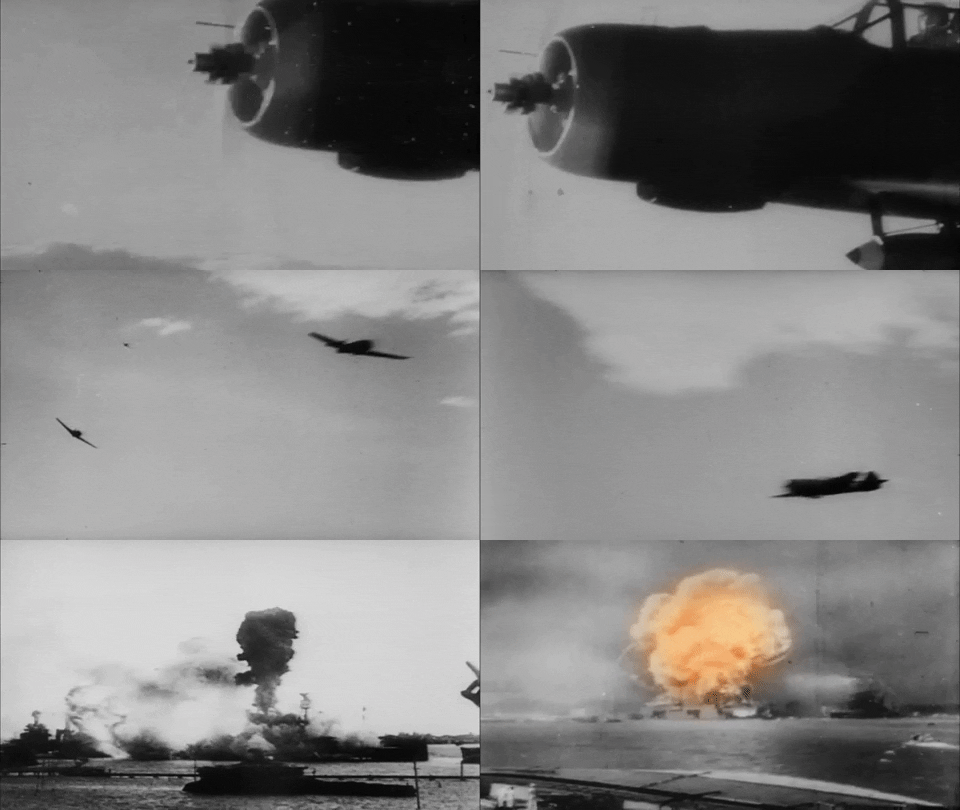
On The Roof Gang is historical fiction based around real events and real characters. It’s about the U.S. naval men who were trained to work in radio listening posts across the Pacific in the prelude to World War Two and specifically the run-up to the Japanese/American declaration of war and the bombing of Pearl Harbor.
The premise of this story reminded me of films I had enjoyed set in this era, as well as the codes and coding element that links to my fascination with espionage. I was interested in how the men were trained to decipher the Japanese messages and transpose them, while the problems associated with setting up of listening posts where local radio signals hampered the listeners was an issue that I had never considered.
Matt Zullo is a retired U.S. Navy Master Chief Petty Officer who has more than 35 years' experience in Radio Intelligence. According to his Amazon author bio, he is one of only a few quantifiable experts on the subject of the On-The-Roof-Gang. Matt’s naval knowledge shines through in this book
and I can see its appeal to fellow naval enthusiasts; however, I do think that to reach a wider audience the story needs more work to make it an entertaining piece of fictional writing. In its current format it reminds me of a naval report and all the many names and ranks just went over my head. For me there were too many mundane navy related details, but not enough memorable story parts set in the listening posts. What I also missed was any empathy and engagement with the characters, which I need to make a piece of fiction a delight to read. So overall, the story was great on the facts but the method of delivery, for fiction, needed more
work.
The premise of this story reminded me of films I had enjoyed set in this era, as well as the codes and coding element that links to my fascination with espionage. I was interested in how the men were trained to decipher the Japanese messages and transpose them, while the problems associated with setting up of listening posts where local radio signals hampered the listeners was an issue that I had never considered.
Matt Zullo is a retired U.S. Navy Master Chief Petty Officer who has more than 35 years' experience in Radio Intelligence. According to his Amazon author bio, he is one of only a few quantifiable experts on the subject of the On-The-Roof-Gang. Matt’s naval knowledge shines through in this book
and I can see its appeal to fellow naval enthusiasts; however, I do think that to reach a wider audience the story needs more work to make it an entertaining piece of fictional writing. In its current format it reminds me of a naval report and all the many names and ranks just went over my head. For me there were too many mundane navy related details, but not enough memorable story parts set in the listening posts. What I also missed was any empathy and engagement with the characters, which I need to make a piece of fiction a delight to read. So overall, the story was great on the facts but the method of delivery, for fiction, needed more
work.October 29, 2020
Bravo Zulu Shipmate!
What an incredible read! Matt Zullo has turned this important history into a story that anyone can read and appreciate. The amount of fact and historical knowledge is simply incredible! I cannot fathom the amount of research that went into thus project and Matt relays the information in such and entertaining way to keep your attention. A definite page turner.
What an incredible read! Matt Zullo has turned this important history into a story that anyone can read and appreciate. The amount of fact and historical knowledge is simply incredible! I cannot fathom the amount of research that went into thus project and Matt relays the information in such and entertaining way to keep your attention. A definite page turner.

July 12, 2022
What a great book! Zullo tells a wonderful story that is engaging and easy to read. I could not put this one down

October 7, 2020
An amazing story!
This account of the US Navy’s growth of the fledgling radio intelligence service provides a detailed personnel perspective of what would become the world’s premier electronic intelligence organization. Because of these visionary pioneers, the US was positioned to exploit Japanese military and diplomatic codes which ensured victory in WWII. Well written and inspiring...this is a great read.
This account of the US Navy’s growth of the fledgling radio intelligence service provides a detailed personnel perspective of what would become the world’s premier electronic intelligence organization. Because of these visionary pioneers, the US was positioned to exploit Japanese military and diplomatic codes which ensured victory in WWII. Well written and inspiring...this is a great read.
September 24, 2020
Fascinating historical account of radio and cryptology leading up to WWII
Anyone who is interested in ham radio, the U S Navy, history and events leading up to the attack on Pearl Harbor will enjoy reading this book. The book is written as a factual account of the development of radio and cryptology after WWI leading up to WWII. The story seemed to end with a mystery of some of the main characters not resolved. Perhaps we will never know, but it would have been nice to find out what happened to some of the sailors involved.
Anyone who is interested in ham radio, the U S Navy, history and events leading up to the attack on Pearl Harbor will enjoy reading this book. The book is written as a factual account of the development of radio and cryptology after WWI leading up to WWII. The story seemed to end with a mystery of some of the main characters not resolved. Perhaps we will never know, but it would have been nice to find out what happened to some of the sailors involved.
September 25, 2020
Well written
Book is interesting and very well written. Definitely recommend for non fiction history buffs. Easy read. Too bad more iimportance wasnt placed on their work.
Book is interesting and very well written. Definitely recommend for non fiction history buffs. Easy read. Too bad more iimportance wasnt placed on their work.

Read
April 19, 2023MWSA Review
The US Navy's On-the-Roof Gang: Prelude to War is the first of a two-volume set that recounts the birth, development, and wartime service of the US Navy's radio intelligence community. The author is a retired Navy master chief cryptologic technician who wisely chose to write this narrative using the "creative nonfiction" style, supplying dialog and descriptive details that bring life to the historical facts, pulling the reader into the account.
The critical role of radio intercept and decryption in both theaters of World War II may be generally known but is not universally understood to any real depth. Recent popular film and television have highlighted the exploits of Alan Turing and the Bletchley analysts in breaking the German Enigma codes. The equally important (and arguably more impactful) achievements by the US Navy in breaking and exploiting the Imperial Japanese Navy codes in the Pacific theater have received relatively little media attention. The On-the-Roof Gang set goes a long way toward correcting that deficiency.
The Volume One story line begins in the early 1920s and follows a real-life Navy radioman whose curiosity leads him to begin eavesdropping on the routine transmissions of the Imperial Japanese Navy. An amateur HAM radio operator, he understands the potential for radio intercept intelligence and lays out the foundation for interpreting the Japanese katakana broadcasts. The account moves through the next two decades as radio intercept and decoding gain a foothold within the Navy’s radio communications establishment.
By 1928 the highest levels of US Navy leadership had recognized the value of intercepting katakana radio traffic. The first training class for fleet radio specialists was convened in Washington, DC, in a makeshift classroom constructed on the roof of the main Navy building on Constitution Avenue. Over the following twelve years, two hundred Navy radiomen were trained in the Japanese codes and in operating the specialized equipment used for intercepting and recording their Navy transmissions. By the outbreak of the war on the Day of Infamy, the US Navy had deployed a set of intercept stations across the Pacific, manned by skilled operators capable of listening in on the Imperial Japanese Navy.
The depth of research and meticulous level of detail in these volumes makes them much more than just creative nonfiction accounts. The author has created a definitive chronicle of the development of the US Navy's radio intelligence capabilities as the world moved inexorably toward war. The result is an engaging, character-based narrative that leaves the reader eager to find out how their stories will play out against the backdrop of the war in the Pacific.
This is well worth reading for anyone interested in military technology advances between the World Wars, and specifically the birth and growth of the US Navy’s radio intelligence abilities in the years leading up to World War II.
Review by Peter Young (April 2023)
The US Navy's On-the-Roof Gang: Prelude to War is the first of a two-volume set that recounts the birth, development, and wartime service of the US Navy's radio intelligence community. The author is a retired Navy master chief cryptologic technician who wisely chose to write this narrative using the "creative nonfiction" style, supplying dialog and descriptive details that bring life to the historical facts, pulling the reader into the account.
The critical role of radio intercept and decryption in both theaters of World War II may be generally known but is not universally understood to any real depth. Recent popular film and television have highlighted the exploits of Alan Turing and the Bletchley analysts in breaking the German Enigma codes. The equally important (and arguably more impactful) achievements by the US Navy in breaking and exploiting the Imperial Japanese Navy codes in the Pacific theater have received relatively little media attention. The On-the-Roof Gang set goes a long way toward correcting that deficiency.
The Volume One story line begins in the early 1920s and follows a real-life Navy radioman whose curiosity leads him to begin eavesdropping on the routine transmissions of the Imperial Japanese Navy. An amateur HAM radio operator, he understands the potential for radio intercept intelligence and lays out the foundation for interpreting the Japanese katakana broadcasts. The account moves through the next two decades as radio intercept and decoding gain a foothold within the Navy’s radio communications establishment.
By 1928 the highest levels of US Navy leadership had recognized the value of intercepting katakana radio traffic. The first training class for fleet radio specialists was convened in Washington, DC, in a makeshift classroom constructed on the roof of the main Navy building on Constitution Avenue. Over the following twelve years, two hundred Navy radiomen were trained in the Japanese codes and in operating the specialized equipment used for intercepting and recording their Navy transmissions. By the outbreak of the war on the Day of Infamy, the US Navy had deployed a set of intercept stations across the Pacific, manned by skilled operators capable of listening in on the Imperial Japanese Navy.
The depth of research and meticulous level of detail in these volumes makes them much more than just creative nonfiction accounts. The author has created a definitive chronicle of the development of the US Navy's radio intelligence capabilities as the world moved inexorably toward war. The result is an engaging, character-based narrative that leaves the reader eager to find out how their stories will play out against the backdrop of the war in the Pacific.
This is well worth reading for anyone interested in military technology advances between the World Wars, and specifically the birth and growth of the US Navy’s radio intelligence abilities in the years leading up to World War II.
Review by Peter Young (April 2023)
May 26, 2021
This well-written and well-researched book immerses the reader in the early days of military cryptology from the 1920s to the 1940s. The narrative begins as Navy radioman Harry "Pappy" Kidder discovers Japanese military coded transmissions and helps put them to use for US intelligence. The sheer determination and intelligence of Kidder, and everyone at the at the Research Desk in Washington, DC, are truly inspiring. Under Kidder's training, the Navy's "on-the-roof" classroom prepared dozens of radiomen to intercept coded Japanese messages from stations around the globe.
I thoroughly enjoyed reading Prelude to War, and the old photographs scattered throughout were a pleasure to see. It was fascinating to follow the complex process of intercepting and codebreaking, with all its successes and its setbacks. I also appreciated the insight into the personal lives of Kidder and others. I felt the tension build as the narrative moved ever closer to that infamous day in Hawaii in 1941. At the conclusion of the book, I had a much richer understanding of the many factors and events that led to the United States entering World War II. I give Matt Zullo's Prelude to War five stars for this detailed and immersive narrative about a fascinating and lesser known bit of history.
I thoroughly enjoyed reading Prelude to War, and the old photographs scattered throughout were a pleasure to see. It was fascinating to follow the complex process of intercepting and codebreaking, with all its successes and its setbacks. I also appreciated the insight into the personal lives of Kidder and others. I felt the tension build as the narrative moved ever closer to that infamous day in Hawaii in 1941. At the conclusion of the book, I had a much richer understanding of the many factors and events that led to the United States entering World War II. I give Matt Zullo's Prelude to War five stars for this detailed and immersive narrative about a fascinating and lesser known bit of history.

August 25, 2021
My very first Historical Fiction. very interesting.
Thank you book tasters for recommending this book to me. Thank you to Mr. Matt for giving me the chance to read such an eye-opening book.
First of all the author did great research to write this book, and his writing style added personality and charisma to the story.
It seems that Japan was playing games and trying to entrap the United States and China
This was learned through the translation of some documents obtained during the storming and attack on the Japanese Embassy in New York at the time.
At the same time, the US Navy was eavesdropping on what is known as Morse code and signals emitted from a Japanese submarine, and this is in a way contrary to international laws and also against Moore's International Law.
The story is very interesting, you will imagine the people, the tension, the secrecy and the seriousness all the time, as if you were in a cinema, watching a movie, but it was simulated in your imagination.
Thank you book tasters for recommending this book to me. Thank you to Mr. Matt for giving me the chance to read such an eye-opening book.
First of all the author did great research to write this book, and his writing style added personality and charisma to the story.
It seems that Japan was playing games and trying to entrap the United States and China
This was learned through the translation of some documents obtained during the storming and attack on the Japanese Embassy in New York at the time.
At the same time, the US Navy was eavesdropping on what is known as Morse code and signals emitted from a Japanese submarine, and this is in a way contrary to international laws and also against Moore's International Law.
The story is very interesting, you will imagine the people, the tension, the secrecy and the seriousness all the time, as if you were in a cinema, watching a movie, but it was simulated in your imagination.
September 3, 2021
This book is a tribute to the actual, however unknown history of the formation of the North American Navy’s fledgling radio intelligence during the period of 1920s and 1940s. This first volume had its conclusion in 1941, informing us about “the Pearl Harbor’s” incident.
The author, for developing the novel’s plot, uses the actual life history of Harry Kidder the character who receives the highest respectful tribute. Kidder was a North American radioman who discovered and deciphered the Japanese katakana telegraphic code. He was responsible for training generations of other radiomen creating “On-The-Roof Gang (title of the novel), and consequently a community of North American Navy’s Radio Intelligence around the world. All these men were responsible for preparing and guide the United States’ war forces during World War II, through their intelligence and intercepting messages’ services. What calls my attention is that the author insisted on naming all the new trainees of every group of students that Chief Kidder had form showing his real consideration about the hard work of these men.
However, do not expect Hollywood’s war stories. This book shows us the actual formation of an intelligence department, thus the life of U. S. Navy’s sailors and marines.
The author's work is monumental and very well done. The book has a tone of reports, but the plot has its rhythm.
Have a good reading.
The author, for developing the novel’s plot, uses the actual life history of Harry Kidder the character who receives the highest respectful tribute. Kidder was a North American radioman who discovered and deciphered the Japanese katakana telegraphic code. He was responsible for training generations of other radiomen creating “On-The-Roof Gang (title of the novel), and consequently a community of North American Navy’s Radio Intelligence around the world. All these men were responsible for preparing and guide the United States’ war forces during World War II, through their intelligence and intercepting messages’ services. What calls my attention is that the author insisted on naming all the new trainees of every group of students that Chief Kidder had form showing his real consideration about the hard work of these men.
However, do not expect Hollywood’s war stories. This book shows us the actual formation of an intelligence department, thus the life of U. S. Navy’s sailors and marines.
The author's work is monumental and very well done. The book has a tone of reports, but the plot has its rhythm.
Have a good reading.
February 1, 2021
Best Story Yet of Some of the Greatest Generation
This book I would definitely recommend to all my friends and family. Being a retired Cryppie myself I now see what I did in the Navy made and still makes sense. These all are true American heroes whose individual stories will never be told but collectively this book says it all! Thank you Matt Zullo for telling our story and still preserving our integrity!
This book I would definitely recommend to all my friends and family. Being a retired Cryppie myself I now see what I did in the Navy made and still makes sense. These all are true American heroes whose individual stories will never be told but collectively this book says it all! Thank you Matt Zullo for telling our story and still preserving our integrity!

May 11, 2021
excellent but have to buy volume 2 to get to the good stuff
October 27, 2020
Matt does an amazing job of making a fairly technical story accessible to a wide range of readers. I was hooked from the first mention of ham radio and pre-war radio research and science, and my mom, a (self proclaimed) less technical reader loved it as well. This story seems central to the run-up to the Pacific Theater yet somehow I have never heard this story before. It is amazingly well researched, and the cadence moves you through the story at a very fast pace and I was always wanting more from the next page.
My only critical comment is that the character development is spread across a wide range of personalities where I would have preferred to get to know a handful of characters better. This is entirely understandable though given the scope of the story and Matt's clear desire to pay tribute to each of these early pioneers. As an example, early on I found myself briskly skimming the names of the sailors in each class, wondering at this amount of detail. Though about half-way through it struck me that each of the men (and women) in this book played a critical roll in this story, and this may be, for some of them their only lasting tribute in print. I slowed down, and also re-read some of the earlier lists I had skimmed, and I hope engaged with the author's desire to have their story told.
I am looking forward to Volume II but am hesitant because I don't want this reading experience to be over -
My only critical comment is that the character development is spread across a wide range of personalities where I would have preferred to get to know a handful of characters better. This is entirely understandable though given the scope of the story and Matt's clear desire to pay tribute to each of these early pioneers. As an example, early on I found myself briskly skimming the names of the sailors in each class, wondering at this amount of detail. Though about half-way through it struck me that each of the men (and women) in this book played a critical roll in this story, and this may be, for some of them their only lasting tribute in print. I slowed down, and also re-read some of the earlier lists I had skimmed, and I hope engaged with the author's desire to have their story told.
I am looking forward to Volume II but am hesitant because I don't want this reading experience to be over -

July 28, 2021
This book tells the story of the US Navy's efforts to Decoding codes of the communications of the Imperial Japanese Navy in the decades leading up to World War Two.
How did they do that? By revealing their future plans to be two or three steps ahead of them.
I thank the writer for his efforts and his deep research in the old records to tell the period that the soldiers lived through in such detail.
Those who tell the story are those who lived this experience. So it's very exciting.
It is very important to learn how things were going back then, waiting for the 2nd book.
How did they do that? By revealing their future plans to be two or three steps ahead of them.
I thank the writer for his efforts and his deep research in the old records to tell the period that the soldiers lived through in such detail.
Those who tell the story are those who lived this experience. So it's very exciting.
It is very important to learn how things were going back then, waiting for the 2nd book.
December 23, 2021
Although my college major was in another field, I received a Master's degree in history. One of my favorite authors in that field has been Erik Larson. Larson has written a number of books, but in each, the methodology was to find out what actually happened, in the eyes of the persons who participated, and document, to the best of his ability, the events that contributed to the result. Thus, Larson wrote about a horrific hurricane in early 1900s Galveston, Texas, a murder in a momentous 1900 World's Fair in Chicago, a murder in England that occurred concomitant with the invention of the wireless, the events behind the sinking of the Lusitania, the horror of the rise of Naziism in Germany, and a couple of other books that currently, due to the author, occupy my "must read" list. A book that should occupy your "must read" book is The US Navy's On-The-Roof Gang." The author, Matt Zullo, has matched Erik Larson in documenting, blow by blow, what happened in the runup to WWII. In this case, he reveals that the US was aware, to a surprisingly deadly extent, of the potential future difficulties with Japan as early as 1921, 20 years prior to the Japanese attack on the US. In this marvelous book, Matt Zullo has, in the best Erik Larson tradition, documented what actually happened in the run-up to World War II. In each step along the way, I found myself rooting for US all-stars Chief Kidder and Lieutenant Commander Safford and hoping against hope that current US policy has us as aware of the potential difficulties with world rivals that this very bright bunch saw in Japan. When an author says, "Here's what happened," I hope his research comes somewhere near that of Mr. Zullo. I further hope you enjoy this book as much as I did.
January 17, 2021
Bravo Zulu! This fascinating, true story of the birth of the U.S. Navy's radio intelligence, and the extraordinary men who bring it to life, is a must-read for all! As a Navy veteran, this book takes me back to my days as a cryptologist and makes me proud to be part of such a great community. Matt's masterful storytelling is so captivating and descriptive that you feel as if you are right there witnessing this great event and watching it as it comes to life. I highly recommend it!
Displaying 1 - 28 of 28 reviews