

What do you think?

A Shortened History of England
A Shortened History of England by George Macaulay Trevelyan, published by penguin Books in 1974. 603 Pages.
603 pages, Paperback
First published January 1, 1942
About the author
George Macaulay Trevelyan
211 books41 followersGeorge Macaulay Trevelyan, OM, CBE, FRS, FBA, was an English historian. Trevelyan was the third son of Sir George Trevelyan, 2nd Baronet, and great-nephew of Thomas Babington Macaulay, whose staunch liberal Whig principles he espoused in accessible works of literate narrative avoiding a consciously dispassionate analysis, that became old-fashioned during his long and productive career. Contemporary E. H. Carr considered Trevelyan to be one of the last historians of the Whig tradition.
Many of his writings promoted the Whig Party, an important aspect of British politics from the 1600s to the mid-1800s, and of its successor, the Liberal Party. Whigs and Liberals believed the common people had a more positive effect on history than did royalty and that democratic government would bring about steady social progress.
Trevelyan's history is engaged and partisan. Of his Garibaldi trilogy, "reeking with bias", he remarked in his essay "Bias in History", "Without bias, I should never have written them at all. For I was moved to write them by a poetical sympathy with the passions of the Italian patriots of the period, which I retrospectively shared."
Many of his writings promoted the Whig Party, an important aspect of British politics from the 1600s to the mid-1800s, and of its successor, the Liberal Party. Whigs and Liberals believed the common people had a more positive effect on history than did royalty and that democratic government would bring about steady social progress.
Trevelyan's history is engaged and partisan. Of his Garibaldi trilogy, "reeking with bias", he remarked in his essay "Bias in History", "Without bias, I should never have written them at all. For I was moved to write them by a poetical sympathy with the passions of the Italian patriots of the period, which I retrospectively shared."
Ratings & Reviews
Friends & Following
Create a free account to discover what your friends think of this book!
Community Reviews
Displaying 1 - 24 of 24 reviews

November 13, 2009
Why English majors should read history:
For many centuries after Britain became an island the untamed forest was king. Its moist and mossy floor was hidden from heaven's eye by a close-drawn curtain woven of innumerable tree-tops, which shivered in the breezes of summer dawn and broke into wild music of millions upon millions of wakening birds; the concert was prolonged from bough to bough with scarcely a break for hundreds of miles over hill and plain and mountain, unheard by man save where, at rarest intervals, a troop of skin-clad hunters, stone-axe in hand, moved furtively over the ground beneath, ignorant that they lived upon an island, not dreaming that there could be other parts of the world besides this damp green woodland with its meres and marshes, wherein they hunted, a terror to its four-footed inhabitants and themselves afraid.
For many centuries after Britain became an island the untamed forest was king. Its moist and mossy floor was hidden from heaven's eye by a close-drawn curtain woven of innumerable tree-tops, which shivered in the breezes of summer dawn and broke into wild music of millions upon millions of wakening birds; the concert was prolonged from bough to bough with scarcely a break for hundreds of miles over hill and plain and mountain, unheard by man save where, at rarest intervals, a troop of skin-clad hunters, stone-axe in hand, moved furtively over the ground beneath, ignorant that they lived upon an island, not dreaming that there could be other parts of the world besides this damp green woodland with its meres and marshes, wherein they hunted, a terror to its four-footed inhabitants and themselves afraid.

January 16, 2017
"Obviously not shortened enough," was my family's view of this book. It's taken me about four months to read, and it was a day of great rejoicing when I finished.
As you can infer, I found parts of this history a bit dry. Some of the problem stems from the fact that this was a history book above my level; Trevelyan assumes that his reader has a working knowledge of key figures and major events for each era, which mostly I do not.
One of the greatest merits of this book, however, is his ability to be sympathetic to previous eras, and to place events in their proper context, rather than simply judge them by modern standards and morality.
Altogether an informative overview of English history.
As you can infer, I found parts of this history a bit dry. Some of the problem stems from the fact that this was a history book above my level; Trevelyan assumes that his reader has a working knowledge of key figures and major events for each era, which mostly I do not.
One of the greatest merits of this book, however, is his ability to be sympathetic to previous eras, and to place events in their proper context, rather than simply judge them by modern standards and morality.
Altogether an informative overview of English history.

October 19, 2019
G.M Trevelyan's 1942 survey of English history is probably not anyone's first choice for the subject: no doubt there are plenty of newer options out there, and even if one were looking for a classic treatment, there's Churchill's History of the English Speaking Peoples. For me, this had the double benefit of being cheap (found in a thrift store for less than a buck), and being part of the Pelican imprint, which I've found to be serious, if at times dry, treatments of the material. (I'd originally started with Pelican's 8 volume history of England, but found the first two so dry, I couldn't retain any of the information. But they were definitely serious)
I'd been looking for such a survey for a while--I'd felt that my knowledge of English history was spotty and difficult to contextualize. I wanted some kind of chronological survey that would fix certain events in my mind and at the same time tie them to world events and trends. Generally, I find the easiest way for this to happen is with a narrative approach to the material, which is what I hoped to find here, rather than the detailed anthropological and social studies that I found in the multi-volume set. What I lose in detail and analysis, I gain in retention.
Trevalyan's method is a mixture of both, and succeeds and fails in the same proportion, at least for this reader. There are very many interesting points Trevalyan makes, and probably where his mixture succeeds the most is when he's able to amplify an historical event by exploring the social causes that created it. A strictly narrative approach might have covered 'what' happened, but not 'why' it happened. One such insight, for myself, dealt with Henry VIII--his problems with his wives is fairly well known, but I had thought his break with the Catholic Church came solely from his interest in begetting an heir. This was, of course, the root of it, but according to Trevalyan, he places blame for Clement's refusal to grant an annulment to Henry directly at the foot of Charles V, King of Spain. Since Henry saw the ecclesiastical authority of the pope usurped by the temporal arm-twisting of Charles, the matter was less one of religion than one of politics. The English people followed him not only for patriotic reasons, but as part of a general mood inspired by the Reformation, and the unwillingness of an insular people to have the terms of their life dictated to them by someone who wanted to rule them from a thousand miles away.
Much of Elizabeth's reign also dealt with the political implications of religious realities--again, in Trevalyan's view, the politics of the situation and the relative weakness of England vis-à-vis Spain often left her no choice, and thus decisions that might on the surface appear only to involve religious dispute often had a very real political threat behind them.
Well, it shouldn't be a surprise to anyone that retention of power will disguise itself in various forms. What I appreciated was Trevalyan's methodical approach in giving the background which made the cause for 'what happened' much easier to see. One charge that might be laid at Trevalyan's door is that he is too methodical: although the repeal of the 18th century corn laws had far reaching implications, one wonders if it couldn't have been summed up a bit more succinctly. Perhaps not.
Trevalyan's attitude toward English history is one of admiration and respect. One might caption several of the chapters with the tag, 'Look how fine this was!' That's fair--there's no reason a historian can't admire the time he writes about. What made this stand out with such a distinction is that I'm not used to historians admiring their subject. In fact, I've often noticed an opposite trend--an emphasis on the abuses in the past in order to either promote modernity or to shock with sensationalism. Trevalyan's having none of it. For example: his treatment of serfs. I've never been a serf, but it doesn't take much for me to believe that the average life of a serf was 'nasty, brutish and short', as the saying goes. Yet Trevalyan convincingly (at least during the moment I'm reading him) celebrates the creation of feudalism as a great advancement in the road to civilization. This is almost a contrarian view--but when one compares the lawlessness of pre-feudal times with the security that came with the manor system, one might concede Trevalyan the point. Would you rather be a serf or be dead?
Trevalyan's writing reminds me of nothing more than the old optical illusion picture of the old woman and the young lady:
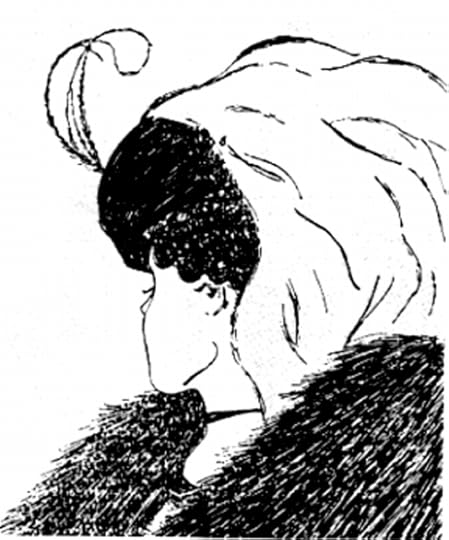
Do you see the hag? Trevalyan sees the beautiful lady--but we're both looking at the same picture. What do you think of colonies?--there's a good chance you may think they are intrinsically bad. When Trevalyan uses the words 'benevolent colonial administration', you can bet he doesn't think so.
As an outsider looking in, or as one who only knows about these sorts of things through his reading, I've always been very impressed with what the English have done in the world--I don't know that I'd go so far as to call myself an anglophile, but I have a healthy respect for their history (hence reading the book in the first place). But Trevalyan's unconscious (and almost unctuous at times) attitudes about the world of 1942 can sound extremely out of place in 2019. So much so that despite the positives, it might simply be too high a hurdle for some readers.
Recommended as a critical survey of English history, with some interesting analysis, but with the caveat that unspoken assumptions from 1942 may be difficult to swallow today.
I'd been looking for such a survey for a while--I'd felt that my knowledge of English history was spotty and difficult to contextualize. I wanted some kind of chronological survey that would fix certain events in my mind and at the same time tie them to world events and trends. Generally, I find the easiest way for this to happen is with a narrative approach to the material, which is what I hoped to find here, rather than the detailed anthropological and social studies that I found in the multi-volume set. What I lose in detail and analysis, I gain in retention.
Trevalyan's method is a mixture of both, and succeeds and fails in the same proportion, at least for this reader. There are very many interesting points Trevalyan makes, and probably where his mixture succeeds the most is when he's able to amplify an historical event by exploring the social causes that created it. A strictly narrative approach might have covered 'what' happened, but not 'why' it happened. One such insight, for myself, dealt with Henry VIII--his problems with his wives is fairly well known, but I had thought his break with the Catholic Church came solely from his interest in begetting an heir. This was, of course, the root of it, but according to Trevalyan, he places blame for Clement's refusal to grant an annulment to Henry directly at the foot of Charles V, King of Spain. Since Henry saw the ecclesiastical authority of the pope usurped by the temporal arm-twisting of Charles, the matter was less one of religion than one of politics. The English people followed him not only for patriotic reasons, but as part of a general mood inspired by the Reformation, and the unwillingness of an insular people to have the terms of their life dictated to them by someone who wanted to rule them from a thousand miles away.
Much of Elizabeth's reign also dealt with the political implications of religious realities--again, in Trevalyan's view, the politics of the situation and the relative weakness of England vis-à-vis Spain often left her no choice, and thus decisions that might on the surface appear only to involve religious dispute often had a very real political threat behind them.
Well, it shouldn't be a surprise to anyone that retention of power will disguise itself in various forms. What I appreciated was Trevalyan's methodical approach in giving the background which made the cause for 'what happened' much easier to see. One charge that might be laid at Trevalyan's door is that he is too methodical: although the repeal of the 18th century corn laws had far reaching implications, one wonders if it couldn't have been summed up a bit more succinctly. Perhaps not.
Trevalyan's attitude toward English history is one of admiration and respect. One might caption several of the chapters with the tag, 'Look how fine this was!' That's fair--there's no reason a historian can't admire the time he writes about. What made this stand out with such a distinction is that I'm not used to historians admiring their subject. In fact, I've often noticed an opposite trend--an emphasis on the abuses in the past in order to either promote modernity or to shock with sensationalism. Trevalyan's having none of it. For example: his treatment of serfs. I've never been a serf, but it doesn't take much for me to believe that the average life of a serf was 'nasty, brutish and short', as the saying goes. Yet Trevalyan convincingly (at least during the moment I'm reading him) celebrates the creation of feudalism as a great advancement in the road to civilization. This is almost a contrarian view--but when one compares the lawlessness of pre-feudal times with the security that came with the manor system, one might concede Trevalyan the point. Would you rather be a serf or be dead?
Trevalyan's writing reminds me of nothing more than the old optical illusion picture of the old woman and the young lady:
Do you see the hag? Trevalyan sees the beautiful lady--but we're both looking at the same picture. What do you think of colonies?--there's a good chance you may think they are intrinsically bad. When Trevalyan uses the words 'benevolent colonial administration', you can bet he doesn't think so.
As an outsider looking in, or as one who only knows about these sorts of things through his reading, I've always been very impressed with what the English have done in the world--I don't know that I'd go so far as to call myself an anglophile, but I have a healthy respect for their history (hence reading the book in the first place). But Trevalyan's unconscious (and almost unctuous at times) attitudes about the world of 1942 can sound extremely out of place in 2019. So much so that despite the positives, it might simply be too high a hurdle for some readers.
Recommended as a critical survey of English history, with some interesting analysis, but with the caveat that unspoken assumptions from 1942 may be difficult to swallow today.

July 2, 2014
I picked up this book to learn from and not to read critically, so I can't offer a lot of insight into Trevelyan's integrity or originality as a scholar. The best I can do is admire and reproduce some of its beautifully written prose. The story begins almost biblically, dwelling for suspense in imaginative vistas of the virgin prehistoric land, still eternal-seeming:
Or take another pretty passage - here how he describes the fervour of approaching modernity in the crucible of the 15th century:
This rapid diversification of modes of living in early modern times is here given one plausible mechanism:
Which can introduce some excerpts demonstrating Trevelyan's characteristic fascination for progress:
...in institutions:
...language (note the superlative: "in the history of man"):
....and in the growth of social cohesion and democracy:
Trevelyan is fascinated by our uniqueness. He traces how we were a society which was remarkably unlatinised by Roman rule:
and originally were part of a larger germanic-speaking culture which, in spite of constant small wars of great violence, formed a coherent cultural scene with it's own "racial character" - a code of morals, a set of ideals, an aesthetic and linguistic spirit:
From these origins as part of shared germanic stock, Trevelyan traces what remarkable steps lead the society apart from all other kingdoms of Europe, with growing provincialism and with that famous "island mentallity" that was commented on even half a millenium ago by "Henry VIII's Venetian envoy":
With a special form of appreciation for each era of evolution, Trevelyan tracks the the Eighteenth Century's contribution to the English character, which he poses as a spirit which rose in spite of profound corruption at the level of its national institutions:
For the democratic spirit to take flame in England, Trevelyan believes that her rugged, ascetic cousins in the colonies had to take the lead:
Trevelyan describes the class divisions that were especially brough into focus under the effects of the Napoleonic wars:
I found this book rich balanced in scope and factual detail. I think that it was appropriate for people not deeply studied in history, like myself, although the later chapters are less easy on the lay reader than those on the pre-modern eras. As I have tried to point to, Trevelyan's style is anything but dry, and his investment of purpose and direction to historical events is at the least a helpful crutch to readers who are looking for a way to assimilate the facts. It struck me that the author had a great deal of sympathy for the historical actors, and was reluctant to accuse anyone of outright cynicism (though not denying that self-interest has always retarded progress).Though the byword of this book is "progress," the style of book does not rob the historical actors of their own individuality, failings or distinctions, over and above their particular slot in time. Trevelyan does not theorize, but feels content to only "point like a showman to the things of the past, with their manifold and mysterious message".
At the time of their coming overland, the chalk downs of Dover and Calais were still united in a continous range; the majestic Thames flowed into the lower Rhine; and the Rhine itself meandered towards the Arctic Ocean through the marshy plain now submerged beneath the waves of the North Sea, where the bones of mammoth and reindeer are dredged off the Dogger Bank. [...] For many centuries after Britain became an island the untamed forest was king. It's moist and mossy floor was hidden from heaven's eye by a close-drawn curtain woven of innumerable treetops, which shivered in the breezes of summer dawn and broke into wild music of millions upon millions of wakening birds; the concert was prolonged from bough to bough with scarcely a break for hundreds of miles over hill and plain and mountain, unheard by man save where, at rarest intervals, a troop of skinclad hunters, ignorant that they lived upon an island, not dreaming that there could be other parts of the world besides this damp green woodland with its meres and marshes, wherein they hunted. p.18-9
Or take another pretty passage - here how he describes the fervour of approaching modernity in the crucible of the 15th century:
the conditions of medieveal society silently dissolving, sure prelude to the coming revolution. The villein is achieving his emancipation under a new economic order. New middle classes in town and country and thrusting themselves in between lord and serf, the two isolated pillars of the old feudal structure. Commerce and manufacture are growing with the cloth trade, and are bursting the boundaries of medieval borough and guild. Laymen are becoming learned and are thinking for themselves. Caxton's press is replacing the monastic scribe. The long-bow of the English yeoman can stop the charge of the feudal knight, and the King's cannon can breach his donjon wall. As climax to all these profound changes, slowly at work through many passing generations, the mist is suddenly rolled back one day off the Atlantic waves, revealing new worlds beyond the ocean. England, it seems, is no longer at the extreme verge of all things, but is their maritime heart and centre. She has long been half European; she shall now become oceanic - and America as well, and yet remain English all the while p.123 [introduction to book 2]
This rapid diversification of modes of living in early modern times is here given one plausible mechanism:
In Saxon times an estate had normally been divided among the sons. In Plantagenet times it normally went to the eldest son alone. And therefore the younger sons, after being brought up as children of the manor house, were sent out into the world to seek their fortunes. This had the effect of increasing the adventurous and roving spirit of the new English nation, and of mingling classes as they were not mingled in Germany or France. The English upper class never became a closed caste, like the continental nobles who married only inside their own order, and despited merchants and commerce. If English history followed a very different course, it was partly because the custom of primogeniture, though originated to meet a fedual requirement, had become part of the land-law of an England that was rapidly escaping from feudalism. We are watching an important step towards the higher stages of civilization - the growth of a leisured class. p.130
Which can introduce some excerpts demonstrating Trevelyan's characteristic fascination for progress:
...in institutions:
The heathen clan or tribe may be relatively equalitarian, and poverty may be more or less equally distributed among its members, but it can never move forward in mass order towards higher civilization and the freedom of the individual. When men collectively are very poor some few must be made rich if htere is to be any accumulation of weatlth for civilized purposes. Wen men collectively are ignorant, progress is only possible through the endowment of an educated few. In such a world, organization can only begin through personal ascenancy and can only be rendered permanent through privilege. [...] In our own democratic and partially scientific age these conditions of progress in the past may seem strange to some, but they are a large part of the secret of early English history. I nthose days, kingship, feudalism and ecclesiasticism grew together as harmonious parts of a general movement. King, thegn, and Bishop, though often rivals, in the main fostered one another's power. All three were at once the exploiters and the saviours of an otherwise helpless society. p.54
...language (note the superlative: "in the history of man"):
During the three centuries when our native language was a peasant's dialect, it lost its clumsy inflexions and elaborate gender, and acquired the grace, suppleness and adaptability which are among its chief merits. It was enriched by many French words and ideas [...] thus improved our native tongue reentered polite and learned society as the English of Chaucer's Tales and Wycliffe's Bible, to be be still further enriched into the English of Shakespeare and Milton. There is no more romantic episode in the history of man than this underground growth and unconscious self-preparation of the despised island patois, destined ere long to "burst forth into sudden blaze," to be spoken in every quarter of the globe, and to produce a literature with which only that of ancient Hellas is comparable. It is symbolic of the fate of the English race itself after Hastings, fallen to rise nobler, trodden under foot only to be trodden into shape. p. 117 [end of book one]
The Nordic humour and poetry, when it reawakened in Chaucer and Shakespeare, poured its impetuous forces into Latin forms, transmuting them into something rich and strange. p.128
....and in the growth of social cohesion and democracy:
Pitt and Castlereagh had defeated Napoleon himself, given peace to Europe, and won a hundred years of security for Great Britain. The task awaiting their successors, under the later monarchs of the House of Hanover, was to adapt this system of Parliamentary Cabinet government to the new social facts created by the Industrial Revolution. This was found to involve the admission first of the middle and then of the working class as partners in the control of the political machine. A failure to make these adjustments would have led to a breakdown of the Parliamentary system and a war of classes. By the good genius of English politics has often retrieved apparently hopeless situations. The last British Revolution is still that of 1688. By a gradual transition towards democracy, seldom hastening and never turning back, political rights were extended to all without a catastrophe. This great manouevre was safely acomplished because all classes and all parties showed, upon the whole, sound political sense and good humour, because the Victorian age was a period of peace and external security for Britain, and becuase its middle years were years of unexampled prosperity. Finally, the extension of the political franchise to all compelled the nation to elaborate a system of national education out of the fragmentary efforts of private and denominational enterprise. p.461 [from the introduction to book six]
Trevelyan is fascinated by our uniqueness. He traces how we were a society which was remarkably unlatinised by Roman rule:
Nor, on the other hand, had the Gauls and Britons an elaborate civilization of their own, like the inhabitants of the Greek and Oriental lands subject to Roman sway. And, therefore, once the Roman conquerors had glutted their first rage for plunder, their main effort was to induce their Western subjects to assimilate Latin life in all its aspects. Their success with the Gauls was permanent, and became the starting point of modern European history. But in Britain, after a great initial success, they had complete ultimate failure. [...] The Latin life of the cities, the villas, the arts, the language, and the political organization of Roe vanished like a dream. The greatest fact in the early history of the island is a negative fact. p.28
and originally were part of a larger germanic-speaking culture which, in spite of constant small wars of great violence, formed a coherent cultural scene with it's own "racial character" - a code of morals, a set of ideals, an aesthetic and linguistic spirit:
Objection may be taken to the word "Nordic" as to all terms invented in after times for historical purposes. But to give a just conception of British history, a single word must sometimes be employed to cover the German, the Anglo-Saxon, and the Sacandinavian peoples of the Fifth Century. They had certain common features, which gave a family likeness to the innumerable and widely scattered tribes of Scandinavians, Anglo-Saxons, Franks and Teutons who ranged conquering and colonizing from Ireland to Constantinople, from Greenland to the Desert of Sahara. [....]Allied languages, the religion of Thor and Woden after which most of the English and some of the German days of the week are called; a body of epic poetry celebrating common racial heroes, like Seigurd or Siegfried known from Iceland to Bavaria, and Beowulf, does does in Denmark and Scaninavia deeds sung in a English poem; a common art for docorating weapons, jewellery and objects in daily use, with patterns of great beauty and richness, quite distinct from Celtic; and lastly, common customs of war and agriculture. p.
The worship of Odin and Thor, the religion common to primitive Anglosaxon and Scandinavian, was pre-emimently a layman's religion, a warrior's religion, a religion of high-hearted gentlemen not overburdened with brains or troubled about their own souls. Its grand old mythology inculcated or reflected the virtues of the race - manliness, generosity, loyalty in service and in friendship, and a certain rough honesty. The social standards of the modern English schoolboy come nearest to it, as a most elementary expression of the racial character. The Danes had a word for acts of cowardice, desertion, or dishonourableness of any kind - "nidings voerk" - as distinct from ordinary breaches of the law, and more terribly punished by public opinion. It was worse to be a "niding" than a man-slayer. p.55
From these origins as part of shared germanic stock, Trevelyan traces what remarkable steps lead the society apart from all other kingdoms of Europe, with growing provincialism and with that famous "island mentallity" that was commented on even half a millenium ago by "Henry VIII's Venetian envoy":
they think that there are no other men than themselves, and no other world but England; and whenever they see a handsome foreigner, they say "he looks like an Englishman"; and when they partake of any delicacy with a foreigner they ask him "whether such a thing is made in his country?"
In the middle of the Tudor period a French visitor wrote:
The people of this nation mortally hate the French as their old enemies, and always call us "France cheneve," "France dogue." (=French knave, French Dog). p.189
With a special form of appreciation for each era of evolution, Trevelyan tracks the the Eighteenth Century's contribution to the English character, which he poses as a spirit which rose in spite of profound corruption at the level of its national institutions:
The period of Walpole and the Pitts was the heyday of the unchallenged abuses in all forms of corporate life. Holders of ecclesiastical, academic, charitable, and scholastic endowments had no fear of inquiry or reform. Schoolmasters could draw their salaries without keeping school. Universities could sell degrees without holding examinations or giving instruction. Parliamentary boroughs and municipal oligarchies could be as corrupt and ridiculous as they liked; it was enough that they were old. "Whatever is it right - if it can show a charter" seems the watchword of the Eighteenth Century. It is not, therefore, surprising that the greatness of England during the epoch that followed the [Glorious] Revolution is to be judged by her individual men, by the unofficial achievement of her free and vigorous population, by the open competition of her merchants and industrialists in the markets of the world, rather than by her corporate institutions, such as Church, Universities, Schools, Civil Service, and town Corporations, which were all of them half asleep. p.378
For the democratic spirit to take flame in England, Trevelyan believes that her rugged, ascetic cousins in the colonies had to take the lead:
English society was then still aristocratic, while American society was already democratic. Six or seven weeks of disagreeable ocean tossing divided London from Boston, so that personal intercourse was slight, and the stream of emigration from the mother country had run very dry ever since 1640. In England politics and good society were closed to Puritans, while Puritanism dominated New England and pushed its way thence into all the other colonies; it was Anglicanism that was unfashionable in Massachusetts. English society was old, elaborate, and artificial, while American society was new, simple, and raw. English society was based on great differences of wealth while in America property was still divided with comparative equality, and every likely lad hoped some day to be as well-off as the leading man in the township. In England political opinion was mainly that of squires, while in America it was derived from farmers, water-side mobs, and frontiersmen of the forest. In two societies so widely set apart in the circumstances and atmosphere of everyday life, it required people with imaginative faculties like Burke, Chatham and Fox to conceive what the issues looked like to ordinary men on the other side of the Atlantic. George III had strength of mind, diligence, and business ability, but he had not imagination. p.404
Trevelyan describes the class divisions that were especially brough into focus under the effects of the Napoleonic wars:
Economic suffering was by no means evenly divided among the whole people. The upper class throve on enchanced rents, and paid too small a proportion of the war taxes; for revenue was raised largely by duties on articles of consumption, of which the effect was felt by the poor in the rise of prices. Pitt's useful new device of the income-tax, which was continued till the end of the war, did something, but not enough, to redress the balance. In 1815 twenty five millions were raised by direct, and sixty seven millions by indirect, taxation. Those who enjoyed rent and tithe, composing a single governing class of the well-born, knew little of the harships of wartime.
It was, indeed, a notable period in the higher civilization of the island, where all through the war great landscape painters, poets, and novelists were working for a large and eager class with the wealth and leisure to enjoy their works. Never was country-house life more thriving or jovial, with its fox-hunting, shooting, and leisure in spacious and well-stocked libraries. Never was sporting life more attractive, with its coaching on the newly improved roads, and its boxing matches patronized by the nobility. In the mirror that Miss Austen held up to nature in the drawing-room, it is hard to detect any trace of concern of trouble arising from the war.
The middle classes suffered more. Many merchants, like poor old Mr Sedley in Vanity Fair, were broken by the sudden opening and shutting of markets, or the rise and fall of war prices. But many also many their fortunes in new factories, and in commerce with the black and brown peoples of the world, whom England was learning to clothe, wholesale, as yet without a rival in that profitable business.
The chief sufferers by the war were the working classes, for whom little was done except the general adoption of the policy originated by the Berkshire magistrates at Speenhamland, for granting rates in aid of wages to prevent families from positively dying of starvation. But the better policy of an enforced minimum wage, though discussed, was unfortunately rejected as old-fashioned and unscientific. Meanwhile, Pitt's Act made Trade Unions illegal, so that the workmen found it difficult, in the face of hostile authority, to keep up wages in their proper relation to prices. That sense of the brotherhood of classes in WWI which was so marked in our own more democratic day had no place in the Anti-Jacobin mentality. Wellington's remarks about the soldiers who won his battles, as "the scum of the earth," enlisted "for drink," represent the common limitations of the upper-class sympathy at that period. p.428
I found this book rich balanced in scope and factual detail. I think that it was appropriate for people not deeply studied in history, like myself, although the later chapters are less easy on the lay reader than those on the pre-modern eras. As I have tried to point to, Trevelyan's style is anything but dry, and his investment of purpose and direction to historical events is at the least a helpful crutch to readers who are looking for a way to assimilate the facts. It struck me that the author had a great deal of sympathy for the historical actors, and was reluctant to accuse anyone of outright cynicism (though not denying that self-interest has always retarded progress).Though the byword of this book is "progress," the style of book does not rob the historical actors of their own individuality, failings or distinctions, over and above their particular slot in time. Trevelyan does not theorize, but feels content to only "point like a showman to the things of the past, with their manifold and mysterious message".

November 25, 2018
Magisterial, elegant, beautifully written. Lord Trevelyan was born to this subject, taking us easily through centuries of British history, royal successions, political and military upheaval. One (small) caveat: he's a creature of his time, so the various "colonies'' in the U.S., India and even Ireland get somewhat short shrift; he's sympathetic to their grievances, but only to an extent. And the latter part of the history, from the First World War to the Second (the book was published in 1942) get somewhat skimpier treatment, with events too fresh to get his full attention. But in many respects, including his diagnosis of the permanent effects of the Industrial Revolution and technology, he is dead on. And there's an amazing amount of information to be gleaned into these 592 pages. A "shortened'' history, indeed.

November 12, 2019
This is a good overview of the major forces and movements that have shaped the British Isles from earliest times to the mid-Twentieth Century. The book was finished in 1942 but much of it was written in the decade preceding the Second World War, so it effectively ends with the First World War. It is interesting to see the difference in perspective of this book, written almost a century ago.

February 1, 2013
Cracking example of narrative history-doesn't let a lack of sources get in the way of a great story.

July 10, 2022
More of a the great trends of England’s History than a precise and detailed description of events, this book is obviously - as any History book - the product of its time. One has to read it always keeping in mind that it reflects the spirit of the beginning of the XXth century with its patronizing apporach. It is nevertheless a good book, developping very interesting theories about the destiny of England - its virtues and successes more than its failures. Worth reading!
Read
January 2, 2024While a little dated in its racial and imperial perspectives, still the shortest and most accessible general history of England I have yet encountered. Appreciate Trevelyan’s thematic structuring of this often-unwieldy narrative and would note that he is still remarkably open-minded and progressive for his class and time, with respect to race and gender. Works well with Donald Horne as a counter-perspective.

August 14, 2023
Written for the English audience, the author assumes the reader has some working knowledge of the island's history. He effectively puts major invasions, wars, and events in the context of the era they occurred. Altogether an informative overview of English history. Curious how he blew through the American fight for independence. Very British, what. Published in 1942.

August 7, 2017
if you're seeking to read a history book about historical characters and not the importance of naval power and endless tirade of reform bills... this will not be the book for you. read winston churchill instead.
November 1, 2019
Too dated and one-sided to be worth the time.

April 25, 2020
“Short” by no means, but the masterly writing really makes up for the profuse review of the history of England. I should also add, it includes many useful maps that support the narrative.
May 25, 2007
Incredibly concise and beautifully written narrative history of Britain from pre-Roman times to pre WW2.
Some antiquated sentiments verging on authoritarian eg that the feudal serf was better off despite his servitude because his lord made the world a more stable place.
But striking, vivid images eg the victorious Saxons who refused to live in abandoned Roman villas meaning that for "some centuries, the Roman ruins must have stood as a familiar a sight as the roofless abbeys under the Stuart Kings, a useful stone quarry sometime by day, but at night haunted in the imagination of the Saxon peasant by the angry ghosts of the races that his forefathers had destroyed."

February 1, 2016
I read somewhere that Trevelyan's works are now "largely unread", which is a very great tragedy. Trevelyan was the most widely read historian in an era when most people had not yet abandoned the habit of reading. His work allows the reader to understand how men once understood and read history (largely as progressing from barbarism to civilizations--as in Trevelyan's case), but Trevelyan also proves without a doubt that one can write compelling and erudite history without sacrificing style. There is no need to write in obscure language and resort to sophistry and semantic subterfuge to be taken seriously (ahem, modern academics).

June 15, 2011
Lots of stuff packed into a small space. Cover painting by Hogarth. Read for a class at U. of Colorado. Professor Simon delivered his daily lecture without notes while chain smoking. No time for any questions at the end. No final exam if you were willing to accept the grade you got on your mid-term. Date read is approximate.
![Profile Image for Anna [Floanne].](https://i.gr-assets.com/images/S/compressed.photo.goodreads.com/users/1566911038i/4459724._UX200_CR0,0,200,200_.jpg)
June 9, 2011
A useful tool I always address myself to when it comes to fill the gaps of my poor historical knowledge of England and the United Kingdom. Concise and very well-written, this book provides an adequate overview of the story of the nation from the remote days of the Celts to the end of WWI.

October 31, 2008
About the anti-war movement in England during the American Revolution

September 19, 2011
Based on Trevelyan's earlier, greater works, this 1959 single volume only covers through the 1930s.

January 13, 2013
More than an American will ever want to know (and this is the short version), but fascinating.
December 19, 2014
i think that this book gives you a claer information about the huge and the great english's civilization, so this book is very rich.
January 25, 2016
Trevelyan's description of historical events is no less than an intellectual as well as artistic masterpiece.

Read
October 3, 2016I've given up.
Want to Read
June 8, 2017I am still near the beginning of this book. It is pretty dense reading and I only spend a little time on it each night before going to sleep. The author writes with the assumption that the reader already has some knowledge of English history, often naming historical figures and events without introducing them. Still, it is interesting, even if I sometimes feel the need to look up people and places that he mentions in passing.
Displaying 1 - 24 of 24 reviews