God, writing about race as a white liberal is hard work. I just wish someone could put it all together for me in a nice readable narrative package so I can consume it and make the right evaluative noises and ultimately approve of the heinous effects of racism on us as humans. And I wish I could get a laugh at the same time, ironic, of course.
Race is re-ignited whenever someone has enough anger to either fight for it or against it. I, being deluded, thought it was fixed by Sesame Street and other such kindergarten TV shows well before rainbow thinking, diversity movements and anti-discrimination training in the workplace.
I thought James Baldwin solved all the problems of our perceptions of race twenty years before that. I was naïve at each point I observed and read about questions of race. But then racism was never fixed. It lurks in dark corners waiting. This probably led me to Percival Everett when this book first came out twenty years ago.
The perfect place to start thinking about race is our own understanding of it. Everett starts there too (as a middle class academic writer) with the most common racism he encounters - the white liberal, polite society racism with a twist of literary academia cant. Categorisation isn’t easy in this book.
Race is a perception. The world I grew up in categorised everything by shades of difference. That’s why I read James Baldwin, Frantz Fanon, Stokely Carmichael, Malcolm X. They were far away, but they explained the world for me. I stopped believing in Sesame Street and rainbows probably because of those books, Everett, too, confirmed it.
Monk Ellison, our protagonist, hates being the recipient of feel-good, well-intentioned thoughts from liberals who say racism is bad. It’s bad according to them because it forces blacks to live in ghettos, and all that accompanies it: misogyny, crime, poverty, crime and victims of violence. But Monk is the son of a doctor, his two siblings are doctors, he's not like ghetto blacks. He has his own views on the world of literature too, he writes a kind of pure intellectual prose, untroubled by poverty, violence, misogyny, crime.
Monk hates these liberal unconscious racists as much as he hates bad writing. And when race and bad writing come together, he gets really mad. He sees behind the veil of polite, empty rhetorical praise when the novel by a black woman written in a vernacular believed to be an authentic representation of ‘the hood’ wins fame, awards, film rights and wealth. Monk is getting nowhere with his own intellectual fiction. Perhaps this is all sour grapes because no one wants to publish his latest unreadable book.
There are plot twists in this novel. So I’ll avoid comments on the action. Monk is failing and flailing and then comes back home to look after his mother with dementia. He experiences tragedy, just like you’d expect in a black American story.
Books rarely make me laugh. But around 11pm one night, I started laughing and couldn’t stop myself. Laughter is a defence mechanism. At first I laughed because Everett, having built up his comedy show routine, finally delivered a punchline. I can’t tell you about it because you need to read the whole spiel. Part way through my uncontrolled laughter, I realised I was also laughing at the irony, the painful, crux of an ironic joke in which a racist idea is expressed so poignantly. And then I just kept laughing, because if I didn’t, I would cry. Laughter cries away the tears.
Everett plays with text. Just like writer-protagonist Monk. At one level, there are these little interludes, no more than a paragraph or two into which Monk enters like a private mental state like meditation, a place where he is free. One is the world of fishing, where he enjoys the technical beauty of lures. And then there’s the emotional and joyous interior zone of wood-working. Both crafts, both deeply satisfying expressions of joy that inject themselves into the story as the character of Monk.
At another level, there is a novel within a novel. If this novel within a novel wasn’t so absurd, no one would believe it. The novel within the novel story goes terribly wrong. And yet, faced with choices about money, family, art, Monk makes an unsavoury decision. A kind of character inside his character emerges making his choices for him. Clever, huh. The comic moments from there build to keep the absurdity of racial matters alive. Twenty years after publication, the absurdity is less obvious. In 2020, these issues felt like they sit on a knife edge. It’s so hard to write about race. I wanted to say so much, thump so many tables with so many words. This is excruciating. Thankfully, I laughed so hard, my defences split.
How do you review a book about race? You don’t talk about it. There’s a joke there but you have to read the book.
____
Addit Apr 2024
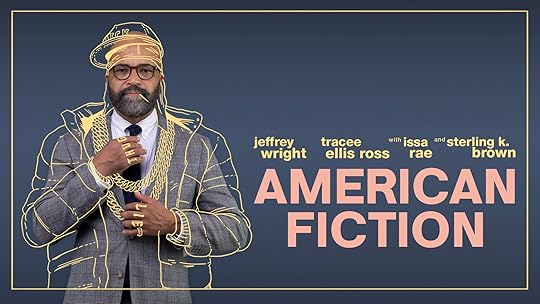
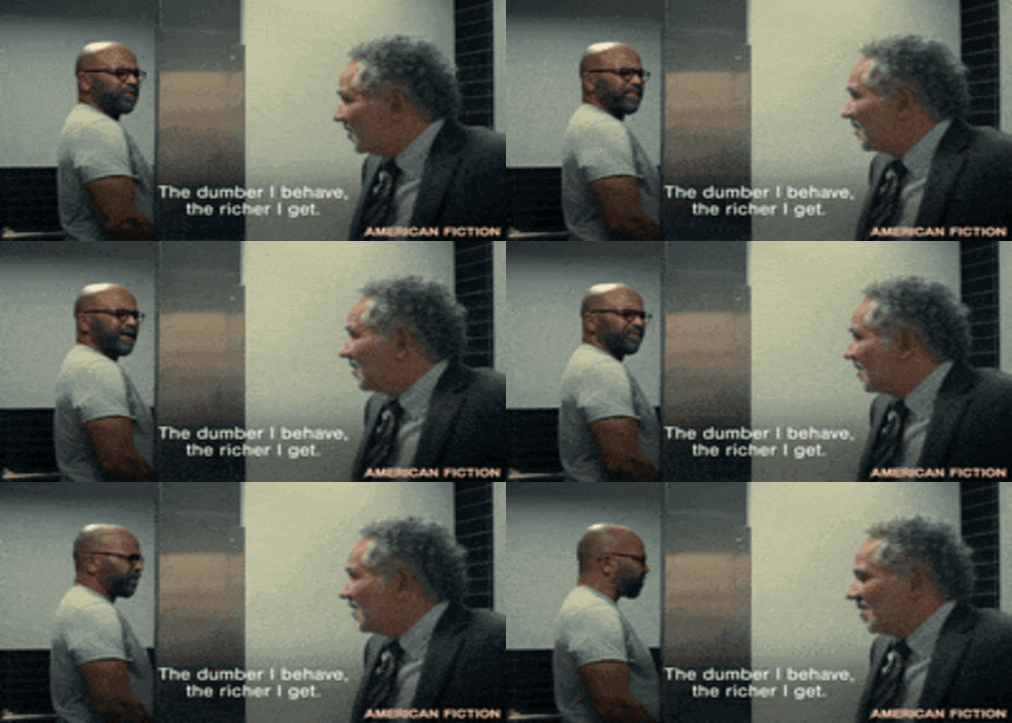
Apparently this has now been turned into a TV show called American Fiction. It's all there already in the novel. So it makes sense.