

What do you think?

Knossos - A Complete Guide to the Palace of Minos
Introduction; Historical outline; Myth and tradition; History of the excavations;Minoans and Knossos; The archaeological site; Route from Herakleion to Knossos; Tour of the palace; The main features; West court - west façade; West porch - corridor of the procession - central court; South propylaeum - west magazines - piano nobile; Throne room - tripartite shrine - pillar crypts; Grand staircase - hall of the double axes - queen's hall; Upper floor of the domestic quarter - shrine of the double axes; Royal workshops and magazines - east hall; North entrance - north lustral area - theatral area; The dependencies of the palace; Art treasures from Knossos.
- GenresHistoryNonfiction
128 pages, Paperback
First published January 1, 1998
Ratings & Reviews
Friends & Following
Create a free account to discover what your friends think of this book!
Community Reviews
Displaying 1 - 5 of 5 reviews

February 19, 2013
An outline of the ancient Minoan Palace
21 February 2013
This is a book that I picked up at one of the gift shops that dot the road to the entrance of Knossos. In fact, when you wonder through Greece you see lots of these stalls with a multitude of books (in a multitude of languages) in the myriad archaeological sites scattered about the country, however the books that tend to dominate the stalls outside of the ancient sites tend to relate to those sites. Mind you, I discovered that there are a number of the books available in Italy as well, but once again they tend to relate to the specific city or site that the stall is in or near. I did consider picking up a book about Florence, until I discovered that it really only contained touristy stuff rather that stuff that I really wanted to know about Florence (that I don't know already).
This book has a small first part which looks at the myths and history that relate to the ruins at Knossos, and then a majority of the book describes a tour around the ruins. It is probably something that you can read through as you explore the ruins, though if you are going to do that then you are going to need to spend much longer than the three hours that I spent there with my brother. The reason that I say that is because the ruins are massive, and following the trail that the book sets out can be a little confusing if you are not there (and even though I am a little familiar with the site, having been there, it was still a little confusing following along in this book).
Knossos is located about half-an-hour by bus from the Cretan capital of Heracleum. Mind you, you need to get one bus from the airport to the city centre, and then another bus to the ruins (though the buses do leave quite regularly). As can be expected with Greek cities though, the roads are quite narrow and clogged with cars, and the locals view road rules as recommendations. I was amazed though that the bus driver was able to get from the centre of Heracleum to Knosses without doing major damage to his bus, or any of the other vehicles on the road. Oh, and you can also do it as a day trip from Athens. We flew out in the morning, spent the day in Crete, and flew back in the afternoon. After visiting the ruins we even had time to wonder around Heraculum (though watch out for the cabbies because they do rip you off).
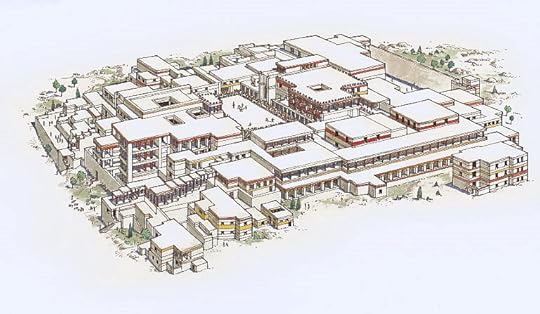
As for the myths, I should make mention of them because that is one of the areas that interests me. The two main myths regarding Crete involve Icarus and Daedelus. The story goes that king of Crete (Minos, who is said to be the child of Zeus, but that is not surprising considering he was a strong king ruling a powerful empire, so they are likely to make up such stories) had sent his son to Athens where he won all of the games at a competition. In a fit of jealousy the Athenians killed the king's son and in response Minos invaded Athens, subjugated them, and forced them to send tribute in the form of young men and women, to be sacrificed to the minotaur who lived in the labyrinth. Theseus, the Athenian Crown Prince, then went with one of the groups, seduced Ariadne, the daughter of Minos, and got her to help him escape the labyrinth (using a ball of twine) after killing the minotaur. When this was discovered, the designer of the labyrinth (Daedelus) and his son (Icarus) then decided to flee, and built wings to do so.
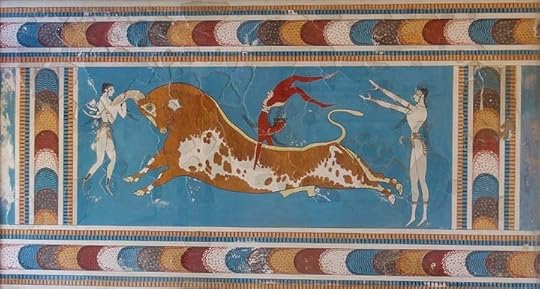
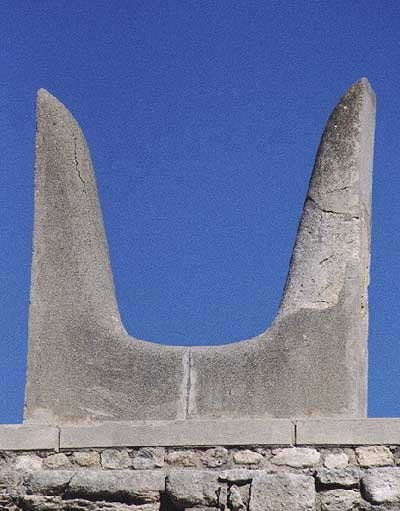
Now, my interpretation of the myth is that they are likely embellished stories based upon facts. The labyrinth most likely existed, but the minotaur did not, with the exception that it was a pretty nasty bull that was thrown into the labyrinth and starved. As you wonder around Knossos you will notice that there are lots of images of bulls as well as horns that have been carved out of stone (as the pictures below show).
The same goes with the story of Daedelus and Icarus. They are probably real people, but the story of them flying is a likely embellishment (and most likely fled Crete by a very fast ship on which Icarus likely died during the voyage, most likely due to his own stupidity). The story does continue in that Minos pursued Daedelus to Sicily where he was killed, and the Minoan fleet was destroyed on the way back by a violent storm (which could have been the volcanic eruption from Thera).
As others accept, there is a lot of truth in myth, but what one needs to do is to be able to sift through the stories and strip away a number of the embellishments. A great hero, or even a great king, is likely to be referred to as the child of a God, due to his almost heroic powers, in the same way that it is possible that the stories about Zeus impregnating queens could easily have been excuses to cover up marital infidelity (though I do wonder if they really would have got away with that, and whether the men were that gullible to actually believe it, but then again in a very religious culture people can be quite gullible).
21 February 2013
This is a book that I picked up at one of the gift shops that dot the road to the entrance of Knossos. In fact, when you wonder through Greece you see lots of these stalls with a multitude of books (in a multitude of languages) in the myriad archaeological sites scattered about the country, however the books that tend to dominate the stalls outside of the ancient sites tend to relate to those sites. Mind you, I discovered that there are a number of the books available in Italy as well, but once again they tend to relate to the specific city or site that the stall is in or near. I did consider picking up a book about Florence, until I discovered that it really only contained touristy stuff rather that stuff that I really wanted to know about Florence (that I don't know already).
This book has a small first part which looks at the myths and history that relate to the ruins at Knossos, and then a majority of the book describes a tour around the ruins. It is probably something that you can read through as you explore the ruins, though if you are going to do that then you are going to need to spend much longer than the three hours that I spent there with my brother. The reason that I say that is because the ruins are massive, and following the trail that the book sets out can be a little confusing if you are not there (and even though I am a little familiar with the site, having been there, it was still a little confusing following along in this book).
Knossos is located about half-an-hour by bus from the Cretan capital of Heracleum. Mind you, you need to get one bus from the airport to the city centre, and then another bus to the ruins (though the buses do leave quite regularly). As can be expected with Greek cities though, the roads are quite narrow and clogged with cars, and the locals view road rules as recommendations. I was amazed though that the bus driver was able to get from the centre of Heracleum to Knosses without doing major damage to his bus, or any of the other vehicles on the road. Oh, and you can also do it as a day trip from Athens. We flew out in the morning, spent the day in Crete, and flew back in the afternoon. After visiting the ruins we even had time to wonder around Heraculum (though watch out for the cabbies because they do rip you off).
As for the myths, I should make mention of them because that is one of the areas that interests me. The two main myths regarding Crete involve Icarus and Daedelus. The story goes that king of Crete (Minos, who is said to be the child of Zeus, but that is not surprising considering he was a strong king ruling a powerful empire, so they are likely to make up such stories) had sent his son to Athens where he won all of the games at a competition. In a fit of jealousy the Athenians killed the king's son and in response Minos invaded Athens, subjugated them, and forced them to send tribute in the form of young men and women, to be sacrificed to the minotaur who lived in the labyrinth. Theseus, the Athenian Crown Prince, then went with one of the groups, seduced Ariadne, the daughter of Minos, and got her to help him escape the labyrinth (using a ball of twine) after killing the minotaur. When this was discovered, the designer of the labyrinth (Daedelus) and his son (Icarus) then decided to flee, and built wings to do so.
Now, my interpretation of the myth is that they are likely embellished stories based upon facts. The labyrinth most likely existed, but the minotaur did not, with the exception that it was a pretty nasty bull that was thrown into the labyrinth and starved. As you wonder around Knossos you will notice that there are lots of images of bulls as well as horns that have been carved out of stone (as the pictures below show).
The same goes with the story of Daedelus and Icarus. They are probably real people, but the story of them flying is a likely embellishment (and most likely fled Crete by a very fast ship on which Icarus likely died during the voyage, most likely due to his own stupidity). The story does continue in that Minos pursued Daedelus to Sicily where he was killed, and the Minoan fleet was destroyed on the way back by a violent storm (which could have been the volcanic eruption from Thera).
As others accept, there is a lot of truth in myth, but what one needs to do is to be able to sift through the stories and strip away a number of the embellishments. A great hero, or even a great king, is likely to be referred to as the child of a God, due to his almost heroic powers, in the same way that it is possible that the stories about Zeus impregnating queens could easily have been excuses to cover up marital infidelity (though I do wonder if they really would have got away with that, and whether the men were that gullible to actually believe it, but then again in a very religious culture people can be quite gullible).

March 12, 2022
Good guidebook for the palace with some useful historical background. Read as prep for cruise later this year.

March 13, 2023
Short but good information about Knossos. Readable in an academic/travel guide sort of way.

October 9, 2024
This book is a great accompaniment to touring Knossos, a Bronze age archaelogical site on Crete.
Initially, the book covers background information about:
1.The myths (Theseus and the minotaur) associated with the palace (and/or a religious/administrative center)
2.The excavations.
3.The Cretans from ancient times (Minoans) who lived there
The narrative then goes on to give you a guided tour of the palace complex.
Descriptions are written about each stop on the palace route.
It's a captivating place to learn more about early European civilization.
We combined our walk through the palace site with a visit to the museum in Heraklion which contains the palace's numerous artifacts.
....
Notes
Section 1.
The palace is situated near Heraklion, Crete, and built on a gently sloping hill (Kephala) by the Kairatos river (in the confluence of the Kairatos/Vlychia streams), which runs east of Knossos (town) and flows into the Aegean Sea. (Wikipedia).
In the Minoan era, aqueducts diverted water to Kephala hill from spring water sources at Archanes, which springs are the headwaters of the Kairatos River. (Wikipedia)
The Minoan civilization was the first advanced civilization in Europe.
Knossos was built about 4,000 years ago (1,900- 1,350 BC). The site has evidence of man's presence from Neolithic times (7000 BC).
The site was initially identified by Minos Kalokairinos who started excavating the west wing in 1878-1879.
British archeologist, Sir Arthur Evans continued excavating the site after the initial discovery. He named the people Minoans after the legendary Minoan king.
Knossos was the center of the Minoan civilization and the ruins contain royal apartments, a throne, shrines and alters, outdoor court areas and store rooms.
Other nearby sites include Gortyn, Miletos and Phaistos.
Knossos and associated sites quite possibly followed eastern models: Ugarit, Syrian coast and Mari, upper Euphrates. (Wikipedia)
There is more excavating to do in the surrounding area (the town dwellers of the era).
Homer mentions the palace in his stories about the Trojan War and King Minos.
Section 2.
1.Route (road) to Knossos.
The Royal Road is the last vestige of a Minoan road that connected the port to the palace complex.
Today a modern road, Leoforos Knosou, built over or replacing the ancient roadway, serves that function and continues south.
2.Palace Complex.
The palace at Knossos was continuously renovated and modified throughout its existence.
The currently visible palace is an accumulation of features from various periods, alongside modern reconstructions which are often inaccurate.
Thus, the palace was never exactly as it appears today. (Wikipedia)
3.Main Features.
The 6 acres (24,000 m2) of the palace included a theater, a main entrance on each of its four cardinal faces, and extensive storerooms. (Wikipedia)
4.South Propylaeum.
"The “South” or “Great Propylaeum” as we see it today is the result of the restoration by Evans, who placed the famous “Cup-Bearer Fresco” here." (Knossos Documenta)
5. Throne Room (1,470–1,420 BC).
Has an alabaster seat which Evans referred to as a "throne" built into the north wall.
On three sides of the room are gypsum benches.
On the south side of the throne room there is a feature called a lustral basin, so-called because Evans found remains of unguent flasks inside it and speculated that it had been used as part of an annointing ritual.
The room was accessed from an anteroom through double doors.
The anteroom was connected to the central court, which was four steps up through four doors.
The anteroom had gypsum benches also, with carbonized remains between two of them thought possibly to be a wooden throne.
Both rooms are located in the ceremonial complex on the west of the central court.
The throne is flanked by the Griffin Fresco, with two griffins couchant (lying down) facing the throne, one on either side.
Griffins were important mythological creatures, also appearing on seal rings, which were used to stamp the identities of the bearers into pliable material, such as clay or wax.
The actual use of the room and the throne is unclear. (Wikipedia)
The Mycenaeans could possibly have held court in this room. They came to power in Knossos at about 1,450.
6. Staircase.
Grand Staircase provided access (leads down) to the royal apartments. (Knossos documenta)
7. Domestic/living quarters.
Southeast quarter (royal apartments) at the foot of the Grand Staircase.
8. Workshops.
Are near what has been disignated the royal apartments.
9.North Entrance.
Via the North Pillar Hall. Narrow doorway used to enter the north part of the palace. Incised clay tablets suggest a record to produce entering the palace.
10. Dependancies.
Around the palace extended the Minoan settlement, with the cemeteries on the hills.
Important buildings from this same period include: the South House, the House of the Chancel Screen, the Small Palace, the Caravanserai, the Royal Villa and the Temple-Tomb. (Meet Crete)
11. Art and Treasures.
Frescos:
1. fresco of the procession
2.the King-Priest fresco
3.the bull-leaping fresco
4.the three partite shrine fresco
5.the griffins fresco
6.the dolphins fresco (on the north wall in the Queen's apartment; possibly fell from the floor above), and
7.the fresco of the charging bull.
12. Columns.
Trunk of a cypress tree, inverted, stone bases w/round capitals, painted red.
13. Ventilation.
Sea breeze, porticoes (porches).
14.Water management.
Several systems for:
1. Supply.
2. Drainage.
3. Waste water.
15.Storage.
Extensive storage magazines.
16. Reception Courtyard.
Tiered platforms.
17. Court Yards.
Central Court: Like other Minoan palaces, Knossos was arranged around a rectangular central court.
This court was twice as long north-south as it was east-west, an orientation that would have maximized sunlight, and positioned important rooms towards the rising sun. (Wikipedia)
Great west courtyard: with its 3 round ‘kouloures’ ,
18. Writing.
Pictographs, two ancient scripts: Linear A and B.
19. Lustral Basin.
The lustral basin is an architectural form used in Minoan architecture. Consisting of a small sunken room reached by a staircase, they are characteristic of elite architecture of the Neopalatial period (c. 1750-1470 BC).
They are hypothesized to have been used either as shrines, baths, or as part of an initiation ritual.
The term was coined by Sir Arthur Evans, who hypothesized that they were used for lustration (purification).
20. Myths.
1.Daedalus built a labyrinth.
2.Minotaur.
The myth of the Minotaur tells that Theseus, a prince from Athens, whose father was an ancient Greek king named Aegeus, the basis for the name of the Greek sea (the Aegean Sea), sailed to Crete, where he was forced to fight a terrible creature called the Minotaur.
The Minotaur was a half man, half bull, and was kept in the Labyrinth – a building like a maze – by King Minos, the ruler of Crete. The king's daughter, Ariadne, fell in love with Theseus.
Before he entered the Labyrinth to fight the Minotaur, Ariadne gave him a ball of thread which he unwound as he went into the Labyrinth so that he could find his way back by following it.
Theseus killed the Minotaur, and then he and Ariadne fled from Crete, escaping her angry father. (Wikipedia)
21. Herodotus.
Herodotus wrote that Minos, the legendary king of Knossos, established a thalassocracy (sea empire). Thucydides accepted the tradition and added that Minos cleared the sea of pirates, increased the flow of trade and colonised many Aegean islands. (Wikipedia)
Also see: Andrew Lambert: Seapower States
Initially, the book covers background information about:
1.The myths (Theseus and the minotaur) associated with the palace (and/or a religious/administrative center)
2.The excavations.
3.The Cretans from ancient times (Minoans) who lived there
The narrative then goes on to give you a guided tour of the palace complex.
Descriptions are written about each stop on the palace route.
It's a captivating place to learn more about early European civilization.
We combined our walk through the palace site with a visit to the museum in Heraklion which contains the palace's numerous artifacts.
....
Notes
Section 1.
The palace is situated near Heraklion, Crete, and built on a gently sloping hill (Kephala) by the Kairatos river (in the confluence of the Kairatos/Vlychia streams), which runs east of Knossos (town) and flows into the Aegean Sea. (Wikipedia).
In the Minoan era, aqueducts diverted water to Kephala hill from spring water sources at Archanes, which springs are the headwaters of the Kairatos River. (Wikipedia)
The Minoan civilization was the first advanced civilization in Europe.
Knossos was built about 4,000 years ago (1,900- 1,350 BC). The site has evidence of man's presence from Neolithic times (7000 BC).
The site was initially identified by Minos Kalokairinos who started excavating the west wing in 1878-1879.
British archeologist, Sir Arthur Evans continued excavating the site after the initial discovery. He named the people Minoans after the legendary Minoan king.
Knossos was the center of the Minoan civilization and the ruins contain royal apartments, a throne, shrines and alters, outdoor court areas and store rooms.
Other nearby sites include Gortyn, Miletos and Phaistos.
Knossos and associated sites quite possibly followed eastern models: Ugarit, Syrian coast and Mari, upper Euphrates. (Wikipedia)
There is more excavating to do in the surrounding area (the town dwellers of the era).
Homer mentions the palace in his stories about the Trojan War and King Minos.
Section 2.
1.Route (road) to Knossos.
The Royal Road is the last vestige of a Minoan road that connected the port to the palace complex.
Today a modern road, Leoforos Knosou, built over or replacing the ancient roadway, serves that function and continues south.
2.Palace Complex.
The palace at Knossos was continuously renovated and modified throughout its existence.
The currently visible palace is an accumulation of features from various periods, alongside modern reconstructions which are often inaccurate.
Thus, the palace was never exactly as it appears today. (Wikipedia)
3.Main Features.
The 6 acres (24,000 m2) of the palace included a theater, a main entrance on each of its four cardinal faces, and extensive storerooms. (Wikipedia)
4.South Propylaeum.
"The “South” or “Great Propylaeum” as we see it today is the result of the restoration by Evans, who placed the famous “Cup-Bearer Fresco” here." (Knossos Documenta)
5. Throne Room (1,470–1,420 BC).
Has an alabaster seat which Evans referred to as a "throne" built into the north wall.
On three sides of the room are gypsum benches.
On the south side of the throne room there is a feature called a lustral basin, so-called because Evans found remains of unguent flasks inside it and speculated that it had been used as part of an annointing ritual.
The room was accessed from an anteroom through double doors.
The anteroom was connected to the central court, which was four steps up through four doors.
The anteroom had gypsum benches also, with carbonized remains between two of them thought possibly to be a wooden throne.
Both rooms are located in the ceremonial complex on the west of the central court.
The throne is flanked by the Griffin Fresco, with two griffins couchant (lying down) facing the throne, one on either side.
Griffins were important mythological creatures, also appearing on seal rings, which were used to stamp the identities of the bearers into pliable material, such as clay or wax.
The actual use of the room and the throne is unclear. (Wikipedia)
The Mycenaeans could possibly have held court in this room. They came to power in Knossos at about 1,450.
6. Staircase.
Grand Staircase provided access (leads down) to the royal apartments. (Knossos documenta)
7. Domestic/living quarters.
Southeast quarter (royal apartments) at the foot of the Grand Staircase.
8. Workshops.
Are near what has been disignated the royal apartments.
9.North Entrance.
Via the North Pillar Hall. Narrow doorway used to enter the north part of the palace. Incised clay tablets suggest a record to produce entering the palace.
10. Dependancies.
Around the palace extended the Minoan settlement, with the cemeteries on the hills.
Important buildings from this same period include: the South House, the House of the Chancel Screen, the Small Palace, the Caravanserai, the Royal Villa and the Temple-Tomb. (Meet Crete)
11. Art and Treasures.
Frescos:
1. fresco of the procession
2.the King-Priest fresco
3.the bull-leaping fresco
4.the three partite shrine fresco
5.the griffins fresco
6.the dolphins fresco (on the north wall in the Queen's apartment; possibly fell from the floor above), and
7.the fresco of the charging bull.
12. Columns.
Trunk of a cypress tree, inverted, stone bases w/round capitals, painted red.
13. Ventilation.
Sea breeze, porticoes (porches).
14.Water management.
Several systems for:
1. Supply.
2. Drainage.
3. Waste water.
15.Storage.
Extensive storage magazines.
16. Reception Courtyard.
Tiered platforms.
17. Court Yards.
Central Court: Like other Minoan palaces, Knossos was arranged around a rectangular central court.
This court was twice as long north-south as it was east-west, an orientation that would have maximized sunlight, and positioned important rooms towards the rising sun. (Wikipedia)
Great west courtyard: with its 3 round ‘kouloures’ ,
18. Writing.
Pictographs, two ancient scripts: Linear A and B.
19. Lustral Basin.
The lustral basin is an architectural form used in Minoan architecture. Consisting of a small sunken room reached by a staircase, they are characteristic of elite architecture of the Neopalatial period (c. 1750-1470 BC).
They are hypothesized to have been used either as shrines, baths, or as part of an initiation ritual.
The term was coined by Sir Arthur Evans, who hypothesized that they were used for lustration (purification).
20. Myths.
1.Daedalus built a labyrinth.
2.Minotaur.
The myth of the Minotaur tells that Theseus, a prince from Athens, whose father was an ancient Greek king named Aegeus, the basis for the name of the Greek sea (the Aegean Sea), sailed to Crete, where he was forced to fight a terrible creature called the Minotaur.
The Minotaur was a half man, half bull, and was kept in the Labyrinth – a building like a maze – by King Minos, the ruler of Crete. The king's daughter, Ariadne, fell in love with Theseus.
Before he entered the Labyrinth to fight the Minotaur, Ariadne gave him a ball of thread which he unwound as he went into the Labyrinth so that he could find his way back by following it.
Theseus killed the Minotaur, and then he and Ariadne fled from Crete, escaping her angry father. (Wikipedia)
21. Herodotus.
Herodotus wrote that Minos, the legendary king of Knossos, established a thalassocracy (sea empire). Thucydides accepted the tradition and added that Minos cleared the sea of pirates, increased the flow of trade and colonised many Aegean islands. (Wikipedia)
Also see: Andrew Lambert: Seapower States
August 13, 2026
I picked up this book in one of the local gift shops in Crete because i wanted to visit Cnossos while there and wanted to be prepared before going there. I liked the introduction because it gives insight on both the Minoan civilization as a whole and most importantly on the palatial culture that was their own important accomplishment. The guide is really well written, it helped me moving throughout the very crowded site and explains everything clearly. For this reason the pictures were really helpful. It is more or less a complete guide if your purpose is to go see the palace.
Displaying 1 - 5 of 5 reviews