Everyone’s favorite comics fan turned comics character is back! Fresh from her stint as a West Coast Avenger, Gwen Poole is desperate not to disappear into comic book limbo, so she’s determined to make an impact on the Marvel Universe! First up: unmask Spider-Man! Then, home-wreck the Fantastic Four! And while she’s at it, why not defeat the Immortal Hulk and lift Thor’s hammer, Mjolnir! But as Gwen’s mad rampage continues, will we — and she — finally learn the truth about her origins? Is this Gwenpool’s greatest retcon yet? Either way, Gwen knows she needs to go big — or go home! Buckle up, strap in and get ready! This is officially the greatest sequel with “Strikes Back” in the title that’s ever been made!
Leah Williams is an American writer originally from Oxford, Mississippi. She has written comics for Marvel, BOOM! Studios, Vault Comics, and is working on more. Her debut novel was a YA Fantasy book titled The Alchemy of Being Fourteen and she is currently writing its sequel, The Divinity of Hitting Fifteen. Leah has nonfiction articles and essays published in The Atlantic, Oprah Magazine, and Salon.
Leah Williams embraces the meta nature of Gwenpool a little too much and it wore very thin by the end of this. David Baldeon is the shining star here. He gets to cut loose every time Gwenpool goes behind the panels and comes up with some inventive designs.
Le doy 4 estrellas por la variedad de recursos y el gran final. Bueno, sólo conocía al personaje de vistas por ahí y me caía más o menos sobre todo porque lo relacionaba a Deadpool. Claro, es el único personaje junto con él que puede salir del cómic y hacer actos fuera del mismo. Como saltarse viñetas o hablarte directamente. Deadpool no me gusta para nada y de ambos prefiero a Gwenpool. En esta serie de cómics trata de buscarse un lugar en Marvel aunque claro ella sabe que es una persona real que está en un mundo de cómics mientras que todo el mundo piensa que es una mujer que no sabe lo que dice. Me parecieron interesantes la variedad de chistes y los recursos de los mismos para causar gracia. No es una historia plana y eso me pareció innovador pues hay muchos recursos que obviamente nunca fueron usados en los cómics tradicionales. El final es muy bueno en mi opinión.
A wonderful slice of Gwenpool hilarity with an honest-to-goodness melancholy ending that actually brought a tear to my eye*. Here’s to much more Gwenpool in the future!
I'm an unabashed fan of Gwenpool, and this series does nothing to change that. Even with a new writer in Leah Williams, the character is intact as she fights against retcons and cancellation in the most insane ways she knows how - by being so outrageous, people HAVE to buy her comic books.
Thus we get Gwen unmasking Spider-Man, beating up the Immortal Hulk with Thor's hammer, breaking up the Fantastic Four's marriage, and having a slap fight with Kamala Khan. It's all kinds of bonkers, but it all serves a purpose. If you're not a fan of fourth wall breaking, I expect you've not read much Gwen anyway, but she breaks it, stomps on the pieces, glues it back together, and then somersaults back through it all over again.
But Williams remembers why Gwen is so endearing, making sure that she's always sympathetic even when she's obviously doing the wrong thing. The ultimate conclusion is nearly as heartbreaking as when Gwen's previous series got cancelled, and there's even a page by Gwen's original writer Christopher Hastings, which is just 100% Gwenpool.
David Baldeon steps up for the art, and his cartoony style fits Gwen very well. He gets to flex his creative muscles with her white-space abusing powers, and there's even an opportunity for him to chameleon his way through an issue as Gwen grabs versions of herself from other comics, and Baldeon has to mimic their respective artists' styles, often all in the same panel.
I really, really hope we get more Gwenpool in the future, because this just can't be the end of her.
Let me begin by saying that I absolutely loved the Christopher Hastings Gwenpool series. It was unexpectedly heartwarming and delightfully meta, and the art by Gurihiru was just fantastic, especially in its depiction of all the in-between panels meta stuff that occurs in the whitespace. Like Gwenpool stated as she came to terms with the cancellation of that series, her adventures may continue, but in the hands of another writer they wouldn't be the same. And that is true, Leah Williams writes a different Gwenpool from Hastings--but I found her version of the character to be quite charming.
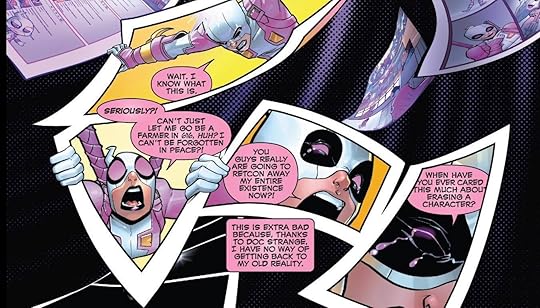
In the middle of a bank robbery, Gwenpool notices that her internal monologue is manifesting itself in the air around her, causing her to realize that she's back in her own solo title once again. She quickly discovers it's not an ongoing, and comes to understand that if she doesn't justify her existence in the 616 Marvel universe with increased sales, she will fade into obscurity again and cease to exist altogether (since Doctor Strange untethered her from her original--OUR--reality in her first solo series).
She decides that the way she will do this is to develop superpowers. She goes about this in a variety of ways that I won't spoil here, but I found her misadventures highly enjoyable. My favorite moment of the book comes when she goes into the whitespace between panels and pulls five different versions of herself from other books she's appeared in, each with different writers and artists. Artist David Baldeón does an AMAZING job here, depicting each Gwenpool in the art style of the original artist. Their personalities all differ as well, as Williams acknowledges the work that came before by writing each version of her in the style of their original writer. Speaking of which, Christopher Hastings, the writer of her original series, makes a delightful guest appearance as the writer for a single page.
Much like at the end of her first series, Gwenpool faces another existential crisis here and she ends up having a heart-to-heart with Kamala Khan as she despairs that she is about to fade away to nothingness. Like the original series, there's some really heartwarming stuff to be found here, and the depictions of the whitespace and other meta stuff is wonderfully handled by David Baldeón (especially when we see her reach forward or backward in time into another page and we to see that same moment from a completely different perspective at another point in the book).
I really enjoy when comic books get all meta on the reader and Gwenpool is a delightful example of that with a very enjoyable main character. She's definitely not for everybody (some will find this kind of thing way too bizarre or goofy), but if this kind of thing is your cup of tea I think you'll really enjoy it.
This was such a unique and creative miniseries! I’m glad Gwenpool is still getting attention in the Marvel universe; she’s such a fun character. 5/5 stars!
I had a really hard time rating this. While there were some moments where I did enjoy reading, the majority of my reading experience was negative. I'm not completely surprised. The Unbelievable Gwenpool run was so incredibly crafted, that I can understand how the new writers and artists would struggle in this next run.
My biggest issue was in the writing of Gwen's character. The majority of the volume she felt like a parody or caricature of herself. I understand that this was purposeful, and I probably would have enjoyed it if she had been written differently, however I feel as though the execution was just wrong for was trying to be accomplished.
Here are some notes I took while reading.
Cons - very clickbaity with its cover art and cliffhangers that were quickly resolved or ignored in the next issue (being self aware of the click baiting does not make click baiting any less annoying) - the "lol memez" humor (this is especially bad because gwen literally talks about not liking deadpool because of this type of humor) - there feels as if there are absolutely no stakes (just because gwen knows that she is in a comic and can leave the comic doesn't mean that there has to be no stakes, as shown in the previous gwenpool run and west coast avengers). because gwen is "hiding her true feelings and fear" we don't really see the stakes of her comic run ending until the very last issue. - all emotional value that gwenpool's character has is completely abandoned - some of the jokes were actually pretty good, but they were non stop throughout the entire volume so it just felt like the same thing repeated over and over again and really took away from any value the jokes actually had - gwen's characterisation is completely abandoned - many plot points go directly against plot points that occurred in the previous run - other than a few blink-and-you'll-miss-it cameos there is nearly no appearances from any of the characters from her previous run (where is cecil? where is teddy?) - the entire thing feels like a rip off of deadpool - the stylized art of the previous run was abandoned (you can still change artists and have the same or at least similar art style) - this whole thing felt like they attempted fan service, without actually knowing what made gwenpool so likable and enjoyable to fans in the previous run
Minor Nit Picks - there is no way kamala khan would tell gwen to read 616 stucky fics when they met when bucky was 16 and steve was 20 i don't care how old they are now, that is borderline pedophilia - it was literally a major plot point in the first gwenpool run that gwen would rather fade away and die than unmask spider-man, yet in the first issue of this run she attempts to unmask spider-man so she doesn't fade away and die - gwen spent a large part of the previous run complaining that she didn't have pants on her suit, so it feels a bit ooc that she asks the artist to give her "d cups" (this just sounds like an excuse to sexualise her character tbh)
Pros - tony taking the first possible opportunity to just completely vibe check steve (how steve and tony were characterized was really fun and pretty much spot on) - the cameos from other characters were pretty fun - kamala and gwen's relationship (we stan girlfriends) - the final issue (even though the marketing for it and cover were so misleading that i had no idea what they were trying to accomplish). i feel as though in this issue, gwen finally felt like gwen, and it was pretty much the first issue i didn't have any major complaints with.
A bouncy comic tinged with existential dread. While I can see how Marvel Comics might not have a place for Gwenpool in their future plans, she is just the character they need to keep relevant.
Gwenpool Strikes Back is a subversive last hurrah for a superhero who may well be dropped due to her metatextual backstory and baffling motive. While Deadpool and Howard the Duck indulge in very similar Fourth Wall breaks, Gwenpool is intended as a character from our world who has entered the comics. To keep her in the universe might burden certain writers and artists and undermine the world-shaking events they have in mind.
Williams does a remarkable job playing with the genre and exploring the crisis of an allegedly real character who has entered a fictional universe just in time to be retconned. I love the new power she gives to Gwenpool which is essentially deliberate plot holes used to her advantage.
While I was bored by the book's midpoint set on the island, I never stopped appreciating the point being made about the fickle nature of mainstream comics and new superheroes doomed by a lack of creative interest. I for one have enjoyed most of what I've read of Gwenpool so far and it seems a shame to let such a peculiar concept go to waste. By in large, superhero comics could do with more unconventional protagonists reliant on their wits and obsessions.
Rant aside, I applaud Williams' madcap but crafty storytelling and Baldeon's dynamic page designs. As far as last chance miniseries go, this one goes above and beyond to justify its existence. I recommend Gwenpool Strikes Back to fans of meta humour and heroes in genuine need.
This is so meta and joke-heavy that any sense of story started to get lost by issue three. It felt more like a Mad Magazine parody of a Marvel comic, but even worse because it explained the jokes, then explained the jokes explaining the jokes.
At one point it makes a reference to a certain famous Grant Morrison story. This made me appreciate the Morrison story a lot more. There is something very sly about the way Morrison started with something very dark and eased into something meta and funny. Morrison made the reader understand the character's motivations and reactions while emphasising he was just a character in a comic book. At no point here does Gwenpool here even feel like a character.
Gwenpool is an anomaly in superhero comics. She’s originally from our world, and that makes her irreverent, nerdy, over the top meta, and nihilistic all at the same time; her “powers” include her comics knowledge and traversing the white space between panels. What made her special in her debut run, to me, wasn’t breaking the fourth wall; it was the way she poked fun at comics and pushed a very particular satire and commentary, as a character who understands both worlds. While Hastings’ run had its ups and downs, he managed to create some emotional resonance with Gwen, especially when she realized her series (and possibly her existence) was coming to an end.
Instead of building on what made Gwen’s original series great, Williams rehashes Hastings’ final volume (which had major problems of its own). Gwen’s manic strategies to save her readership and continue existing in the Marvel universe are basically the same: she tries to be a villain, then switches to “sex sells” (swapping Batroc for Deadpool, and resulting in a very strange trip to the Fantastic Four home), and then she organizes a Battle Royale with other superheroes that dragged on far too long. This was already overdone last time, so the rehash was unoriginal, exhausting, and frankly, artificial. Just like Hastings’ finale, we know things will end positively for Gwen, so when Williams tries to eke out something emotional, it falls flat. And very ironic that Gwen lamented the loss of her original secondary characters in volume five, knowing they wouldn’t exist outside her series, yet here they only make one nonessential appearance. Gwen did have a sweet moment with Kamala Khan towards the end of the book which was nice, since she is so often paired with male characters (even when she was on West Coast Avengers, Gwen was almost immediately and exclusively paired with Quinten).
Compounding these problems is the humor, a staple in Gwen’s series. In Strikes Back, the humor was pretty forced. As a millennial, I’m probably no longer allowed to comment on what is cool anymore, but it often didn’t land. The slang, use of emojis and so on felt artificial and very time specific. I chuckled maybe once or twice the whole book.
I loved David Baldeón’s work on Domino and Storm (two Baldeón books in a row!), and his expressive, slick style really lends itself to Gwenpool. I love how he visualized her white space-jumping, and the artist himself has a fun cameo too. The one thing that really bothered me was giving Gwen a gap, or at least a line, between her teeth. It’s a small detail but really changed her look and I wasn’t a fan.
Gwen is all about taking risks and I wish Williams had gone in a bolder new direction with her character instead of largely repeating her former arc.
Leah williams is fast becoming one of my top 5 authors of comics at moment. Her use of jarring swerves in this book left me wanting more. She thinks about her characters at a macro level and then slowly works down to the micro. This is seen here as we get the impression that beneath the gwenpool facade their is a really naiive girl whith depth.
However this won't be for all people, it just worked for me.
I've been a Gwenpool fan since (almost) Day One, so this was a fun, meta read for me. It has the same flavor as her original series, as opposed to how she was portrayed in "West Coast Avengers."
SPOILERS:
I feel fairly satisfied with the resolution to this series, though I imagine that a future writer will ditch this new (potential) explanation of her powers.
Read as single issues, forgot to review the final volume. Another fun romp with Gwenpool and some other Marvel heroes. I thought the whole thing was hilarious.
First two issues were meh but the ending made me cry. More of a 3.5 but it’s 2022 and Goodreads doesn’t have half star ratings bc amazon bought it and let it rot to death ❤️
Naprosto geniální meta-komiks, který zachraňuje Gwen ze svrabu podivných týmovek a hostovaček, kam v posledních letech upadla. Sešity #2 a #3 jsou strašně blbý, ale paradoxně je to všechno autorčin záměr, takže se nenechte odradit. Před posledními dvěma sešity smekám, ty jsou totálně boží.
4,5* za originalitu Pozor: Nečíst, pokud by tohle měla být vaše první série s Gwenpool.
There are three different types of clickbait. The first is Asshole clickbait. This is where whatever was advertised never actually happens. The second is Normie clickbait where it does happen, albeit in a greatly underwhelming and often disappointing way. The third is David Dobrik clickbait where it actually happens and might even be better. This books falls under the second.
☼ Clickbait is popular between creators because it gets them clicks, not because the consumers like it. Maybe the author didn't get the memo? Although I suppose Gwenpool does keep going on about sales, so maybe sacrificing quality for profit was the intent.
☼ I feel bad giving this book anything other than 5 stars. Why? Because the entire narrative seemed to be about how Gwenpool was going to die if she didn't get enough sales. It felt like I was reading a blog post by a desperate fan begging other people to buy the books; this was only emphasised by Gwenpool's ability to break the fourth wall. I came to read a story not a multipage advertisement bro.
☼ So all the cover situations do happen but . . . it's all quite underwhelming. It should have been a chaotic tumble of well known characters and clever commentary; a battle royale between a shit ton of popular characters? Sign me up! The other characters might as well have been cardboard cut outs (and in some cases, were). If you want an example of a character who goes around, visits more well known characters and integrates themselves into the stories well, I would recommend reading most of Booster Gold's comics.
☞ | DO I RECOMMEND THIS?
Sorry dude, stan Booster Gold or Deadpool instead.
This book is...complicated to review. And I think the only way to really do it justice is with full spoiler mode on.
I guess I should start off by saying that the original Hastings/Gurihiru run of Gwenpool is one of my favorites of all time. Gwen was a super endearing character, Hastings walked the line between making her Meta and Zany but not annoying. When you first open this book the first thing you'll notice is that this version of the character just fucking crosses that line basically immediately and almost never looks back. And these first 2 issues are ROUGH to get through, the first issue especially breaks almost every rule of good writing and especially good comedy. She's needlessly hip with Fortnite dances, her humor is "LOL SO RANDOM" like she accuses Deadpool of being in the previous series, she lampshades how the writer is trying too hard to be hip and with the kids (Lampshading something doesn't automatically make it ok) and it's just...it's rough. The plot is that she just came back from the "dead" due to getting a miniseries again, and in order to keep herself around she realizes she has to do something drastic, her first plan is to try to get Superpowers.
The second issue isn't much better, with the beginning of the issue having her team up with Deadpool and stressing that she's only 19 and how pairing her up with the old characters in the Marvel Universe (Specifically Deadpool, in this case) would be nasty. Before saying that her next plot to stay relevant is to fuck Reed and/or Sue Richards of the Fantastic Four? And having Deadpool around amps up the zany 4th wall breaking nature. It's also super rough to read, but for slightly different reasons.
The third issue is an improvement. Her next (And final, since this plot lasts the rest of the miniseries) plan involves getting her own island together (with a cute reference to Yoshi's Island) and getting all of the popular characters to show up, in bathing suits, and then fight each other, because that will sell books. There's a really good scene here where you get an inkling of just how done Gwen is by this point. She makes a speech about how she's basically been worn down by how everyone in universe treats her like a joke and how she knows that's gonna ruin her, and so to try to do something drastic enough to keep her book alive she kidnaps and shoots the Hulk.
The fourth issue involves the Hulk freaking out, of course and Gwenpool trying to fight him. But she doesn't really know how, so she recruits Gwenpool's from other series to assist, which gives us the welcome return of best Gwenpool, referred to as Marshmellow Gwen. The eventual plan to defeat Hulk is clever, but kind of weird, using Thor's severed arm (It at some point got cut off during Jason Aaron's Thor run) to lift Mjolnir.
The fifth and final issue is actually really good. At this point it's just Gwen and Khamala Khan left on the beach battlefield. Khamala is one of Gwen's only friends so she doesn't wanna fight, she wants to talk. And this is when all of the subtext of the series thus far becomes pure text. Gwen knows she might be cancelled again, and the stress of that basically means she's been having a breakdown throughout the whole series, which explains why she's been so much more manic than she was portrayed in her original series. At the end of the issue she actually apologizes for not being the character fans wanted and how this series was for her to grow and while that would obviously be really weird and on the nose for pretty much any other character it rings really true and authentic here considering the concept of the character.
This is genuinely good development and the final issue is REALLY good and paints what came before in a different light. But unfortunately, not enough for those first two issues to actually be enjoyable. I can appreciate what was being attempted, but they leaned too much into Gwen being more wacky and zany without enough looks into the turmoil underneath, until the end.
The art by David Baldeon also improves throughout the issues, it's a very radical departure from Gurihiru at first, and I don't think I'll ever truly get used to her not being drawn by the iconic Japanese team, however it does still fit the manic energy of this series and they really get to show off their artistic skills in Issue 4, where they make each of the different Gwen's recognizable just by how they're drawn.
The series as a whole middles out as middle of the road, due to the series starting out at rock bottom and ending on a hell of a high note. But because of that it's a hard series to recommend. Would only recommend to people with a high tolerance for cringy humor and who can push through some truly awful stuff to get to the heart underneath the LOL SO RANDOM humor.
This entire review has been hidden because of spoilers.