

What do you think?

The Tolstoy Estate
Epic in scope, ambitious and astonishingly good, The Tolstoy Estate proclaims Steven Conte as one of Australia's finest writers.
From the winner of the inaugural Prime Minister's Literary Award, Steven Conte, comes a powerful, densely rich and deeply affecting novel of love, war and literature
'Grave, moving, engaging ... full of the flash and fire of dramatic incident, but also full of real feeling, humour and poignancy, and equipped with plenty of panache ... It deserves the widest possible readership.' The Saturday Paper
In the first year of the doomed German invasion of Russia in WWII, a German military doctor, Paul Bauer, is assigned to establish a field hospital at Yasnaya Polyana - the former grand estate of Count Leo Tolstoy, the author of the classic War and Peace. There he encounters a hostile aristocratic Russian woman, Katerina Trubetzkaya, a writer who has been left in charge of the estate. But even as a tentative friendship develops between them, Bauer's hostile and arrogant commanding officer, Julius Metz, becomes erratic and unhinged as the war turns against the Germans. Over the course of six weeks, in the terrible winter of 1941, everything starts to unravel...
From the critically acclaimed and award-winning author, Steven Conte, The Tolstoy Estate is ambitious, accomplished and astonishingly good: an engrossing, intense and compelling exploration of the horror and brutality of conflict, and the moral, emotional, physical and intellectual limits that people reach in war time. It is also a poignant, bittersweet love story - and, most movingly, a novel that explores the notion that literature can still be a potent force for good in our world.
Shortlisted for the 2021 Walter Scott Scott Prize
'Breathtaking ... an intelligent. cinematic blockbuster. celebrating the power of literature to dissolve barriers and forge connections.' The West Australian
'Reading a book that is such a complete world, evoked in such fine detail, is almost wickedly satisfying ... Elegant, intelligent, utterly engrossing and immersive ... He reminds us that travel is always possible in the imagination even when reality goes dark and that literature always leads us towards the light.' Caroline Baum
'Steven Conte has written a sweeping historical saga spanning the second world WAR and the frigid decades of PEACE that followed; an essential novel about essential things - love's triumphs and failures, the redoubtable human spirit, and the power of literary art itself. Tolstoy, of course, is at the novel's heart, and in its very soul.' Luke Slattery, author, journalist, Books Editor of Australian Financial Review
'A riveting story of war, love and literature - Conte's prose does not miss a beat.' Jane Gleeson-White, award-winning author of Classics and Double Entry
From the winner of the inaugural Prime Minister's Literary Award, Steven Conte, comes a powerful, densely rich and deeply affecting novel of love, war and literature
'Grave, moving, engaging ... full of the flash and fire of dramatic incident, but also full of real feeling, humour and poignancy, and equipped with plenty of panache ... It deserves the widest possible readership.' The Saturday Paper
In the first year of the doomed German invasion of Russia in WWII, a German military doctor, Paul Bauer, is assigned to establish a field hospital at Yasnaya Polyana - the former grand estate of Count Leo Tolstoy, the author of the classic War and Peace. There he encounters a hostile aristocratic Russian woman, Katerina Trubetzkaya, a writer who has been left in charge of the estate. But even as a tentative friendship develops between them, Bauer's hostile and arrogant commanding officer, Julius Metz, becomes erratic and unhinged as the war turns against the Germans. Over the course of six weeks, in the terrible winter of 1941, everything starts to unravel...
From the critically acclaimed and award-winning author, Steven Conte, The Tolstoy Estate is ambitious, accomplished and astonishingly good: an engrossing, intense and compelling exploration of the horror and brutality of conflict, and the moral, emotional, physical and intellectual limits that people reach in war time. It is also a poignant, bittersweet love story - and, most movingly, a novel that explores the notion that literature can still be a potent force for good in our world.
Shortlisted for the 2021 Walter Scott Scott Prize
'Breathtaking ... an intelligent. cinematic blockbuster. celebrating the power of literature to dissolve barriers and forge connections.' The West Australian
'Reading a book that is such a complete world, evoked in such fine detail, is almost wickedly satisfying ... Elegant, intelligent, utterly engrossing and immersive ... He reminds us that travel is always possible in the imagination even when reality goes dark and that literature always leads us towards the light.' Caroline Baum
'Steven Conte has written a sweeping historical saga spanning the second world WAR and the frigid decades of PEACE that followed; an essential novel about essential things - love's triumphs and failures, the redoubtable human spirit, and the power of literary art itself. Tolstoy, of course, is at the novel's heart, and in its very soul.' Luke Slattery, author, journalist, Books Editor of Australian Financial Review
'A riveting story of war, love and literature - Conte's prose does not miss a beat.' Jane Gleeson-White, award-winning author of Classics and Double Entry
416 pages, ebook
First published September 1, 2020
Ratings & Reviews
Friends & Following
Create a free account to discover what your friends think of this book!
Community Reviews
Displaying 1 - 30 of 152 reviews
September 4, 2020
The atmospheric cover of this book drew me into reading it and it is certainly very evocative of the time and place at the centre of this wonderful novel.
In November 1941, a German medial unit was sent to find buildings suitable for setting up a field hospital close to the front near Tula, which the German army was attempting to take in the push towards Moscow. They choose Yasnaya Polyana, the country estate of Leo Tolstoy, which had been converted to a museum in honor of Tolstoy, much to the disgust of Katerina Trubetzkaya, the fierce and somewhat feisty custodian in charge of the museum. She made no qualms about her hatred of the Germans and refused to leave the museum in their hands, negotiating for her staff to continue caring for it. A writer herself, she gradually warms to one of the surgeons, Paul Bauer, who taught himself Russian while reading 'War and Peace' as a teenager, and is enthralled to be in Tolstoy's home. She finds him a copy in German to re-read and they start to enjoy conversations about life and literature. Both widowed and in their forties, they discover they have more in common than a love of literature.
For six weeks, during the onset of a brutally cold winter that would to see the start of the tide turning against Germany, the surgeons dealt with horrifying casualties, operating for long hours to save as many wounded men as they could. Paul is horrified to learn that his commanding officer and senior surgeon, Julius Metz is taking amphetamines to cope with the long periods without sleep, especially as he becomes increasingly erratic and unpredictable. Even under these conditions, the men show their humanity, forming friendships, enjoying banter and coming up with schemes to occupy their free time.
This is a very immersive tale of a group of men faced daily with horrendous wounds, doing their best to save lives under appalling conditions and numbing exhaustion. Conte's prose is both strong and tender as he observes the interactions and conversations between the characters and the development of an enduring love story. About half way through the book, letters written after the war appear, interspersed with the chapters, and offer a glimpse of what happened to the main characters after the events of those six weeks spent at Tolstoy's home. Together it all made for a wonderful and compelling read that will stay in my mind for some time.
With many thanks to Harper Collins Australia and Netgalley for a copy of this book
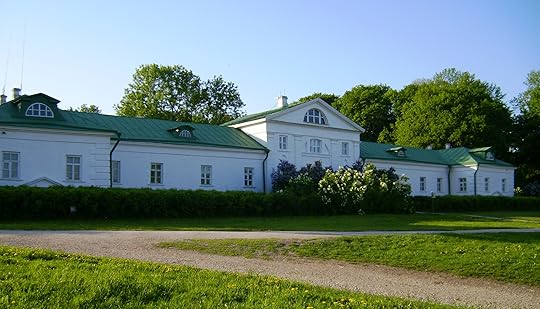
Yasnaya Polyana (below) is still maintained as a museum today:
In November 1941, a German medial unit was sent to find buildings suitable for setting up a field hospital close to the front near Tula, which the German army was attempting to take in the push towards Moscow. They choose Yasnaya Polyana, the country estate of Leo Tolstoy, which had been converted to a museum in honor of Tolstoy, much to the disgust of Katerina Trubetzkaya, the fierce and somewhat feisty custodian in charge of the museum. She made no qualms about her hatred of the Germans and refused to leave the museum in their hands, negotiating for her staff to continue caring for it. A writer herself, she gradually warms to one of the surgeons, Paul Bauer, who taught himself Russian while reading 'War and Peace' as a teenager, and is enthralled to be in Tolstoy's home. She finds him a copy in German to re-read and they start to enjoy conversations about life and literature. Both widowed and in their forties, they discover they have more in common than a love of literature.
For six weeks, during the onset of a brutally cold winter that would to see the start of the tide turning against Germany, the surgeons dealt with horrifying casualties, operating for long hours to save as many wounded men as they could. Paul is horrified to learn that his commanding officer and senior surgeon, Julius Metz is taking amphetamines to cope with the long periods without sleep, especially as he becomes increasingly erratic and unpredictable. Even under these conditions, the men show their humanity, forming friendships, enjoying banter and coming up with schemes to occupy their free time.
This is a very immersive tale of a group of men faced daily with horrendous wounds, doing their best to save lives under appalling conditions and numbing exhaustion. Conte's prose is both strong and tender as he observes the interactions and conversations between the characters and the development of an enduring love story. About half way through the book, letters written after the war appear, interspersed with the chapters, and offer a glimpse of what happened to the main characters after the events of those six weeks spent at Tolstoy's home. Together it all made for a wonderful and compelling read that will stay in my mind for some time.
With many thanks to Harper Collins Australia and Netgalley for a copy of this book
Yasnaya Polyana (below) is still maintained as a museum today:

June 13, 2021
Maybe 4.5. I really enjoyed this one – cleverly written, with fantastic characterisation and some really moving moments. I highly recommend it.

September 5, 2020
This was a really absorbing read about a German army surgeon during the German invasion of Russia during WWII. His battalion stumbles upon and commandeers Leo Tolstoy's estate which has become a museum and the story references War and Peace all along the way. Having not read War and Peace didn't seem to detract from this book, but I imagine there would be more depth to it had I read that previously.
There is a lot about what daily life at the front was like in a medical unit and it was fascinating. I wasn't expecting to be so drawn in by that, but I was. And the banter among the men and the main character's jaded inner dialog were the real highlight for me.
The other main aspect of the story was a romance between our surgeon and the Russian caretaker of the estate. This was in no way romance-novel style, but very much a human story of how connections can be made over literature even in the most unexpected and hostile situations.
I would recommend it, and not just to historical fiction lovers but also to lovers of literature and the human experience.
Thank you to Netgalley and the publisher for providing me with an ARC. The opinions presented here are all my own.
There is a lot about what daily life at the front was like in a medical unit and it was fascinating. I wasn't expecting to be so drawn in by that, but I was. And the banter among the men and the main character's jaded inner dialog were the real highlight for me.
The other main aspect of the story was a romance between our surgeon and the Russian caretaker of the estate. This was in no way romance-novel style, but very much a human story of how connections can be made over literature even in the most unexpected and hostile situations.
I would recommend it, and not just to historical fiction lovers but also to lovers of literature and the human experience.
Thank you to Netgalley and the publisher for providing me with an ARC. The opinions presented here are all my own.

August 23, 2020
My advanced copy of The Tolstoy Estate (Fourth Estate Harper Collins 2020) arrived with this emblazoned on the cover: ‘A Novel for People Who Still Believe in the Saving Grace of Literature in Dark Times’. We are certainly in dark times now in this Covid world, and the novel is set in the dark times of World War Two, but as promised, this story is like a blessing, a saving grace, a tale of love and optimism and hope amidst the absolute terror and trauma of war.
This is the second novel for author Steven Conte, who won the inaugural Prime Minister’s Literary Award for Fiction in 2008 for his debut The Zookeeper’s War. I can only assume that this second book has been quietly cooking away for the last 12 years and now here it is, eagerly anticipated, extremely well done, delicious and worth the wait.
The Tolstoy Estate is both a well-crafted and beautifully written literary tale but also a dynamic and powerful story with unforgettable characters. The novel explores themes of sacrifice, love, desire, betrayal, duty and the power of great literature to inspire thought, to change minds and to connect people.
Rarely do you come across a book that excels in so many aspects. This is a tender and poignant love story. It is a poetic and evocatively descriptive tale. It is plotted like a tense page-turner, with the raw facts of war – specifically of the medical treatment of war injuries – rendered comprehensible and compelling. And it is driven by its characters, people who we care about from the first pages; personalities that burst onto the page and refuse to stay silent. So much of this story is told in dialogue and this enhances the engagement between character and reader – the spoken words are authentic, sharp, funny, carefully observed, colloquial and interesting. And yet scaffolding all of these relatable aspects is the highly literary work of Leo Tolstoy, his book War and Peace a touchstone for the characters, for the setting and for the narrative.
Set during the German invasion of Russia in WWII, the story features Paul Bauer, a German military doctor, who is assigned to establish a field hospital at Yasnaya Polyana, the former grand estate of the famous writer Count Leo Tolstoy. He encounters the woman left in charge of the estate, fiery Russian Katerina Trusbetzkaya, and despite her initial hostility, a tentative friendship develops between them. But the war is not going according to Germany’s master plan, and over six weeks in the bitterly harsh winter of 1941, Bauer’s arrogant commanding officer Julius Metz becomes more unstable and unhinged, Bauer’s patients come thick and fast from the frontline, and his friends and colleagues suffer the traumas of war in many different ways.
The writing is astonishingly good. It doesn’t shy away from the brutality of war, from the visceral, messy, bloody, heartbreaking horror, and the sections that describe Bauer’s long, unremitting working hours in his relentless attempts to treat wounded soldiers with only basic equipment and supplies, and in freezing temperatures, are both frightening and compelling. But this is balanced by the relationship dynamics between the men, and by the developing frisson of desire between Paul and Katerina, and the absolutely engaging dialogue which exactly captures the characters’ torn loyalties, their unspoken reservations, their bravado and their quietly held fears. These are men and women in extreme circumstances, expected to achieve extraordinary feats while suffering terrible personal trauma. Conte manages to emphasise both the very best and the very worst of human behaviour through the smallest acts, the simplest phrases and the most subtle and nuanced interactions. He explores the ‘moral, emotional, physical and intellectual limits that people reach in war time’, and he does this through the interpretation of a story so engrossing and readable that I found it difficult to put down.
As is typical of a great writer, Conte takes us immediately into the action from page one. This means that those first few pages are dizzying and intense as we try to orientate ourselves into THIS place, THIS time, and engage with THESE people. But by the end of Chapter One, which finishes with a shocking act, I was completely hooked.
Structurally the linear narrative is straightforward until a surprising point about halfway through the novel where the author suddenly takes us forward in time, through an exchange of correspondence, to give us a tantalising glimpse of where some of the characters are in the future. It is only a taste, a small teaser, enough to make us wonder, and then we are back in the thick of the action. He uses this device several times throughout the story, jarring us out of the war and catapulting us into the future. Rather than spoil any plot points, this serves only to whet our curiosity for how he plans to get us from A to B, and how indeed the characters are going to end up where they seem to be.
The final chapter – with its characteristically offhand summation of the fate of one of the characters – is devastating and beautiful and so, so moving.
And the entire story begins and ends with Tolstoy: his life, his work, his writing, his relationships, his death, his legacy.
This is an absolutely riveting book. While it will have obvious appeal to readers who love war stories or who are fascinated by the life and work of Tolstoy, the human emotion and tenderness, the poignancy and humour will have as much wide appeal as books such as All the Light We Cannot See by Anthony Doerr and The Book Thief by Markus Zusak.
This is the second novel for author Steven Conte, who won the inaugural Prime Minister’s Literary Award for Fiction in 2008 for his debut The Zookeeper’s War. I can only assume that this second book has been quietly cooking away for the last 12 years and now here it is, eagerly anticipated, extremely well done, delicious and worth the wait.
The Tolstoy Estate is both a well-crafted and beautifully written literary tale but also a dynamic and powerful story with unforgettable characters. The novel explores themes of sacrifice, love, desire, betrayal, duty and the power of great literature to inspire thought, to change minds and to connect people.
Rarely do you come across a book that excels in so many aspects. This is a tender and poignant love story. It is a poetic and evocatively descriptive tale. It is plotted like a tense page-turner, with the raw facts of war – specifically of the medical treatment of war injuries – rendered comprehensible and compelling. And it is driven by its characters, people who we care about from the first pages; personalities that burst onto the page and refuse to stay silent. So much of this story is told in dialogue and this enhances the engagement between character and reader – the spoken words are authentic, sharp, funny, carefully observed, colloquial and interesting. And yet scaffolding all of these relatable aspects is the highly literary work of Leo Tolstoy, his book War and Peace a touchstone for the characters, for the setting and for the narrative.
Set during the German invasion of Russia in WWII, the story features Paul Bauer, a German military doctor, who is assigned to establish a field hospital at Yasnaya Polyana, the former grand estate of the famous writer Count Leo Tolstoy. He encounters the woman left in charge of the estate, fiery Russian Katerina Trusbetzkaya, and despite her initial hostility, a tentative friendship develops between them. But the war is not going according to Germany’s master plan, and over six weeks in the bitterly harsh winter of 1941, Bauer’s arrogant commanding officer Julius Metz becomes more unstable and unhinged, Bauer’s patients come thick and fast from the frontline, and his friends and colleagues suffer the traumas of war in many different ways.
The writing is astonishingly good. It doesn’t shy away from the brutality of war, from the visceral, messy, bloody, heartbreaking horror, and the sections that describe Bauer’s long, unremitting working hours in his relentless attempts to treat wounded soldiers with only basic equipment and supplies, and in freezing temperatures, are both frightening and compelling. But this is balanced by the relationship dynamics between the men, and by the developing frisson of desire between Paul and Katerina, and the absolutely engaging dialogue which exactly captures the characters’ torn loyalties, their unspoken reservations, their bravado and their quietly held fears. These are men and women in extreme circumstances, expected to achieve extraordinary feats while suffering terrible personal trauma. Conte manages to emphasise both the very best and the very worst of human behaviour through the smallest acts, the simplest phrases and the most subtle and nuanced interactions. He explores the ‘moral, emotional, physical and intellectual limits that people reach in war time’, and he does this through the interpretation of a story so engrossing and readable that I found it difficult to put down.
As is typical of a great writer, Conte takes us immediately into the action from page one. This means that those first few pages are dizzying and intense as we try to orientate ourselves into THIS place, THIS time, and engage with THESE people. But by the end of Chapter One, which finishes with a shocking act, I was completely hooked.
Structurally the linear narrative is straightforward until a surprising point about halfway through the novel where the author suddenly takes us forward in time, through an exchange of correspondence, to give us a tantalising glimpse of where some of the characters are in the future. It is only a taste, a small teaser, enough to make us wonder, and then we are back in the thick of the action. He uses this device several times throughout the story, jarring us out of the war and catapulting us into the future. Rather than spoil any plot points, this serves only to whet our curiosity for how he plans to get us from A to B, and how indeed the characters are going to end up where they seem to be.
The final chapter – with its characteristically offhand summation of the fate of one of the characters – is devastating and beautiful and so, so moving.
And the entire story begins and ends with Tolstoy: his life, his work, his writing, his relationships, his death, his legacy.
This is an absolutely riveting book. While it will have obvious appeal to readers who love war stories or who are fascinated by the life and work of Tolstoy, the human emotion and tenderness, the poignancy and humour will have as much wide appeal as books such as All the Light We Cannot See by Anthony Doerr and The Book Thief by Markus Zusak.

July 7, 2020
This was an exceptionally good novel. It’s the story of a German medical unit that has set up their hospital on the grounds of Tolstoy’s Estate in the middle of the Russian winter of 1941. The novel spans six weeks although in a stylistic twist, the author gives us the ending about half way through with the introduction of a series of letters that begin in the 1960s. Surprisingly, this didn’t spoil the tension of all that was still to come. Although, Conte displays such a command of his narrative, perhaps I shouldn’t be surprised by this.
‘War is filthy, of course. It hurts and it hardens. But the fact is that for surgeons it’s also an opportunity. Every month we’re making medical advances: honing old techniques, inventing new ones, even upending a dogma or two.’
‘You’re a seeker after truth.’
‘Is that irony I detect?’
‘Yes, but go on.’
‘Truth be told, professional satisfaction is the least of it, because as well as seeking truth I’m also revelling in mystery. I delve into people, and you’ve just seen how strange, how wondrous that can be. What I’m trying to express,’ he said, ‘earnestly…’
‘No matter. Go on.’
‘…is that surgery is more of an art than a science. There’s an imprecision to it – a fuzziness, if you will – that’s maddening but also compelling.’
Paul Bauer, our narrator for this story, is a highly skilled and dedicated surgeon, widowed, in his forties, a German Officer who is not a Nazi, who, in all honesty, appears to not even support Hitler. He is a fan of Tolstoy and relishes the opportunity to be present on the great literary giant’s estate. There he meets Katerina Trubetzkaya, caretaker of the estate, a Soviet woman who burns with anger and realism. She is also in her forties, and I only mention this because it was refreshing to read a war story that wasn’t entirely populated by young and glamorous twenty year olds. These were characters that had all lived lives prior to the war, loved and lost, been members of political movements and developed ideologies of their own. Both Paul and Katerina were well read, well educated, and their conversations were lively and stimulating, all the more so for them being on opposite sides of the war.
‘Oh, they were grand days,’ she said, smiling, ‘thrilling days. You’ve no idea. We were poor, of course. Everyone was. But there was a feeling of extraordinary possibility in the air: factories would end want, mechanised agriculture would abolish hunger, science would conquer disease. People would be free to work as they pleased, love as they pleased. Some of this we even accomplished. Homosexuality was made legal, though that was later reversed. And literacy – there’s one achievement that’s endured.’
Her eyes were shining and it occurred to Bauer there was no period in his own life that he looked back on with such passion.
‘I don’t know why I’m telling you all this,’ Katerina said. ‘You’re probably a Nazi. Are you a Nazi?’
‘No, I’m not,’ he said. ‘In the election that brought Adolf Hitler to power I voted for the Social Democrats.’
She pretended to recoil at this. ‘Oh, good grief, one of those. If it gets out I’ve talked with a petit-bourgeois socialist I’ll be shot when our forces come back.’
Tolstoy himself is a vivid presence throughout the novel, and not just because the hospital camp is based on his estate. Paul begins a re-read of War and Peace and this novel, more than any other of Tolstoy’s works, becomes a symbol for Paul, a connection to others he encounters who have also read it. Katerina, as caretaker of the estate, has a great affection for Tolstoy and has studied his works extensively. Metz, Paul’s commanding officer, develops a different fixation with Tolstoy, a more bizarre and concerning one. He believes he can feel Tolstoy’s ghost, and rapidly descends, with the aid of rampant drug use, into a manic state whereby he believes he must conquer Tolstoy in order to win the war. Not a state of mind you want in a commanding officer. All of this is unfolding against a background of a war being fought without adequate resources in a country whose harsh winter climate will act as a hand of fate like no other.
‘To be clear, I’m not saying that the novel as a form will disappear, any more than poetry has disappeared since it lost its status as the most prestigious branch of literature. But its importance will fade. Everything fades, I suppose, certainly everything made by human hands, and yet I can’t help feeling bereft to witness this diminution of the novel, which for all its inadequacies has trained us to see the world from others’ points of view. To borrow a Stalinist idiom, the novel is a machine, a noisy, violent thing whose product, oddly enough, is often human understanding, perhaps even a kind of love. I daresay some might look at the last one hundred years and say, ‘Nonsense, what love?’ but if so they are naive because the terrifying truth is that it could have been worse. Hitler could have won. Kennedy and Khrushchev could have blown us all to hell. And who knows what other horrors we’ve evaded because someone, or someone’s teacher, or someone’s mother or grandfather, once put down a novel and thought, ‘My God, I am like that stranger’ or ‘That stranger is like me’ or even ‘That stranger is utterly different from me, and yet, how understandable his hopes and longings are.’ And in the future, as fewer and fewer people use these engines of empathy, what horrors will we not avoid?’
This novel is visually stunning, allowing you to imagine the unimaginable. It’s also a love story, and not only between two people, but more subtly, for novels as a form of creative expression. This is a really intelligent work of fiction that had me thinking critically and feeling deeply.
Thanks is extended to HarperCollins Publishers Australia for providing me with a copy of The Tolstoy Estate for review.
‘War is filthy, of course. It hurts and it hardens. But the fact is that for surgeons it’s also an opportunity. Every month we’re making medical advances: honing old techniques, inventing new ones, even upending a dogma or two.’
‘You’re a seeker after truth.’
‘Is that irony I detect?’
‘Yes, but go on.’
‘Truth be told, professional satisfaction is the least of it, because as well as seeking truth I’m also revelling in mystery. I delve into people, and you’ve just seen how strange, how wondrous that can be. What I’m trying to express,’ he said, ‘earnestly…’
‘No matter. Go on.’
‘…is that surgery is more of an art than a science. There’s an imprecision to it – a fuzziness, if you will – that’s maddening but also compelling.’
Paul Bauer, our narrator for this story, is a highly skilled and dedicated surgeon, widowed, in his forties, a German Officer who is not a Nazi, who, in all honesty, appears to not even support Hitler. He is a fan of Tolstoy and relishes the opportunity to be present on the great literary giant’s estate. There he meets Katerina Trubetzkaya, caretaker of the estate, a Soviet woman who burns with anger and realism. She is also in her forties, and I only mention this because it was refreshing to read a war story that wasn’t entirely populated by young and glamorous twenty year olds. These were characters that had all lived lives prior to the war, loved and lost, been members of political movements and developed ideologies of their own. Both Paul and Katerina were well read, well educated, and their conversations were lively and stimulating, all the more so for them being on opposite sides of the war.
‘Oh, they were grand days,’ she said, smiling, ‘thrilling days. You’ve no idea. We were poor, of course. Everyone was. But there was a feeling of extraordinary possibility in the air: factories would end want, mechanised agriculture would abolish hunger, science would conquer disease. People would be free to work as they pleased, love as they pleased. Some of this we even accomplished. Homosexuality was made legal, though that was later reversed. And literacy – there’s one achievement that’s endured.’
Her eyes were shining and it occurred to Bauer there was no period in his own life that he looked back on with such passion.
‘I don’t know why I’m telling you all this,’ Katerina said. ‘You’re probably a Nazi. Are you a Nazi?’
‘No, I’m not,’ he said. ‘In the election that brought Adolf Hitler to power I voted for the Social Democrats.’
She pretended to recoil at this. ‘Oh, good grief, one of those. If it gets out I’ve talked with a petit-bourgeois socialist I’ll be shot when our forces come back.’
Tolstoy himself is a vivid presence throughout the novel, and not just because the hospital camp is based on his estate. Paul begins a re-read of War and Peace and this novel, more than any other of Tolstoy’s works, becomes a symbol for Paul, a connection to others he encounters who have also read it. Katerina, as caretaker of the estate, has a great affection for Tolstoy and has studied his works extensively. Metz, Paul’s commanding officer, develops a different fixation with Tolstoy, a more bizarre and concerning one. He believes he can feel Tolstoy’s ghost, and rapidly descends, with the aid of rampant drug use, into a manic state whereby he believes he must conquer Tolstoy in order to win the war. Not a state of mind you want in a commanding officer. All of this is unfolding against a background of a war being fought without adequate resources in a country whose harsh winter climate will act as a hand of fate like no other.
‘To be clear, I’m not saying that the novel as a form will disappear, any more than poetry has disappeared since it lost its status as the most prestigious branch of literature. But its importance will fade. Everything fades, I suppose, certainly everything made by human hands, and yet I can’t help feeling bereft to witness this diminution of the novel, which for all its inadequacies has trained us to see the world from others’ points of view. To borrow a Stalinist idiom, the novel is a machine, a noisy, violent thing whose product, oddly enough, is often human understanding, perhaps even a kind of love. I daresay some might look at the last one hundred years and say, ‘Nonsense, what love?’ but if so they are naive because the terrifying truth is that it could have been worse. Hitler could have won. Kennedy and Khrushchev could have blown us all to hell. And who knows what other horrors we’ve evaded because someone, or someone’s teacher, or someone’s mother or grandfather, once put down a novel and thought, ‘My God, I am like that stranger’ or ‘That stranger is like me’ or even ‘That stranger is utterly different from me, and yet, how understandable his hopes and longings are.’ And in the future, as fewer and fewer people use these engines of empathy, what horrors will we not avoid?’
This novel is visually stunning, allowing you to imagine the unimaginable. It’s also a love story, and not only between two people, but more subtly, for novels as a form of creative expression. This is a really intelligent work of fiction that had me thinking critically and feeling deeply.
Thanks is extended to HarperCollins Publishers Australia for providing me with a copy of The Tolstoy Estate for review.
June 1, 2022
What an amazing and absorbing book this is to read. Developed, interesting and diverse characters throughout that jump out of the pages!
An expansive time frame dealing with the invasion of Russia by Germany and the aftermath of the war. The trauma of war is dealt with on many fronts, emotionally, physically and socially through the many incidents that occur throughout the book.
How wonderful that this takes place at Tolstoy’s famous estate Yasnaya Polyana where he wrote War and Peace and Anna Karenina.
Well researched, intelligently written and beautifully constructed. Highly recommended and it will inspire anyone to read not only this book but all the very favourite Russian authors.
An expansive time frame dealing with the invasion of Russia by Germany and the aftermath of the war. The trauma of war is dealt with on many fronts, emotionally, physically and socially through the many incidents that occur throughout the book.
How wonderful that this takes place at Tolstoy’s famous estate Yasnaya Polyana where he wrote War and Peace and Anna Karenina.
Well researched, intelligently written and beautifully constructed. Highly recommended and it will inspire anyone to read not only this book but all the very favourite Russian authors.

August 27, 2020
I was instantly attracted to this book for its stunning cover, it being historical fiction and the incorporation of renown literature ie. Tolstoy. This is a very ambitious undertaking and the author does an admirable job in delivering the many finer details of a side of war not often portrayed. Seen through the eyes of a moral forty year old German doctor involved in a very immoral situation, this book is compelling in its exploration of the brutality of war in the harsh Russian winter.
“Are you a good man, Paul Bauer?” she said to him as soon as he sat down again. “Is that why you’re here?” He glanced at her sideways to see if she was mocking him. “Because I must say I like you better as a saviour of innocent civilians than as a servant of the German war machine.” “The men I operate on are people too, you know.” “Just not innocent.”
Conte covers a six week period when the German army occupies the former residence of author Leo Tolsoy. There are many layers to this book. Firstly there is the confronting descriptions of being part of a field hospital and the detailed accounts of the injuries and many deaths. There is also a strong sense of time and place - Russia in winter - the arctic cold is very much a character in itself for this story. Then there is what the author terms his ‘dark version of M.A.S.H’ with the relationships and banter amongst the German officers. There is the romance (not overt) through a love of literature and the incorporation of themes from Tolstoys, ‘War and Peace’ between the good doctor and the Russian woman left in charge of the estate. Overall, this is a detailed and precise focus on one point in time and the lasting impact war can ravage on both person and place.
‘Six weeks we’ve been here - the same amount of time as Napoleon held Moscow.”
“I suppose I should be grateful you haven’t followed his example and burnt the place down.”
“Yet,” he warned.’
Interspersed throughout the war narrative, are letters written much later by the survivors, which assists the reader in understanding how this impacted on their lives after this six week period. This book is brutally honest and confronting. It is full of horrors yet moments of love (human) and reverence (literature) for what people cling to as an anchor to see them through such times. Somehow Conte weaves it all together for a complete exploration of German and Soviets during WWII and the physical, social, emotional and intellectual strains during a dark period in history.
‘War and Peace also had the odd effect of restoring my faith in doing good in the world; because if as Tolstoy argued, we are all specks in a vast world-historical drama, even those of us pretending to be in charge, it followed that everyone’s actions were at least potentially equal, and that a humble person sometimes influences events more profoundly than did generals, emperors and tsars.’
This review is based on a complimentary copy from the publisher in exchange for an honest review. The quoted material may have changed in the final release.
“Are you a good man, Paul Bauer?” she said to him as soon as he sat down again. “Is that why you’re here?” He glanced at her sideways to see if she was mocking him. “Because I must say I like you better as a saviour of innocent civilians than as a servant of the German war machine.” “The men I operate on are people too, you know.” “Just not innocent.”
Conte covers a six week period when the German army occupies the former residence of author Leo Tolsoy. There are many layers to this book. Firstly there is the confronting descriptions of being part of a field hospital and the detailed accounts of the injuries and many deaths. There is also a strong sense of time and place - Russia in winter - the arctic cold is very much a character in itself for this story. Then there is what the author terms his ‘dark version of M.A.S.H’ with the relationships and banter amongst the German officers. There is the romance (not overt) through a love of literature and the incorporation of themes from Tolstoys, ‘War and Peace’ between the good doctor and the Russian woman left in charge of the estate. Overall, this is a detailed and precise focus on one point in time and the lasting impact war can ravage on both person and place.
‘Six weeks we’ve been here - the same amount of time as Napoleon held Moscow.”
“I suppose I should be grateful you haven’t followed his example and burnt the place down.”
“Yet,” he warned.’
Interspersed throughout the war narrative, are letters written much later by the survivors, which assists the reader in understanding how this impacted on their lives after this six week period. This book is brutally honest and confronting. It is full of horrors yet moments of love (human) and reverence (literature) for what people cling to as an anchor to see them through such times. Somehow Conte weaves it all together for a complete exploration of German and Soviets during WWII and the physical, social, emotional and intellectual strains during a dark period in history.
‘War and Peace also had the odd effect of restoring my faith in doing good in the world; because if as Tolstoy argued, we are all specks in a vast world-historical drama, even those of us pretending to be in charge, it followed that everyone’s actions were at least potentially equal, and that a humble person sometimes influences events more profoundly than did generals, emperors and tsars.’
This review is based on a complimentary copy from the publisher in exchange for an honest review. The quoted material may have changed in the final release.

May 3, 2023
An interesting historical fiction love story mainly set during six weeks in the winter of 1941 at the former grand estate of Leo Tolstoy. Paul Bauer, a German military doctor is assigned to establish a field hospital at the grand estate. There he encounters a hostile aristocratic Russian woman, Katerina Trubelzkaya, a writer. After the war Paul and Katerina communicate by letters.
There are descriptions of the surgeries Paul Bauer performs. Bauer is a humanitarian who will try to save anyone who needs his help. This produces some conflicts with his superior officers when Paul performs surgery on Russians. There is an interesting issue when a Ukrainian man working for the Germans, accuses a German officer of homosexuality.
Overall, a very worthwhile read with an interesting plot and well developed characters. Paul and Katerina’s ongoing discussion of Tolstoy’s book, ‘War and Peace’, adds to the novels appeal.
This book was shortlisted for the 2021 Walter Scott Prize for Historical Ficton.
There are descriptions of the surgeries Paul Bauer performs. Bauer is a humanitarian who will try to save anyone who needs his help. This produces some conflicts with his superior officers when Paul performs surgery on Russians. There is an interesting issue when a Ukrainian man working for the Germans, accuses a German officer of homosexuality.
Overall, a very worthwhile read with an interesting plot and well developed characters. Paul and Katerina’s ongoing discussion of Tolstoy’s book, ‘War and Peace’, adds to the novels appeal.
This book was shortlisted for the 2021 Walter Scott Prize for Historical Ficton.

September 19, 2021
Superb! The best book I've read this year and that includes other great books like Shuggie Bain, American Dirt and The Lying Life of Adults. What makes this book so good and sets it apart from so many others, I think, is the author relies heavily on shaping the characters through what they say i.e. dialogue. I listened to the beautifully read audio version. Again, a brilliant book.
September 7, 2020
Well.....I wasn't expecting that!
I am sure that I am not alone in expecting that, when I open a book, I am going to enjoy it. I certainly don't start a book expecting not to like it. It is, however, a delight when you start a book and know that you are going to LOVE it within a few pages, especially when it is an author you haven't read before. That is what happened with this book.
Dr Paul Bauer is a military doctor who finds himself stationed in Russia during the harsh winter of 1941. The German army is fighting it's way towards the city of Tula which is around 200 km south of Moscow - almost within striking distance of their ultimate destination. The medical unit is tasked with finding a base to use as a hospital when they commander the estate that was the family home and final resting place of Leo Tolstoy, Yasnaya Polyana.
Bauer is an educated man who read and loved War and Peace as a young man, and he is therefore thrilled to find himself living in the famous author's home. He is especially pleased when he finds a German copy of War and Peace still in the library after all of the most important historical items had been evacuated prior to their arrival. Despite his commanding officer demanding that the book is disposed of, Bauer begins to reread it. As he also speaks a bit of Russian, Bauer finds himself designated to deal with the locals.
To read more head to
http://www.theintrepidreader.com/2020...

July 2, 2020
This historical fiction verges into a romance without it taking over the story.
The events revolve around the 6 week German occupation of the estate formerly owned by the author Leo Tolstoy, history which is woven throughout and emerges in dialogue showing the character's love for Tolstoy and his stories and adds a deeper layer to this book. This appreciation for and knowledge of Tolstoy is obviously Conte's own, and he has done a lovely job of communicating that through his characters. Certainly, I feel I know more about Tolstoy and his epic War and Peace from reading The Tolstoy Estate.
Told chiefly from the point of view of a German doctor is something that sets this war narrative apart from others, which are often told from the point of view of the Allies and highlighting the atrocities committed by the Germans; in this story, we see the humanity of the German troops and how they fared in attempting to invade the Soviets (it's no spoiler to say that they did not fare well).
This a story of war but also of literature appreciation and a relationship between two people on opposing sides of the war. The plot is not broad and sweeping; it's a pinpoint view of a tiny fragment of the war and two people (and those around them) caught in it.
If you enjoy war fiction with a dash of romance and literature, this is highly recommended.
The events revolve around the 6 week German occupation of the estate formerly owned by the author Leo Tolstoy, history which is woven throughout and emerges in dialogue showing the character's love for Tolstoy and his stories and adds a deeper layer to this book. This appreciation for and knowledge of Tolstoy is obviously Conte's own, and he has done a lovely job of communicating that through his characters. Certainly, I feel I know more about Tolstoy and his epic War and Peace from reading The Tolstoy Estate.
Told chiefly from the point of view of a German doctor is something that sets this war narrative apart from others, which are often told from the point of view of the Allies and highlighting the atrocities committed by the Germans; in this story, we see the humanity of the German troops and how they fared in attempting to invade the Soviets (it's no spoiler to say that they did not fare well).
This a story of war but also of literature appreciation and a relationship between two people on opposing sides of the war. The plot is not broad and sweeping; it's a pinpoint view of a tiny fragment of the war and two people (and those around them) caught in it.
If you enjoy war fiction with a dash of romance and literature, this is highly recommended.
November 1, 2022
2.5 / 5
Overall decent prose, suffering from the same problems of almost all Western books about the Eastern front, or about Eastern Europe for that matter. A considerable lack of understanding of the relationship between the two murderous ideologies, communism and nazism, and the way they were percieved. The moral superiority of Katerina, the way Paul accepts her devotion to communism as some higher achievement, instead of what it was, namely joining a gang of murderers, really let me down. This further continues with the implicit portrayal of the USSR itself as a victim, when for more than a year, Hitler and Stalin were allies and split Eastern Europe beween them, with the same results. Also the accent placed on the "bestiality" of Germans and the strange or rather convenient omission of what the soviet NKVD was doing to Ukrainians, Belarussians, Romanians, Poles, Tatars, Latvians, Lithuanians, Estonians... I don't want to accuse the author of whitewashing the genocides of communist regimes, particularly of the Soviet one, but as an East European myself, he's really walking that thin boundary.
Overall decent prose, suffering from the same problems of almost all Western books about the Eastern front, or about Eastern Europe for that matter. A considerable lack of understanding of the relationship between the two murderous ideologies, communism and nazism, and the way they were percieved. The moral superiority of Katerina, the way Paul accepts her devotion to communism as some higher achievement, instead of what it was, namely joining a gang of murderers, really let me down. This further continues with the implicit portrayal of the USSR itself as a victim, when for more than a year, Hitler and Stalin were allies and split Eastern Europe beween them, with the same results. Also the accent placed on the "bestiality" of Germans and the strange or rather convenient omission of what the soviet NKVD was doing to Ukrainians, Belarussians, Romanians, Poles, Tatars, Latvians, Lithuanians, Estonians... I don't want to accuse the author of whitewashing the genocides of communist regimes, particularly of the Soviet one, but as an East European myself, he's really walking that thin boundary.

November 9, 2020
I decided to read this book because as a fan of military non-fiction I thought I would enjoy the setting in Russia during World War. As much as I found the description of a wartime German surgeon operating in the mid-winter in Russia shocking and at times heartbreaking to my surprise this is not what I loved about this book. I won't spoil it but the theme of wanting to return to something you once had but can never have again is what I really liked. The focus on literature and how it endures is also thought-provoking. Part war book, part saga, part love affair during the most difficult circumstances imaginable this book has it all.

September 29, 2023
"To borrow a Stalinist idiom, the novel is a machine, a noisy, violent thing whose product, oddly enough, is often human understanding, perhaps even a kind of love. I daresay some might look at the last one hundred years and say, ‘Nonsense, what love?’, but if so they are naive because the terrifying truth is that it could have been worse. Hitler could have won. Kennedy and Khrushchev could have blown us all to hell. And who knows what other horrors we’ve evaded because someone, or someone’s teacher, or someone’s mother or grandfather, once put down a novel and thought, ‘My God, I am like that stranger’ or ‘That stranger is like me’ or even ‘That stranger is utterly different from me, and yet how understandable his hopes and longings are.’ And in the future, as fewer and fewer people use these engines of empathy, what horrors will we not avoid?"
Regretfully have to say that I did not enjoy this book. I read it a sort of frenzy that resulted from half curiosity and half boredom. It's dense and wordy with a pacing that is to be expected from a book set in wartime that talks about literature -- 'literature' more like a book, really, Tolstoy's War and Peace -- and makes it its focal point. In short it is somewhat what I expected of it but still I decided to give it the benefit of the doubt and hoped for more. This was more recollections of life as a military doctor than the grand story of triumphs and tribulations of love and literature (and love of literature) in the rage of war. Would recommend for people who like detailed accounts of war in fiction.
1.5/5
Regretfully have to say that I did not enjoy this book. I read it a sort of frenzy that resulted from half curiosity and half boredom. It's dense and wordy with a pacing that is to be expected from a book set in wartime that talks about literature -- 'literature' more like a book, really, Tolstoy's War and Peace -- and makes it its focal point. In short it is somewhat what I expected of it but still I decided to give it the benefit of the doubt and hoped for more. This was more recollections of life as a military doctor than the grand story of triumphs and tribulations of love and literature (and love of literature) in the rage of war. Would recommend for people who like detailed accounts of war in fiction.
1.5/5
September 29, 2020
The novel surprised me in its beauty, in its intensity, in its most skilful characterisations and, above all, in its blending of the horror of war with humanity and a love of literature. Taking place in 1941 over six weeks at a German field hospital set up as the German forces were near defeat in their march towards Moscow, the focus was on German surgeon, Paul Bauer. What was intriguing was that the hospital occupied the former estate of Leo Tolstoy (Yasnaya Polyana), whose presence lingered/haunted over both the literary Bauer and the Russian writer-now estate manager Katerina Trubetzkaya. With references to Tolstoy's "War and Peace" a constant refrain throughout the novel, Conte portrayed the power of literature to endure and to bring light to the otherwise darkest of times.
A war story, a love story, a narrative about the best and worst of human behaviour and the loyalties that generated those responses, the novel did not rely on the previous conventions of either genre. Conte began with a linear structure, but midway through introduced a series of flashes forward (not flashbacks) that took the reader into the futures of the two main characters, who had moved past initial hostility into an unexpected liaison. This was handled with skill and integrity, never approaching melodrama. Their characters were stunningly revealed, as were the minor characters who were stationed with Bauer as part of the German forces and medical team.
Because of the graphic details of the horrific war injuries encountered by Bauer and his staff, this was not a novel for the faint-hearted. There were continual connections between what Bauer witnessed and what Tolstoy had so masterfully portrayed in his classic novel. Not having read "War and Peace" since university, I am anxious to reread it.
A war story, a love story, a narrative about the best and worst of human behaviour and the loyalties that generated those responses, the novel did not rely on the previous conventions of either genre. Conte began with a linear structure, but midway through introduced a series of flashes forward (not flashbacks) that took the reader into the futures of the two main characters, who had moved past initial hostility into an unexpected liaison. This was handled with skill and integrity, never approaching melodrama. Their characters were stunningly revealed, as were the minor characters who were stationed with Bauer as part of the German forces and medical team.
Because of the graphic details of the horrific war injuries encountered by Bauer and his staff, this was not a novel for the faint-hearted. There were continual connections between what Bauer witnessed and what Tolstoy had so masterfully portrayed in his classic novel. Not having read "War and Peace" since university, I am anxious to reread it.

September 20, 2020
This account, The Tolstoy Estate, taps into a vein of literary romanticism that I possess in relation to Russian literature and in particular works such as The Brothers Karamazov, War and Peace, Anna Karenina, One Day in the Life of Ivan Denisovich and Darkness at Noon to name but a few read many years previously.
The narrative itself is contained to a brief six week period, yet much unfolds in that time period and the setting of the Tolstoy estate is an intriguing location for the action that unfolds. The complicated relationship between Paul Bauer and Katerina Trubetzkaya is pivotal to the events that transpire but so too are the complex relationships between the German soldiers temporarily ensconced in the Tolstoy main house and surrounding buildings not to mention Bauer’s reading of the first German translation of War and Peace with alleged hand written comments or asides by Tolstoy himself at the very time WW2 German medicos and soldiers are in combat with their contemporary Russian counterparts.
War makes many individuals unpredictable and hard to fathom when the desire for individual survival competes with the need to be there for others and to keep them safe.
This was an interesting read- probably more a 3.5 than a 4.0 rating but I remain glad to have tackled it as my lead in read for the current school holidays.
It may reboot a commitment to read more Russian literature and that in itself is a commendable if unexpected outcome for which I have Steven Conte to thank.
The narrative itself is contained to a brief six week period, yet much unfolds in that time period and the setting of the Tolstoy estate is an intriguing location for the action that unfolds. The complicated relationship between Paul Bauer and Katerina Trubetzkaya is pivotal to the events that transpire but so too are the complex relationships between the German soldiers temporarily ensconced in the Tolstoy main house and surrounding buildings not to mention Bauer’s reading of the first German translation of War and Peace with alleged hand written comments or asides by Tolstoy himself at the very time WW2 German medicos and soldiers are in combat with their contemporary Russian counterparts.
War makes many individuals unpredictable and hard to fathom when the desire for individual survival competes with the need to be there for others and to keep them safe.
This was an interesting read- probably more a 3.5 than a 4.0 rating but I remain glad to have tackled it as my lead in read for the current school holidays.
It may reboot a commitment to read more Russian literature and that in itself is a commendable if unexpected outcome for which I have Steven Conte to thank.

July 26, 2021
Let me count the ways that I hated this book. One - it’s just another war story there’s nothing special about it. Two - the main character is completely bland. He doesn’t make a decision about anything. He is so middle of the road I cannot stand it. He also had no voice!!! Three - what the fuck are the stupid letters in the middle and the end? They are very strange time jumps. Four - why are there so many pointless side things? The weird super soldier shit? The gay dentist? Shooting the young soldier. Why did the character even do that, and then he just mostly forgot about it. What the fuck?!? Five - what role did the old lady play in Metz undoing? She played pretend at a seance for three minutes and now she’s a war hero? Six - these characters are not very well written, they make choices that don’t make any sense for them, I don’t understand Daria or Winkel’s love for her for that matter. Seven - the author did an awful job of setting the scene. Not only could I not picture any scenery but I had no concept of how many patients there were, or how many military personnel, near the end when they evacuated Bauer still had like 45 men under his command but most of them had left? How many dudes were there in total? I was picturing like 20. Eight - why wasn’t Katerina like Tolstoy’s illegitimate daughter or granddaughter? Or was she? What else was even the point in the whole Tolstoy thing? Or was this just the author’s ode to war and peace? I don’t know but I don’t think it’s very well done.
This entire review has been hidden because of spoilers.

January 2, 2021
Wow! 2021 has begun with a belter. For all those who loved A Gentleman in Moscow I highly recommend this. Winter, 1941 and a German military hospital unit seizes control of the estate of the revered Russian writer. Occupying the site for a mere 6 weeks, we gain rare insight as to what it was like for the medical staff coping with the cold, the isolation, the lack of supplies, the lowering morale and the slaughter that accompanied the doomed Nazi drive towards Moscow. The setting is captured brilliantly - so cold - but it is the clever characterisation, the witty dialogue and the literary references to Tolstoy, ever present in the story that are a highlight. Even more so, I loved the two main characters, surgeon, Captain Paul Bauer and feisty, obstructive, outspoken Katerina Trubetzkaya, Acting Head Custodian of the estate. What a pair! This book delivers so much. But it is their story that really tugs at the heart strings. Post-war their narrative is continued through sporadic and dangerous letter writing, and the sheer beauty of Paul’s letter to Katerina in November 1969 brought tears to my eyes and a lump to my throat. Magnificent and an utter delight.

October 31, 2021
In the last couple of weeks I picked this book, read a couple of chapters and then put the book away to pick it up later on, because I want to find this book good but feeling more annoyed with every word.
I’ve try to read it at least five times but every time I struggled harder reading this book.
Not only the writing style, but also the main characters were getting hard on my nerves. So I finally decided after these weeks to put this book down and to DNF it.
For those who know me, normally I try to read a book 2 times if I find it interested so trying it five times is big for me. But I read to enjoy books and this book is the opposite from that for me.
I’ve try to read it at least five times but every time I struggled harder reading this book.
Not only the writing style, but also the main characters were getting hard on my nerves. So I finally decided after these weeks to put this book down and to DNF it.
For those who know me, normally I try to read a book 2 times if I find it interested so trying it five times is big for me. But I read to enjoy books and this book is the opposite from that for me.

February 28, 2021
A fascinating take on the classic WW2 fiction. I love the underlying themes and messages in this book but I found it very slow for the first half. Also (personal taste here) some of the chapters were 40+ pages which took a mammoth effort to push through. Definitely not the book if you’re after something easy to pick up and put down

September 20, 2021
This book was very well researched and pleasantly written. However I can only give it 3 stars because while I enjoyed the characters, the detailed world, and the homage to Tolstoy, I wasn’t completely gripped by the story line.

June 30, 2021
This book is worthy of awards on so many levels. An epic saga in the Tolstoy tradition, it tells the story of the people caught up in the Germam/Russian offensive of WW11. It's a love story, a war story, an historical drama and a well researched exposé of the horrors and deprivations of medical staff working in the field. Highly recommended.

August 9, 2021
"War is filthy of course. It hurts and it hardens"
I listened to this on audio and the Germans having British accents threw me quite a bit at first.
I listened to this on audio and the Germans having British accents threw me quite a bit at first.

October 13, 2023
A story about what happened when a German military hospital was temporarily set up in the home of Tolstoy during WW2. Suffice to say I went out and bought "War and Peace" as a result.
December 8, 2020
I enjoyed the story, however feel the letters that are exchanged that start in the middle of the story seem to give a lot away.
November 25, 2021
Great read
December 30, 2022
An interesting book set during the push forward into Russia by the Nazis in WWII. Centred around the relationship between a surgeon who loves books and a woman trying to protect Tolstoy's collection and Estate grounds from being ravaged by the Germans. They develop a relationship.The underlying interpersonal relations between the members of the surgical Corp provides a back drop to the story.
I listened to the audio book and enjoyed it.
I listened to the audio book and enjoyed it.

October 29, 2020
A deeply moving and atmospheric read. I could almost feel the freezing winds of Russia and the futility of giving of healthcare in the world war setting.
Your leaders and colleagues are literally going insane. Your conflicted and struggling against the military waves of the German/Russian front.
Yet there’s a little light in the darkest and coldest of places, shining the light on the power of literature and love during war time.
Your leaders and colleagues are literally going insane. Your conflicted and struggling against the military waves of the German/Russian front.
Yet there’s a little light in the darkest and coldest of places, shining the light on the power of literature and love during war time.

Read
October 31, 2021I loved this book and read it in a couple of days. It was just what I needed, a page-turner with interesting historical details, memorable characters, and a compelling, cleverly-crafted storyline. :-)
February 27, 2021
Struggled. Got up to about page 90. DNF.
Might get back to it another time as it reviewed well in the SMH. It was loaded with inane conversations, that seemed to go no-where. Will see about trying to get into it again in a few months.
Might get back to it another time as it reviewed well in the SMH. It was loaded with inane conversations, that seemed to go no-where. Will see about trying to get into it again in a few months.
Displaying 1 - 30 of 152 reviews