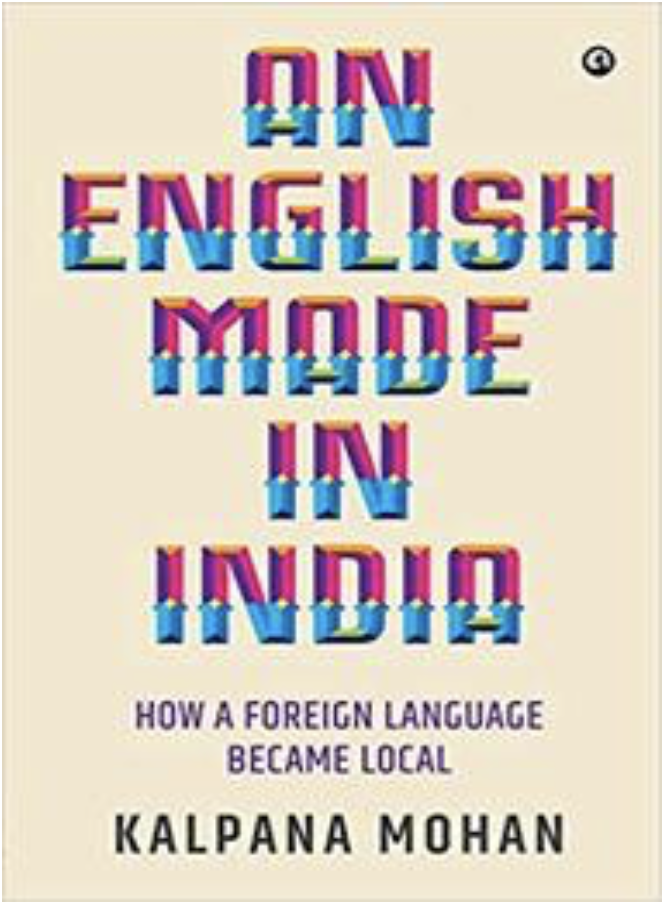
In An English Made in India, the author delves into the various aspects of Indian English— as lingua franca, colonial bequest, the language of the elite, and those who aspire to elite status.
She explores the English language’s earliest influences on Indian languages (and vice versa), the evolution of Indian English after independence and the way the language is spoken today. She talks to people from different parts of the country to create a colourful portrait of the ways in which the English language has influenced different segments of Indian society.
The book is an entertaining narrative about the myriad Indianisms to be found in the English used by a large percentage of Indians; the growing importance of Indian English in a world of many Englishes; the ongoing tussle between the elite who speak the King’s English and those who speak in their mother tongue or mother-tongue-accented English; the effect of the IT boom on global English; and the changing attitudes of young Indians towards a language introduced by the Raj hundreds of years ago.
A multilayered largely anecdotal look on the situation of English in today's India; that is in everyday life, in literature, academia and different layers of society.
What you should not expect:
An attempt of a definition of or even a real acknowledgement of "Indian English".
The author does describe the way English loan words flow into regional languages, what kind of mistakes lesser educated people make while speaking or writing English and how excellently English is spoken by various intellectuals in India. To me though this approach really doesn't manage to put the finger on just what Indian English is.
Various "Indianisms" seem to be regarded as mere mistakes, to be a little ashamed about, when really they are what makes Indian English, well... Indian English. The problem here is, English doesn't become Indian English just because it is spoken by Indians in India. No matter if you are a proponent of Oxford English or of standard American English, neither are (quite obviously) Indian English.
Even if you're not going to make it a linguistic study, in a book titled "An English Made in India" I would expect at least a rough attempt to capture in one chapter the most common characteristics of Indian English, without putting them off as 'incorrect English', mind. That to me is the whole point about acknowledging the existence of an Indian English, a language variance born from an old (now outdated) largely bureaucratic style of British English tempered with idioms and grammatical elements that transgressed over from local languages. A language variance that is part of the country's colonial history. And frankly after the way the British drained and used the country for their own gain, I think Indians should be able to proudly claim the language as their own and to naturally modulate to their own cultural and linguistic needs as they please.
Besides the very anecdotal style, that felt a bit aimless in some parts, this is the one major gripe I had with this book.
However, I did appreciate especially the last chapter, which is very much a call in support of literary expression in the local languages. To me this was the most outstanding chapter in the book. English as vehicle for international communication undoubtedly has quite the dramatic pull, especially on young people. And while this can hardly be avoided, it would indeed be a shame if the literary prowess of local languages were allowed to completely fade away as a consequence. There are things to be done about it, like reserving larger portions of literature festivals for local language literature and the like. Many Indian languages have a great literary heritage. I hope young Indians too will rediscover and appreciate it eventually.
Yes, Indian English is here to stay and it doesn't have to feel ashamed in front of British or American English. Just as native Indian languages have just as deep a potential for literary expression as any other language in this world.
Looking down on Indian English as 'wrong' English and down on local languages as 'crude' languages are the last persistent remnants of the colonial mindset. One can only hope it's an attitude that won't survive into the next century.
🍧An English Made In India By Kalpana Mohan🍧 In An English Made in India, the author delves into the various aspects of Indian English— as lingua franca, colonial bequest, the language of the elite and those who aspire to elite status. She talks to people from different parts of the country to create a colourful portrait of the ways in which the English language has influenced different segments of Indian society. The growing importance of Indian English in a world of many Englishes; the ongoing tussle between the elite who speak the King’s English and those who speak in their mother tongue or mother-tongue-accented English; the effect of the IT boom on global English; and the changing attitudes of young Indians towards a language introduced by the Raj hundreds of years ago. . I am quite new to what the author has introduced, to be very honest I never read a book which explores many angles and aspects of any language, but I must say I quite enjoyed this one. Firstly, the cover is a classy and perfect for the content which it carries inside. This is something which was extremely informative and new to my knowledge. I pure living loved the author's research that she made before compiling this work which is is clearly visible while reading the book. . For me, the writing style was classy and on point. It's a short one which you can easily read when you are looking for a short hot pot book. We live in a society where a person is considered illiterate if he / she doesn't know English and the author makes us understand the importance and effect of this language on various parts of our country. At times I felt a bit monotonous but I would advise you to read it slowly. For me, it was such an amazing read. I will definitely recommend it. . Rating: 3.7🌟
I'm studying Hindi, and along with learning vocabulary and grammar, I'm also interested in the language as a cultural tool. This book came along at an opportune moment, answering a lot of the cultural questions I've started to develop as well as introducing me to thoughts, concepts, and questions I hadn't come up with on my own. Way more than Hindi, this book takes a look at English's troubled relationship with the old and new culture and languages (not just Hindi, but with Bengali and Southern Indian languages like Tamil, Telugu, and others) developing in the exponentially evolving India. I was afraid it would be over my head or too academic for my tastes. It wasn't. It was extremely readable, and relatable, even for a Western white woman who only speaks English and only dabbles in Hindi. Highly recommended for linguophiles and/or anyone looking for insight into Indian culture from an author who has both insider and outsider perspectives.
I made my decision to pick this one up to read after I found the one professional review out there up until now by Peter Gordon (dated 6 September 2019), on scroll and the asian review of books. I tend not to trust social network and online shopping reviews because they can so easily be flooded by paid reviewers or "friends" of the author from the usual watering holes wannabes haunt.
Now although Peter Gordon did point out, straight off the bat, that this wasn't a book on linguistics, I decided to give it a go anyway. It seemed like an interesting enough subject, brought out by a good publisher - Aleph, the author already has a book out ("Daddykins" - I haven't read it yet). So, I thought, this one is worth a shot maybe and a travelogue instead of a textbook on linguistics did not sound like such a bad idea after all. Except (at 212 pages) it isn't much of a travelogue either.
As much as this book doesn't know what it wants to be, I didn't know what I was looking for in it either. So, that makes the two of us. I first noticed a post someone made about it on Facebook - in one of them "language" groups - Indish Language Club - has about 465 members at the time of this writing, and they regularly put up English expressions Indians normally tend to use in their own unique way, which some alternatively call Hinglish or Hindish if it also has a bit of Hindi in it, depending on who you ask. So, I was like, yeah, I think I could read this. I had once bought this book of essays called "Chutnefying English" edited by Rita Kothari & Rupert Snell, which I never did get around to reading. It came out in 2011 - 9 years ago - and I found it a tad too academic for my taste back then but it may not be such a bad idea to pick it up again to read now, come to think of it.
Anyhoo, I may have been thinking - yey! maybe I will find a few funny Indish expressions or something, but these were few and far between, besides the author was clearly at a loss as to how to bring these up, present them or work them into the narrative or I don't know, because she'd be going on about something and boom, suddenly, there it was out of context and it didn't work. But then again, how many of these can you laugh at, all at once, really? For example, talking about Facebook groups, there is this one called "English Whirled Wide", which features signs and notices in public spaces in countries where English is not the first language (mostly asian) and if you have seen one sign with a blooper, you've seen them all. So there is a typo in something. ha ha.
The "research" consists of the author traveling around the country, talking to a few people, and providing the goings-on, if not entire transcripts and it comes across (at least to me) like the conversation was deliberately made up to fit the narrative - which in turn was nothing you haven't heard before - ad nauseam. Like, say, the dabbawalas' modus operandi making it to Harvard or Chetan Bhagat and the call centers. If you are an Indian reading it, it reeks of condescension until you remember this is an NRI writing for the west, and so what else is new? It all came across as terribly derivative, pretentious even and I am afraid to say I learned nothing. No epiphanies. No aha moments. No new insights gained. And certainly nothing that contributed in any significantly new way to the book's overall goal: "How a foreign language became local". Just the same old, same old. Except, maybe, the one thing going for it were the many footnotes, which I could perhaps look up if the links are still around by the time I get to it. But then those are other authors' research and their work. Nothing this here work brings to the table except that it collates and rearranges some of that material - for whatever good that may do you.
So, yeah. A bit underwhelmed. Disappointed even. I bought the paper copy and it may read and work better for me the next time over, but I am not sure if it makes for very good reference either - and with so much other stuff to pick up, I may never go back to it. If you are thinking of picking this one up to read, you might be better off with the Kindle version - you can leverage the footnotes better. Say you are on the Kindle App, then you can look up the link to a referenced article immediately. More bang for your buck!
This would have perhaps worked better as a BBC documentary series. Kalpana Mohan presenting in 8 of her best saris (one for every episode to correspond with the eight chapters in her book) should be a welcome change instead of the usual suspects, say a staid Michael Wood or an unkempt William Dalrymple .
P.S. not too fond of the cover on the paperback. just saying. don't ask me what it should look like. i am only a reader. all i know is that it is too plain and I don't like it. and yeah, didn't care for the resident poet and the poetry either. Took up the better part of a chapter. Sure Indians are writing poetry but maybe we could have featured or talked about some real talent out there instead of embarrassing some part-time poet moonlighting on Facebook, who has since gone and disabled his twitter account! (maybe not because of this, but I did look up the footnote link, and it wasn't there.)