During her long, distinguished career, Jessamyn West had an enduring love affair with the short story. Her first novel, the ever-popular The Friendly Persuasion, was conceived as short stories. Among her nineteen books, Love, Death, and the Ladies’ Drill Team and Crimson Ramblers of the World, Farewell were collections of her independent stories. They, with the addition of eight others never before assembled, make up the thirty-six stories in this vibrant, compelling volume.
The variety is breathtaking: a tale of suspense, a romantic idyll, a touch of the supernatural, a young man’s pursuit of a lost love, a glorious awakening in the wilderness, a chilling portrait of sexual torment, the joys and agonies of the young—these are the merest clues to the content. Comedy mingles with tragedy, tenderness with irony. The most ordinary human being is seen as remarkable. And daily existence is touched with magic.
Jessamyn West rings changes in time, presents a startling sweep of personalities and moods. Her themes span a breadth of experience from the bite of misery to the balm of delight. Her achievement, taken totally, is a spectrum of living, a haunting, rewarding experience that attests to her consummate skill and extraordinary vision of the worlds before us and within us.
"It was too late now for coyotes. The smoke on the heated air was transparent. The voices, singing or talking, already tempered by the sun, were thin and sweet--like sharpened knives. Human voices, animal voices; domestic fires and the wild heat of the untamed sun; smoke, an autumn thing, a thing of fallen leaves and coldness, drifting upward now into the summer heat; everything at once so balanced and so contradictory, and likes and opposites so solemnly meshing, Rusty thought he might have to run up some hilltop and there, like Senor Coyote, give a great yelp of happiness. You surely weren't supposed to just walk through stuff like that doing nothing, were you? But he didn't know what to do. Not yet, he didn't. Except, he thought, to call it beautiful; which was true but somehow not enough."
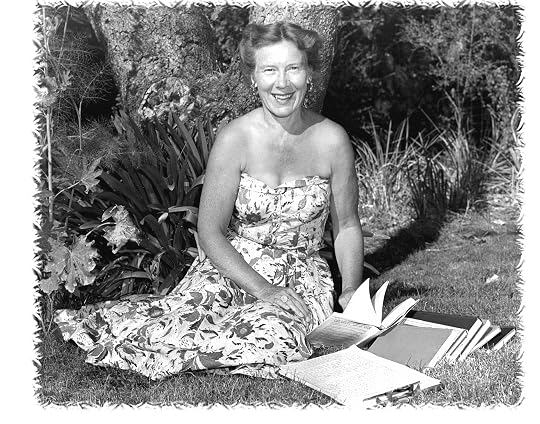
~~Jessaymn West 1902-1984
Ms. West's publisher, Harry Maxwell McPherson, has given readers a post-humus collection of short stories by Jessaymn. Many of them were previously published in books, magazines, or newspapers over the course of her career. A few are new to this publication. All I can say after completing this collection is that it is perfect. There are many good reads out there. Then there is the smaller collection of outstanding reads. Perfect reads come a few times a year if one is lucky. This is one to savor and enjoy.
Usually I have a hard time getting into short stories. It feels like I have just gotten to know the characters when the story ends. West, however, knows how to quickly rope readers in within the first few paragraphs. Her descriptions of time and place are spot on. There's really nothing more I can say except to read this dang collection already. I'm going to finish out my review with some of my favorite quotes. Given 5 stars or "Perfect".
"The Senator didn't like to be called Harold. Hal he tolerated. But his proper title was the Senator. The name had been given him by the kids in the purest derision, as Joe well knew, and Harold had wrapped it around himself with such ostentatious pride that the Home was now impressed by what it had itself created. But not me, Joe thought. I'm not impressed."
"But what really got you were his eyes. If they were any color they were air colored--or maybe water colored or ice colored. Anyway they were transparent and they were bottomless. You got the same feeling looking in them you get looking down an empty elevator shaft. It's only your eyes that travel the length of that shaft, when you lean over, but your body follows somehow and you have the sensation of falling. It was the same way looking into that fellow Sterling's eyes. They gave me a sensation of falling, so I decided to concentrate on my drink."
"Before he had any, Purdy had thought of his children as being little replicas of Zenith and himself: a boy, himself when young; a girl, a smaller Zenith, all coppery and shining. The three thus far, for any resemblance they had to him or Zenith, and almost as well been scooped up with a fishnet, hit or miss, from any shoal of children. Purdy loved them, but they were queer to him, and strangers. Chasteen, at ten, Purdy considered as practical to look at as a kitchen cabinet, but trying to follow what went on inside her head made him giddy. In Purdy, Jr's head, nothing, insofar as his father could tell, went on. [...]The baby, Hogan, who had Zenith's maiden name, was fie; and for him, Purdy thought hopefully of the Presidency, fearfully of the pen. This morning, the three, unbickering, washed, and, what was more uncommon, dried, were ranged around the table in an arc so seemly that Purdy had fewer fears than usual of what his next three, with this beginning, would be like."
"She wanted people to feel what she did--and if they didn't, it hurt her. She had either to keep her mouth shut and pretend or open it and argue. People liked her pretending self better than her arguing self, but she liked neither and dreamed of a time when (or was it some person with whom?) all pretending and arguing would be over."
"Mr. Fosdick used the name of God, Christ, Jesus, heaven, hell, the devil, and damnation very often. I wouldn't exactly call it cursing. It was more as if he felt himself the resident of a universe where there were more powers and personalities than were visible, and that this was his courteous way of letting them know that he was aware of them and was trying to include them in his life. He certainly included them in his conversation."
"Ordinarily, life was fragmentary. It was shreds, and particles. It was tasks, and obligations, worries, pleasures, all so mixed and, while each persisted, so sharp and pressing that one never caught sight of the whole life. Above all, it was not often that one was able to catch sight of oneself in the center of that small and satisfying world. The experience for Meredith Johnson was so unusual and so beautiful that he tried, by concentrating upon it, to prolong it. Remember, he told himself, remember."
Every single one of these short stories is perfectly crafted, with luminous prose, interesting characters, often a dark twist in a story filled with California sunshine. A must for any student of the short story, and for those striving to write them.
This being a collection, and a large one, we also see the weaknesses. Maybe I shouldn't call them weaknesses--it just seems that nearly every story has the same settings, similar themes, and seemingly interchangeable characters. I wouldn't call the stories dated--but they are nearly all set in some unspecified era, mostly from the 1920s through the 40s. So young people will find all the stories about tuberculosis puzzling--yes, this is before antibiotics were used in the cure of tuberculosis. To make this disease the core of so many of her stories tells us of the prevalence and power of this disease.
West's minimal plots and predictable settings make for a tedious read, if you do it all at once. I put the book down for over a year, and read the last few stories all at once. I certainly respect the quality of the writing--but I'm not overly interested in young women with controlling mothers, absent or cheating fathers, young women with difficult husbands, and small town life in general.
While West traveled extensively, she only writes about the small town life that probably no longer exists in southern California. It's vaguely interesting, in a time travel sort of way, but not enthralling.
I admit, a few stories were particularly interesting, and even eerie, like nightmares. And while I'm glad I read these literary classics--the lives she describes are not engaging. At least for me, they are not.