Gustave Doré (1832–1883) was the greatest illustrator of 19th-century France and the leading book illustrator of his day. His startling conceptions and brooding surreal imagery lent overwhelming power to his often definitive illustrations of the The Divine Comedy, Gargantua, and Pantagruel, The Rime of the Ancient Mariner, and the Bible, among others. In 1879, having produced over 90 illustrated books, he published the last major work of his illustrious 618 illustrations for Ludovico Ariosto's magnificent epic poem, Orlando Furioso . Little known today, the work contains some of Doré's finest illustrations. Ariosto's poem combines medieval legends of King Arthur and Charlemagne in a long, complex narrative involving scores of characters, numerous interweaving subplots, and many interpolated tales. The conflict of Christian versus Moor provides the epic background of the work. The present volume contains 208 of Doré's finest illustrations for the poem, painstakingly reproduced from a beautifully printed 19th-century German edition. Included are all 81 full-page plates, the large frontispiece, many other illustrations that fill an entire Dover page, and a generous sampling of smaller, chiefly zinc-engraved plates. The latter consist of many lively and felicitous drawings reproduced directly from Doré's originals without the intermediate service of his team of wood engravers. Ariosto's extended saga provided an almost endless succession of characters, creatures, and events upon which Doré lavished the skill and experience of a lifetime. The illustrations range from brilliant quick sketches to highly finished and shaded studies, many of which convey and incomparable feeling of metaphysical gloom. Desolate landscapes, ghostly castles, and titanic battles furnish darkly romantic settings in which tiny human figures often appear overwhelmed — helpless pawns of destiny. Against this stark backdrop, a panorama of jousting knights, damsels in distress, heroic deeds, romantic interludes, and mystical events comes to life under Doré's exuberant pen style. His haunting interpretations, suffused with a shadowy mysticism, seem the perfect visual expression of Ariosto's monumental historico mythological tableau. For this edition, Stanley Appelbaum has selected illustrations and provided captions describing the scene depicted, with appropriate canto and stanza numbers. He has also provided an informative introduction and plot summary. Anyone interested in the special artistic magic that results from the fusion of great art and great literature will want to add this inexpensive reprint of one of Doré's finest achievements to their bookshelves.
The most popular and successful French book illustrator of the mid 19th century. Doré became very widely known for his illustrations to such books as Dante's Inferno (1861), Don Quixote (1862), and the Bible (1866), and he helped to give European currency to the illustrated book of large . He was so prolific that at one time he employed more than forty blockcutters. His work is characterized by a rather naïve but highly spirited love of the grotesque and represents a commercialization of the Romantic taste for the bizarre. Drawings of London done in 1869-71 were more sober studies of the poorer quarters of the city and captured the attention of van Gogh. In the 1870s he also took up painting (doing some large and ambitions religious works) and sculpture (the monument to the dramatist and novelist Alexandre Dumas in the Place Malesherbes in Paris, erected in 1883, is his work).
If, in a dull moment, someone wondered what caused me to become so interested in Ludovico Ariosto’s sixteenth century saga Orlando Furioso that I not only read a prose translation but searched out Gustave Doré's illustrations as well, they'd hardly be surprised to hear that the answer, like many questions in the history of literature, leads directly back to Don Quixote.
Chapter VI of the English translation of Miguel de Cervantes' most famous work is subtitled: Regarding the beguiling and careful examination carried out by the priest and the barber of the library of our ingenious gentleman…
The chapter begins with the end of the title sentence …who was still asleep (which is only one example of the liberties Cervantes takes with conventional story telling). In any case, while Don Quixote is sleeping through most of Chapter VI, his friends the priest and the barber use the time to destroy his books about chivalry which they suspect are the cause of his obsession with knight errantry. They begin to sort through the titles, quickly consigning most of them to a bonfire in the yard by tossing them out the window. A few books are spared: The History of the Famous Knight Tirant lo Blanc, for example (who unlike most knights got to die in his bed with his will made (didn’t that happen to another famous knight, you ask? ).
Also saved from the fire is Part I of La Galatea by a certain Miguel de Cervantes (Cervantes? but, but, isn't he the author of this book his book is in, you frown..). Another book that was reprieved was The Mirror of Chivalry (come on, what has all this to do with Orlando Furioso, you demand impatiently..)
Let's allow Don Quixote’s priest friend explain as he glances through The Mirror of Chivalry: There you’ll find Reinaldos de Montalbán and his friends and companions, and the truth is, I’m inclined to condemn them to no more than perpetual exile, if only because they contain part of the invention of Matteo Boiardo, from which the cloth was woven by the Christian poet Ludovico Ariosto, who, if I find him here, speaking in some language not his own, I will have no respect for him at all; but if he speaks in his own language, I bow down to him. And so Don Quixote’s edition of Ariosto’s Orlando Furioso was also saved from the fire and the barber took it into perpetual exile at his own house where he planned to read it. I decided I wanted to read it too and so I did, in a French translation, Roland Furieux, with clever additional commentary by Italo Calvino.
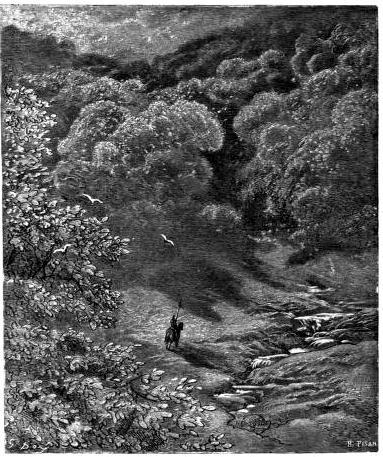
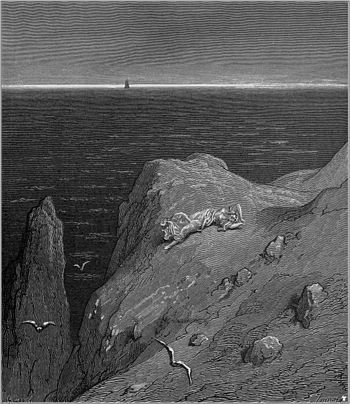
However, the version of Ariosto’s work I’m reviewing here isn’t in some language not his own, and the priest ought to be happy, but then again, he probably wouldn't have been, because this version is a completely illustrated one with hardly any text at all. Gustave Doré’s drawings for Orlando Furioso (engraved by H Pisan), were done in 1878, fifteen years after he’d completed his fun-filled illustrations for Don Quixote, and about five years before he died. There are distinct differences between the two sets of drawings, some of which can be ascribed to the differences between the texts concerned.
There are far more interior views in Doré's Orlando Furioso, and since the interiors are often the great halls of castles and palaces, rather than tumble-down stables and dilapidated taverns as in Don Quixote, Doré takes the opportunity to add a lot of sumptuous detail: The figures are often very small while the architecture seems to grow larger and larger:
Similarly with countryside scenes, the landscape dwarfs the figures. We're in 'sublime' territory here:
The images are generally in darker tones, and there are quite a few night time scenes:
Doré's drawings for both Orlando Furioso and Don Quixote display the same virtuosity and the same marvellous plunging perspectives,
but the type of caricature that abounded in Don Quixote is mostly absent from the illustrations for Orlando Furioso, and yet Ariosto’s text is lighter in tone than these drawings sometimes make it seem. While it’s not nearly as funny as Don Quixote, it does contains its own sly humour. From time to time, Doré gives us an image reminiscent of the absurdity he conjured up for Don Quixote but the absurdities strike a different note. We're almost in the grotesqueries of Hieronymus Bosch's world.
And the episode of the completely 'furioso' Orlando dragging a dead horse across a mountain is more tragic in Doré's illustration than it is in Ariosto's text:
A less playful, more serious Gustave Doré produced these drawings.
You'd better believe I grabbed this when I saw it in a comic shop in midtown NYC. Doré and Ariosto: a confluence of brilliance and delight almost too wondrous for man to behold--you may want to use your eclipsoscope, just to be safe.
This volume is filled with glorious illustrations from Ludovico Ariosto's epic masterpiece Orlando furioso. The illustrations are in the public domain and can be used to help enliven your narrative and/or websites.
My favourite pictures are the fight scenes, the action. There's a few where Doré anticipates Looney Tunes, the melee that turns into a ball of dust (and severed limbs, in this case).
I’ve studied the illustrations both to learn more about the inspiration behind the drawings by Walter Moers and to learn more about Orlando Furioso. Some of them are really monumental. It’s a bit disappointing that the resolution is not always of a great quality.
I'm infatuated with Dore's work. This atlas is the most valuable and very helpful tool to comprehend and memorize complex scenes from epic poems like Ariosto's Orlando or Dante's The Divine Comedy.