Jump to ratings and reviews
Rate this book

D-Zug dritter Klasse

Rate this book
Während des »Dritten Reiches« lernen sich sieben Menschen im Zug von Berlin nach Paris kennen. Es kommt zu allerhand Verwicklungen zwischen ihnen ...

149 pages, Hardcover

First published January 1, 1938

1 person is currently reading
55 people want to read

About the author

Irmgard Keun

27 books150 followers
Irmgard Keun (1905 – 1982) was a German novelist. She is noted for her portrayals of the life of women in the Weimar Republic as well as the early years of the Nazi Germany era. She was born into an affluent family and was given the autonomy to explore her passions. After her attempts at acting ended at the age of 16, Keun began working as a writer after years of working in Hamburg and Greifswald. Her books were eventually banned by Nazi authorities but gained recognition during the final years of her life.


Ratings & Reviews

What do you think?
Rate this book

Friends & Following

Create a free account to discover what your friends think of this book!

Community Reviews

5 stars
12 (15%)
4 stars
26 (33%)
3 stars
27 (35%)
2 stars
9 (11%)
1 star
3 (3%)
Displaying 1 - 13 of 13 reviews
Profile Image for Lisa.
1,108 reviews3,288 followers
April 30, 2020
Poor Lenchen has too many fiancées.

Her main problem seems to be that she has no tools to say no when a man approaches her and pushes his strong will upon her weak one. This patriarchal dominance over her reluctant mind and body becomes a reflection of the Nazi dominance over weak individuals.

And Lenchen has no talent for picking attractive men to follow either.

So her life and other complications lead to disaster that unfolds while she is stuck with the worst of her men, the sociopath Karl, and her insane aunt on a train from Nazi Germany to Paris.

The entire book is a collection of stories that the passengers in Lenchen's waggon share, and the reader leaves them as confused and stranded on the station in Paris as they were when they embarked on their journeys full of plans.

Even though there is hardly any plot at all, the book is a sad witness account of regular people's worries and wishes and feelings during the early years of the Third Reich. There is really nothing special about these characters - and that makes the novel scary in a way. How could these regular, harmless idiots turn into a collective pack of monsters - supporting, contributing to or tolerating the crimes of the Nazis?

By accident, seems to be the answer in the book. One stupidity led to another, one vendetta to a denunciation, one ambition to an infamous career, ...
Profile Image for Tarian.
336 reviews18 followers
September 10, 2022
Keun gelingt in diesem roman eine gute darstellung der einfachen leute und ihrer lebensumstände, aber leider bleibt die charakterzeichnung zu erratisch und oberflächlich, und die emazipatorischen ansätze, die sich in der figur des lenchens verdichten, bleiben unvollständig. Dazu kommt, dass keun zwar mit einer witzigen sprache und unvermuteten metaphern aufwarten kann, ihre geschichte allerdings zerfasert und einigermaßen langweilig ist.
Profile Image for Amalie.
70 reviews5 followers
November 26, 2023
Noch ein Lieblingsbuch von Irmi Keun, hab ich sehr gemocht, es macht auf seine naive, lustige Art traurig und nachdenklich.
Profile Image for Ronja Röhrs.
107 reviews1 follower
March 6, 2023
toll geschrieben, relativ unaufregend, aber schnell und angenehm zu lesen
Profile Image for Viktoria.
270 reviews33 followers
May 15, 2010
in der literaturwissenschaft wird keun hier (1938 erschienen) vorgeworfen unpolitisch zu sein. aber gerade das macht diese geschichte so unglaublich melancholisch. lenchen ist eine junge frau und auf dem weg von berlin nach paris. ihre reise ist von angst und geschichten der mitreisenden geprägt. sie selbst äußert sich nicht über politik. aber gerade das, macht dieses buch so politisch. es zeigt menschen, die sich eigentlich aus allem raushalten wollen, die angst haben. keun hat hier nicht mehr den schwung ihrer früheren werke (wie gilgi oder kunstseidenes mädchen), aber eben gerade diese schwere, die keun hier neu hat, überträgt ein wages gefühl der angst und melancholie. spannend!
Profile Image for Emilz.
13 reviews2 followers
April 20, 2024
war schwierig fertig zu lesen. Die Hauptcharakter gefiel mir nicht. Auf das Ende hin wurde es besser.
Profile Image for Britten.
49 reviews1 follower
June 11, 2025
Ich weiß garnicht, was mir an dem Buch nicht so gefiehl. Ich glaube es war Lenchens Anziehung zu Männern, die offensichtlich nichts für sie taten.
Profile Image for Katharina.
16 reviews1 follower
November 24, 2025
If Irmgard Keun has a hundred fans, i‘m one of them

If Irmgard Keun has one fan, it‘s me

If Irmgard Keun has zero fans, i‘m dead
Profile Image for Noam.
250 reviews35 followers
April 9, 2025
Seven people find themselves sharing a compartment in a train from Berlin to Paris. Most of them do not know their traveling companions. It could have been a jolly adventure, don’t you agree? Well, actually it is and at the same time it isn’t, because this train trip takes place in 1937. More than they are traveling to Paris, the passengers are fleeing Germany.

Lenchen is a naïve young woman who dreams to be an actor. She always does what others ask her to do because she doesn’t want to disappoint them. She has two boyfriend, Bruno and Alfred, who want to marry her but she cannot choose between them. She travels to Paris with yet another boyfriend, Karl, and her aunt Camila, who everyone considers crazy. She takes her aunt to relatives in Paris on request of her uncle. At the same time, she smuggles 9000 Reichsmarks for Karl, even though he’s quite nasty to her. How will this trip end? Will Lenchen marry Karl, Bruno or Alfred? Or maybe one of the other passengers? You’ll have to read the book to discover the answer…

While all passengers are waiting for the train to depart, one of them say that the train derails. Obviously, they all panic at first, but they do calm down once they understand he wasn’t talking about their own train. He saw a derailing train through the window. While the plot of this novel is quite amusing, more important are the stories about what lead the seven passengers to flee. Each one of them have his own sad story. Each one of them is a victim of their times. Their lives were derailed, each one in his or her own way. All of them have become afraid and melancholic.


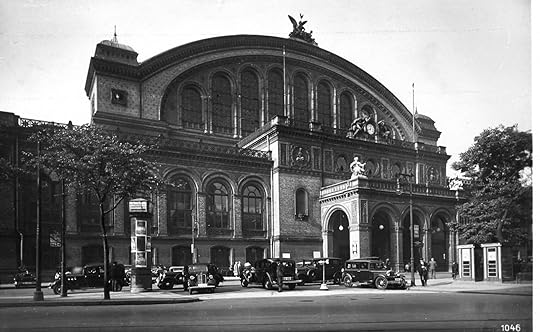
 Berlin Anhalter station 1930s, later bombed during World War II and demolished eventually in 1960. Via Wikimedia commons
Berlin Anhalter station 1930s, later bombed during World War II and demolished eventually in 1960. Via Wikimedia commons

Irmgard Keun was a sharp observer of human nature. Just like Erich Kästner and Hans Fallada, she had an amazing talent to write in a light-footed way about depressing serious matters. This book is an important portrait of that time. Keun makes you feel what these seven passengers felt: There isn’t any way out… Keun didn’t have to wait for the war to understand this.

This novel was written by Irmgard Keun in 1937 while she was in exile and had a relationship with Joseph Roth. They both wrote wonderfully, but while he is still very well-known, not many people ever heard of her. This book was published in 1938 by Querido in Amsterdam, a publisher of many books of writers in exile.

It amazes me this wonderful book wasn’t filmed till now!
'Es ging nett und sommerlich zu in diesem Abteil, die Leute fingen bereits an, schweigend miteinander vertraut zu werden.' p.6

'Gleich Bruno war der Redakteur Alfred Lieder entzückt, weil Lenchen anders war als die Frauen vom Theater, die er bisher gekannt hatte. Er fragte sie, ob sie ihn heiraten wolle. Lenchen sagte: “ja", weil es kränkend gewesen wäre, "nein" zu sagen.' p.26

'Und wie oft geschah einem gerade das, was man nicht wünschte.' p.32

'Ein jüdischer Großvater wäre für die gesamte Familie vernichtend gewesen. Eine verrückte Tante war auch nicht angenehm.' p.59

‘Jedes Verschweigen wiegt schwerer als der schwerste Koffer.' p.88

'"Soll ich Sie nach Hause bringen?" fragte der junge Mann, und Lenchen nickte und ging mit. Sie mochte den jungen Mann nicht, sie hatte den Regierungsrat lieber. Aber der junge Mann wollte, daß sie mitging.' p.134

'Er hatte Lust, Lenchens verweintes Gesicht zu trocknen und sagte laut: “Ich bin ein alter Mann." Es fiel ihm ein, daß er in Paris war, er erschrak und verneigte sich vor den fremden Steinen und wiederholte auf französisch:"Je suis un viel homme."'p.135
Profile Image for Arnis Arnicāns.
112 reviews4 followers
February 9, 2025
Lasīju "Vaidelotes" 1996. gada izdevumu Silvijas Brices tulkojumā. Neliels apjoms, bet ne viegli lasāms. Valoda speciāli mazliet primitīva, iespējams, lai pieskaņotos galvenās personas Lēnas domāšanas veidam. Vairāki asprātīgi joki, kas gan nemanāmi ieslēpti tekstā. Droši vien, daudz kas man palika nesaprasts, tik labi nesaprotot, grāmatas sarakstīšanas apstākļus un laiku. Tas esot otrais Keinas romāns, kas sarakstīts 1937. gadā trimdā. Sižets tāds, kādam tam jābūt ar šādu nosaukumu. Galvenā sižeta līnija vijas ap to, ka Lēnai jāizved deviņi tūkstoši marku, kas pēc tā laika Vācijas noteikumiem ir aizliegts. Tas ir viens līmenis. Otrais, galvenais ,vilciena kupejā brauc vairāki pasažieri, kuru biogrāfijas tiek izstāstītas šī brauciena laikā.
Profile Image for Angel Serrano.
1,373 reviews12 followers
April 20, 2013
Un tren viaja de Berlín a París. En uno de los departamentos de tercera clase se desarrolla un drama que mezcla lazos familiares, evasión de divisas, híper inflación, adulterio, maltrato y, en el fondo, el régimen nazi que lo ocupa todo.
Displaying 1 - 13 of 13 reviews

Can't find what you're looking for?

Get help and learn more about the design.