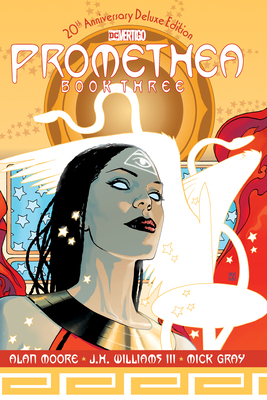
Promethea and her alter ego, Sophie, embark on a quest to find a different sort of magic, leaving Sophie's friend Stacia behind as a new, temporary Promethea! And this untried hero has her hands full as the forces of hell take control of New York's mayor.
Alan Moore is an English writer most famous for his influential work in comics, including the acclaimed graphic novels Watchmen, V for Vendetta and From Hell. He has also written a novel, Voice of the Fire, and performs "workings" (one-off performance art/spoken word pieces) with The Moon and Serpent Grand Egyptian Theatre of Marvels, some of which have been released on CD.
As a comics writer, Moore is notable for being one of the first writers to apply literary and formalist sensibilities to the mainstream of the medium. As well as including challenging subject matter and adult themes, he brings a wide range of influences to his work, from the literary–authors such as William S. Burroughs, Thomas Pynchon, Robert Anton Wilson and Iain Sinclair; New Wave science fiction writers such as Michael Moorcock; horror writers such as Clive Barker; to the cinematic–filmmakers such as Nicolas Roeg. Influences within comics include Will Eisner, Harvey Kurtzman, Jack Kirby and Bryan Talbot.
The appeal of Promethea comes from the strange marriage of JH Williams III's lush artwork to Alan Moore's baffling neo-occult philosophising. It doesn't seem that they could match; but they do.
In this concluding volume, the comic-book superhero narrative is brought back into contact with the Kabbalistic metaphysical narrative, with uneven results. Again, one is struck by the chutzpah of what the series attempts to do: here we have a depiction of the actual Apocalypse, as all time and space come to an end, affecting not just everyone in the book, but everyone reading it, and even the authors writing it, who make a cameo appearance.
Promethea culminates in a final issue which is one huge, psychedelic picture, studded with different magico-historical factoids and strange naked women; the pages all fit together to form a massive, two-sided incomprehensible poster. It's a hell of a way to go out. On balance I enjoyed it all a little less than the preceding volumes, but perhaps the astonishment of it all is just starting to wear off. It's a series that definitely tries a lot of new things, and for the most part pulls them off with remarkable results.
This deluxe edition (like the first) includes one of Alan Moore's scripts for one of the issues, which really shows how much control he has over all of the artwork involved: he essentially describes the layout, perspective and style of every single page and panel, and Williams – who I had assumed brought a degree of artistic interpretation to how he illustrated the story – is actually generally just executing instructions (albeit brilliantly). They make a very productive team and Promethea is a series that does things other series would never dare to attempt. Sometimes for good reason, but still, you have to admire the ambition.
And that's that. Volume Three wasn't the mind fuck Volume Two was. Lots of shit went down in record time.
On the heels of finishing this a little while ago, I have to say JH Williams III is a better artist than I ever thought with fantastic versatility. This is top level shit. As for the writing, I respect what Alan Moore was trying to do but a lot of it went over my head. I'm reminded of Gene Wolfe's quote about literature. “My definition of good literature is that which can be read by an educated reader, and reread with increased pleasure.” Once I bone up on the occult and the Kabballah, I'll approach this work a second time and see what shakes out.
An incredible finale to a series that had, up to this point, only been "good." All of the dense, expositional descriptions of Kabbalah and the Tarot that Moore had his characters literally walk through over the past two (beautiful) volumes finally culminates into something that feel a lot more like a story. Many tiny, almost overlooked plot threads from the previous two books are finally focused on here, and it makes the entire thing feel like it was worth the sometimes arduous journey that came first.
Where the previous volumes felt what I would call "interesting," but by no means moving, this one feels strongly tied to the emotional arcs of the characters. I finally get a sense for what worries these people, and how Promethea's fear of being a "world-ender" presents itself to her. There are actual human beings to care about now, and that makes a huge difference to the narrative.
Also, somehow Williams has outdone himself with the art in this one. He experiments with even grander ideas and layouts than he has before, coming into his own in tandem with the character he's drawing. It's kind of incredible how well those two threads, one fictional and one meta, manage to overlap here. I found myself flying through this book, but also wanting to slow down and really take in all this wonderful artwork.
This series has been a huge joy to read. I know it isn't for everyone, so if you hate it after volume 1, give up. No harm no foul. But if you even sort of like it, power through to volume 3. You won't regret it.
„Nije ni boginja, ni poluboginja, njoj je ništa nalik. Ona je Prometeja.”
„Duh, sućut, um i fizičko postojanje. Sve ti to treba da budeš Prometeja... Ili čovjek...”
*Prometeja je remek - delo. Scenario i crtež su genijalni. Čitanje ovog dela je posebno iskustvo, magija koja vas vodi u Imateriju na više nivoa😊 Našla sam svoj ”strip života” koji bih spasila iz požara i odnela na pusto ostrvo.
*Ovaj strip vam se može dopasti ako volite fantastiku, umetnost, mitologiju, promišljanje o životu, čovečanstvu, vremenu, prostoru, preispitivanje stvarnosti kakva nam se čini da jeste i jake ženske likove.
*Prometeja je junakinja beskraja koja čini ljude svesnije nematerijalne ravni. Kletva ili dar čovečanstvu jednog umirućeg oca. Svemir zasnovan na ljubavi. Tuga u raju jer raj nije Disneyland. Mašta, svest, magija, priča i istina. Fantastično tkanje života vremena❤
Radnja:
*Knjiga prva; U prvom delu se upoznajemo sa Prometejom kao junakinjom i njenom istorijom kroz Sophie Bangs, studentkinjom koja piše referat o njoj. P. se manifestuje kroz pisce i crtače, osobe koje propovedaju o njoj i tako Sophie postaje njeno otelotvorenje.
*Knjiga druga; Sophie kreće na svoje putešetvije sa Barbarom (prethodnom P.) da traži preminulog muža a na scenu stupa zamenska P. Najbolja drugarica Stacia. Ovo putovanje je neverovatno, a crtež i boje su tako usklađeni da ćete prelaziti svoje emotivne lomove od besa do mira i potpune tišine.
*Knjiga treća; Prati sukob prave i ”zamenske” Prometeje, ali i paniku i strah od kraja sveta koji dolazi sa Prometejom. Da li će do toga doći saznaćete u stripu uz promišljanje sveta, vremena i prostora kakvog poznajemo.
The final volume of Promethea offers the return to reality that volume two was missing in its elongated trip through the galaxy. And that's Promethea at its best, when we get Sophie as a real character facing real-life problems.
The turn to the end of the world later in the volume is interesting, and generally well done, though the final issue as always remains hard to read (in part because of the bad choice to mix the speech balloons with the background, but in part because Moore makes it all philosophy that gets redundant by the end).
Still, a strong end that's very in character with Promethea to date.
At some point in this volume I passed into new-to-me comics, which was pretty exciting! Still pretty minimal plot at this point and it includes some of my least favourite entries into the series, but again, still enjoyed the ride. I would love to know at what point you can get away with writing yourself as the author into the story. Because we're all part of the story man. A controversial move for any author (looking at you The Dark Tower), but I generally enjoy it as a trope in all its cring-y glory. It's a little more fun in graphic novel form because he not only had to write himself in, but also have himself illustrated doing the actual writing the book and getting the illustrations illustrated. All very meta.
Que locura...demasiado denso para la etapa lectora en la que estoy. En estas obras gigantescas de Moore siempre acostumbra a haber una historia más ligera, una primera capa de lectura. En esta creo que no, o no en todos los números, por lo que es difícil. Pero me ha encantado el esquema narrativo y como juega con las posibilidades del cómic. Es un genio.
Treća knjiga mi je djelovalo malo prekonfuzno i malo razbacano. Radnje kao da niti nema već se sve usmjera na crteže koju su stvarno prekrasni i fenomenalni. Sve u svemu nešto novo drugačije i izuzetno filozofski orijentirano pa ako vas zanima takva tematika ovo je pravi strip za vas.
having these Absolute editions has spoiled me, I want artbook sized comics to be the norm now. the ending to probably my favorite Alan Moore comic (maybe of all comics) ends with one of the greatest issues ever inked and JH Williams III really outdoes himself co-creating a list of visual and written correspondences for a finale about imagination's origin in both written and visual, snakelike and lunar, male and female affinities of colored explosion and frequency.
this edition has a second (half-sized) version of this issue already fitted together in poster format, reframing the entire piece as a macrocosm AND for actually framing (which I will have to stop myself from doing).
pick these up but don't fall for the buy-it-now bs price as you sit in front of ebay at 3am.
I love this story to bits. I really do. But. Knocked off a star because, hm, in the end I found it kind of boxed in by some of the Crowley shit. I felt the same the first time I read it. It's just wild to me that a man can conceive of a world in which the living and the dead interact freely with each other...all religions are one...and yet...cannot imagine a world without prostitution. And that bit was just like...a little throwaway line...snuck in there. It was not explored at all. He just had to put it in there and I'm like.......my dude....why??????? Dream bigger!!!!!!!!!!!
Una obra maestra y una manera distinta de utilizar el formato cómic para contar a través de una historia, a priori estándar, algo que está entre un compendio histórico de cosmovisiones humanas y simple y llana poesía, tanto visual como escrita. Además, lleva el concepto "meta" a niveles brutales.
Es también uno de los cómics más densos que he llegado a leer, y no porque tenga demasiado texto, si no porque cada página requiere pararse un buen rato a disfrutarla y entenderla.
This whole series is a very interesting entry in the corpus of literature about the tarot. It's basically a love letter to the Thoth tarot. Definitely a must read for any fans of that deck.
What can I say about the perfection that is Promethea? You can't help but feel like you've been strongly educated by the end of all, and you really don't mind because the journey was so captivating and beautiful. I could read this incredible series a hundred times and take something new and enlightening each and every time.
I have always been a fan of Allen Moore, I really loved Promethea from the start - I still love the idea of her, and how important she is to humanity (the many vibrant, tantalising ideas of her that came together so beautifully). I think most creative people will find her deeply resonant and quite literally empowering, in her uncompromised championing of the raw act of creation being good, and even approaching holy. There aren't a whole lot of new yet timeless-feeling ideas out there, but Promethea might be one of them.
The first book of Absolute Promethea is breathless with infinite potential. The second book is practically a textbook on Kabbalah, and how the arc of personal growth maps onto it, but I still found it interesting through the lens of my dear Promethea.
However, the third book of Absolute Promethea left me deeply unsatisfied and actually rather wishing I hadn't read it at all. It opens very strongly with the idea of two warring Prometheas, mirrored in the Crusades and the Promethea of Islam is simply stunning... but then quickly discards this conflict and starts another one. It then builds up several threads of conflict without any payoff, including a multitude of new characters that don't get resolved and really didn't need to exist. The art is still often breathtaking, and it is full of some good ideas (of course), but the ambitious 'big climax' is ultimately unfulfilling and not worth all of the fuss before and after.
I would simply stop reading after issue the first issue of the third book of Absolute Promethea. Dream the rest, and perhaps Promethea will tell you what really happened in the rest of the story, before Mister Moore wrote something wrong.
The End of the world! But not as we picture it. I was always of the believe that the end of the word was more a matter of consciousness than war, pandemic, ect... The end of an era that ushers in a new period of understanding, spirituality and existence. When we elevate our selves by understanding that we are god and god is us we can then start to live the happiest period in our existence. This book is like a version of this happening. The whole promethean character was conceived to help us rise from the material world and connect with the idea of god.
This is a review of all three volumes as it really has to be viewed as one complete work, and all three parts are an absolute must...
Anyway, having just finished the third of three deluxe editions of Alan Moore and JH Williams III's Promethea, I'm still finding it difficult to express just how mind-blowingly brilliant I found the whole series. It seems to be seen by many as a relatively minor Moore work, but I consider it easily among the best things he ever did.
The League of Extraordinary Gentlemen is the title from his ABC line of comics that gets all the attention, but give me Promethea (and certainly Top 10 and probably Tom Strong) over it any day of the week. Not least because the League books suffered from a really off-putting amount of cynicism in them, as well as the sense that as they went along, they were less interested in compelling stories and characters than referencing as many obscure literary characters as possible.
Which is, of course, ironic considering how the main complaint about Promethea is that it's just a long-winded summation of Moore's religious beliefs. I mean, it kind of is that, especially in the final issue, but it's so much more than that too.
For a start, it's arguably the least cynical thing that Moore has ever written. More than that, I would say that it's one of the most uplifting, genuinely spiritual comics I have ever read - and I've read a whole lot of them. Admittedly part of this comes down to the fact that as a relatively religious Jew, I found the kabbalistic aspects of the book to be much easier to hook into than I'm sure many, if not, most readers will, and I was shocked to see just how much Tarot and the kind of "magic" practiced by Moore draws from it. I'm usually more drawn to the more rationalistic tradition in Judaism than the kabbalistic, but I was already fairly familiar with the Tree of Life stuff and the Sephirot and have long appreciated these concepts as a more serious and believable way to view God than the usual, fairly childish, "old dude in the sky" approach.
I mean, I still found 80% of the more New Agey stuff... extraneous, shall we say, what with my viewing Kabbalah through a Jewish rather than Gnostic lens, but I still found his exploration of consciousness, creativity, Oneness and human connectedness genuinely beautiful, even transcendent. And a real balm for all the horrible stuff happening in the world.
I am, therefore, genuinely curious to see how hardened atheists react to the book. Not in the sense of whether it "converted" them, but if they find something to hook onto, emotionally, in all the "hocus pocus".
I truly think they will, though, because there's so much more to Promethea than just its "spiritual" aspects. It's exceptionally inventive and imaginative. It's a total masterclass in comics storytelling. It is plainly heartfelt, genuinely hopeful and I thought the characters were pretty wonderful. And it's also very, very funny at times, with tons of gags especially coming from the quirky futuristic New York that Moore clearly put a lot of effort into creating.
Well, him and JH Williams III, I mean.
Williams is, very simply, every bit as much a part of the genius of the book as Moore is - arguably even more so. I thought it was his work on Batwoman that saw his art take a quantum leap forward, but nope, it's all right here. And then some. All the incredible layouts, shifting styles (often in one panel) and immaculate line work. His work on promethea is genuinely nothing less than awe-inspiring, which really could not be more fitting for such a comic.
Special props too, of course, to Mick Gray (inks), Jeromy Cox (colours) and Todd Klein (letters and design), as they contributed enormously to bringing the very best out of Williams's spectacular pencils.
Which is why, though I do wish they were sewn-bound rather than glued, these deluxe prestige editions are the best way to read this book - outside of, I presume, the Absolute editions. They are oversized and absolutely gorgeous, with tons of great bonus material too, including a couple of Moore's complete scripts, extensive examinations of the art process and even pages from other ABC titles in which Promethea appears. They're fairly expensive (though nowhere near the Absolutes) but absolutely well worth the price. Hell, even if you inexplicably have no use for the writing whatsoever, I can easily recommend just buying them as art books.
I only wish the stuff that Moore worked on after this had even one tenth of Promethea - and much of the ABC line's - appeal to me. Though if we do ignore everything that came out afterwards, this would make one hell of a swan song for arguably the greatest writer the comic book medium has ever known.
Not sure when I read exactly. Summer I read Promethea forever ago when it was first coming out (single issues) - maybe when I worked at the comic book store in college so like, early 2000s. I had the softcover trade paperbacks and at some point upgraded to the hardcover three-volume "Deluxe" editions - which are... not what this is, but are somehow not on Goodreads as editions I can enter? I WISH I had the Absolute editions, which usually include more supplemental materials and footnotes and things.
I mainly decided to re-read Promethea because I have been reading stuff about chaos magick and other sort of occult themed things and I recalled the amazing adventure the main character takes along the Kabbalah tree of life and how interesting that part was. That bit still REALLY holds up - even if it's just a comic book tour of Alan Moore's personal belief system, it's really interesting.
I read all 3 volumes, and I love the concept and story of Promethea a lot, but the first volume is still the best, in my opinion. The last one goes predictably off the rails a bit. The storyline w/ the Five Swell Guys and the Painted Doll wraps up, which I guess I appreciate because it's actually got a great few twists but... it's also so background to everything else that it doesn't matter? Which is kinda sad - that got short shrift. Same w/ the Grace Brannagh Promethea and Stacia bit - it wraps up, is kinda disappointing, then we move on. I had (again - I remember this the first time) having a very visceral "UGH" reaction to seeing who Sophie was bunking with during her hiding out years - like, I get that this is written by an aging sort of schlubby dude, so of course writing the young hot superhero as finding love with an older sort of schlubby dude is predictable, but it doesn't mean I'm not BEYOND tired of seeing that. The main thing I remember from the last volume is that, the stupid FBI idiots don't really have enough motivation for me to go as extreme as they do, and they never once really realize like, oh, hey, our dumb-ass gung-ho ness to arrest somebody or something we know nothing about actually CAUSES THE THING WE ARE AFRAID OF - no, they just do it and move on. No shame, no guilt, no remorse. I guess that's on-brand for the personality type but... jeesh, I didn't really want to read that, either. I like my villains to have comeuppance.
Lastly, there's a super cool conceptual thing that happens in the last issue of this book. The final issue of Promethea you can tear out every page and put them together to make a HUGE poster. It's kinda cool! However, it makes the entire last issue, like, nearly UNREADABLE. Seriously I just skimmed basically the entire conclusion and denouement of this book (again, this happened before I recall, every other time I've read this) because I couldn't be bothered to get out like, a magnifying glass and find the right lighting or whatever to read all this boring dense text that's completely buried in these psychedelic colors and IN WHITE INK OH MY GOD WHY. I hope these Absolute editions included like, the transcript for the final issue because if you actually want to read it, that may be the ONLY way how. I would probably actually give the last volume of Promethea 3.5 stars. Volume 1 - 5 stars, Volume 2 - 4 stars - Volume 3, 3 is a bit too low but 4 is too high.
This is a review specifically of the 20th Anniversary Deluxe Edition of Promethea Book Three. This volume contains the final 12 issues of Promethea by Alan Moore and JH Williams III. The artwork and the writing continue to be a creative showcase that pushes the envelope of what’s possible in the pages of the comic book medium that Moore and Williams have set up in the previous 23 issues. That being said, the plot takes an unexpected left turn, with Promethea returning to superhero tropes, such as multiple fights between science heroes as well as the end of the world. This is after its previous didactic exploration of the Kabbalistic tree of life and examination of Alan Moore’s view of magic in the previous volumes. While all this is executed brilliantly, I felt that the new directions the story goes in throughout these issues feel sudden and present a break from the organic flow of the previous 23 issues. All in all, the story gets brought to a beautiful conclusion, but it’s just not as good as the volumes that preceded the current one. While this is all about the story and the art, I also have some grief with the packaging of this volume. The famous/infamous last issue is a brilliant poster, which in the original single issue required disassembling the comic. The volume includes an unfolding poster, which I was initially excited about. However, the poster is drastically shrunken from its original format, making the text nearly unreadable without a magnifying glass. Fortunately, this volume also contains all the pages of the poster in an oversized format, so reading was not a problem. Unfortunately, the pages were ordered just like they were in the original comic (which originally was intended to be one folded piece of paper without staples, which influenced the page order), which required a lot of flipping forwards and backwards to read the text in the intended order. Preserving this page order did not add anything of value to the book and could have been easily fixed and quite simply did not feel ‘deluxe’ at all. This continues the trend of the previous two volumes of the 20th Anniversary Deluxe Editions of Promethea; the backmatter feels haphazardly put together without much thought.
Turning back to the wonderful work of Alan Moore and JH Williams III I can say that I have thoroughly enjoyed the full run of Promethea and that Alan Moore’s explanation of magic resonates deeply with me, particularly his ideas about the power of stories, the creative process, and their ability to transcend one’s limitations. The ideas expressed in Promethea go far beyond everyday, conventional thinking, offering a thought-provoking exploration of art, magic, and the imagination that lingers long after reading. It has inspired me to create art myself as well as to further explore Moore’s thoughts on this in the Voice of the Fire and Jerusalem.
Not as great as the first two but quite the metaphysical ride.
“Promethea Volume 3” by Alan Moore
“Know that you our life, that you are mine. You are the awareness of the universe. You are its dearest child. Space and time exploded into being. Every atom. Every moment. All at once. Explosions still going on. This is all part of it. We are all sparks of its electrostatic, blazing consciousness. And we are rare. And we are precious. And we are all one thing. ...And all conceivable places are in truth one place... and all the time but a single, endless moment. Let us draw in by the fire, and be glad. Every one of us.... Don’t be frightened. Our lives are all a story we’ve been telling to ourselves, while away the lawn, afraid at night of our human ignorance.... but now we are grown. Now the night is over. Now there is light.”
“Although isn’t having a dream or reading a book a real experience? After all, real or not, this room is where you’re awareness is currently centered. And someone’s talking to you. Well, yes, but...I mean, if it’s a dream, it’s my own subconscious talking. If it’s a book, it’s either just some writer. Either way, you’re a fiction.”
“We are all spacetime’s sensory organs, spacetime’s mind, our thoughts and lives naught but the three-dimensional, material expression of its blazing and immortal soul.”
“An angel somersault came through our consciousness, imagination derives from image, a colorful form unfolding mentally. Both angels and imaginative thoughts, being a phenomena not reliably repeatable under laboratory conditions, are equally outside the province of empirical science. Cautiousness, unprovable by scientific standards, is forever, then, the impossible phantom and the predictable biologic machine, and you’re every thought a genuine supernatural event. You’re every thought is a ghost, dancing.”
“As readers, you are physical beings engaging in a DNA snake-dance with me, fiction, your immaterial, lunar imagination. To the Old Testament creator God, or to any newborn infant, the universe and themselves are initially perceived as one indivisible thing. Naming things, God, or the infant, separates itself from everything else with language, divides earth from sky, fish from foul, and thus creates and constructs the diverse universe around them.”
Der letzte Teil von Promethea setzt nach deren Rückkehr aus den kabbalistischen Sphären an und zeigt, was geschieht, wenn ein Bewusstsein, das die Grenzen der Sprache, des Ichs und der Materialität überwunden hat, wieder in die Welt eintritt. Das Ganze gipfelt in einer im wörtlichen Sinne zu verstehende Apokalypse der Ästhetik, in welcher die Schleier zwischen materieller Realität und immaterieller Vorstellungskraft gelüftet werden. Die Welt endet nicht, sondern es wird eine neue Art eingeläutet, die Welt zu sehen – ein Erkenntnismoment, der erleuchtet und eine neue Wahrnehmung ermöglicht.
Weiterhin ist der Plot im Hintergrund, weiterhin ist das Werk primär eine theoretische Abhandlung und Darstellung von Moore’s Philosophie, die all seine Werke durchdringt und prägt, aber mich noch nie so stark angesprungen hat wie in Promethea. Promethea verkörpert sein Verständnis von Sprache als Magie. Sie existiert nur weil sie erzählt und künstlerisch hervorgebracht wird. Seinem Verständnis von Kunst als Erkenntnis. Die Lektüre selbst wird zur Initiation durch die Reise der Bewusstseinsebenen. Und zuletzt noch die Freiheit als höchstes Gut, seine anarchistische Ethik in Form einer transformierenden Apokalypse, die unsere Wahrnehmung von hierarchischen und herrschaftlichen Illusionen befreit und das Göttliche in uns Selbst offenbart. Ich konnte damit einigermassen mehr anfangen, da es aus dem Okkulten hinaus auf eine höhere, universellere Ebene trat.
Und auch hier wird wieder Alles durch die unfassbar starke Visualisierung transportiert und unterstrichen. Noch mehr spiegeln hier Struktur, Stil, typographische Übergänge Prometheas Offenbarung wider und die Form selbst wird noch mehr zum Inhalt. Das Ganze gipfelt in einer Reihe psychedelischer Bilder, gefüllt mit Plot-Schnipseln und Fakten aus Geschichte, Psychologie, Okkultismus, die zusammen ein grosses, zusammenhängendes, doppelseitiges Poster ergeben, dass dann auch noch als Gesamtbild beigelegt ist. Es ist eine Kulmination dieses Kunstprojekts, das viel wagt, Neues macht und ausprobiert. Nicht immer erfolgreich und nach meinem Geschmack, aber die schiere Ambition gehört respektiert.
This is not a normal comicbook. This is something magical. Alan Moore set out from the very beginning of the series to convince the reader that stories and imagination are literally magical and as far as I'm concerned he succeeded. This has some of the most tender and loving messages, I can't describe the feelings the last couple issues gave me. I happy cried. I really appreciate all the behind the scenes development notes on how the artwork came about. JH Williams III puts so much into each issue and it was fascinating to hear about his process. It was also great to hear how meaningful this series was to him as well, to the point of him getting his wife involved for a very specific and abstract photo panel. I loved all the different reactions especially when the other ABC characters came back. I adored the paneling and color for the Millennium City issues, how all the characters are drawn in a style close to their original artist's, and Jack B. Quick's entrance is so fucking funny and perfect. The scenes with these characters won't have the same effect if you don't read Alan Moore's Tom Strong and Tomorrow Stories, which I urge everyone to check out because they're also great. The last issue is unlike any other comicbook. It's a finale that's as experimental and interesting as the entire series. The way Moore constructed the dialogue to work both in the collected comic order as well as the numbered poster order was truly one of the most expertly done things I've ever read. This is a series that welcome's you, the reader, as an inherent part of the narrative. It's honestly beautiful how interactive it feels sometimes. This is a book that makes me want to learn more, live more, and love more. Now that's something magical.
Igual de denso que los dos volúmenes anteriores, aunque al tener que ir cerrando todo, y a pesar de tener menos números (que no menos páginas - viene con bastantes extras interesantes, no los típicos bocetos y/o guión, aunque eso también) hay más historia en el sentido de que ocurren más cosas, no hay tanta exposición de ideas. Sobre todo en los números iniciales la trama avanza bastante, y aun con sus particularidades la historia es más convencional. Sin embargo cuando se acerca el gran evento en torno al cual gira todo el volumen (y, en buena parte, la historia) todo vuelve a su tono "normal" y lo remata con la "fiesta de despedida" final.
En cuanto al dibujo, una vez más J.H. Williams III se viene arriba y, aparte de sus creativas composiciones de página, tan pronto se pone a experimentar con programas de diseño por ordenador, como imita el estilo de otros dibujantes (al incluir a sus personajes en la historia), como se pega una currada bestial para ilustrar el número final. No llega al nivel del tomo anterior, quizás por ser menos números, pero aun así es un trabajo al alcance de muy pocos.
Buen cierre a una obra que merece (aunque sólo sea porque es imposible pillar todo a la primera) varias relecturas.
Turns out the Apocalypse that Promethea was supposed to bring was not the one we've been promised - the four horsemen, the beast, the second coming, none of this gory stuff. Turns out Apocalypse means just turning people into being... good. Which, if you think about it, makes perfect sense. The Apocalypse is supposed to be the end of the world as we know it, so... it was. A lot of balls thrown in the air in the previous books finally land in this one, like what happened to Barbara and her husband, or the Scree that was captured in the first book.
The last chapter is basically an acid-fueled trip which explains the premise of the whole story and I read it as an homage to imagination, something that was always with us, from the cavemen staring in the fire and seeing shapes, to the religious fanatics seeing Jesus in a loaf of bread.
Anyway, I feel like this morning I don't have the words to describe this masterpiece, so I'll just leave it at that.
So, first things first, there's a lot of casual homophobia right at the outset of the series that makes it clear that Alan was trying to aggressively communicate how edgy his characters are. Then there's the awkward halting approach to one character being essentially trans, but isn't... but is... that reminds us all that this is set in the late 90s, and was written earlier.
All that being said, the story is pretty good, and the artwork is truly spectacular. There are a LOT of long digressions into chakras, tarot, and neo-pagan mysticism that get really esoteric and I had to double check that it wasn't published by Llewellyn for how far down that particular rabbit hole it goes. I don't necessarily think this is for everyone, not even fans of Alan's other works, but I certainly enjoyed it.
Returning back to the waking world after Sophie's epic quest through the immaterial world, we see the Apocalypse as Moore interprets it to be. An elevation of human consciousness to a higher plane of existence.
It reads like Moore wrote a sermon on religion. More specifically how we should hail the virtues of various religions as opposed to the religions themselves. All previous characters are pulled together in the final issue, and there's an unexpected happily ever after for all involved.
Again, for a graphic novel, it's exceptionally wordy and longwinded. However, the art of Williams carries a lot of weight. In a deluxe edition, I'd have liked to see more behind the scenes or WIP pages to display the amazing artwork.
I doubt this story stands as one of Moore's best, but it is refreshing to read Moore before his distaste for the superhero genre really set in.
The third volume of this legendary comic series could no longer convince me as much as the second. The second was actually all that is expected of Prometheus according to the stories. Fantasmagorical, cabalistic, yes magical, one could say, in his journey to other worlds. The third volume is too much of a single scenario, the end of the world. Of course, it remains exciting, and both the author Alan Moore and the art of Williams are still far beyond all standards. Nevertheless, compared to the brilliant predecessor, it falls short, because here, as I said, only one scenario is negotiated in length, which I could have imagined to be shorter.
Fantasía, ciencia ficción, magia, filosofía, superhéroes, imaginación, creatividad, arte, referencias culturales, simbolismo, religión... Promethea lo tiene todo. Alan Moore vuelve a demostrar todo su talento, y esta vez acompañado del impresionante apartado artístico de J.H. Williams III. Una obra imprescindible para quienes buscamos cómics que impacten y nos lleven a otros territorios menos convencionales. Eso sí, conviene advertir a los lectores que es una obra experimental que a medida que avanza profundiza cada vez más en el esoterismo y la cábala, con todo lo que eso conlleva.
While Book 3 was the weakest of the three for me, it still concluded the series extremely well. The spiritual journey has ended and the apocalypse has come.
By the end, with the many fourth wall breaks, it feels like you didn't just observe the journey as an outsider. You feel as if you are just as much a part of the series and anything on the printed page. The many trials and tribulations of the characters, weren't just teaching them lessons, but also yourself and there is a lot to be taken in for those who are open to hearing it.
This entire review has been hidden because of spoilers.
I loved this, especially the final instalment where things get undeniably Alan Moorish. The art is incredible, the story is enjoyable, but the concept is everything. It’s not often I come across something that describes the way I view the world so specifically, so succinctly, so beautifully. Would definitely recommend to anyone even slightly interested in the magic imbued in everything around us. It’s wonderful.
The final book of Alan Moore’s Promethea was a mixed bag for me. Maybe if I had read it again from scratch, I might have appreciated the story more. However, I do have complaints about the illustrations in Chapter 32. While beautiful, I felt like they were too blaring for me to read the speech bubbles properly. The crossover of the final issue of Tom Strong may have been a little off-putting, but I guess anything for fans of Tom Strong is good.