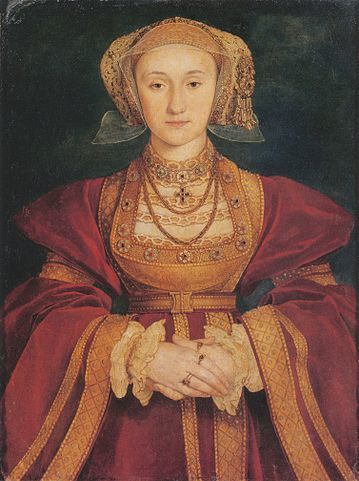
Ovdovělý Jindřich VIII. se hodlá znovu oženit. Z politických důvodů padla volba na německou princeznu Annu Klevskou, jejíž portrét králi učaroval. Anna však neoplývá žádnou ze ctností, jež Jindřich na ženách obdivuje. Ví, že není žádná kráska, a modlí se, aby se mu zalíbila. Uprostřed zimy připlouvá do Anglie a nedočkavý král jí spěchá v ústrety. Jejich první setkání je však katastrofa. Jindřich je hluboce zklamaný. Snaží se „vyvléct z chomoutu“, jak sám říká, ale smlouvy jsou smlouvy. Přichází Annina svatební noc a ona trne strachy. Pokud krále nepotěší, jak to celé skončí? Rozvodem? Popravou? Jindřich dovede být krutý. Celý dvůr si o ní myslí, že je naivní a hloupá, ale ona ví, co se odehrává za jejími zády. A má tajemství. Existuje snad něco, co má zůstat skryto? Tuto duchaplnou a okouzlující dámu si časem zamilovali všichni, kdo ji znali, a Jindřich VIII., který ji zapudil, se nakonec stal jejím nejlepším přítelem. Tím však její příběh neskončil.
Librarian Note: There is more than one author in the GoodReads database with this name.
Alison Weir is an English writer of history books for the general public, mostly in the form of biographies about British kings and queens, and of historical fiction. Before becoming an author, Weir worked as a teacher of children with special needs. She received her formal training in history at teacher training college. She currently lives in Surrey, England, with her two children.
Thank you to Random House Publishing Group- Ballantine who provided an advance reader copy via NetGalley.
There is an extremely shocking event that occurs in the beginning of this book that really blindsided me. As a passionate Tudor History lover, 4th wife Anna of Kleve is a bit of a mystery in comparison to some of King Henry VIII's more notorious wives. Alison Weir is an icon of British history authors, but has recently travelled the path of poetic license while presenting these historical fiction novels of King Henry VIII's six wives. She explains the leaps she took based on research materials in an "Author's Note" at the end of the book. The irony of the fact that information is scanty regarding this wife is that this book is an arduous almost 500 pages! I felt hard pressed to get through it as I neared the end, which isn't a good sign. I think this book would have done well to have been whittled down considerably.
After marrying for love on three previous occasions, all ending in disaster, King Henry VIII is urged to marry for political alliance purposes. Anna of Kleve in Germany is suggested by Thomas Cromwell, chief minister to the King. The King sends his master painter Hans Holbein to paint a portrait of Anna so he can judge her likeness. In scores of historical documentaries and books over the centuries, it is said that perhaps Holbein painted her too favorably from the front, concealing her long nose and chin. In addition, as legend has it, on the marriage night when the King and Anna took to bed, he was turned off by her smell, sagging breasts and belly. He couldn't bring himself to consummate the marriage, which lasted just six months. Physical failings put aside, Anna was known for an even temperament, a patient, thoughtful and sensible character, and these favorable traits served her well when Henry put her aside. Upon their divorce, Anna was to be known as the King's "sister" and was provided several handsome estates in England and a generous income. She wasn't banished to unhealthy houses and ignored to die, wasn't beheaded, and didn't die post childbirth like Henry's previous wives. Because of her level-headedness and plain smarts, I always held a high regard for this wife that was never crowned. I was rather looking forward to the ride Alison Weir would take me on, but was sadly disappointed.
I asked myself if I was jaded from reading so many Tudor books over the decades. The endless minute details of Anna's windswept, rainy journey from Germany to England, as well as the various progresses she would take being introduced to the English public bored the hell out of me. Another thing that turned me off was hearing about all the elaborate homes Anna was given upon her divorce, much of which had belonged to people that were executed by order of the King, and some that used to be Catholic religious houses until Henry closed them all. I just kept thinking about the incredible waste of life.. moving every so often among these homes with staff to wait upon you... Perhaps I've just become cynical about all this.
I guess in summation my gripe with this book was it should have been at least 200 pages less. The author fleshed out what we know already about Anna of Kleve with another storyline that exploded at the beginning of the book. That initial spark really got my attention, but the endless political maneuvering at court, especially at the end of the book, had me skimming through the pages.
My thanks go to Alison Weir, Ballantine Books, and Netgalley for the free copy of this book in exchange for my unbiased review. I had such high hopes for this book, the fourth in the series, but I wasn't sure where the material would come from since little is known about her to create an extensive tome. Then it hit me in the face-she's making it up. Sooo much making up. I like my historical fiction based on fact, and typically Weir is spot-on. If I rated this book merely as a fiction it's wonderful, but I just can't. I'm too much of a purist and the other books in the series were so well-researched. I still have high hopes for the remainder of the series, though most definitely!
Alison Weir returns with yet another novel in her Six Tudor Queens series, turning the attention to one of the lesser known (and seemingly, least scandalous) queens. Anna of Kleve served a brief time on the Tudor throne, but much about her differed greatly from the other wives of Henry VIII. Anna grew up in the House of La Marck, part of Germany, and was tied to the Duchy of Kleve. Her family ruled the region effectively and ensured that the princess had all she could want. A chance encounter with a cousin led to a scandalous event in the early 1530s, one about which only a few were aware, though it marked Anna deeply. As the years passed, Anna could not help but wonder what might come of her life, though she did have a loose betrothal to a local prince, but nothing was ever solidified. When news arrived from England that King Henry VIII was looking to make strong political ties with Kleve, which could include a wedding, Anna was a likely candidate to secure the union. Sending a miniature portrait to secure the king’s favour, Anna waited to see if she would be invited to Court and potentially made the new wife in the Tudor realm. A delayed arrival in England saw Anna accepted, though neither Princess Anna nor King Henry seemed ready for what was to come. Her wedding delayed for political reasons—said to be tied to her potential betrothal back in Germany—and then a wedding night that proved disastrous, Anna was left to wonder if this was a huge mistake. However, she sought to bring forth children for the king, in hopes of not ending up like his past wives. Health and seeming impotence impeded any marital congress, which turned out to be the out King Henry sought to annul the marriage. Anna was left shocked and completely beside herself, but was not sent off or scorned by Henry. Rather, she was given all the amenities that one might expect of a dear family member and given the title of ‘Sister of the Queen’. However, there were still issues, particularly with her small retinue, as she was no longer respected. Henry had moved on to a new (and spritely) wife, leaving Anna to bide her time and turn to those she knew back in Kleve to provide much needed attention. In the final years of her life, Anna saw significant changes to the House of Tudor and of England’s foundation, which would dramatically flavour the path forward. By the end of her life, Anna had shown herself as a respected member of the English Court, even if she was not active in affairs. Recounting many little-known facts about Anna and her years after being queen, Weir dazzles the reader with stories, some factual and others completed fabricated, to tell of the most unique—read: bizarre— of the six wives. A stellar piece of work that will keep the reader enthralled throughout. Recommended to all those who love Weir’s work and especially those who enjoy all things Tudor!
It is always a pleasure to see a new piece by Alison Weir, as I am permitted the chance to learn something while being entertained. This Six Tudor Queens series has proven helpful in fuelling my passion for all things Tudor while also introducing me to a great deal more information about which I had no idea. Anna of Kleve is the queen about whom I know the least, though Weir made sure to fill the book with much that left me wondering and racing for the ‘author’s historical note’. Anna began life as a naive princess, overcome by the wiles of an older relative, but still kept the secret in order not to stain her family. Her use as a pawn in the England-Kleve political alliance seems not to have soured her resolve to make the most of her responsibility, as she knowingly and voluntarily loved Henry VIII as best she could. Tossed into quite the quagmire, Anna was left to fend for herself when demeaned by Henry and his advisors, but did not become a shrinking violet (rose?) for the latter years of her life. Seeking to move on, she grew in personality and resolve, as Weir depicts throughout. There are the usual characters who fill the pages of the novel effectively, from King Henry through to the lowest servants, all of whom add a flavour to this fourth novel in the series. The reader is even able to see ahead, looking at the final two queens chosen after Anna was tossed to the side. The premise of the story is intriguing, offering up some interesting facts that I knew nothing about before, including in the opening chapters of the book. Weir is one who always spins a tale, adding fiction into her factual findings and creates an effective final product that will keep the reader wondering. I cannot wait to see what else is to come, with two queens yet to receive their own novels. I know Weir will keep her readers enthralled, though I will have to wait until next spring for the next instalment.
Kudos, Madam Weir, for another wonderful novel. I thoroughly enjoy your writing and all you bring to the story.
I first became familiar with Alison Weir by reading her historical biographies which are far from dry and boring, but are instead entertaining, engaging, and read like novels. When she ventured into historical fiction, I did not hesitate to follow her along on that transition. I have yet to be disappointed. In Weir’s most recent novel, “Anna of Kleve: The Princess in the Portrait,” Weir weaves an intriguing story about Henry VIII’s fourth wife.
Anna of Kleve was an enigmatic individual. Of the four wives whose marriages ended at the King’s whim, Anna’s story was the least tragic and the most unusual. The King didn’t like her from their first meeting, but he married her anyway and quickly regretted it. Henry then came up with a weak excuse for a divorce and set out to convince Anna to accept his terms. If Anna would agree to end the marriage, Henry vowed to thereafter consider and treat her as his dear sister. Anna was no fool—this was a far better offer than being exiled or executed, so she agreed to the divorce. Henry was true to his word. He bestowed upon Anna various properties, provided her an income, allowed her to retain a retinue of advisors and household staff members for the rest of her life, and did indeed treat her as a beloved sister.
Those were the historical facts that appear in Weir’s novel, but Anna of Kleve’s life was not as well documented as some of Henry’s other wives. Weir uses that lack of recorded information to create an interesting backstory for Anna, beginning with her early teen years and the mistakes of youthful innocence. Those mistakes are used to define and explain Anna’s behavior and personality into adulthood, particularly during her brief tenure as Queen and her much longer tenure as “sister” of the King. Weir weaves a plausible and believable story and does it in a way that keeps you turning the pages to the very end. This is a “must read” for anyone who loves Tudor-era historical fiction.
Thank you to Netgalley, Ballantine Books, and the author for a digital ARC in exchange for an honest review.
While I have read some of Alison Weir’s non-fiction, history, in the past, Anna of Kleve is my first foray into her historical fiction and it has been a pleasurable, positive experience. I am an advocate of well executed historical fiction, where the factual basis is apparent and the fictional overlay allows greater access to the story, opening up the details of everyday life long ago in service to plot.
After his third wife died, Henry found himself in need of another wife and in a struggle to find a suitable mate. We read here of all the machinations from the point of view of the duchy of Kleve and princess Anna. There are the political and religious aspects, the current and anticipated future power plays, and, of course, Henry’s probable wish for another son. He only knows Anna through Holbein’s portrait.
This novel begins with a young Anna, with a hypothetical story that may not have happened as written but for which Weir provides background and some possible evidence. Some suspension of disbelief is required to fully enjoy this aspect of the story. But remember—this is historical fiction, not history.
What sets Weir apart in all of her writing is her attention to detail and her ability to incorporate it into a very readable text. I recognize the descriptions of wedding gifts and parade/displays from her history writing. Her descriptions of Anna’s travels and travails in England after her separation from Henry give such strong signs of reality (and the type of petty notes that were retained for centuries).
Through Anna of Kleve, we have a bird’s eye view of some of the major events of English history which Alison Weir has blended skillfully into this work of historical fiction. She also provides an afterword which summarizes her decision making in writing of Anna and the genesis of various plot elements.
All in all, I enjoyed the story of Anna very much. And I greatly appreciate Weir’s ability to use her extensive knowledge in this way. As I said above, I find historical fiction to be valuable when well done. This is valuable.
A copy of this book was provided by the publisher through NetGalley in return for an honest review.
I love this series and this one, the one I've been looking forward to the most, is, in my opinion, the best. Perhaps the least well known of Henry's six wives, Anna is presented here in such a compelling way. And she is so relatable. She made the best of a situation that could have proved very bad indeed. But she also, as shown here, dealt with some of the other constraints that were made on women at the time. Much of this can only be speculation but it makes for a very good story and an appealing and very human heroine. I cared for her and tears were shed. The tantalising glimpse we're given of Katherine Howard makes me look forward to the next book more than ever! Review to follow closer to publication on For Winter Nights.
This was extremely detailed and reads almost more like a biography enhanced with dialogue. This just drags mostly from overly descriptive narrative of palaces, staff, horses, dresses, banquets, etc. This was dull and boring in tone. I really wish that Queen Anna had lived her life as described in this novel. I like to think of her having a secret lover and child. At the same time much of the gossip about Anna comes from Chapuys' letters to the Emporer. Chapuys was not a reliable or unbiased source, he was quite a gossip as well. Sexism allows many of the wives of Henry VIII to be seen as stereotypes. In fact Henry was the jerk and there was nothing wrong with any of his wives. Even the one caught cheating, after all he was famously and flagrantly unfaithful to *all* of his wives. He murdered his cousins, 2 of his wives, his old tutor, old friends and threatened to kill his daughter Mary AFTER he cut off Anne Boleyn's head. This man was never okay. Like every other tyrant in history he blamed and slandered his victims. Anne Boleyn wasn't unfaithful and certainly wasn't cheating with her brother. Half of the dates given that she was accused on she wasn't physically where she was accused of being unfaithful. Henry lied and I don't understand why historians continue to treat his blatant lies as possible facts. It's highly doubtful that Anna of Kleve wasn't a virgin when she married Henry. She came from a very conservative court and it was not uncommon not to speak of sexual matters to unwed women. The discussion that's given as proof that Henry never slept with her, based on testimony from her English ladies is dubious at best as she didn't have the vocabulary in English at that time to discuss such matters. Finally virginity is a made up concept that really only supports patriarchy. The author must be aware that some folks born with vaginas don't have a hymen at all. Or that the hymen can be broken jumping, dancing, riding, etc. Also tons of people who haven't had children have loose bellies, saggy breasts and stretch marks. I find it hard to believe someone as educated as herself doesn't know this. I have no issue with her adding this storyline to this fictional book, just her attempting to make it seem plausible in the Author's Notes section.
This entire review has been hidden because of spoilers.
In Anna of Kleve, The Princess in the Portrait, readers are introduced to Henry VIII's fourth wife, Anna von Kleve, commonly referred to as Anne of Cleves. Following the loss of his third wife, Jane Seymour—who died less than two weeks after the birth of Henry's longed-for male heir, Prince Edward—it was decided Henry's next wife should be the means of forming a political alliance, in case England was attacked by France and the Holy Roman Empire. Thomas Cromwell (Henry's Principle Secretary and Chief Minister) suggested Anna, so the King sent Hans Holbien to paint a portrait of Anna and her younger sister, Amalia. Henry would use the portraits to decide which sister to marry. Pleased with Anna's portrait, Henry chose her to be his wife.
The King (wearing a disguise) met Anna for the first time in Rochester on New Year's Day, 1540. Anna failed to recognize him, displeasing the King, who decided she looked nothing like her portrait. He no longer wished to marry her, but to back out of the marriage would threaten the alliance with Kleve, which Henry believed he needed. In order to preserve that alliance, Henry and Anna were married January 6, 1540—but their marriage was never consummated. The morning after their wedding, Henry reportedly told Cromwell: "I liked her not well before, but now I like her much worse, for I have felt her belly and her breasts, and thereby, I can judge, she should be no maid, which so strake me to the heart when I felt them that I had neither will nor courage to proceed any further in other matters." (Quote source: Author's Note, Anna of Kleve, The Princess in the Portrait.)
Within six months, Anna was ordered to leave the Court, and shortly afterwards was asked to give consent to an annulment. Anna agreed, and their marriage was annulled July 9, 1540. Pleased with her acquiescence, Henry gave her a generous settlement of properties and income, referred to Anna as "The King's Beloved Sister," and decreed that she would be given precedence over all the women of England, except for his wife and daughters.
None of this is a spoiler, it's all history. (I may or may not have gotten a bit carried away in sharing all of that, but hey... I'm a history geek. It's what I do.) Weir covers all of this within the book, as well as historical events that take place following the annulment of the marriage all the way up to Anna's death. (I'm betting anyone reading this review is relieved I didn't mention all of that, as well!) So how did the fictional aspects of the story fare? Weir made a bold choice in that regard... and it is likely to prove controversial among Tudor enthusiasts. (This is an assumption on my part, as I've not yet read any reviews of this book... but I suspect it will prove to be a correct assumption.)
I won't discuss what that 'bold choice' was in this review, but I will say that it was definitely surprising, and more than a little shocking to me when I realized where things were heading. It put a whole new spin on the failure of Anna's marriage to Henry, and—even though I don't consider it to be something that could have actually happened—the idea of it certainly sparks the imagination, and made for an intriguing storyline. It gives the reader something new to discover amidst all the historical fact, an unknown with the potential to take the story in a completely different direction that they expected it would... and in doing so, keeps the story fresh and entertaining.
Anna was the wife to live the longest—surviving not only Henry, but his heir, as well. As such, Anna's story includes (to some degree) Katherine Howard, Katherine Parr, Edward VI, and Mary I. With each succeeding monarch, Anna's life—not to mention, her financial circumstances— was to change course in ways that were completely out of her control. This was of particular interest to me, as I was either unaware or had forgotten what became of Anna after Henry's death. This, along with the fictional storyline I mentioned earlier, kept me eagerly reading until the end.
Historical fact and fictional possibilities combined served to make Anna of Kleve, The Princess in the Portrait a fascinating read. The bold choice that drives the fictional storyline may not appeal to all readers, but it gave the story a unique edge not found elsewhere. I loved this book, and highly recommend it to others who enjoy reading Tudor historical fiction.
i love this book so much because of the fact that it gives more to the storyline . when i start learning king henry the eight . i did not knew much his wife anna of kleve till i read this book . i know what to do more reading up about her . i was always read about the other wives of henry the eight.
We're onto wife #4 and perhaps the least-well known: Anne of Cleves, as her English designation has her. Perhaps the sources are limited in comparison with, say, Anne Boleyn as there seems to be more novelistic licence on Weir's part than the first two books. There is a massive imaginative leap taken which proves the foundation of the book: even if it were true, I found it very hard to believe it could have happened *in this way* given Anna's status, her upbringing, her family expectations and so on.
Other than that, the strengths and weaknesses remain the same as the previous books: on the plus side, Weir knows the sources and the places (in fact, at times this sounds like 'Home and Gardens: The Tudor Edition!) so the setting and context is well coloured in, but the prose and psychology is very simple and straightforward, almost YA in terms of vocabulary and understanding. Every time there's a tense moment we're told Anna's heart is thumping, she's almost fainting, lightening flashes before her eyes and all kinds of other romantic clichés (there are even men with 'devastating' smiles!)
I enjoyed reading this account of Anna’s life. She was strong and intelligent to endure the terrifying ordeal of being wed to Henry VIII. It’s well researched and written with a captivating flair. Full review on my blog: https://poetryofreading.blogspot.com/...
Anna of Kleve - Queen of Secrets is another brilliant addition to the Six Tudor Queens series by historian Alison Weir. This is the fourth historical fiction novel in the series and is the story of Anna of Kleve, or Anne of Cleves as most of us know her.
The Author's Note is quick to inform the reader that Anne of Cleves actually signed her name 'Anna'. She also tells us that Henry VIII came to refer to her Anna, informing her decision to refer to her as Anna in this novel. Furthermore, Kleve is the German name of her town and Duchy, while Cleves is the anglicised form. Therefore, in order to be historically accurate, Anna should be referred to as Anna von Kleve. Who knew?
In this historical fiction imagining of her life in the 1500s, Weir has provided an alternate history for Anna of Kleve and I predict it will be a polarising one for fans of Tudor history. I was open to an alternate storyline and wasn't scandalised by what the author has proposed here. Besides, historians can't be 100% sure about the secrets of a life lived in the 1500s - especially when it comes to women - as so little was recorded and much less has survived the ravages of time.
What is agreed, is that there has been much speculation that at the time of wedding Anna of Kleve, King Henry VIII was suffering from impotence. It has been posited that the reason the King didn't consummate their marriage is that he couldn't muster the will.
My favourite episode from The Tudors TV show is the night after King Henry is supposed to have consummated his marriage with Anna of Kleve. Cromwell asks the King: “How does your Majesty like the Queen?”
He replies: “Surely My Lord, I didn’t like her very much before and I like her much worse now. She is nothing fair and she has evil smells about her. And I know she’s no maid because of the looseness of her breasts and other tokens. So I had neither the will nor the courage to prove the rest. I have no appetite for unpleasant airs. I left her as good a maid as I found her.”
In the Author's Note, Alison Weir tells us more about what was actually said, and it wasn't much different.
On the morning after his wedding night, the King told Thomas Cromwell: "I liked her before not well, but now I like her much worse, for I have felt her belly and her breasts, and thereby, as I can judge, she should be no maid, which so strake me to the heart when I felt them that I had neither will nor courage to proceed any further in other matters."
For weeks afterwards, he made similar complaints to others, saying he "plainly mistrusted her to be no maid by reason of the looseness of her belly and breasts and other tokens", and stating, "I have left her as good a maid as I found her." Page 488
Of course, much has also been made of the portrait of Anna of Kleve painted by Hans Holbein and whether it was a true representation or not. This is also covered in the novel, as is the possibility King Henry didn't find Anna attractive as she wasn't skilled in dancing or playing music, which was much desired in a lady of her status at an English court.
Prior to reading Anna of Kleve - Queen of Secrets, my knowledge extended only as far as the King having their arranged marriage annulled and Anna being known from then on as the King's Beloved Sister. I've always admired that Anna seemed to deem it safer to acquiesce to King Henry's demands than to protest.
In Anna of Kleve - Queen of Secrets, we stay with her beyond this turning point in her life all the way through until King Henry's death in 1547 and her own death a decade later in 1557. I enjoyed reading and learning about the rest of her life, which I hadn't explored in fiction until now.
The proposed love affair between Anna and her cousin is bound to cause controversy, however the author makes a good argument for the relationship in her Author's Note.
I'm thoroughly enjoying this series and am already looking forward to the next one. No doubt it'll be the story of Catherine Howard and I know I'll be in Alison Weir's expert hands once again.
I am always deeply conflicted when historians write fabricated stories BASED on facts, it just doesn't feel right. I can only tolerate it when Alison Weir does it, no one else! I went through ups and downs reading this, because I knew that most of what I read was simply not true. Author herself admits in final pages that she just went to town with her imagination and made up some pretty major events in Anna's life. I kept asking myself - am I reading this as a history book or as historical fiction? Still, after wrapping up this story, I feel that Alison Weir once again managed to create a compelling narrative, great characters and wonderful depiction of Tudor era, told from a German princess's POV.
Kleve was a small duchy in Germany and, after three unsuccessful marriages, Henry VIII decided to marry for political reasons. Anna was chosen based on her portrait which showed her face from the front, but, as it turned out, her profile was unacceptable for Henry. It reminded me of guys complaining how girls on Instagram don't look like that in real life or people asking for their money back when they order something from Aliexpress. Henry made all the arrangements for marriage, a bunch of people were included in negotiations, Anna and her entourage traveled all the way to England only for Henry to be like: "Uhm, she's ugly, do I have to marry her?" Their marriage was not consummated and it was annulled after only a couple of months, so their "love" story was not really in focus and there was not much to tell in regards of two of them together. I had to remind myself that these are not stories about Henry, but about his wives.
Anna outlived Henry, but her life was not that exciting without him in the picture and I dare to say, she was his most boring wife. Her character was simple and dull. I can't praise Alison Weir enough for making me hate Anna just by giving me little hints. Anna doesn't know how to dance, she doesn't know any languages, she doesn't read books, she doesn't like to talk back, avoids conflicts, doesn't have a backbone basically. The only thing that matters to her is just to have a nice house where she can spend her days in peace. If that means that she has to pretend to support whomever is on the throne, to deny that she is Catholic, to sign anything just to have money to support herself - she will do it and won't lose a minute of her sleep.
If you've read Anne Boleyn: A King's Obsession, you know what mu frustration is. That was the best book in this series, you could tell why Anne Boleyn is fascinating even today. Alison created the most touching and human story and, loved her or not, you could understand why Anne Boleyn seduced left and right. After living with her for so many years, it really is no wonder why Henry wanted to scream when he met Anna of Kleve.
I appreciated what author managed to create with so little material and known facts. I only wish that the book was a little shorter, I didn't need to know so many details on Anna's traveling obstacles from Kleve to England, her dresses and her troubles with managers of her estate. I understand that Henry was out of the picture, but was it necessary to know all about Anna fighting for her right to cut down the trees from her back yard.
Can't wait for book No5!
I got my advanced copy through Edelweiss, thank you, Random House!
Anna of Kleve, The Princess in the Portrait is the fourth book in Alison Weir's Tudor queens series. Prior to this, I've read a couple of accounts of Anna of Kleve. Her situation with Henry VIII was so bizarre and never really understood. This is a man who chops heads off every day for no reason at all. Why, then, did he marry, divorce then send Anna away to live a pretty comfortable life? It's like she was his one act of kindness. Anna of Kleve was, in my opinion, the most successful queen. Henry called her ugly and not a maiden, and it seems like he just ran from here for some reason. Yet, he later calls her sister? It's puzzling indeed. I enjoyed reading this account of Anna's life and from where she came. She was strong and intelligent to endure the terrifying ordeal of being wed to a notorious wife killer. I love all of Alison Weir's work, including this new addition. It's well researched and written with a captivating flair. I felt like I was there. If you are a fan of the Tudor queens series, this is a must read. Thanks to NetGalley for an arc in exchange for an honest review.
Well, that was amazing. The fourth story of the Henry the eighth Saga, belonged to his German queen who was really never a queen. I liked that this book focused on Anna's life in Kleve at the beginning, introducing how life is in that part of Europe, and how they fit in the whole scheme of things. This book was really informative and detailed, despite the fictional events within, as it showed us how Anna become a queen and soon to be forsaken, and how her fortunes have risen or fallen. Also, Anna's story tells the tale of most of the important events after her coming to England from her point of view, however brief they were. I liked Alison's fiction and would recommend it to any historical fiction geek.
DNF. I made it about 130/140 pages in and quit. This read more like a biography than a historical fiction piece or whatever genre it should fall in. The pace certainly made me feel like I was back in medieval times when it came to the wedding negotiations, the route Anna would travel to England, the clothes she would wear, it just dragged, dragged, and dragged some more that I was impatient for her to get on with it and meet her aging, obese husband Henry VIII. By the time their paths finally crossed, I had lost all interest. Do I want to address the plot of Anna having, one) sex with a cousin hours after meeting him and two) having an illegitimate son? No. I'm all for creative license but even that plot was a HUGE stretch. Just because she wasn't an English rose waif didn't mean she had a child prior to meeting Henry. Surprise! there is an abundant number of thick or well-proportioned women with child-bearing hips who have never had a child. Shocker, right? Anyways, this novel was pedestrian; the characters talked at exclamation point levels during every conversation (no lie the number of !'s I saw could compete with the national debt), and it just wasn't good, intriguing writing.
I greatly respect Alison Weir as a brilliant researcher and historian. I have all her previous works, however as with the other books in this series I sadly just didn’t enjoy this. The best bit by far were the early chapters on Anna s life in Kleve and her journey to England. I found them detailed, believable and interesting. However the big issue for me was the idea that she had borne a illegitimate child (later 2 children) the whole storyline seemed inserted for sensation and sat disjointed with the historical world the author invoked. Henry VIII is suitably tyrannical, alternately kind and monstrous, Mary dignified and Elizabeth haughty. These characters were interesting and well established. Sadly for me Anna herself as a character just didn’t ring true, the love affair was so out of character for the woman Weir had created it just spoilt the story. It felt a bit like Anna wasn’t interesting enough on her own so a different life for her had to be made up. I appreciate this is historical fiction and therefore the author is free to make up any stories she likes but it didn’t work for me.
This entire review has been hidden because of spoilers.
It's interesting that there are two subtitles to this book; there are editions in GoodReads for Anna of Kleve: The Princess in the Portrait and Anna of Kleve, Queen of Secrets. I prefer the second title, as 'the princess in the portrait has been basically my sum knowledge of Anne of Cleeves until now. She was the one who entranced Henry by her portrait but he was so disgusted by her that he called her 'the flanders mare' and got a divorce. I've always wondered why they even went through with the wedding.
Well, no need to wonder as much anymore! However, this book needs to come with a big disclaimer: this is the most fictionalised account by Alison Weir that I have read so far. From reading the author's note, you'll discover that little is known of Anna of Kleve's (the proper German pronunciation) life before she came to England, so a HUGE plot point has been invented by Weir. It is perfectly plausible that these things could have happened, as Weir explains, but there is no historical evidence to back it up. There's no evidence to say it didn't happen either but... well.
Whilst with some of the other books in the series, I felt that they could have done with some good editing, I didn't feel that for Anna of Kleve. The fact that it was fictitious was a double-edged sword: there was so much room for narrative creativity, but I also felt a little cheated that there was less real history in this one. However, there are plenty of facts amongst the invented storyline and I know a lot more about Henry's fourth wife than I did before!
Kleve is a Duchy in what is now Germany, and Anna is summoned to the British court to be married to the terrifying Henry VIII, notorious for 'getting through' wives. She doesn't even speak English and multiple delays to her arrival in England frighten Anna, followed by a disastrous wedding night. (This part is pretty much historical fact, I believe).
I don't want to talk about the huge deviation from historical fact because it is a massive spoiler for the whole book. Instead, I'll talk about Anna. Her marriage was brief and she never remarried, in fact outliving King Henry. Compared to Jane Seymour's short life, Anna's seems to be rich and full. The King addresses her formally as 'Sister' and she, like Jane, is keen to see his children from previous marriages (Mary and Elizabeth) restored to the succession. Anna is deeply religious, a devout Catholic and is dismayed to find that many people see her as a symbol of the new Protestant religion, as she has never given any indication of it. But to speak out directly is dangerous; she decides to pay lip service to the new ways if it is needed of her (probably after having seen how difficult Katherine of Aragon's life was made). Pragmatic, likeable and strong-willed, Anna decides to stay in England after the divorce and became a much respected member of Court, although she was not active.
As Anna's life spans right from Queen one to Queen six, it is interesting to get a 'long-lensed' view on Henry VIII's reign. Weir's story of Anna is intriguing and probably needed to flesh out the book due to the paucity of sources, and I really felt for her as a woman. She is the Queen I feel I can relate to the most (so far). Maybe that's because she is so fictionalised - I'm in two minds about the huge artistic license that Weir made.
Basically, I really enjoyed this book! - but I feel ambivalent about liking it due to historical inaccuracies: should I be really be enjoying this book more than the others in the series when it's the most fictitious? I really wanted to learn more about the Tudors, a strangely compelling obsession - and although I learnt a lot about 'Anne of Cleeves' (because I basically knew very little), I learnt more about Weir's character than the historical figure.
I guess it depends on your viewpoint, which is why I'm conflicted. In terms of enjoyment, this was my favourite so far. But it is most definitely a novel. Try it for yourself!
The Six Tudor Queens series continues with the fourth of Henry VIII’s wives, Anna of Kleve. This is one I’d been looking forward to, happy to move even further away from the Great Matter, and also because I didn’t know much about Anna herself.
Anna hailed from Germany and to all intents and purposes seemed to have lived quite the sheltered life under the watchful eye of her mother. Until the day Henry VIII, King of England, decides he needs another wife and preferably another heir. With Spain and France joining forces against him, an alliance with the Duke of Kleve would be quite an advantage. Henry asks his court painter for a portrait of Anna. He likes what he sees. Until Anna finally arrives in England. Despite the marriage going ahead, it quickly becomes clear Henry isn’t happy and when Henry isn’t happy, heads roll. But will it be Anna’s?
There is quite the controversial storyline running through Anna of Kleve. As always, Alison Weir takes facts and builds her story around those. In this case, the reasons Henry listed for his marriage to Anna to remain unconsummated. By that time, he was nearing 50, massively overweight and unfit, and quite possibly impotent. But of course, that’s not something he would ever have admitted. In his attempts to have his marriage to Anna annulled, Henry shows a side of himself we’ve not really seen before. At times he managed to come across as likeable even.
Now imagine Anna. A young woman sent off to England to marry a King. She spoke no English, knew nothing of the culture or customs but did know the stories about what happened to Henry’s previous wives. How incredibly frightening is that? Unable to please Henry, through no fault of her own, her life at the court must have been spent in sheer fear and anxiety.
I mentioned the controversial path Alison Weir takes with this story. Up to a certain point, I was quite willing to follow it. It explained a lot, it made sense while keeping Henry’s words in the back of my mind. But as the years went on, I must admit that that particular fictional part of the story lost me a little bit. I’m being deliberately vague here because I want the readers to experience this for themselves. If you do read this novel, and you definitely should, I’d be incredibly interested in knowing your thoughts.
I absolutely adore the Six Tudor Queens series and boy, do those hardcovers look amazing on my bookshelf. As always, Alison Weir’s research is immaculate and her descriptions are fabulously vivid. From the various palaces and their furnishings to the food served to the gorgeous clothes, she brings this era to life like no other. While I enjoyed Anna of Kleve, it wasn’t my favourite of the series though. It’s a bit hard to explain but for the first time in this series, I really felt like I was reading fiction. Which it is for the most part, of course, but some of it just didn’t quite work for me. Nevertheless, putting those misgivings aside, Anna of Kleve is another fantastic addition to this series and I can’t wait for the next one.
After the death of Henry's beloved third wife, Jane Seymour, the aging and ponderous monarch searches for a new bride who can increase his count of heirs. Anna of Kleve, a young woman from one of the small German principalities becomes the chosen one, and what follows is the story of a woman who was rejected almost as soon as she was married.
I struggled to maintain interest in this book (spoilers ahead). The author's choice to have Anne birth an illegitimate child while in her teens was highly speculative and somewhat offputting. This was coupled with a historical writing style that was highly literal and had little symbolism and foreshadowing. Many times, the narrative contained specific and lengthy descriptions of items and clothing, and though doubtless designed to create an atmosphere, it often felt like an info dump.
While the first person narrator (Anna) felt fully fleshed out as a character, the speculative nature of the initial events shed doubt on whether the character shown in the book was anything like the original wife of Henry VIII. Henry himself is adequately repulsive, alternating between kindness and cruelty. Cromwell was interesting, but fairly flat. Anne's retainers from Kleve were my favorite characters in the book.
Fans of Alison Weir's earlier books in the Six Tudor Queens series will enjoy seeing the story of Henry's fourth wife as well as the introduction of young Katheryn Howard (soon to be the fifth).
Disclosure: I received a complimentary copy of this title from the publisher via NetGalley. All opinions expressed in this review are my own.
This entire review has been hidden because of spoilers.
Anna of Kleve was the first book in this series I can say I honestly enjoyed. Probably because, mercifully, George, Anne and Jane Boleyn are only rarely referenced in it (Weir's take on all three of them in the preceding books nearly gave me heart failure). Anna is kind and endearing, the sort of protagonist that you come to love even in spite of her missteps. Weir makes it clear that even though she is thought of as Henry VIII's luckiest wife, things weren't always coming up roses for her and the Tudor court remained a treacherous place...even if you lived far from the palace. These dangerous times put Anna in a precarious position and I often found myself getting really irritated by historical persons I normally admire...which is good because it underlines the fact that no one is purely good or evil. The conclusion was heart-rending and I found myself tearing up at Anna's farewell.
I loved Anna as a character and the intricacy and detail in these novels are incredible. I enjoyed the speculative element in this book and the evidence that Alison Weir reinforced it with made it even more enjoyable. While it is unlikely that these events took place, it is always interesting to wonder "what if?". This was another stunning instalment in the Six Tudor Queens series, and I enjoyed it a lot, although I will admit that the last quarter perhaps required a little more editing down.
Weir is always a fan of stirring up the most controversial possibility and trying to pass it off as a fact. As a story it kind of works, as historical fiction it feels akin to slander.
The pacing is all over the place, with important events glossed over in a page or two, and far too much time given to Weir's invented storyline.
This is my least favourite in this series so far. I appreciate the fact that not much evidence exists of the true facts of Anna's life and some poetic license is necessary, but Alison Weir took it too far. I highly doubt that Anne of Cleves gave birth to two illegitimate children and there was far too much waffling to pad the book out. Hoping the next one will be better.
This entire review has been hidden because of spoilers.
Alison Weir has done it again! I've loved every book in this series, and "Anna of Kleve" was no exception. Like Jane Seymour, it took me some time to connect with Anna, but once I did, I was thoroughly invested in her story until the very end. Alison's ability to make any character compelling and likable, even when they were distinctly less so in real life, continues to astonish and delight me. As with all the volumes in this series, there is rich historical detail, loads of juicy court gossip, and enough romantic intrigue to make King Henry and his festering leg wound seem exciting. If you're a devotee of the series, and/or of royal history, dive in with confidence. You're in for a wonderful treat.
I was disappointed in this. Although the historical background of 16th century England and the Holy Roman Empire is fairly sound (though rather sketchy), the story the author weaves about Anna and Henry VIII's dislike of her is a fantastical, unconvincing tale woven out of whole cloth. Alison Weir generally does better than this.