Jump to ratings and reviews
Rate this book

The Syrian Goddess: "De Dea Syria"

Rate this book
Book Description:

"Lucian of Samosata's De Dea Syria, (the Syrian Goddess) is one of the most 'notorious' classical writings. Not only does it acknowledge that at one time a paramount Goddess was worshipped in regions of the Ancient Near East, it goes into details of the practices of her devotees which later generations considered reprehensible. Nonetheless De Dea played an important role in the development of modern Neopaganism; Robert Graves cited it as one of the few actual accounts of ancient Goddess-worship.

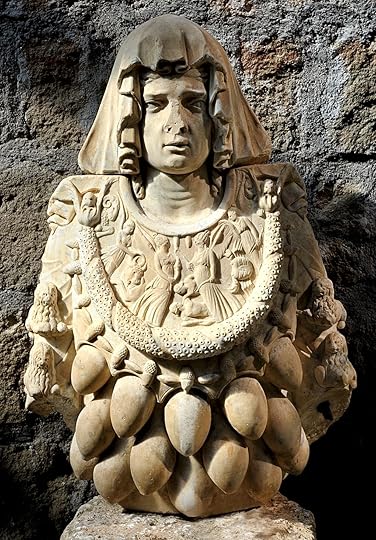
Lucian recounts his personal observations of the worship of the Goddess Atargatis (a form of Isthar or Astarte) at the temple of Hierapolis, in what is today Turkey. Lucian writes in the style of Herodotus, and, remarkably, in Herodotus' dialect of Greek, which at that time was over five hundred years old. Lucian describes huge phalliform idols, cross-dressing priests who castrated themselves, ritual prostitution of female worshippers, and occasional infant human sacrifice. Unlike most of the other writings of Lucian, he is not being explicitly satirical or ironic, nor is he writing fiction. Strong and Garstang claim that this was largely a historically valid description, supported by other ancient writers, texts, and archaeology. Among other passages of interest, there is a variant account of the Greek flood myth of Deucalion which is here blended with pre-biblical Ancient Near Eastern deluge accounts.

Victorian and early 20th century scholars found this text difficult to process. It is conspicuously absent from the expurgated Fowler and Fowler translation of Lucian's Works of 1905. While A.M. Harmon included De Dea in volume four of the Loeb Classics Library Lucian in 1925, he rendered it in middle English! Harmon's rationale was that Lucian wrote De Dea in an archaic dialect of Greek, so this was an attempt to convey the experience of a contemporary of Lucian reading this. But it is not helpful for the modern non-academic reader. Fortunately, Strong had translated De Dea into clear modern English in 1913, and so this is the edition which I used. However, the Strong translation has never been reprinted and used copies are almost impossible to come by. I had to obtain a copy of this book by interlibrary loan from a small college in Pennsylvania. Even still, Strong and Garstang wreathe the translation in a thick nimbus of apparatus, which gives the appearance of a scholarly distancing tactic. This tendency has continued into the 21st century: a recent academic edition ran to 600 pages--all for a text about the length of a short magazine article. (Lucian, On the Syrian Goddess, J.L. Lightfoot, Oxford University Press [2003])

Lucian's authorship of De Dea has been questioned. One issue is the archaic dialect. In addition, his other works are quite cynical about religion. And where is Lucian's relentless humor? The effect is like watching Robin Williams do a completely straight reading of the Gettysburg Address. Is he being absurdist by affecting not only a different dialect, but a pious attitude, as some have suggested? Or is he being serious, for once? There is one clue: in a personal note at the end, Lucian says that a lock of his youthful hair was dedicated to the Goddess at this temple. This may hold the key to why he wrote this piece." (Quote from sacred-texts.com)

Table of Contents:

Publisher’s Preface; Editor's Preface; Introduction; Life Of Lucian; Translation And Notes; Appendix; Bibliography; Endnotes

About the Publisher:

Forgotten Books is a publisher of historical writings, such as: Philosophy, Classics, Science, Religion, Esoteric and Mythology. www.forgottenbooks.org

Forgotten Books is about sharing information, not about making money. All books are priced at wholesale prices. We are also the only publisher we know of to print in large sans-serif font, which is proven to make the text easier to read a

98 pages, Paperback

First published January 1, 150

Loading...
Loading...

About the author

Lucian of Samosata

1,401 books193 followers
Lucian of Samosata was a Greek-educated Syrian rhetorician, and satirist who wrote in the Greek language. He is noted for his witty and scoffing nature.

Ratings & Reviews

What do you think?
Rate this book

Friends & Following

Create a free account to discover what your friends think of this book!

Community Reviews

5 stars
16 (30%)
4 stars
23 (43%)
3 stars
11 (20%)
2 stars
2 (3%)
1 star
1 (1%)
Displaying 1 - 9 of 9 reviews
Profile Image for Yann.
1,414 reviews405 followers
July 20, 2011
Il existe, en Syrie, une ville située non loin de l'Euphrate ; elle se nomme Hiéra, la ville sacrée, et elle est, en effet, consacrée à la Junon assyrienne. [...] Assyrien de naissance, je relate des faits que j'ai vus de mes propres yeux, ou qui m'ont été communiqués par les prêtres, quand ces faits étaient antérieurs à mon époque.


Ce texte de Lucien en a laissé plus d'un perplexe, dont moi : cet auteur, pourfendeur notoire des superstitions et autres impostures s'attarderait à décrire le fonctionnement d'un temple syrien à Hiérapolis (aujourd'hui Manbij, au nord de la Syrie, près de la frontière turque) qu'il a bien connu dans son enfance, étant natif de cette région? Cette dernière a de nombreuses fois changée de mains (Perses, Romains, Arabes, Croisés, Mongols, Turques). Peut-être était-elle est habitée alors par des Gallo-Grecs (les fameux Galates des Évangiles à qui Saint Paul envoie ses épîtres), des descendants de Gaulois émigrés quelques siècles auparavant. Je me demande s'il faut les identifier aux Galles qui servent le dit temple.

Je n'en ai pas rencontré de [temple] plus grand que celui d'Hiérapolis, ni d'édifice plus auguste, ni de contrée plus sainte. Ce temple renferme des ouvrages précieux, d'antiques offrandes, une foule d'objets merveilleux, des statues vénérées et des dieux toujours présents. En effet, les statues y suent, se meuvent et rendent des oracles. Souvent une voix se fait entendre dans le sanctuaire, le temple fermé : beaucoup l’ont entendue.


On apprend donc que l'éviration, loin d'être le seul apanage d'Origène, était une pratique des Galles servant le temple destinée à honorer la mémoire de Combabos et de Stratonis. Une histoire tout à fait dans le goût des romans grecs orientaux, ou des mille et une nuits. La haine du cochon est également expliqué par le mythe d'Adonis, qui fut tué par un sanglier. On est épaté par le syncrétisme antique, où toutes les divinités d’Égypte, d'Asie mineur et de Grèce étaient identifiées les unes aux autres : Deucalion (l'équivalent grec du Noé de la Bible, ou du Utanapishtim dans Gigamesh), Hercule, tous ont leur équivalent en Orient.

L'appareil critique est d'une rare qualité : les notes sont directement en bas de page et le traducteur n'a pas négligé de parcourir Plutarque, Hérodote, Athénée, Pline l'ancien, Ctésias, Diodore de Sicile et Pausanias, les auteurs les plus prolixes, pour recouper toutes les informations, et fournir des éclairages très utiles sur les coutumes religieuses de l'Orient antique.

Le texte en traduction:
http://remacle.org/bloodwolf/philosop...
Profile Image for Katya.
42 reviews3 followers
April 20, 2021
An ant's-eye tour of Ancient Near Eastern customs under the guidance of the ever well-informed Lucian of Samosata. And yes, he was not as much of a pathological fibber as some of the other renowned ancient historians *cough* Herodotus *cough*.

Laden with details and critical commentary, although it lacks the biting wit for which Lucian is so praised.

Recommended for: mythology buffs, nerds of the ancient near east and comparative classical studies.
1,576 reviews25 followers
June 8, 2024
En genomgång av kultbruk i "herakulterna" i mellanöstern. Lite småintressant för oss antiknördar, men knappast mer.
Profile Image for Artur Coelho.
2,678 reviews79 followers
May 18, 2026
Como amante que sou de palavras milenares, não resisti a este achado de alfarrabista. Não será obra maior, mas isso não retira o fascínio de ler pensamentos preservados de um mundo que nos é longínquo. A descrição das prática religiosas greco-romanas foge à nossa visão estereotipada de elegância e hieratismo; as descrições dos praticantes de rituais míticos estão cheias de um certo espírito de confusão e desordem, complexos com só a vida consegue ser. É um excelente mergulho no passado, evocando uma imagética viva. Esta edição inclui um curioso ensaio sobre o luto, com uma posição crítica e satírica (não surpreende, dado ao autor) sobre os rituais da morte.
3 reviews
October 10, 2025
One of the most important primary texts on ancient Syrian religion and religion in the Greco-Roman East generally. Lucian is a native Assyrian but is also a satirist so its difficult to know when to take him seriously. Regardless, this is a short and interesting read.
Profile Image for A..
353 reviews78 followers
October 30, 2024
Felt like a gossip article more than anything, not what I expected from Lucian.
Profile Image for Sam.
170 reviews
March 20, 2015
Excellent little tract describing in some detail the worship of the Goddess at Hieropolis. Lucian includes some of the stories surrounding the institution of the Galli as well as the ritual they employ to become the third gender; a brief mention of the rules of temple prostitutes, and a descriptive tour of the temple itself.

The version I read was the one issued by FORGOTTEN BOOKS which adds a good introduction, a short biography of the life of Lucian, and notes to supplement the text.
Displaying 1 - 9 of 9 reviews