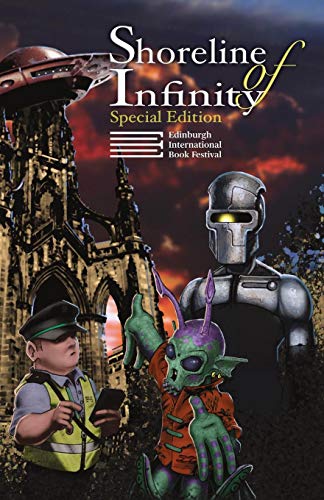
This is a special edition produced in partnership with the Edinburgh International Book Festival for 2017. We have fantastic sci-fi stories, articles and poems from Pippa Goldschmidt, Adam Roberts, Ken MacLeod, Ada Palmer, Nalo Hopkinson, Charles Stross, Jo Walton and Jane Yolen (all of whom are appearing at the Book Festival).
This issue also shows off some of the fine Scottish science fiction talent we have been privileged to publish. Tips of the hat go to: Caroline Grebbell, Iain Maloney, Russell Jones, Dee Raspin, Gary Gibson, Thomas Clark, Katie Gray and Andrew J Wilson for their stories. We are also delighted to use this issue as an excuse to re-publish Ruth EJ Booth’s BSFA award winning story, The Honey Trap. Ruth writes a regular well-loved column on the boulder-strewn path to becoming a writer.
This special issue is also an opportunity for the editorial team to reflect. Iain Maloney, takes a look at Scottish dystopian fiction, Russell Jones talks about SF poetry and, as MC and organiser, tells us about Event Horizon. Monica Burns brings us up to date with SF Caledonia, our project on early Scottish science fiction, and Mark Toner explores the artwork of Shoreline of Infinity.
We also include poetry from: Iain M Banks, Marge Simon, Shelly Bryant, Benjamin Dodds and Grahaeme Barrasford Young
I'm Editor-in-Chief of Science Fiction magazine, Shoreline of Infinity (www.shorelineofinfinity.com), published in Scotland.
I've been a reader for as long as I can remember, my tastes tending towards the fantastical rather than the realistic. After all, isn't that the point of a story, to be taken to a different place?
Science Fiction and fantasy is where I have lived and dreamed since I first read Grimm's Stories. My teenage years were spent absorbing every word I could find by the likes of Asimov, Clarke, Heinlein, Wyndham, Bradbury, McCaffrey, LeGuin, Moorcock, Ballard, Priest.
I loved the early stuff from the 30s and 40s with writers such as E E Smith, Olaf Stapledon and the many other writers who earned their keeping bashing away at typewriters in dark, dust attics.
And my enjoyment in SF continues unabated with the writings of Stephen Baxter, Charles Stross, Ken MacLeod, Eric Brown, Peter Hamilton.
And many more. Many, many more.
I've written on and off over the years, dabbling in SF as a teenager when I had some stories published in fanzines. I have recently returned to the words with greater relish, and have released a couple of small collection of tales based on my adopted home town of Edinburgh.
I was shortlisted for a short crime story competition for Bloody Scotland, and the story is available, along with its fellow shortlistees, as an ebook published by Blasted Heath.
This is a prime example of how random our library’s ordering system is…an 8.5 volume of a Scottish science fiction magazine. Of course, the only volume of it they have, then again it is the only Scottish science fiction magazine, so…there it is. I just figured I’d check it out, no one ever seems to, it always just sits on their catalog’s website with its bright Scottish green cover. Plus I like to read internationally and I wasn’t sure how much Scottish fiction I’ve read, but having read this one, I’m glad to report that Scots sci fi scene is alive and well, bustling even. I don’t normally read magazines, especially in eform, so I wasn’t sure what to expect, but this set up pretty much seemed right on then money. A foreword, a nice (very nice) selection of short stories, a few articles, some poems and a lovely comic. Yeah, that works. Most of the names were barely to not at all familiar to me, but that’s neither here nor there, since a lot of the authors seem to have thriving careers with a variety of published titles. In fact, actually I’m hoping to remember some of their names long enough to check if our super random library might have them. The thing is, despite having an all around pretty good memory, it’s complete crap when it comes to remembering things from anthologies, so right now two days after reading the magazine, I’m only recollecting Gary(?) Gibson. I’ll need to check the table of contents, I suppose. But what is easy to remember is liking most of these stories very much indeed. The Faustian tale of Edenborough Masks (ok, good, I actually did remember a title) was one of my favorites. I ever (surprisingly) liked some of the poems. And I really enjoyed the comic (who can resist a tale of accommodating Martians), although it was fairly tedious to read on a Kindle. I found the two articles on the future of…well, writing about the future quite interesting. According to their authors, the future is fairly optimistic (at least for the majority of the world’s population, that is, while first world countries and former empires might be on the downswing) and there’s a lot to be excited about. It doesn’t quite mash with my own, distinctly more dystopian, perspective, but it was a well presented argument and I appreciated it. So yeah, all in all a very enjoyable read, one I would definitely recommend, especially to science fiction fans. Shoreline of Infinity (the title evocative as it’s meant to be just makes me think of the shore like most things these days) seems like a really great publication, in fact they are even putting books out, the magazines features several adverts for those, some very exciting things. Long may they live and prosper. I mean, that’s vaguely in a ballpark, right, cause of Scotty. Ok, well, anyway, beam me up.
Ken Macleod takes the editorial slot as he curated the SF strand in 2017’s Edinburgh Book Festival. He cautions that SF does not predict the future but can warn of it and notes Scotland’s present flourishing SF and fantasy scene inspired by its distinguished history. In From the Editor’s Log, Noel Chidwick introduces the authors and stories. Some of the fiction has appeared previously, The Great Golden Fish by Dee Raspin in Shoreline of Infinity 3; The Stilt-Men of the Lunar Swamps by Andrew J Wilson, Organisms by Caroline Grebell, Senseless by Gary Gibson and SF Caledonia by Monica Burns with an extract from Gay Hunter by James Leslie Mitchell (Lewis Grassic Gibbon) were in Shoreline of Infinity 4; The Revolution Will be Catered by Iain Maloney and Incoming by Thomas Clark in Shoreline of Infinity 5; The Worm by Russell Jones in Shoreline of Infinity 6 while 3.8 Missions by Katie Gray and The Beachcomber Mutable Marians graced the magazine’s 7th issue. In Edinburgh Masks by Adam Roberts a mediocre jobbing actor playing Iago in Edinburgh is given a gift of two theatrical masks, Comedy and Tragedy. They speak to him and he agrees to seven great performances in exchange for his soul, meaning to cheat his fate by retiring before the seventh. Whether by accident or design Roberts has mined one of the rich seams of Scottish literature, the meeting with the devil story. The Last Word of Ken MacLeod’s story is produced by a meme generator coupled with a learning algorithm using out-of-copyright texts to combine phrases with ostensible meaning; a future equivalent of a million monkeys with typewriters. Lowland Clearances by Pippa Goldschmidt is a neat inversion of a piece of Scottish history. Here people are cleared from Glasgow to the Highlands in order to make way for rubbish-eating sheep from ‘Dolly Enterprises’. Ruth E J Booth’s The Honey Trap is a reprint from Le Femme, NewCon Press, of her BSFA award winning story. Agriculture has been thoroughly collectivised. A representative at a Faire is intrigued by an ugly but utterly delicious apple variety brought to him by a young girl in a hoodie. Whimper by Nalo Hopkinson is a reprint from the very last edition of Clock magazine wherein each story wsa entitled either Bang or Whimper and ended in the middle of a sentence. Here people are being pursued to their death by things called leggobeasts. Our narrator claims she dreamed them all. New Gray Ring to Olympic Five by Ada Palmer reads like a newspaper report of the addition of a sixth ring to the Olympic flag. In the non-fiction:- Imagining Possible Futures by Charles Stross addresses the problem of writing optimistic futures in pessimistic times by pointing to the positive developments in the non-Western world. The following, Tomorrow Never Knows, written by Iain Malone follows on from Stross’s short essay by discussing recent examples of Scottish dystopian fiction. Russell Jones outlines the genesis of Shoreline of Infinity’s monthly “sci-fi” cabaret: Event Horizon. Mark Toner in Making Art on the Shoreline of Infinity describes the magazine’s evolving policy on art work. Multiverse is introduced by Russell Jones making the case for SF poetry and showcases poems by Jo Walton, Iain M Banks, Ken MacLeod, Jane Yolen, Marge Simon, Shelly Bryant, Benjamin Dodds and Grahaeme Barrasford Young.