Freda lives in a town where people are always telling her to be more careful. But Freda loves to explore—which is how, one day, she discovers an injured beetle. She names him Ernest, feeds him, and befriends him. They become inseparable as Ernest grows ever bigger and stronger.
Noticing Ernest’s now-enormous size, the townspeople put him to work. But Ernest is strange, and has a strong appetite, and when a prize ewe goes missing, people start to talk. Freda listens to their appeals and sends her beloved friend away. But when a terrible storm puts the villagers in real danger, Freda knows who can help—and she stands up and says so. After Ernest uses his unique strength to save the day, everyone wants him to stay. But maybe this time, Freda and Ernest choose to listen to their hearts.
Illustrated in watercolor and gouache, this is a fantastical modern fable about the value of listening to your heart, not always listening to others, and making your own voice heard.
Sophie Gilmore is a writer and illustrator living in Italy. She works with watercolour and pen and illustrates friend, foe, and ordinary girls quietly doing extraordinary things. Sometimes all in one book.
Freda always listens when the other townsfolk tell her what to do. Yet that doesn’t stop her from setting off on her own adventures, and one day she discovers an injured blue beetle. After taking him home and naming him Ernest, he soon thrives and grows huge—as does his appetite. When a prized ewe goes missing, the townsfolk suspect Ernest and complain until Freda finally listens and forces him away. However, after a sudden emergency, Freda knows Ernest is the only one who can help—but will he hear her?
Author Sophie Gilmore leans into an idea not often explored in picture books: learning when not to listen to someone is just as important as learning to listen at all. She does this by setting the villagers up as concerned neighbors, but soon their actions turn to obvious meddling. When they come between Freda and her new best friend—a calm, helpful entity—however, it’s apparent that their actions are damaging. But can Freda remedy the situation? Gilmore’s short, lyrical text makes these complex ideas more digestible.
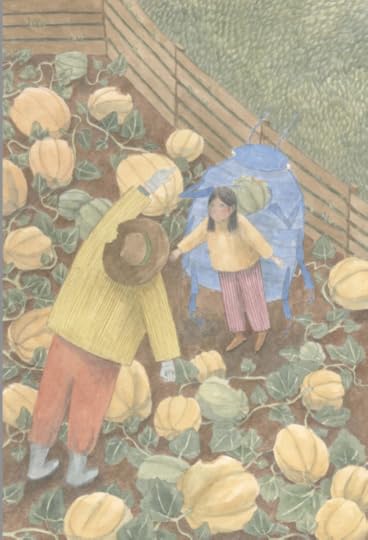
All of this is enhanced by Gilmore’s watercolor and gouache illustrations. Through earthy tones, she creates a peaceful village that’s punched up by the sudden appearance of a blue beetle. The illustrations feel light, reminiscent of classic fairy tale collections, yet as the action turns to trouble, Gilmore provides a genuine surprise by suddenly changing the palette until the action settles down. It’s incredibly effective.
Ultimately, Freda and the Blue Beetle showcases a unique, intricate viewpoint in children’s literature and Sophie Gilmore is the perfect voice—and artist—to represent it.
Note: I received a free ARC of this book through NetGalley.
This is a bit of a surreal tale about a girl named Freda and her friend, a giant blue beetle named Ernest. Freda is a girl who doesn't listen. She climbs trees and swims in dangerous waters. The townspeople think she's going to come to harm, but she often makes fascinating discoveries as a result of her disobedience. One day, she finds a little blue beetle with a broken wing. She takes him home, nurses him back to health, and gives him a name. But Ernest grows quickly, and when he proves to be strong, the villagers put him to work. That growth and strength relies on being fed, though, and after a prized sheep goes missing (and Ernest is blamed for eating it), he is cast out of the village. It isn't until a calamity befalls the village and Ernest comes to the rescue that the townspeople start to see his value (or, rather, how he can benefit them). The story ends with Freda making an unusual, though completely logical, choice.
I'm not sure about the message in this one. It might be just a bit too nuanced for younger readers. (It's basically: Don't listen to your elders if they're being self-serving bigots.) Learning when not to listen is an important skill, but I'd be concerned that some kids might take that too far. Discernment is key. As an adult, I like the message just fine, as I think it's important; we shouldn't listen to our elders if what they're telling us to do is potentially harmful. I just wonder if that message is clear enough in this particular book.
Overall, though, I think this could be a good picture book for slightly older kids who are starting to learn more about boundaries (and that adults--even if they have good intentions--aren't always right).
Thank you to NetGalley and Owlkids Books for providing a digital ARC.
This is actually a book about not listening to people in authority. On the surface, it is a story about friendship, between Freda and her blue beetle. Underneath that, though, there lurks a hatred of the people in the village, because although the beetle does more work than everyone else, they resent that it also eats more than anyone else.
Freda, in the end, realizes that she can't listen to the people of the village. That she has to listen to her heart.
Thanks to Netgalley for making this book available for an honest review.
A folktale about friendship, listening to others, and listening only to oneself. The beetle is magnificently blue. Freda is not like the townsfolk around her.
Library copy
This entire review has been hidden because of spoilers.
This book tells a story of adventure, following your heart and listening to yourself. It also tells the tale of a beautiful friendship that grows between a girl and a blue beetle that she finds and brings home. The story encourages you to stand up for others and to believe in yourself. Beautifully written with beautiful soft art with muted bright colors.
Thank you to Netgalley for the Advanced Readers Copy in exchange for an honest review! #FredaAndTheBlueBeetle #NetGalley
I received an ARC from NetGalley in exchange for an honest review.
I'm a bit torn by this book. I loved the beautiful illustrations. I wanted to love the story. On the surface it's a story about a girl listening to her own voice and trusting her instincts. Freda doesn't listen to the villagers when they warn her of the dangers around her. When they warn her not to bring the injured beetle she found home, she does it anyway. Ernest grows and is helpful around the village. But then a prized Ewe goes missing and everyone blames him. Freda listens and sends him away. This turns out to be a mistake and when the whole village finds itself in trouble, Ernest comes back to save Freda.
Ok, so I sincerely appreciate the idea of trusting yourself. However, there are times when we need to listen to those around us. And the ending...it put a bad feeling in the pit of my stomach. The villagers were wrong, yes. But I want to teach my children about forgiveness and being the bigger person. I want them to listen to their own instincts but take the warnings of others seriously. I think this story could have been more balanced.
Freda and the Blue Beetle by Sophie Gilmore. PICTURE BOOK. Owlkids, 2020. $18. 9781771473811
BUYING ADVISORY: EL (K-3) - OPTIONAL
AUDIENCE APPEAL: LOW
Freda is not very good at following orders and the people of her village are not very supportive. One day she rescues a blue beetle and as it grows larger and larger it helps around more. But when something goes missing in the village, the beetle gets the blame.
The illustrations are muddy and uninspiring. The idea of a beetle growing larger than a human doesn’t come out as being whimsical and magical – it just feels clunky.
Sophie Gilmour is one of my new favourite children’s book authors. Her books have an incredible nostalgic quality, harkening back to the fables and fairy tales of many years ago. Many of us were raised on the classic fables and fairy tales of the past: Little Red Riding Hood, Chicken Little, Goldilocks and the Three Bears. We have delightful childhood memories of listening to these stories and perhaps even learning mixed up versions of the same stories. Sophie Gilmour give us that feeling back. In the digital age where everything is faster, brighter and available at our fingertips we are reminded, through her stories, to slow down and enjoy the magic of a good story.
In Freda and the Blue Beetle we meet Freda who doesn’t always listen. She has a mind of her own which sometimes gets her into a spot of trouble. When she takes in a blue beetle, affectionately named Ernest, and nurses him back to health the whole town enjoys the help of Ernest as he grows big and strong, strong enough to fell trees and help plow the fields. As with anything unusual, soon the townspeople become wary of Ernest since he is eating what they consider to be more than his fair share, blaming him for the loss of a ewe and turning on him. Freda realizes that sometimes she has to listen but only to always listen to her heart.
Just like in Little Doctor, Sophie Gilmour takes us back in time to when life was seemingly more simple and stories had a clear aim and message. I really feel a sense of calm when I read her stories, the illustrations are muted and soft, perfect for a cozy time story. She does such an incredible job of capturing the feeling of the story in both words and illustrations. Her pictures are full of life but not busy, without too much outside noise. Her stories will be cherished additions to your bookshelf and will hold a place of nostalgia in your heart. These will be the stories that are passed down from us to the next generation
This is a beautiful tale about finding inner strength to fight for what you want. This story begins with a girl named Freda who is known in her small town for doing exactly what she wants to do, despite any warnings from others. That could be climbing tall trees, swimming in the bay, or enjoying nature. Freda has always found that if she does not listen to others and only listens to herself, it leads to great adventures. One day, Freda finds an injured blue beetle on a path and decides to take him home and care for him. The townspeople warn her that this beetle will only do harm, but Freda does not listen. She takes him home, heals his broken wing, and names him “Ernest”. As Ernest gets bigger, the townspeople realize he could be valuable to them, so they enlist his help with chores on their properties. Everything is fine until a prize sheep goes missing and Ernest is accused of eating it. Freda knows that she needs to protect Ernest so she takes him to the forest where he can live in safety. Time passes, the missing sheep is found, and winter is approaching. One night, a terrible storm forces the townspeople into the great hall for shelter. While inside, the roof collapses, trapping everyone under a pile of rubble. Freda knows what to do and she reaches out to Ernest for help. He slowly eats away at the rubble and frees the townspeople. They are so happy to see Ernest because they remember how much he worked on their farms--but Freda and Ernest have other plans. They are no longer going to listen to what others want from them, but they are going to listen to what they want--and off they fly together to start a new life. The pen and watercolor illustrations in this story are beautiful. Muted colors of green, yellow, purple, and red are used to create a pale background to the bright blue color of Ernest. The emotions of Freeda, Ernest, and the townspeople are also captured in the illustrations.
“Freda wasn’t reckless. But she found that not listening ... often led to wonderful discoveries.”
Against the townfolk’s advice, Freda take the Blue Beetle home and raises it. “She gave the beetle food, friendship, and a name. They were inseparable.” The beetle, Ernest, grew large and strong and at first the townsfolk appreciate all the hard work that Ernest can do. But as he continues to grow and need more food, the townsfolk don’t want to give him extra shares and begins to grumble against Ernest. When a prize ewe disappears, they all blame Ernest. “Freda fought for Ernest, but it was impossible to shut the clamor out.” And Freda sends Ernest away. “Sometimes we have to listen.”
Not until the town is in trouble does Ernest return to help them. After the rescue, the townsfolk are ready to have him come back and work for them again, but he only sees Freda. And together, they leave the town behind. “Sometimes we should only listen to ourselves.”
An interesting message, especially for older students.
Hmm. I’m only slightly torn on this book. I wanted to like it so much more. Pros: Illustrations are beautifully drawn, in muted colors which really works for a calm moral tale. Freda is curious and adventurous. The blue beetle didn’t jump at the chance to return to help the people who had been somewhat abusive to him. There’s a lot to teach about the beetles actions and response. Cons: Freda is disobedient to the point of being foolish. She constantly believes she knows better than the wisdom of the townsfolk. While going against the common or traditional way can be right, the storyline just doesn’t teach when it’s wise to do that vs not, so young children could easily come away with “it’s good not to listen.” For that reason I wouldn’t read this to my young children. But with my upper elementary children we could have a conversation about prejudice, disobedience, courage, wisdom, and even freedom.
This had the potential to be a great story about a girl who listened to her heart. However I worry that reading this to young children can send the wrong message that it's always okay to ignore authority figures. This could translate to disastrous consequences that could cost a child their life (like running out into the street when their parents say no and then getting hit by a car). This is an interesting fictional story but I think a follow up discussion would be needed to help students understand that this was mostly about friendship between a girl and a giant beetle rather than about ignoring all authority.
What a beautiful story! Freda is a nonconformist that befriends a beetle. The beetle, Ernest, proves beneficial to the townsfolk, who sing his praises until they perceive fault with him and turn on him. It takes a moment of hardship for them to recognize the fault in their ways, but by then, both Freda and Ernest have moved beyond seeking their acceptance, and seek only to enjoy each other's friendship. It's a well-told story and I'm sure I could read this aloud to my primary grade students. Nicely done.
Letting your voice be heard can be difficult when you're a child especially so, when it differs from everyone else's. Freda is a kind soul who sees beauty and wonder whenever she goes. Her act of befriending a beetle goes unnoticed by her fellow townspeople until they realize they can benefit. A heartwarming story about friendship and staying true to yourself. Every voice matters no matter how small.
A picture book for a slightly older audience (k+, mostly just bc it's a little long for a storytime book) that is ripe for inviting discussions around friendship, being seen as "different," solidarity, and scapegoating. Adventurous Freda befriends a beetle, Ernest, who is first used and then scapegoated by the townspeople. At first, Freda does not stand by her friend, but eventually she acts differently.
Themes: Friendship, Solidarity, Being Different Age range: 4-7
A story of friendship between a girl who doesn’t listen and a strong blue beetle, and then there are townsfolk that are just plain difficult to please. The illustrations look like pencil and maybe watercolor. The colors are muted, but all the imagery is clear.
Strange book about a girl with no adult figures in her life except some nagging villagers and a blue beetle that grows larger than life. I feel like there was some deep metaphor in the story that I missed.
This fantastical fable follows the unlikely friendship between a girl and a large beetle named Ernest. When the villagers grow suspicious of Ernest, Freda must make a choice between following her heart and following the crowd. A quirky story about trusting your instincts and kindness.