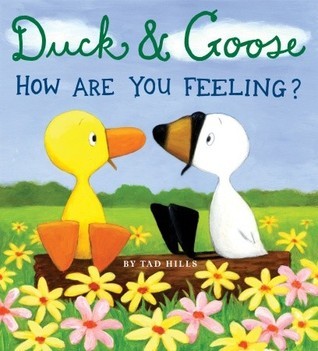
“Whenever I picture myself [as a child],” says Tad Hills, “I am doing art. I spent a lot of time on my own making things, drawing, and painting.” Hills was not consciously trying to become an artist, rather his motives were innocent and pure. “I liked making things,” he says.
As a graduate of Skidmore College in New York with a degree in art, Hills describes himself as the ultimate freelancer. He’s done some acting, made jewelry, makes fake teeth for stage productions, dabbled in interior renovation, and illustrated book jackets for adult trade books. But Hills’ break into children’s publishing coincided with his wife Lee’s new position as the art director for Simon and Schuster’s children’s book division. “Lee used to ask me to try illustrating some books she couldn’t find an illustrator for,” Hills says. When Lee moved to Random House to start her own imprint with long-time friend and associate, Ann Schwartz, she encouraged Hills to write his own picture books. “I started with four stories,” says Hills. His break out book, Duck and Goose (Schwartz and Wade, 2006) was one of them.
The idea for Duck and Goose started with only a title—The Silly Goose, the Odd Duck and the Good Egg. As Hills developed the story, he realized his egg would have to be rather large to support Duck and Goose so they could hatch it. Hills also had to consider what would hatch out of such a large egg. A dinosaur? An ostrich? Additionally, Hills floated the title by his son’s kindergarten class and was rewarded with blank stares. Hills took the hint and changed his egg to a ball, and changed the title.
“For me, the writing is really difficult. I stare at a blank page for hours,” he says. “When Lee comes home and asks me about my day, I say it was okay. I wrote one sentence. . .But when I’m in the zone, I literally hear the dialogue between [Duck and Goose]. They were telling me what they wanted to say! That is the best feeling. That is when it’s not work. It’s fun!”
Hills paints with water-soluble oil paint on paper, using colored pencils for the last details. Although Hills’ Duck and Goose characters look simple enough, he drew hundreds of ducks and geese before finding a style with which he was comfortable. “The first ones [I drew] were older looking,” he says. “They looked like cigar-smoking tough guys.” Over a matter of months, Hills finally pared down Duck and Goose to their essential elements—circular heads, long rectangular legs, triangular feet, and door-shaped beaks. “When I apply the eyebrow,” he says, “I can express what Duck is feeling.”
As Hills’ two children grow, he finds himself drawn to how kids treat each other. “I didn’t tolerate meanness or injustice as a kid,” he says. In Duck, Duck, Goose (Schwartz and Wade, 2007), Hills creates a friendship triangle by introducing a new duck named Thistle. Together Duck, Goose, and Thistle give Hills’ observations a voice and provide several conversation starters for parents and children.
Hills writes from his home in Brooklyn, New York. Some days he doesn’t write at all, but tries to stay receptive to what he’s experiencing. “Most of my ideas come to me when I’m not looking,” he says. “It’s hard to get yourself to a point where ideas are out there and you can grab them.”
Cute illustrations, but only 1 word per page. I guess that allows for an open dialogue about Duck & Goose feel that way and then you can ask your child what makes them feel that way. I will probably read this book with Baby Girl and re-review it in a couple of years.
I haven't read all the books in the Duck & Goose series by Tad Hills. But the few I have read, I have enjoyed immensely. I love this pairing of friends. In this board book adventure, we see ten emotions illustrated: hopeful, selfish, proud, frustrated, scared, patient, sad, happy, angry, loving. This identify-your-emotions concept book is fun. Fun because we've all been there. My favorite illustration? Frustration.
Duck and Goose are back to show us how they're feeling. While this is not one of my favorite books in the series, Tad Hills' addition to the emotions books for kids includes some more involved interpretation of emotion than just the standard happy and sad. At our house, we especially like the pages for scared and selfish.
Gives and image and a word to some of the big emotions that children are learning and experiencing for the first time. I knew this book was a winner when my daughter was trying to move the ottoman for quite a while and then, said "Frustrated!!!" Way to empower kids by giving them language to describe what they feel!
Hills Valleys #9 Duck and Goose #9 A really brief and simple look at emotions. SO brief and simple that it is quite trite and doesn't really give the young reader a chance ti understand them. Perhaos a series of books exploring emotions one at a time would be a better investment of time and energy, and be actually meaningful.
This simple, yet whirlwind of a book tells, yet mostly shows, how the duck and goose are feeling when something happens to them. First the duck shows that he is "hopeful" when waiting for a plant to grow, then "selfish" when the plant grows and produces flowers that another bird takes. Each page of this book shows a different emotion according to the coinciding illustrations. It is a cute book that teachers could use to show students what each emotion is and how they make not only people feel, but also how animals feel. Suitable for children ages 2-4
it is a very simple and short story that shows the expressions and feelings duck and goose are feeling throughout the whole book. i would use in a younger classroom setting, but not in a upper elementary level.
This was quite unlike the other emotional books I have read for children. The pages have one word, sometimes two, and some of the emotions are deeper and more complex, such as hopeful, selfish, and frustrated. Lovely illustrations.
i am very entertained by this quick book, but going with 4-star because my dad is not a fan. i like when my mom reads and is expressive with all of the different feelings. for some reason i think the “scared” page is pretty silly.
Each page is a word for a feeling with a corresponding illustration. There's not really a story progression in the feelings, but it does end on a happy note with "loving."
Another great entry in the Duck & Goose series. This one is better suited for older toddlers or preschoolers as it identifies different feelings. There is no story for littler ones to follow along with and it would be difficult for them to identify with abstract concepts.
The illustrations are adorably perfect; as Duck, Goose, and friends demonstrate their emotions, so too do the clouds, butterflies, flowers, etc. Hills even includes some non-typical but all too preschooler-ish emotions: frustration and selfishness stand out. These are great for helping this age group label and identify why they might feel and act a certain way.
Have you ever tried to explain the concept of hope? Or frustration? This book combines pictures with single abstract words and requires the reader to fill in the details. In other words, it's not a book to read when you're tired or not on your "A" Game. You also might want to do some brainstorming before reading it out loud the first time. Otherwise you might find yourself nervous and stumbling over how to explain "anger" and what the proper response for a two-year old who's angry is. I will say that my son loves this book to the tune of "read it again" (for the sixth time in a row), so it must be pretty good.
Another cute Duck & Goose book! This one captures the essence of emotions like frustration, anger, happiness, and patience with its bright, adorable, and humorous illustrations.
I am biased I just love Tad Hills I wish this was not just in board book it would be fun for storytime if bigger. Hills can really capture emotions and this is a great book that shows this to young children. Ages 2+