

What do you think?
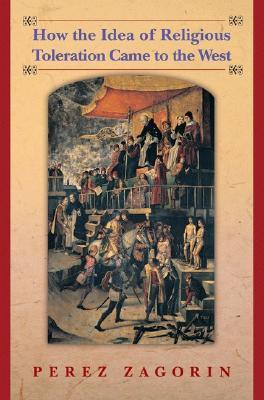
How the Idea of Religious Toleration Came to the West
Religious intolerance, so terrible and deadly in its recent manifestations, is nothing new. In fact, until after the eighteenth century, Christianity was perhaps the most intolerant of all the great world religions. How Christian Europe and the West went from this extreme to their present universal belief in religious toleration is the momentous story fully told for the first time in this timely and important book by a leading historian of early modern Europe.
Perez Zagorin takes readers to a time when both the Catholic Church and the main new Protestant denominations embraced a policy of endorsing religious persecution, coercing unity, and, with the state's help, mercilessly crushing dissent and heresy. This position had its roots in certain intellectual and religious traditions, which Zagorin traces before showing how out of the same traditions came the beginnings of pluralism in the West. Here we see how sixteenth- and seventeenth-century thinkers--writing from religious, theological, and philosophical perspectives--contributed far more than did political expediency or the growth of religious skepticism to advance the cause of toleration. Reading these thinkers--from Erasmus and Sir Thomas More to John Milton and John Locke, among others--Zagorin brings to light a common, if unexpected, thread: concern for the spiritual welfare of religion itself weighed more in the defense of toleration than did any secular or pragmatic arguments. His book--which ranges from England through the Netherlands, the post-1685 Huguenot Diaspora, and the American Colonies--also exposes a close connection between toleration and religious freedom.
A far-reaching and incisive discussion of the major writers, thinkers, and controversies responsible for the emergence of religious tolerance in Western society--from the Enlightenment through the United Nations' Universal Declaration of Human Rights--this original and richly nuanced work constitutes an essential chapter in the intellectual history of the modern world.
Perez Zagorin takes readers to a time when both the Catholic Church and the main new Protestant denominations embraced a policy of endorsing religious persecution, coercing unity, and, with the state's help, mercilessly crushing dissent and heresy. This position had its roots in certain intellectual and religious traditions, which Zagorin traces before showing how out of the same traditions came the beginnings of pluralism in the West. Here we see how sixteenth- and seventeenth-century thinkers--writing from religious, theological, and philosophical perspectives--contributed far more than did political expediency or the growth of religious skepticism to advance the cause of toleration. Reading these thinkers--from Erasmus and Sir Thomas More to John Milton and John Locke, among others--Zagorin brings to light a common, if unexpected, thread: concern for the spiritual welfare of religion itself weighed more in the defense of toleration than did any secular or pragmatic arguments. His book--which ranges from England through the Netherlands, the post-1685 Huguenot Diaspora, and the American Colonies--also exposes a close connection between toleration and religious freedom.
A far-reaching and incisive discussion of the major writers, thinkers, and controversies responsible for the emergence of religious tolerance in Western society--from the Enlightenment through the United Nations' Universal Declaration of Human Rights--this original and richly nuanced work constitutes an essential chapter in the intellectual history of the modern world.
392 pages, Paperback
First published January 1, 2003
About the author
Perez Zagorin
25 books7 followersPerez Zagorin was an American historian who specialized in 16th- and 17th-century English and British history and political thought, early modern European history, and related areas in literature and philosophy. From 1965 to 1990, he taught at the University of Rochester, New York, retiring as the Joseph C. Wilson Professor of History Emeritus.
Ratings & Reviews
Friends & Following
Create a free account to discover what your friends think of this book!
Community Reviews
Displaying 1 - 4 of 4 reviews

June 15, 2013
A work of intellectual history focusing on the documentary heritage. Its thesis is that religious toleration was not simply the result of religious skepticism or political expediency, but was developed and advocated by sincerely religious people acting in the best interests of their religion.
Full review: http://wp.me/pMeOB-h8
Full review: http://wp.me/pMeOB-h8

June 27, 2026
Focusing on the era between the sixteenth and eighteenth century, there is a broader introduction which looks at the Roman and early medieval era, but the main focus of the book is deliberately upon the reformation period and its aftermath.
The strength of that approach is that it provides the opportunity to explore, in detail, the thinking of some significant figures, such as Sebastian Castellio and his books denouncing the killing of heretics in the sixteenth century.
One of the potential problems of such a narrow focus is that even with some introductory chapters, there is still a gap in the late medeval era where the inadvertent implication is that the era has nothing of interest to say about tolerance. Yet we know that Peter Abelard, for example considered some of the issues. And perhaps more fundamentally, throughout the medieval era Christianity had an awkward relationship to Judaism. On the one hand it considered it superseded, but on the other hand it exercised (sometimes) a degree of tolerance in allowing it to exist alongside Christianity. That attitude really needed to be explained.
Another issue with books about tolerance is that in a modern world in which tolerance seems self-evidently right, it is sometimes difficult to understand the opposite arguments for intolerance. We see some of the issues in places in the chapters, where tolerance is justified by appeals to peace, or by the impossibility (or at least difficulty) of knowing the truth.
But there are even deeper and more fundamental issues, especially in Catholic theologians and they don't really appear. For example, one of the reasons why Bellarmine argued so vehemently for enforcing Catholic theology is that it has moral implications, which differ from Protestantism. So the enforcement of a religion is actually an attempt to insist upon a moral framework.
That argument was not always clearly evident on the ground during the period in question, as in the centuries immediately after the reformation, Protestantism carried many of the prior Catholic attitudes (such as rejecting divorce, or at least making it extremely difficult for ordinary people). However, as time has passed, Protestant ethics has separated more and more from Catholic ethics, with permissible attitudes towards abortion, euthanasia, etc. And that has implications for what States should (theoretically) approve in terms of their laws. It is in that consequential context that some of the arguments for intolerance need to be understood. If those implications aren’t properly realised, then the motivations and interests of the arguments cannot be properly evaluated.
Overall, this is a narrowly focused set of studies, which are accessible without prior expertise or background in the issues. They narrate well the history of the era and the understanding of the texts which they consider, but I think it would have been helpful to focus a little more on trying to understand the reasoning behind intolerance (where it was a reasoned position, rather than a knee jerk reaction).
The strength of that approach is that it provides the opportunity to explore, in detail, the thinking of some significant figures, such as Sebastian Castellio and his books denouncing the killing of heretics in the sixteenth century.
One of the potential problems of such a narrow focus is that even with some introductory chapters, there is still a gap in the late medeval era where the inadvertent implication is that the era has nothing of interest to say about tolerance. Yet we know that Peter Abelard, for example considered some of the issues. And perhaps more fundamentally, throughout the medieval era Christianity had an awkward relationship to Judaism. On the one hand it considered it superseded, but on the other hand it exercised (sometimes) a degree of tolerance in allowing it to exist alongside Christianity. That attitude really needed to be explained.
Another issue with books about tolerance is that in a modern world in which tolerance seems self-evidently right, it is sometimes difficult to understand the opposite arguments for intolerance. We see some of the issues in places in the chapters, where tolerance is justified by appeals to peace, or by the impossibility (or at least difficulty) of knowing the truth.
But there are even deeper and more fundamental issues, especially in Catholic theologians and they don't really appear. For example, one of the reasons why Bellarmine argued so vehemently for enforcing Catholic theology is that it has moral implications, which differ from Protestantism. So the enforcement of a religion is actually an attempt to insist upon a moral framework.
That argument was not always clearly evident on the ground during the period in question, as in the centuries immediately after the reformation, Protestantism carried many of the prior Catholic attitudes (such as rejecting divorce, or at least making it extremely difficult for ordinary people). However, as time has passed, Protestant ethics has separated more and more from Catholic ethics, with permissible attitudes towards abortion, euthanasia, etc. And that has implications for what States should (theoretically) approve in terms of their laws. It is in that consequential context that some of the arguments for intolerance need to be understood. If those implications aren’t properly realised, then the motivations and interests of the arguments cannot be properly evaluated.
Overall, this is a narrowly focused set of studies, which are accessible without prior expertise or background in the issues. They narrate well the history of the era and the understanding of the texts which they consider, but I think it would have been helpful to focus a little more on trying to understand the reasoning behind intolerance (where it was a reasoned position, rather than a knee jerk reaction).
March 30, 2026
As a history of intellectual thought, this book is fine, but the whole book is a victim of traditional history theory (which is really to the detriment of understanding this specific topic as a continental social phenomenon)

August 23, 2016
An excellent overview of the battle over religious tolerance in the West from Augustine's defense of state persecution of heretics to today.
Displaying 1 - 4 of 4 reviews