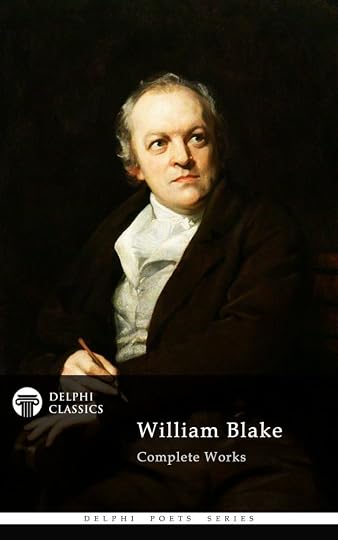
William Blake was an English poet, painter, and printmaker. Largely unrecognised during his lifetime, Blake's work is today considered seminal and significant in the history of both poetry and the visual arts.
Blake's prophetic poetry has been said to form "what is in proportion to its merits the least read body of poetry in the language". His visual artistry has led one modern critic to proclaim him "far and away the greatest artist Britain has ever produced." Although he only once travelled any further than a day's walk outside London over the course of his life, his creative vision engendered a diverse and symbolically rich corpus, which embraced 'imagination' as "the body of God", or "Human existence itself".
Once considered mad for his idiosyncratic views, Blake is highly regarded today for his expressiveness and creativity, and the philosophical and mystical currents that underlie his work. His work has been characterized as part of the Romantic movement, or even "Pre-Romantic", for its largely having appeared in the 18th century. Reverent of the Bible but hostile to the established Church, Blake was influenced by the ideals and ambitions of the French and American revolutions, as well as by such thinkers as Emanuel Swedenborg.
Despite these known influences, the originality and singularity of Blake's work make it difficult to classify. One 19th century scholar characterised Blake as a "glorious luminary", "a man not forestalled by predecessors, nor to be classed with contemporaries, nor to be replaced by known or readily surmisable successors."
Before the Blake lovers see my 3 star rating and blow a gasket, let me clarify that my rating is not for Blake's work but for the book itself.
This claims to be the 'Complete Works' of William Blake and that's where it falls at the first hurdle because even someone like myself, who studied Blake at school but certainly does not claim to be an expert on the man, can tell there's stuff that's just not in here.
I also have to dock points for the layout, which is slapdash, and the lack of any kind of perceptive editing. There are so many typos I stopped counting them before I got to the 10% mark, the photographs and illustrations are often mislabeled and in the wrong place and some of the illustrative plates are just missing.
I can't bring myself to give this fewer than 3 stars because of the quality of Blake's work but it definitely doesn't deserve more due to the above issues. A shame; Blake deserves better.
(I’m using this listing to review Anne Malcolmson’s William Blake: An Introduction, since no listing for the book exists on Goodreads. You can find it on Amazon here: http://www.amazon.com/William-Blake-I....)
A perfect little introduction to Blake, Malcolmson’s biographical note and comments on the poems are well done and unobtrusive. Not at all academic, she gets at Blake’s real strangeness as well as his appealing, compassionate humanity. A dozen or so color plates are included. The book is out of print, but I found a lovely teal hardcover at a used bookshop. I plan to leave it in a strategic spot where my kids are sure to pick it up and flip through it on a rainy day.
I have now read the complete works of William Blake. All of them. From Poetical Sketches (1783) to Laocoön (1826), every poem, every prophetic book, every philosophical broadside, every satiric epigram, every letter, every piece of art criticism — everything in this 3,021-page eBook, plus the additional illuminated works not included in the Delphi edition. It took me from late April to mid-July of 2026, roughly three months, and it was one of the most rewarding reading experiences of my life.
I have read complete works before. I have read all of Plato's canonical dialogues — those considered to have actually been written by him. I have read all of Shakespeare. I have read all of Edgar Allan Poe. I have read all of Amy Hempel, who deserves far more recognition than she receives. I have read all of Octavia E. Butler. I have read all of H.P. Lovecraft's fiction — not all of his letters or poetry, but everything he wrote as a storyteller. Blake belongs in this company. He also belongs in a category of his own.
What Blake Is
William Blake (1757–1827) was a poet, painter, printmaker, engraver, and visionary mystic who spent his entire life in or near London, was largely ignored by his contemporaries, and is now recognized as one of the most original creative minds in English literary history. He invented his own method of relief etching that allowed him to combine text and image in a single plate: the "illuminated books" that are his most distinctive achievement. He developed a complete mythological system, populated by figures of his own invention (Urizen, Los, Luvah, Tharmas, Albion, Jerusalem), that rivals Milton's cosmos in ambition and exceeds it in strangeness.
He was, as I described him in several of my individual reviews, a poet-artist-mystic-madman. All four of those words are accurate. None of them alone is sufficient.
The Shape of the Project
Reading Blake in chronological order (which is roughly how this Delphi eBook is organized) gives you the experience of watching a creative and philosophical system develop in real time. The early works are relatively accessible: Poetical Sketches shows a young poet finding his voice, An Island in the Moon shows his gift for savage comedy, the 1788 aphoristic works All Religions Are One and There Is No Natural Religion establish his philosophical foundations. By the time you reach The Marriage of Heaven and Hell (1790), you are in the presence of something genuinely extraordinary: one of the most subversive and entertaining works in the English language, disguised as a theological pamphlet.
Then the prophetic books. This is where the difficulty concentrates and where the rewards are greatest. Northrop Frye's Fearful Symmetry is the essential companion — without it, the prophetic books are nearly impenetrable; with it, they are one of the most ambitious poetic projects ever attempted. I recommend reading Frye alongside Blake from The First Book of Urizen onward.
The summit of the complete works, in my assessment:
Jerusalem: The Emanation of the Giant Albion (1804–1820) — the magnum opus, by the judgment of Frye, Harold Bloom, and Benjamin McEvoy. 100 engraved plates, the complete expression of Blake's mythological system, among the most visually extraordinary books ever produced.
Milton: A Poem (1804–1811) — more focused than Jerusalem and in some ways more emotionally immediate. The passage in which Milton descends into Blake's left foot is one of the strangest and most vivid moments in English poetry.
The Four Zoas (1796–1807) — the great unfinished masterpiece. Frye called it "the greatest abortive masterpiece in English literature," and I agree. I read much of it accompanied by early Opeth albums, which was the right choice.
Songs and Ballads from Blake's Notebook — the most immediately pleasurable section of the complete works, containing "Auguries of Innocence," "The Mental Traveller," "Mock On, Mock On, Voltaire, Rousseau," and "My Spectre Around Me Night and Day." Accessible, funny, strange, brilliant.
Blake on Art: The Prose Works
One discovery that surprised me: Blake's prose criticism — the Descriptive Catalogue (1809) and Public Address (c. 1810), both in the Uncollected Works section — is as vivid and original as anything he wrote in verse. His attacks on Rubens, Rembrandt, and Sir Joshua Reynolds have a ferocious energy that connects directly to the Satiric Verses and Epigrams. And the Laocoön plate (1826) — a single engraved image surrounded by aphorisms — is one of the strangest and most compelling objects he ever made.
A Note on the Biographies
The Delphi eBook includes two biographies: Irene Langridge's William Blake (1904) and Charles Gardner's William Blake: The Man (1919). I read the Langridge and skipped the Gardner — having read Langridge, I felt I had encountered the genre at full strength and did not need to repeat the experience. Both are products of an earlier tradition of literary biography in which the biographer's function was primarily to praise rather than to illuminate. Langridge herself says so explicitly: "my function is chiefly that of praise." For biography and criticism at the level this subject deserves, Frye's Fearful Symmetry is the only book you need.
On the eBook Format
I want to say something directly about why the eBook format matters for a project like this. I have a reading disability, and reading on a Kindle is considerably easier for me than reading a physical book — I can control the lighting, adjust the text size, and use the OpenDyslexic font, which has been genuinely transformative for my reading life. For a 3,021-page book, these are not minor conveniences. They are what made the project possible.
The economics are also worth naming. The Delphi Complete Works of William Blake cost $2.99. For less than the price of a coffee, you get every poem, every prophetic book, every letter, every prose work, every piece of art criticism Blake ever wrote, along with two biographies and a catalogue of visual works. This is an extraordinary resource, and its accessibility — financial as well as physical — is genuinely democratizing.
One important caveat: the Delphi eBook's images are low resolution, noticeably below the quality of Delphi's own Masters of Art series. For anyone who wants to see Blake's illuminated plates properly — and you should; the visual art is inseparable from the poetry — the e-artnow Complete Illuminated Books of William Blake (available at sackett.net/blake-illuminated.pdf) is the right supplement. Use both.
Blake Among the Greats
I have now read the complete works of Plato (the canonical dialogues), Shakespeare, Poe, Amy Hempel, Octavia E. Butler, Lovecraft's fiction, and Blake. Each of these projects taught me something about what a single imagination can do when given enough time and freedom. Blake's lesson is perhaps the most extreme: that a man working largely alone, ignored by his contemporaries, producing books by hand one copy at a time in a back room in London, can create a body of work that forty years after his death will force critics to reckon with it, and that two hundred years after his death will still resist being fully understood or contained.
He was deep and vulgar, cosmic and crude, furious and tender, systematically brilliant and occasionally baffling. He disagreed with me about almost everything important — the Enlightenment, empiricism, the value of reason, the nature of God — and I found him indispensable. That is, I think, the mark of a great writer.
Blake, W. (2012). Delphi complete works of William Blake (Illustrated) (Delphi Poets Series) (Kindle Edition). Delphi Classics. https://www.amazon.com/dp/B009BEED6I/
Title:Delphi Complete Works of William Blake Author(s): William Blake Year: 2012 Genre: Poetry, Prose, Biography Page count: 3,021 pages Date(s) read: 4/25/26–7/16/26 Book 144 in 2026
His poems were bit different than the other romantic poets. However, he was not a romantic poet also. The angelic touch and bit of holiness make his poems even better. One stanza that I remembered the most form his collection is: "He who binds to himself a joy Does the winged life destroy; But he who kisses the joy as it flies Lives in Eternity's sunrise." The poem of Blake presents questions that derail conventional thinking, rather than providing the reader with easily assimilated answers.
Essay is a basic chronology of Blake's life and his artwork. plates are of course wonderful. Some are very familiar, but some I've never seen. realized I haven't seen the illustrated Songs of Innocence and Death, just read poems in anthologies. I think I will like them more if I can see them with the d paintings. Essay illuminated philosophies between such included works as the Marriage of Heaven and Hell. what an interesting character Blake was.
Any book which displays Blake’s plates in full colour is a 4* minimum every time. This is a lovely, quick dip into Blake’s art. It covers a range of Blake’s plates, including some lesser known ones. The short explanations dip into technique, history, related plates and collections. Be aware, it only really covers Blake’s art work, barely touching on his poetry.
Fab as an introduction to Blake’s work or as a pleasant distraction for an hour or so for fans.
I'm not really interested in poetry, but I wanted to learn a little bit about William Blake since he is the subject of a Newbery Medal winning book that I'm planning to reread soon. I found an abridged version of this book on Hoopla audio which only includes a little over an hour of William Blake's poetry.
I have spent months reading this book, and I am not confident it was worth my time. I am reading additional books regarding the man and his works, so maybe my appreciation of Blake will improve.
Blake's work is fascinating and visionary. It must be said I found this edition highly under-edited, as there were very few useful notes on the more opaque references in his poems.
Blake seems to combine the talents of a very fine poet with a rare intellect, able to see and describe things of which the rest of us are oblivious. Mind you, I didn't read the entire book, but those parts selected by Fadiman and Major in their New Lifetime Reading Plan. Treat yourself to something worthwhile! Recommended!
"But most, through midnight streets I hear How the youthful harlot's curse Blasts the new-born infant's tear, And blights with plagues the marriage hearse."
William Blake is probs my favourite poet, or is at least in the top ten.
взялась читати,бо через твір спіткаєшся об аллюзію на блейка.може,забагато очікувала,може,надто його зпопсували і,читай я раніше,може,мене б теж вивернуло_перевернуло, - зараз - просто темна,лячна,хороша така поезія.дуже дощова,до слова
"Não revele aos amigos os seus segredos, porque você não sabe se algum se tornará seu inimigo. Não cause ao seu inimigo todo o mal que lhe possa fazer, porque você não sabe se ele se tornará um dia seu amigo".
To be honest this was likely to stay on my currently reading status for an age as I never tire of Blake's prose and consistently return yo it,dipping in and out of various bits as the mood takes