Burton Egbert Stevenson (1872-1962) is the author of A Guide to Biography--Men of Mind, A Soldier of Virginia, Days and Deedspoetry, and Days and Deedsprose. Godwin is a newspaper reporter who was formerly a police detective. Lester, a lawyer, who follows along and reports what Godwin discovers is the Watson figure to Godwins Sherlock Holmes. Vantine, a wealthy friend of Lester's, purchases a Boule table made during the reign of one of the French Louis and owned by Madame Montespan, a famous poisoner. The mystery begins when two people, including Vantine, are poisoned by the table. After Godwin figures out the secret of the table, a French man assumes several disguises as he attempts the get the table, which now contains some hidden jewels.
Burton Egbert Stevenson was an American author, journalist, anthologist, and librarian. He attended Princeton University 1890–1893 and married Elizabeth Shepard Butler. Marietta College awarded him the degree of Litt.D. in 1955.
The Stevenson Center at Ohio University-Chillicothe is named after him.
I just finished The Mystery of the Boule Cabinet written by Burton E. Stevenson and published in 1912. Stevenson was an American author, anthologist, and librarian. He was born in Chillicothe, Ohio on November 9, 1872, and attended Princeton University 1890–1893. While at Princeton, Stevenson was a correspondent for United Press and for the New York Tribune. He was city editor for the Chillicothe Daily News, and worked for the Daily Advertiser.
Stevenson became director of the Chillicothe public library in 1899 and held that position for 58 years. I asked a librarian once if she got time to read during her working hours and she said never, she read more before she was a librarian, that being a librarian was work, a lot of work. I don't think Stevenson got much time to read either, he was busy with things like this:
Stevenson was well known for his war efforts. At Camp Sherman, located in Chillicothe, Ohio, he established a library of 40,000 volumes and 22 branches. The Camp Sherman library was said to be a model for national efforts to establish such libraries. In 1918, in his role as Director of French operations for the Library War Service, he helped establish what would grow to become the American Library in Paris. He was the director of this ALA outpost from 1918 until the library privatized in 1920, and returned from 1925–1930. He was then made European director of the American Library Association`s Library War Service, a position he held for seven years.
When he wasn't busy doing all his librarian things he was writing novels, lots of them. And now I have read exactly one of them. It was an interesting book. In the beginning an error in shipping sends a 17th century ornate cabinet supposedly created by André-Charles Boulle to the home of Philip Vantine, wealthy collector of antiques. He did purchase a Boule cabinet but it is not this one, this one is an extravagantly designed masterpiece. He may have got the wrong cabinet, but he loves it and wants to keep it. So he calls his lawyer and friend and tells him that he is willing to pay up to five hundred thousand francs" for the cabinet. He plans to do a careful examination of the cabinet as soon as he can. During all this time his butler comes in with a card, a gentleman is waiting to see him. Vantine doesn't know the name, but tells his man to have him wait. Then when the lawyer is about to leave this happens:
He led the way out of the room and down the stairs; but when we reached the lower hall, he paused.
"Perhaps I'd better see my visitor first," he said. "You'll find a new picture or two over there in the music-room—I'll be with you in a minute."
I started on, and he turned through a doorway at the left.
An instant later, I heard a sharp exclamation; then his voice calling me.
"Lester! Come here!" he cried.
I ran back along the hall, into the room which he had entered. He was standing just inside the door.
"Look there," he said, with a queer catch in his voice, and pointed with a trembling hand to a dark object on the floor.
I moved aside to see it better. Then my heart gave a sickening throb; for the object on the floor was the body of a man.
It is the man who was waiting, the man no one seems to know. Vantine calls his servant, but he doesn't seem to have any idea what happened:
"Well," said his master, sharply. "Who is he? What is he doing here?"
"Why—why," stammered Parks, thickly, "that's the man who was waiting to see you, sir."
"You mean he has been killed in this house?" demanded Vantine.
"He was certainly alive when he came in, sir," said Parks, recovering something of his self-possession. "Maybe he was just looking for a quiet place where he could kill himself. He seemed kind of excited."
"Of course," agreed Vantine, with a sigh of relief, "that's the explanation. Only I wish he had chosen some place else. I suppose we shall have to call the police, Lester?"
"Yes," I said, "and the coroner. Suppose you leave it to me. We'll lock up this room, and nobody must leave the house until the police arrive."
"Very well," assented Vantine, visibly relieved, "I'll see to that," and he hastened away, while I went to the 'phone, called up police headquarters, and told briefly what had happened.
Twenty minutes later, there was a ring at the bell, and Parks opened the door and admitted four men.
How these people thought it was a good idea that the mysterious dead guy was there because he needed somewhere to kill himself I can't imagine. The only marks they can find on him are two deep incisions on the back of his hand, just above the knuckles, from which a few drops of blood had oozed and dried. The marks were less than half an inch apart, and might have been made by a serpent's fangs. Except there aren't any serpents crawling around the room. One of the four men who came to the door that night was Jim Godfrey, the Record's star reporter. If it wasn't for this guy people would still be getting killed by wounds that look like serpent's bites. And so the coroner comes and takes the body away, and the police go away, and Lester the lawyer goes home, and Godfrey goes home, and Vantine goes back to his cabinet, and all is quiet. And then Lester's phone rings:
"Hello," I said, taking down the receiver.
"Is that you, Mr. Lester?" asked a voice.
"Yes."
"This is Parks," and I suddenly realized that his voice was unfamiliar because it was hoarse and quivering with emotion. "Could you come down to the house right away, sir?"
"Why, yes," I said, wonderingly, "if it's important. Does Mr. Vantine need me?"
"We all need you!" said the voice, and broke into a dry sob. "For God's sake, come quick, Mr. Lester!"
And so Lester returns to the home of Vantine and Godfrey goes with him. There they find in the same room as the dead guy had been, in almost the same position, another dead man, only this time it is Philip Vantine laying there. And on the dead man's hand, the right hand, just above the knuckles, were two tiny wounds, from which a few drops of blood had trickled.
The Mystery of the Boule Cabinet is the fourth detective novel to feature Lester, the narrator lawyer and his friend ex-policeman turned newspaper reporter Jim Godfrey. You can tell that from things they say even without reading any of the other books. I didn't know it, but comments about it being like old times being back together made it clear they were together before. A lot is going on with this Boule cabinet. They figure out - I can't remember how - that the first dead guy was looking at the cabinet, inspecting it and now he's dead. Then Philip ends up dead after telling Lester he was going to examine the cabinet that night. So they decide that the cabinet is killing people. Something in the cabinet that is. A secret drawer protected by some sort of poison that will get shot into your hand if you reach at the wrong place. Eventually secret love letters enter the novel, along with stolen diamonds, and lots of bad guys led by a master criminal, L'Invincible. I would think he has a better name, but I can't remember it. I'm no longer sure who ends up with this cabinet, but I'm glad it wasn't me.
So this was free on my Kindle. I actually finished reading a few months ago, but while perusing my shelf aptly titled "pulpy fun," I realized I'd not reviewed it yet.
{It needs to be re-shelved under "Classic Mysteries," because it is most definitely not pulp}
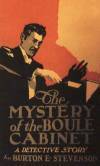
This is a better cover by the way:
This was written in 1911 and it shows its age; at the same time, it is very nearly ageless.
Mr. Vantine has had a Boule cabinet mistakenly shipped to his house. A stranger (also from France) is now dead in his house; not long after, Mr. Vantine dies. Yes, the cabinet done did it, Ethyl. But why?
For those of us who started reading mystery novels after 1911, a lot of this is fairly predictable, sort of cheesy fun. However, it is a unique story with a very cool premise (a cabinet that kills people).
The narrator is an attorney, Lester, who has all sorts of free time to tag along as detective Godfrey investigates the strange occurrences involving the mysterious cabinet. Forget that he leaves the room when he knows the villain is waiting for him to do so, that he comes across as Inspector Japp on the old Poirot TV shows, and Mr. Lester drops into school-girl like faints whenever something over dramatic happens. However:
There is a dark-ish and subversive little plot going on here, with subtle clues as to what the strange Boule cabinet is all about, and why it wound up in Vantine's possession by mistake. Stevenson masterfully unraveled the mystery and the conclusion is somewhat satisfying.
Definitely worth it for nostalgic charm. It is a great "cozy" mystery.
See CL's review for a colorful description that will whet your appetite. I listened to the Librivox audiobook. The readers are volunteers and I appreciate their efforts. This reader had a sing song approach for narrative and dialogue which made it harder for me to follow at times. Overall, I appreciated the complexity of the story although a bit melodramatic.
Dated, but absorbing detective story revolving around a priceless antique. Lots of melodrama, a master criminal, some prejudiced stereotypes, and a journalist-detective. It's not going to strain your brain, but it does clip right along.
I happened to come across this book while browsing Classics and the title caught my attention based on my interests in mystery/crime novels, history, France, and interior design. (Andre Boulles was a 17th-Century French cabinet maker known for his beautiful "marquetry" artistry of applying veneers to create richly intricate and decorative designs on furniture pieces.) This story, despite little being revealed about the setting and characters, was initially quite surprisingly engaging even though it mainly and simply focused on the history, design, and mystery of a furniture cabinet. Unfortunately, I ultimately found the revelation of the mystery relatively uninteresting, anti-climactic, and a little convoluted with the introduction of too many new characters and circumstances towards the end of the book. Given the often interesting history of expensive antique furniture pieces and the fact that murder mysteries specifically based on poisoning were not uncommon throughout history, I thought such a premise would make for a uniquely captivating historical mystery/crime novel and still think it could have in this situation if the critical point of the book where the mystery was revealed had been as intriguing as the earlier part of the story.
🖍️ The Mystery of the Boule Cabinet: A Detective Story really turned out to be a good old mystery story. Not only was the plot easy to follow, but the writing was intelligent, including believable character dialogue and scenes. It was just plain fun! I learned also what a boule cabinet is, too. The only disappointment I had was that usual the > Project Gutenberg e-book version includes the original illustrations of books, but this time – no! That is a mystery as to why not!
📙Published in 1911.
🟢The e-book version can be found at Project Gutenberg. 🟣 Kindle. ˋ°•*⁀ ˋ°•*⁀➷
I think I was expecting more because of how much the person who recommended it to me raved about it. The beginning mystery is rather intriguing. The solution was kind of "meh." I would say more about that, but it would contain spoilers. Not bad for a free kindle book though.
One thing to ponder is how the narrator complains about the younger generation being "too hurried, unfinished & nervous." Considering it was written in 1911, he's talking about the generation that we later refer to as The Greatest Generation!!
I’m afraid that it wasn’t very mysterious. Maybe, I’ve read too many mysteries, but I figured out all of the ‘surprises’ well ahead of the narrator and the ‘hero’. All the plot points were just so obvious. It was still a fun read. Mostly, because I thought there would be some great twist or reveal. But, I didn’t care for the ending. I’m all for setting up for a sequel, but No, thanks. So I wouldn’t recommend it, but there was nothing wrong with it, it was just rather boring.
Stevenson is brilliant in presenting the mysteries of the Boule cabinet. The twists and turns throughout the story is fascinating. Characters are convincing and smartly designed to keep the reader enraptured. Great novel. Thanks. Ken B
Okay, I’ve been reading murder mysteries for a while now, and have come across a lot of creative ways that authors have bumped off their victims. Untraceable poisons no one can pronounce, crossbows set to kill on a timer or ice bullets which will melt after completing their deadly mission leaving no trace. In spite of that, I think I’ve come across one that is truly unique. The Mystery of the Boule Cabinet; A Detective Story by Burton Egbert Stevenson written 1911, is a bit on the sensational side, with stupid policeman, clever amateur sleuths, and a villain who is just a bit too...much of everything. However, my favorite thing in this book is the murder weapon. Forget Professor Peacock in The Library with The Revolver. Or even a frozen leg of lamb or a toaster. In this story the murder weapon is…wait for it. A piece of furniture. A rather large cabinet to be precise. Not a built-in, free standing. No it doesn’t fall on anybody, it’s a little more complicated than that of course. The plot is basically a locked room mystery, which is basically that someone is murdered in a locked room. The door isn't locked in this, but it still applies. You see there’s no way the person or persons could have been murdered in this room, and yet there’s this dead body. Then another one. And another one. Plus some near misses, but no one realizes that until later. The only commonality is this cabinet, and it’s definitely the murder weapon. No spoiler there that’s established almost immediately. But how is the murderer using it to kill people? Well that’s the mystery, and if I told you, you'd be mad. So I won't do that. It's dated, but still quite a good story, and the solution does make sense which I appreciated. In my opinion those are the best, they are unlikely, but still possible, besides having the most ingenious of murder weapons. The furniture did it, think about that the next time you move it to vacuum behind it
A good read! Had me guessing all the time. The author kept me on the ropes as he gradually unfolded the mystery. Moved along nicely too. Nineteenth century authors enjoy detail, which he provided, but I never felt bogged down, as can so often happen with authors of that era. I'll read another of his books for sure.
A classic mystery complete with a naive narrator, mysterious antique, bumbling police, master criminal, and a plot that twists like crazy. I love that Audiobooks allows readers to rediscover old books in new ways.
I love classic mysteries and this was a great one! You figure things out as you read, but its still great "watching" the characters figure it out, and there's plenty of surprises as well!