Perhaps Norman Rockwell will always be saddled with the reputation of a sentimental magazine illustrator who airbrushed American reality. But art historian Karal Ann Marling's generous reassessment strives with considerable success to rescue Norman Rockwell (1894-1978) from cultural cliché. "Rockwell fits readily into the grand continuum of realist masters," she contends persuasively. His life had its share of hardships, Marling notes, including his wife's alcoholism and his own bouts of depression; his depiction of American society became more somber over time and eventually led to his break with the Saturday Evening Post. Handsome reproductions of all of the famous images brace her argument.
Karal Ann Marling is professor of art history and American studies at the University of Minnesota. She is the author of numerous books on topics including American mural painting of the Depression era, illustration of the 1940s, the architecture of theme parks, and the influence of television on visual culture in the 1950s.
Born in New York City in 1894, Norman Rockwell always wanted to be an artist. At age 14, Rockwell enrolled in art classes at The New York School of Art (formerly The Chase School of Art). Two years later, in 1910, he left high school to study art at The National Academy of Design. He soon transferred to The Art Students League, where he studied with Thomas Fogarty and George Bridgman. Fogarty’s instruction in illustration prepared Rockwell for his first commercial commissions. From Bridgman, Rockwell learned the technical skills on which he relied throughout his long career. Rockwell found success early. He painted his first commission of four Christmas cards before his sixteenth birthday. While still in his teens, he was hired as art director of Boys’ Life, the official publication of the Boy Scouts of America. He began a successful freelance career illustrating a variety of young people’s publications. At age 21, Rockwell’s family moved to New Rochelle, New York, a community whose residents included such famous illustrators as J.C. and Frank Leyendecker and Howard Chandler Christy. There, Rockwell set up a studio with the cartoonist Clyde Forsythe and produced work for such magazines as Life, Literary Digest, and Country Gentleman. In 1916, the 22-year-old Rockwell painted his first cover for The Saturday Evening Post, the magazine considered by Rockwell to be the “greatest show window in America.” Over the next 47 years, another 321 Rockwell covers would appear on the cover of the Post. Also in 1916, Rockwell married Irene O’Connor; they divorced in 1930. The 1930s and 1940s are generally considered to be the most fruitful decades of Rockwell’s career. In 1930 he married Mary Barstow, a schoolteacher, and the couple had three sons, Jarvis, Thomas, and Peter. The family moved to Arlington, Vermont, in 1939, and Rockwell’s work began to reflect small-town American life. In 1943, inspired by President Franklin Roosevelt’s address to Congress, Rockwell painted the Four Freedoms paintings. They were reproduced in four consecutive issues of The Saturday Evening Post with essays by contemporary writers. Rockwell’s interpretations of freedom of Speech, Freedom to Worship, Freedom from Want, and Freedom from Fear proved to be enormously popular. The works toured the United States in an exhibition that was jointly sponsored by the Post and the U.S. Treasury Department and, through the sale of war bonds, raised more than $130 million for the war effort. Although the Four Freedoms series was a great success, 1943 also brought Rockwell an enormous loss. A fire destroyed his Arlington studio as well as numerous paintings and his collection of historical costumes and props. In 1953, the Rockwell family moved from Arlington, Vermont, to Stockbridge, Massachusetts. Six years later, Mary Barstow Rockwell died unexpectedly. In collaboration with his son Thomas, Rockwell published his autobiography, My Adventures as an Illustrator, in 1960. The Saturday Evening Post carried excerpts from the best-selling book in eight consecutive issues, with Rockwell’s Triple Self-Portrait on the cover of the first. In 1961, Rockwell married Molly Punderson, a retired teacher. Two years later, he ended his 47-year association with The Saturday Evening Post and began to work for Look magazine. During his 10-year association with Look, Rockwell painted pictures illustrating some of his deepest concerns and interests, including civil rights, America’s war on poverty, and the exploration of space. In 1973, Rockwell established a trust to preserve his artistic legacy by placing his works in the custodianship of the Old Corner House Stockbridge Historical Society, later to become Norman Rockwell Museum at Stockbridge. The trust now forms the core of the Museum’s permanent collections. In 1976, in failing health, Rockwell became concerned about the future of his studio. He arranged to have his studio and its contents added to the trust. In 1977, Rockwell received the nation’s highest civilian honour, the Presidential Medal of Freedom. He died peacefully at his home in Stockbridge on November 8, 1978, at the age of 84. In 2008, Rockwell was named the official state artist of the Commonwealth of Massachusetts, thanks to a dedicated effort from students in Berkshire County, where Rockwell lived for the last 25 years of his life.
Well, this was something completely new for me. In my ignorance I had never heard of the American illustrator Norman Rockwell, and when I found this book at the library I thought I would investigate some more.
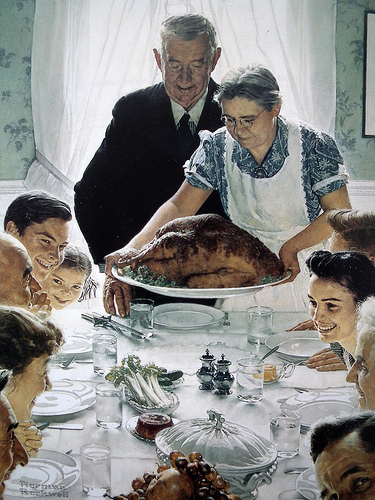
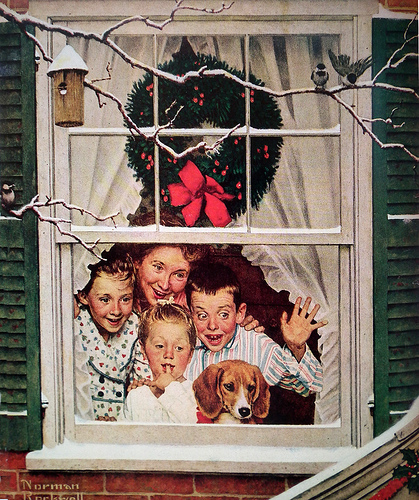
His career began when The Saturday Evening Post magazine bought some of his pictures in 1916, and he worked for them until 1964. This was a pity. Rockwell was attracted to neatness, sugary prettiness, escapist art and sentimentality……and the Post supported and encouraged this propensity every inch of the way. He was fantastically popular with the public, if not with the art world. Here is a typical picture from Rockwell’s years at the Post.
In the 1930s he spent some time in Hollywood, and was deeply influenced by the theatrical and cinematic effects used there. These are very obvious in his paintings, for me particularly in the dramatic perspectives and viewpoints that he often used.
A lot of the figures portrayed in Rockwell’s works are slightly distorted. This is partly because of instructions issued by the Post. Rockwell was told that the audience needed to “get” the story within two seconds, or the sale was lost. That meant exaggerating facial expressions, and various foibles of key figures and items in the picture. In some ways he was almost like a cartoonist. Whilst his methodology in painting was every bit as scrupulous as a classical artist (he used models as well as photography, and did detailed preliminary sketches), the end result was often slightly exaggerated.
Then in the 1960s he had a big change of heart. He got to dislike the Saturday Evening Post’s rosy view of the world, and left the publication. He joined Look magazine instead, specialising in painting current affairs. Also, in his private life he had become good friends with two psychiatrists, both passionate advocates of civil rights.
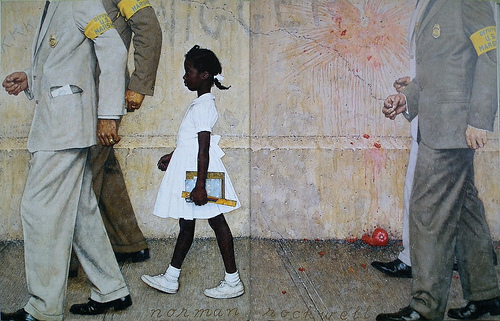
His first picture for Look was a picture of Ruby Bridges – the girl who attended a 'white' school in New Orleans despite violent racist opposition. I feel a bit ambivalent about this work, whilst I applaud its subject, I feel it is too sedate and pretty to convey the brutality of the situation.
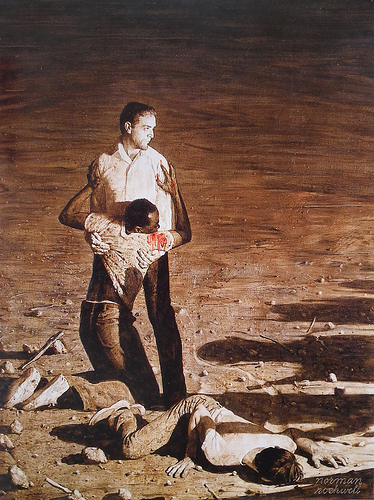
Later he did another picture showing an episode racial abuse, this time about three civil rights workers killed for their efforts to register African-American voters. I think this one carries a lot more weight.
I found the few pictures at the end of the book depicting Rockwell’s work for Look, far more interesting than the mawkish illustrations showing his work for The Saturday Evening Post. Technically he was a brilliant artist, but the bulk of his work had an injection of kitch which I found alienating. The book was an excellent little round up of his life and work though, and the illustrations were beautifully reproduced.
I love-love-love Norman Rockwell's paintings, I've been to the Museum at Stockbridge twice so far. This book gives quite a bit of information on Rockwell's career and life.
There was one comment that still irks me a little, on "The Boy in the Dining Car". The waiter is a somewhat elderly black man, and Marling interprets this as Rockwell still clinging to the old cliché of blacks being the servants. I actually read somewhere else that for precisely this reason Rockwell was reluctant to cast this model, but he was simply the best choice, the one with the exact facial expression Rockwell was looking for. Or something to that effect.
All in all I think I prefer my big coffee-table Rockwell books, of which I have quite a number ...
Norman Rockwell is my favourite illustrator. His painting are extremely detailed and show the friendliest side of a bucolic, traditional and rural America. Moreover, his paintings hide an interesting symbolism that escape to the untrained eye.
This book has really nice illustrations in a glossy paper that I love looking at. Nevertheless, the descriptions about his pictures are too basic and do not offer a lot of information about the technique and symbolism.
This edition has the right extension to give an overview about the life of Norman Rockwell. I would recommend completing the study about this artist with some of the docummentaries that are available in open source platforms. Norman Rockwell used photography as a tool to do his paintings. Since he used the people of his village as models, it is fascinating to watch some of them years later personally talk about the life of the artist.
Taschen books are always lavishly produced but sometimes the accompanying text isn't great. Happily in this case Marling provides an excellent introduction to the life and work of one of America's best known commercial artists.
The contrasts between Rockwell's life and work were fascinating. Although the majority of his paintings had a sunny and upbeat quality, Rockwell suffered from depression, yet this did not seem to affect his work in any way. Despite appearing to have a conservative style, he admired modern artists such as Picasso and Pollock.
Ultimately Rockwell became set on the idea of creating a 'Great Picture' and his attempts to produce something of significant depth were certainly interesting if not wholly successful. They will certainly seem surprising to those familiar with his more typical productions.
Rockwell once stated that he realised he would never be as great as Rembrandt, which sounds regretful but in a sense it didn't really matter. It seems pointless to compare the two as their work is so completely different. This book captures very well how great Rockwell's contribution was to what now appears as a golden age of magazine illustration.
My only minor criticism of this book is that some of the pictures are reproduced in a rather small format which made it hard to discern all of the details that Rockwell packed into his canvases. Otherwise this can be warmly recommended to those interested in American and commercial art.
a coffee table book we had since I was a kid. his images alone are a joy to look at but it was really great to read through some of the history and timeline behind each piece, especially in the context of american history and culture as well as his personal growth. in particular, enjoyed reading about his tension in artistic identity between fine arts and illustration, the effect of photography on his methods, and the maturation of his art closer to the end of his life.
this doesn't seem to be as popular of a book as some of the author's later ones. he also has an autobiography that should be nice to check out.
Un libro básico para aproximarse a la obra de uno de los más grandes e influyentes ilustradores de todos los tiempos. La obra de Rockwell es fascinante por su equilibrio, su capacidad para captar la humanidad de sus personajes y su técnica y preciosismo tantas veces imitados sin alcanzar su expresividad y su categoría artística.
Yo me he pasado horas perdido dentro de este libro estudiando y admirando cada solución técnica del maestro, y maravillándome por la manera en q consigue q, en su caso, el todo de la ilustración sea superior a suma de las talentosas partes. Maestro.
Rockwell siempre me ha parecido uno de los grandes y este libro me permitió conocer un poco ma de el, aunque esta muy enfocado a su obra en el saturday Post, es muy bueno, con presentaciones de su evolución muy buenas,a demás de explicaciones técnicas de su arte y el avance que tuvo a lo largo de los años.
A very good introduction to the work of Norman Rockwell, well illustrated in typical Taschen style. Spans his life and art from 1919 to the 1970s. Includes many Rockwell masterpieces and some lesser known works as well.