TRAVESTY is an anthropologist’s personal story of working with foreign aid agencies and discovering that fraud, greed, corruption, apathy, and political agendas permeate the industry. It is a story of failed agricultural, health and credit projects; violent struggles for control over foreign aid; corrupt orphanage owners, pastors, and missionaries; the nepotistic manipulation of research funds; economically counterproductive food aid distribution programs that undermine the Haitian agricultural economy; disastrous social engineering by foreign governments, international financial and development organizations--such as the World Bank and USAID-- and the multinational corporate charities that have sprung up in their service, CARE International, Catholic Relief Services, World Vision, and the dozens of other massive charities that have programs spread across the globe, moving in response not only to disasters and need, but political agendas and economic opportunity. TRAVESTY also chronicles the lives of Haitians and describes how political disillusionment sometimes ignites explosive mob rage among peasants frustrated with the foreign aid organizations, governments and international agencies that fund them. TRAVESTY recounts how some Haitians use whatever means possible try to better their living standards, most recently drug trafficking, and in doing so explains why at the service of international narcotraffickers and Haitian money laundering elites, Haiti has become a failed State. TRAVESTY reads like a novel. It takes the reader from the bowels of foreign aid in the field; to the posh and orderly urban headquarters of charities such as CARE International; to the cold, distant heights of Capitol Hill policy planners. The journey is marked by true accounts involving violence, corruption, appalling greed, sexual exploitation, disastrous social engineering, and the inside world of drug traffickers. But TRAVESTY it is not a novel. It is founded on 15 years of academic and field experience, research, and hard data. It entertains the reader with vivid first hand accounts while treating seriously the problems inherent not only in international aid, but the sabotaging effects of the drug war on economic development in remote and impoverished areas of the hemisphere.
I’m a bit torn about whether to recommend this book. Few have done a better job of laying bare the many levels of failure in the humanitarian aid industry - for the scathing information contained, this is one to read. The detailed account of the complete scams that are US food aid, and “orphanages” without orphans are things that we need to know and deal with.
He shows how the poor of Haiti are structurally attacked by external forces that include those NGOs claiming to be helping. Another strong theme is how out of touch with reality the Haitian elite are, with their handy escapes to Miami and Paris - and how they continue to plunder.
Unfortunately, it’s not very easy to read for other reasons. The author is unusually difficult to like - his contempt for individual Haitians, dismissal of local customs, paternalism at times, misogynistic comments and of course, total cynicism and pessimism. None of this invalidates his arguments, but wish he would check his attitude and privilege.
I don’t want to criticise the writing too much but a good editor would have pushed this to another level. Could easily trim 10k words that were repetitive.
Overall I think anyone really interested in Haiti, or aid issues more generally should read this work. But don’t expect a totally polished book- I’m going to check out his 2017 book soon and expect he has dealt with these issues.
This book explains why Haiti is such a failed state case even after billions have been showered on the country. Food aid from the US is a joke. CARE doesn't deserve anyone's money. Travesty is an under-statement.
Heavy stuff, but then again it has to do with Haiti so what isn't? He puts together a pretty compelling case on how food aid has completely effed the country, but I can't get over the sensational feeling of his writing. I don't know how I'd do it better, but he seems to continuously revert to these raw/visceral/primitive tropes in describing the Haitian lifestyle, which made me lose sight of his subject's humanity. They're people down there, and that's why we care about their suffering. He does, too, I don't doubt that, but he sometimes sounds like he's angrier that we're being jerks than that someone's suffering because of it.
While this book absolutely could have used the help of a good editor, the content is important enough to overlook the misspellings, self-repeating and extensive unnecessary descriptions. Years ago, I attended a talk about how NGO's were actively holding back reconstruction from the devastating earthquake of 2010; well, this book makes it all too clear that this has been going on for decades and not on accident.
The real unanswered question is, who can we trust? Do we just ignore the extreme poverty and let Haiti try to sort it out by itself, or is there an organization that is truest trustworthy and actually helpful?
I thought the author did a brilliant job of taking many concepts of food aid, health care and orphanages and uncovered a confusing and shocking level of corruption. He did so through the cultural lens of Haiti. Anyone considering sending aid in any form to Haiti should read this book. It will help you make educated decision about where to put your money and good intentions. This book appears to be self-published and cry's out for some serious editing. I'm shocked that no major publisher has picked up on this extraordinary book.
This is a first hand account of the author’s extended stay and immersion into the Haitian culture, living among the poor. The book portrays an interesting cross section into Haitian society, as illuminated by the author’s direct experiences of living in the countryside. During his time in Haiti, the author develops strong opinions about the ineffectiveness of foreign aid and this essentially serves as the theme throughout the book.
The author lived in a Hamlet that is a part of Jean Makout County, a remote portion of Haiti. At the time, 130,320 people lived there, all scattered about the rugged countryside, in little thatch-roof huts, cultivating garden plots, raising goats, sheep, and pigs, or fishing out of homemade boats and small kayaks. Most people traveled by foot, donkey, mule, or horse.
The author remarks that a major principle in anthropology is that one should never study their own culture because of being essentially stuck inside of it by preconceived notions. You can’t see things from within as clearly as you can observe other ethnic groups. The detachment provides objectivity. The author asserts that he gained a much better understanding of his own culture by getting outside of it in Haiti.
Prevalence of Evil
The author reports how people in the villages consider themselves better than the peasants of the countryside, laughing at them, teasing them, making fun of their illiteracy, ridiculing their use of animals for transportation, their rags, and their rude way of talking. The author describes the Haitian elite as haughty, arrogant, and ignorant of their own poverty.
The author recounts a story of getting dragged into court over a petty and false accusation. As the court case progresses, it turns into a comical charade of name-calling. The account of the trial is indicative of, not only a perversion of justice, but also the purposeful reduction of justice to foolishness. The author’s depiction of the Haitian court system reminds me of children attempting to play court and instead descending into name-calling and jest.
Through his depictions, the author exposes a thread of evil in Haitian society: nurse practitioners who verbally degrade poverty-stricken patients, doctors refusing to tell Haitians they have aids for fear they will go out and spread it maliciously, modern day slavery disguised as domestic servitude, and the general cultural acceptance of deceit and manipulation. And voodoo! The author gives the following first hand account of his attendance at a voodoo ceremony:
“Ram sat in a corner by a table covered with white linen on which rested cola bottles and candles. From where he sat Ram commanded a room full of disciples, dancers, and onlookers. He held a wooden drum between his legs, expertly beat out a rhythm on the drum, sang a couple lines, and then the entire room would respond in exquisite chorus. After each song, Ram sent around a bottle of klerin (moonshine). Occasionally a “lwa”, or spirit, possessed someone. The person would fall to the floor jerking, then stand up and greet “la societe”. Several times Ram himself was possessed. He passed around the room, going from person to person, greeting them, shaking hands, still holding on to the first hand, he would cross his arms and shake the other. He would then pass back around the room spraying something like deodorant and rubbing faces with a silk scarf.” Later, when Ram died of Aids, the people of the Hamlet were delighted that he was dead. Everyone in the Hamlet believed that Ram had been killed in retribution for having killed a man name Dipara. They said Ram had killed Dipara and ate him as a goat in a ceremony and that people close to Ram had partaken in the feast. They said that Ram was responsible for killing many other people in the Hamlet and surrounding area. They said that it had been him who had killed thirty-some children several years before, causing them to waste away in what appeared to be typhoid, and then consuming their souls. They said that he had sold his own son, Tiyol, to the demon who aided him in his evil machinations. –Timothy T. Schwartz, Ph.D.
Orphanages
The author reports the results of his investigation into Haitian orphanages, which he discovered to be populated by “children with parents”, who were using the orphanages for their schools. The author’s “announced” visits to orphanages would reveal many children; but upon his “surprise” visits to the same facility, he would discover very few children. Other orphanages were found to be kicking out any residents over 14 years of age because of the greater difficulty in obtaining sponsors (contributors from wealthy countries) for them. On the contrary, the cute younger children were found to have many, many different sponsors. The author discovered the orphanages were being operated as businesses by local proprietors. Many such proprietors were found to be spending only a fraction of the money they received on the children and pocketing the rest. The author found that many of the parents of the so-called “orphans” were government officials, business owners, lawyers, or other Haitian elites. According to the author, the “poorest of the poor’ were often excluded from help in Haiti.
Food Aid
The author contends that much of the food sent to Haiti never makes it to the “poorest of the poor” because it is misdirected and sold in the cities. This thievery not only fails to feed those in the most need, it also destroys the produce market for the local rural farmers, by crashing prices. The author cites various accounts of fiscal mis-management, wherein custodians of aid profit through disbursing it. The author shows how foreign aid is inappropriately re-directed to middle and upper class Haitians, for whom it is not intended.
Throughout the book, the author contends that foreign aid has destroyed the Haitian economy. In fact, one has to wonder why any place receiving such heavy amounts of aid is not improving? The stark economic reality is that free or inexpensive food over-supplies and lessens the need for localized farming. The author writes as follows, contrasting Haiti (particularly Jean Makout county where he resided) “before” and “after” the arrival of foreign aid:
“When the NGO’s (Non Governmental Organizations) arrived in the early 1950’s, the county boasted banana plantations and refrigerated ships that regularly visited the Jean Makout harbor and hauled the produce to Miami; a five thousand-acre sisal plantation; tobacco farms; a major rum distillery; and a sugarcane planation. There were thriving export houses to which the peasants sold goat and cow hides, coffee, castor bean oil, and aloe. But by the 1980’s, all that was gone. There were no more private companies, no mining operations, no manufacturing industries, no plantations, indeed, no agro-industrial enterprises at all. Beyond the small peasant homesteads and their semi-subsistence gardens and the few animals they tethered to bushes, there was nothing left in Jean Makout county but the NGO’s and the Haitian government.” –Timothy T. Schwartz, Ph.D.
Schwartz asserts that it was precisely the aid that was sabotaging the capacity of the economy, by breeding dependency. Food distributed during harvest seasons crashed crop prices. The author reveals an “industry of poverty” in which people derive their salaries, not from curing poverty, but from its existence. When money, materials, and food arrive, it is embezzled by employees, politicians, administrators, pastors, priests, and school directors, who then redirect it for profit. The author recounts actually observing food being sent to non-existent schools and then redirected back to the cities to be sold for profit.
Foreign Domination
Schwartz even entertains the diabolical and nearly unbelievable notion that food distribution has been purposefully distributed at harvest time to paralyze Haitian agricultural production and to encourage the Haitian population to work in factories. Schwartz cites many examples, including the allocation of fifty tons of emergency flour for the summer drought of 1997, that didn’t arrive until a full year later, right in the middle of the bumper crop of July 1998. And again, in September of 1998, when emergency food was issued for the destruction from Hurricane George, but didn’t arrive until eight months later, again, right in the middle of a good harvest. During the six months from November 1998 to April 1999, a period that farmers cite as the most bountiful Haitian harvest in 30 years, an average of 15% more food was distributed in Haiti, than during the horrible drought of 1997.
The author relates that not only has the U.S. military “physically” invaded Haiti twice, Cuba four times, the Dominican Republic three, Honduras seven, Nicaragua seven, Panama four, Guatemala and El Salvador once each, it has also invaded these places “economically” by promoting delivery of U.S. corn, wheat, cotton, and rice, all of which are highly subsidized in the United States! In other words, according to this author, U.S. taxpayers compensate large domestic land-owners for flooding third world countries with foodstuffs that destroy the impetus of the third world countries to produce and profitably sell locally produced food! The winners are the exporting land-owning class. The losers are U.S. taxpayers and third world farmers. The author cites that much of the same thing has occurred in the garment industry, through the process of subsidies and custom taxes.
Through this process, U.S. taxpayer wealth is transferred to landed interests and foreign production is discouraged. The U.S. policy has not been for impoverished Haitians to “produce” more food or to “adopt” better farming techniques, but rather, to “import” more food from the United States. Ships leave Haitian ports empty and return packed with hundreds of thousands of tons of subsidized wheat, rice, corn, and beans. Excess agricultural products can be dumped in Haiti, as food relief, thereby essentially marketing it to taxpayers who, in reality, can pay much more for it than the Haitians ever could!
U.S. food aid began in 1954 with the goal to promote overseas sales of U.S. agricultural produce. Haiti, which was once among the greatest sugar producers in the world, was actually importing 25,000 tons of U.S. sugar in 1995! The plight of Haitian agriculture has resulted in a declining rural population and a rising urban population, where city dwellers work at $2 per day jobs in urban factories.
Jean-Bertrand Aristide
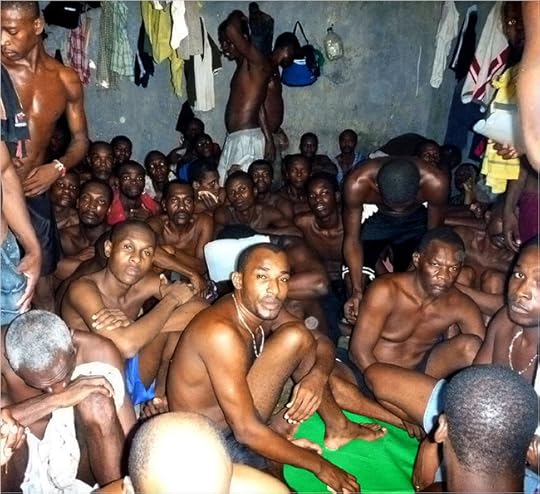
To combat this, Jean-Bertrand Aristide gained the presidency in 1990. As an activist priest, Aristide first came to national attention when he led a march to the infamous Fort Dimanch prison, where thousand of political dissidents were tortured and killed. Aristide was being interviewed on live radio as he and other protestors approached the prison, when suddenly the prison authorities opened fire on the protestors. Aristide escaped this and many other attacks unscathed, including an open attack upon his church, where a dozen or more of his congregation was slaughtered. With each new harrowing experience, Aristide gained mystique and a perception of invincibility.
Inmates in The Fort Dimanch prison
Aristide condemned capitalism as a mortal sin, raised the minimum wage, implemented reforms against privatization, and referred to the Haitian poor as “the proletariat”. However, seven months after being elected, Aristide was paced aboard a plane by CIA operatives and sent into exile. During the three days that followed, some three thousand people were killed by the military. Propaganda about Aristide atrocities was then circulated. Much violence was perpetuated by impoverished mobs because the impoverished masses loved Aristide.
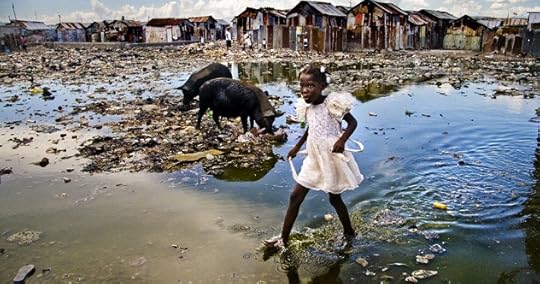
Little Girl Wanders in Refuse
Urban Haiti
In one of his more artful descriptions of urban Haiti, the author writes as follows:
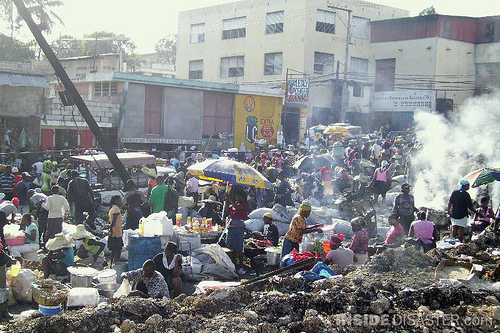
“What I see is a chaotic gloom of shanty towns and reeking open air markets that jag down the Caribbean mountainside and crowd across a congested plain. Rising ominously from the squalor is a venomous haze of carbon monoxide, petro-chemicals, half burnt dilapidated vehicles, and the smoke from charcoal fires burning the last of Haiti’s disappearing trees. The sea beyond is brown and thick with human excrement, slick with a suffocating film of motor oil and floating morass of discarded bottles and plastic bags. My eyes follow along the shore, out to the dingy fringes of more sprawling shanty towns where the visitor is afraid even to breathe the putrid air; where at any hour of any day, people can be seen wandering out amongst the ubiquitous garbage heaps and defecating while others walk nonchalantly past. Trash spreads out onto a cove and homes made of it with scraps of wood, cardboard and plastic bags. When it floods, these people, the wretched of one of the most wretched cities on earth, must crawl from their hovels and seek refuge on the highest mounds of garbage. Sick people, too weak to pull themselves to safety, sometimes drown while lying ill in makeshift beds of cartons and rags.” –Timothy Schwartz, Ph.D.
The Plight of Urban Haiti
The Drug Trade
The author describes how Haiti became a transshipment point for Columbian cocaine and many Haitians became smugglers, many with their own security forces, artillery, visas, planes, and boats. Drug lords came to control neighborhoods, towns, cities, and politicians. Extravagant houses, hotels, and related development came from Columbia, another poor country, not the wealthy nations. Haitian development came about from an industry that these rich countries see as a threat to their survival. In an ironic sort of way, the drug trade reverses the odds, turning a 3rd world country into an exporter to the rich countries, extracting away their wealth, in exchange for addictive drugs. In this ironic way, the Haitians get a cut of wealth from the vices of the very countries that once enslaved them. One is reminded of the opium trade of the 18th and 19th centuries, in which Great Britain, for lack of anything else the Chinese wanted, exported opium from India and sold it to the Chinese in exchange for luxury products such as porcelain, silk, and tea. By addicting the Chinese to opium, the British were able to exploit them for profit.
Conclusion
After reading this book, you have to ask yourself: is it enough just to give? From the author’s point of view, simply giving creates a paralysis. Simply giving only transfers the obligation to “do” onto someone else and often fosters corruption. Can we simply pay to relieve ourselves of the responsibility to “do”? Can we simply throw money at situations that stir our conscience and ever expect them resolved? Haiti needs more than our food and money. Haiti needs our interaction and organization. Until we do more than just throw food and money at the problem, it will not heal.
An intriguing book about a subject I care very much about. This book, though, left me with more questions than answers. One unsettling part of the book was that it appears to be self-published, and includes several grammatical/spelling/typesetting errors. I also found it unsettling that the author seemed to have quite a bit of difficulty getting along with people while in Haiti, so I do not feel certain how reliable this account is. Definitely an eye-opening book. Left me wanting to know more, especially about how Compassion, Inc. works in Haiti.
Although set in a particular time and place, this book explores the complications and corruption of NGO and U.S. government involvement in other countries. Worth reading.
This book takes the first person perspective of an anthropologist who spent 10+ years in Haiti. The title word says it all - travesty. The author goes through various spheres in Haitian humanitarian aid, including food aid, orphanages, medical care, and schools. He also touches on voodoo, the police and justice system, poverty in rural Haiti, and finally on drug trafficking. The author walks away with a cynical and disillusioned perspective after all of his research - for good reason after all the travesty he witnessed.
For those who've never been to Haiti, this is a good primer to some of the things we're dealing with down there. Don't get discouraged though, because from my experience I still have reason for hope and the potential for lasting change in Haiti. Relationships always outweigh programs.
Disclaimer: there is a bit of language toward the end of the book, but it is more illustrative of the situation rather than excessive.
I knew a lot about Haiti when I read this - I had been there twice, and had pretty much written a book of my own about Haiti politics. But Tim Schwartz's book was still shocking, and his insights are still pretty searing. The chapters on food aid and orphanages especially were of the "too unbelievable to be anything but true" kind. I like his writing too. There is this kind of trick he does where, in each chapter he explains how naively he thought things were one way, then they turned out to be completely unlike what he thought. You realize by the end of the book that this is probably a writing technique and that he's actually probably extremely shrewd.
Despite some vulgarities, this should be mandatory reading for anyone involved with church missions, and/or third-world development work. It's a sad, eye-opening account of the absolute catastrophe of foreign aid in Haiti. The widespread corruption, especially in governmental NGO's, but also in some "Christian" missions is appalling, frustrating, and leaves the reader feeling hopeless because of the macro-economic forces and the micro-scandals behind Haiti's ruin.
After recounting a number of different corruptive forces, Schwartz's final chapter shows how a hijacked shipment of Columbian cocaine, which then opened the floodgates of cocaine trafficking, is about the only thing that brought actual "development" to Haiti. He concludes that despite all the efforts at development, it's only first-world vices which have actually brought any real change to Haiti.
I really appreciated this work because it's from a guy who lived on the ground for years in Haiti with a researcher's eye. He was in the heart of it all--the major NGO's, the home of a druglord, the slums, the courts, and the streets. This guy is blunt and his work is a needed word for much of the naive development and missions work that occurs in Haiti. Good missions and development can occur on a micro level in Haiti, but one thing is clear: throwing money at a problem with no accountability only makes more problems.
I had high hopes for this book, especially considering the subtitle. Expecting to find an engaging account of the misdeeds of foreigners in Haiti, I was looking forward to this engaging read. A couple chapters in, it became nearly unreadable.
First, let's talk prose. If there's any travesty contained in the 200-odd pages of this book, it's the author's abominable writing style. He could desperately have used a copy editor, or at least a basic proofreader with a high school education. It is a marvel the author has managed to obtain a PhD without ever learning the basic rules of the English language.
Even if you are able to glaze over the deplorable writing, however, you will find plenty of substance that is deeply problematic with this book. The author has an extremely flawed, incomplete, and severely limited knowledge of Haitian culture and history. This is particularly disturbing, considering the fact that he is allegedly an anthropologist. His exoticized description of Vodoun rituals in the very first couple chapters -with zero understanding of their context in the socioeconomic structures of the Haitian countryside- is more fitting of a B-movie about zombies than a book by a doctor of anthropology.
While the author ostensibly sets out to expose the misdeeds of foreigners in Haiti, he spends just as much time describing Haitians through the same old, tired, racist tropes that have been used in American and French descriptions of the nation since its liberation. The Haitian people are painted as feckless, uneducated, desperate, poor masses who will easily sell out to the highest bidder. Needless to say, the world doesn't need any more of this libel.
To top it all off, the one Haitian leader whom the author idolizes as representing "the good old days" is Henri Christophe, the dictator who worked to squelch the young revolution, declared himself king, and reinstated forced labor on the nation just recently liberated from slavery. Nice hero, Dr. Schwartz.
If you actually want to learn about the fascinating history of Haiti, its rich cultural traditions and inspiring war of independence, I recommend Wade Davis's "The Serpent and the Rainbow." Davis is the right kind of foreigner in Haiti - respectful of the country's traditions, willing to learn from them, devoting time to delve deeply into the ancient mysteries of the Vodoun religion and the African roots of Haiti's heritage. Davis gets it. I only wish Schwartz had taken a page or two out of his book.
I thoroughly enjoyed this book. I have read a bit about development at this point and have my own experiences of working for a small NGO in Tanzania, but this was a really great view into the failings of development work. I read this book while I was in the middle of White Man's Burden and I really felt as though Travesty in Haiti was the perfect complement to Easterly's book as it provided on the ground observation concerning the same travesty that happens on a larger scale throughout the world.
I appreciate Schwartz's irreverence throughout the book and that he doesn't pull his punches. As someone that has worked in a developing country and have at least a cursory understanding of cultural anthropology, I was amused by his bluntness in talking about being annoyed by the people he worked among and the detestable food (it does happen!) In the midst of that, you really see his honest belief in the capability of the Haitians that he lived among and as anyone on the ground knows, the solution for poverty in any society lies within the nation itself.
I found this book through the documentary Poverty, Inc. which is another must for people interested in development work or Haiti in general. I had to contain myself to read up to the chapter on orphanages rather than just skipping straight there. With our work in orphan care, we've found a lot of the same things he described to be true in East Africa as well, but it was nonetheless good to read it from another context. This chapter was telling, and I will incorporate some of the stories that he shared as cases that exemplify the importance of supporting vulnerable families and exposing corruption in child welfare.
Wow. This appears to be a self published book by an anthropologist who spent 10 years in Haiti hoping to have a career in Development. He ends up walking away from it all after finding case after case of corruption, lying, stealing, and a general lack of accountability from nearly ALL the people he met there. People from charity organizations, NGO's, pastors, priests, educators, police...you name it. Very eye opening and disheartening. Will there ever be any hope for this country? So much has to change, but will it?
This should be essential reading for anyone that wants to work in development. It is an unidealized and painfully truthful account of what goes on beyond the periphery of most observers of development. I forget where I read that the author could not find a publisher for this book because of how many organizations it spoke ill of. We also see the challenges the author faces working alone in rural Haiti for his PhD fieldwork. It really hit home for me and captures the essence of this type of work, both academic and in the development field.
Wow, this is one to pass on to others who share an interest in Haiti or in other third world countries. It is written almost as a memoir of the author's stay in Haiti. He is an anthropologist, a good story teller and an astute observer. The subtitle tells it all. Don't give up on trying to help, but read this book before you write another check.
Excellent read for anyone involved in foreign non-profit endeavors. While I believe his intentions are good, Schwartz comes across a little cynical at times. Still, his point is well taken and I have seen examples of some of these "travesties" enough times to understand his bitterness. Definitely worth checking out!
If you want to know how the world really works, read this book. Read about how food aid often puts native farmers out of work. Read about NGO's that do more harm than good. Read about rampant graft in foreign aid programs. Read about how people pretend to care about the poor, but don't bother to check whether their programs actually work.
A broad expose of broken development work in Haiti with a particular focus on food aid, written by a bewildered anthropologist/aid worker. Moral of the story: narcotrafficking is probably more effective and less unjust than development projects.
Fascinating, insightful, and depressing view into the NGO world of Haiti. He includes a few good suggestions for improvement in an appendix. One of the major disappointments with the book is how do of typos it is -- they get painfully frequent in the last third of the book.
The record of NGO's in Haiti is even worse than I thought! Schwartz portrays them as universally corrupt or naive, mostly corrupt. This seems unlikely 100% of the time, but his point is well-taken that donors have no idea about what actually happens on the ground.
The few typos found in here are worth ignoring ! This is a very eye opening look into how some of the "charities" we entrust our funds to "help others," are really working behind the scenes. Highly recommend!
Excellent and a must read for people working and volunteering in Haiti or working in the development field in general. It's pretty scorching but fair and well researched.
A complete story behind shelves of the internal changes of a poor country during the time the author was living there, among the irony the people wanted to help, did the oposite.
“As it turns out, U.S. food aid was born in 1954 with the passage of PL 480 and the specific goal was not principally to help people but to promote overseas sales of U.S. agricultural produce.”
“And I think about the greatest irony of all: How the people of the Hamlet and the Village, many of whom really are the poorest of the poor, had done more in one day to better their lives than the Haitian government and all the foreign NGOs had accomplished during half a century…by hijacking a cocaine shipment.”