

What do you think?
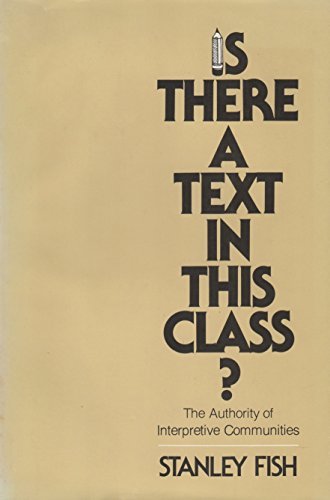
Is There a Text in This Class?: The Authority of Interpretive Communities
Stanley Fish is one of America's most stimulating literary theorists. In this new book, he undertakes a profound reexamination of some of criticisms most basic assumptions.
408 pages, Hardcover
First published November 28, 1980
About the author
Stanley Fish
67 books120 followersStanley Eugene Fish is an American literary theorist and legal scholar. He was born and raised in Providence, Rhode Island. He is often associated with postmodernism, at times to his irritation, as he describes himself as an anti-foundationalist.
He is the Davidson-Kahn Distinguished University Professor of Humanities and a Professor of Law at Florida International University, in Miami, as well as Dean Emeritus of the College of Liberal Arts and Sciences at the University of Illinois at Chicago, and the author of 10 books. Professor Fish has also taught at the University of California, Berkeley, Johns Hopkins University, Columbia University, and Duke University.
He is the Davidson-Kahn Distinguished University Professor of Humanities and a Professor of Law at Florida International University, in Miami, as well as Dean Emeritus of the College of Liberal Arts and Sciences at the University of Illinois at Chicago, and the author of 10 books. Professor Fish has also taught at the University of California, Berkeley, Johns Hopkins University, Columbia University, and Duke University.
Ratings & Reviews
Friends & Following
Create a free account to discover what your friends think of this book!
Community Reviews
Displaying 1 - 23 of 23 reviews

September 21, 2016
The subtitle of this book ought to be "Stanley Fish Deconstructs Himself".
This is a collection of essays on literary theory by literary critic Stanley Fish. The book is interesting throughout, but of particular interest is how it is organized. Fish states, right from the introduction, that the perspective from which the bulk of the essays was written is wrong.
Fish began his journey into literary theory as a reader-response theorist. That is, he believed that there is no objective text, but the text is created through the experience of reading. He then made several moves to sidestep the radical implications of this theory; drawing on psychology and Chomsky's universal grammar to try and thread the needle between saying there is one strictly correct reading, and there are no correct readings.
In the introduction to the book, Fish says that this move implicitly reintroduced the text as the objective factor; in creating a stable, if flexible, reading experience, he was all but recreating the notion of a stable text. So any time he advanced arguments which effectively undermined the partisans of stable texts, he also undermined his own position.
The introduction fleshes out not only his mistakes, but how they led him to the conclusion ultimately embraced in the last quarter to a third of the book. As the actual subtitle implies, he centers his theory on interpretative communities. In a way readers create texts, but it is more accurate to say that communities create the conditions for creating texts---and yet more accurate to say that communities create both readers and texts. I will not here delve into the subtleties of this argument, which is well worth the price of admission, but Fish advances it masterfully.
In creating a book that centers so much on reader experience, Fish also cultivated a unique experience for his reader. The deconstruction of his journey in the introduction is followed by opening statements at the beginning of each essay, talking about the circumstances, strengths, and fatal flaws of what you are about to read. This created a useful tension for me---I could see problems straightaway, but I wasn't sure if I was seeing them because they were obvious or because Fish had given them away from the start.
Progressing through the book feels much like watching someone work out a problem by sketching solutions again and again. The reader-response section shifts subtly as you go along, in response to criticisms he received at the time. He also includes an interesting discussion of Speech Act Theory, which is an excellent essay in its own right. In general I felt the pleasure of seeing a clearly intellectually curious person attending to their own growth, and owning the mistakes made along the way.
It does not hurt that Fish is an excellent stylist, bringing wit and bravado into the dry subject of literary theory. And once you have done the work of following through his reader-response phase, you can more plainly see how interpretive communities sweep away a lot of conceptual problems. Of course, they also create problems of their own---but the structure of the book leads me to believe that that is exactly what he wanted you to see.
If you wanted to dip your toes into literary theory, or have ever wondered about the nature of meaning, you could do worse than starting here.
This is a collection of essays on literary theory by literary critic Stanley Fish. The book is interesting throughout, but of particular interest is how it is organized. Fish states, right from the introduction, that the perspective from which the bulk of the essays was written is wrong.
Fish began his journey into literary theory as a reader-response theorist. That is, he believed that there is no objective text, but the text is created through the experience of reading. He then made several moves to sidestep the radical implications of this theory; drawing on psychology and Chomsky's universal grammar to try and thread the needle between saying there is one strictly correct reading, and there are no correct readings.
In the introduction to the book, Fish says that this move implicitly reintroduced the text as the objective factor; in creating a stable, if flexible, reading experience, he was all but recreating the notion of a stable text. So any time he advanced arguments which effectively undermined the partisans of stable texts, he also undermined his own position.
The introduction fleshes out not only his mistakes, but how they led him to the conclusion ultimately embraced in the last quarter to a third of the book. As the actual subtitle implies, he centers his theory on interpretative communities. In a way readers create texts, but it is more accurate to say that communities create the conditions for creating texts---and yet more accurate to say that communities create both readers and texts. I will not here delve into the subtleties of this argument, which is well worth the price of admission, but Fish advances it masterfully.
In creating a book that centers so much on reader experience, Fish also cultivated a unique experience for his reader. The deconstruction of his journey in the introduction is followed by opening statements at the beginning of each essay, talking about the circumstances, strengths, and fatal flaws of what you are about to read. This created a useful tension for me---I could see problems straightaway, but I wasn't sure if I was seeing them because they were obvious or because Fish had given them away from the start.
Progressing through the book feels much like watching someone work out a problem by sketching solutions again and again. The reader-response section shifts subtly as you go along, in response to criticisms he received at the time. He also includes an interesting discussion of Speech Act Theory, which is an excellent essay in its own right. In general I felt the pleasure of seeing a clearly intellectually curious person attending to their own growth, and owning the mistakes made along the way.
It does not hurt that Fish is an excellent stylist, bringing wit and bravado into the dry subject of literary theory. And once you have done the work of following through his reader-response phase, you can more plainly see how interpretive communities sweep away a lot of conceptual problems. Of course, they also create problems of their own---but the structure of the book leads me to believe that that is exactly what he wanted you to see.
If you wanted to dip your toes into literary theory, or have ever wondered about the nature of meaning, you could do worse than starting here.

August 13, 2024
3.5 stars, maybe?
When I mentioned in a conversation the other day that I had just finished reading this book, a friend who has studied this said: “Stanley Fish is very seductive.” That captures well how I feel at the moment — I am engaged, even entranced at times by Fish’s command of language and his ability to respond to and expand an idea, but when I step outside of his precisely ordered lines of thought, I find myself echoing elements, perhaps, but not much (not yet, at least) of the whole.
On the structure of the text: This is a collection of essays organized on the topic of the reader’s relationship to the text and how this is worked out in literary criticism, many prefaced by Fish’s analysis of his own work past the essays’ original publication. Fish concludes with several chapters building out the notion of “interpretive communities,” a concept presented as a resolution of some of the inconsistencies he self-identifies in previous essays. The collection, taken as a whole, charts his progress in developing his contributions to literary criticism — this, I think, is well done, even as it softens the blow of the more stinging critiques he levels against other writers. I doubt it could have been structured more sensibly, but I will say that I would have liked to get to the last set of chapters more quickly. They most clearly articulate his theories, where prior essays are mostly a demonstration of these in handling literature or else his responses to contemporary disagreement.
I really enjoyed this quite a bit, even though I am not especially practiced at reading theory and had to take the essays in measured doses. Other Goodreads reviewers have characterized Fish as arrogant, and I agree — he writes with the assumption that one is held captive by his reasoning. This is not wrong, because he is a brilliant writer, and as I read, I wanted to be convinced. I found his style of storytelling and rhetorical sleights of hand amusing, if dry. I liked the essays that were samples of his own literary readings of Milton’s poetry or speech-act theory in Shakespeare, even when his analysis was beyond me (it would probably help to actually read L’Allegro or Coriolanus).
However, I also have several hesitations. Although some broadly concern what I consider the weaknesses of reader-response theory, I am not wholly convinced by the particular solutions Fish proposes, seductive though they might be. I am most interested in: first, the relativism problem and whether interpretive communities answer here, and second, the relationship of authorial intent and determinate meaning to the stability of a text.
First, Fish writes explicitly to counter formalist concerns about reader-response criticism as inevitably leading to a descent into relativism, which is, for good reason, the main argument against reader-response theory. If the reader, in interpreting a text, is responsible for constructing its meaning, then there is no accountability and a reader can go off and develop all manner of meaning from all manner of readings. To safeguard against problems of solipsism, Fish proposes the notion of “interpretive communities,” which are characterized by shared sets of interpretive strategies. Interpretation is always happening, he says — there is no way not to play the game, and there is no way not to play it in the absence of an interpretive community. At a more basic level, no interpretation happens independently, because no instance of communication happens independently. Every instance of language occurs within systems that are governed by assorted norms and values, these mostly tacitly known. They are specific to and shaped by particular contexts, but also beyond the control of the individual. No individual reader, then, can isolate oneself so thoroughly from communication norms such as to have a totally individual reading of any text — there is no ambiguous, undefined space that is either pure language in the absence of interpretation or where any possible reading can be legitimate.
I think Fish is absolutely right in that language is informed by structures well below the surface, and instances of it never take place absent of context and many levels of meaning. In his model, no one can ever get to a purely relativistic reading of a text, because it will always take place within an interpretive community. However, I am not convinced that interpretive communities sufficiently safeguard against a less extreme form of relativism. I also don’t think that Abrams, Hirsch, et. al are concerned about the possibility of some pure relativistic reading — the concern is much more quotidian, about ordinary interpretive exercises and their failures. An example of this could be the story with which Fish opens Chapter 14, “How to Recognize a Poem When You See One.” Fish describes a classroom exercise in which he writes a list of the names of several linguistic theorists on the blackboard and tells his students that it’s a poem. They then construct interpretations of it, coming up with what it could be doing as a poem. By asking his students to read a list of names as not a list of names but as a poem charged with religious undertones, Fish invites the students into a particular interpretive community. He offers the story as a demonstration of his theory that interpretive structures and strategies shape the meaning of a given text more than the text itself does.
Again, I think there’s some truth to this, but also, this isn’t being fair to the best version of interpretation, and this is what people worry about when they worry about reader-response criticism! This example shows what an interpretive community might look like in action, certainly, but it doesn’t endear the concept to me. For one thing, this makes interpretive communities seem restrictive, not liberating. Fish controls the community and the context in which his students operate and interpret. Even if a student were to recognize a couple of the names and realize what’s going on, what is that student supposed to do — refuse to participate in the assignment? Challenge Fish as the instructor? This suggests to me that interpretation in Fish’s model relies on selecting a source of authority and deriving interpretive strategies from that source, but that source, for some reason, can’t be the text itself.
This leads into my second objection, which is that I have a hard time assessing precisely what Fish wants us to think about determinate meaning in a text. He seems to walk back over the course of this book the hardline stance at the outset that there is no determinate meaning in a text. Possibly he does not want us to toss out all authorial intent, just to grant the reader more authority in constructing meaning. Initially, I thought Fish’s theory went hand-in-hand with Roland Barthes’s work on the “death of the author.” I think now I would revise that position — Fish proposes something less radical. Barthes would have us discard the author’s context in favor of constructing meaning from the reader’s conversation with the text. Fish would have us treat the text as not itself determinate in creating meaning, but he would not necessarily have us put the author to death, just the finality of the text as determined by the author.
Even if Fish cares more about authorial intent than I’m currently giving him credit for, I think I still just have a much higher view of what it means to be an artist. It seems really unfortunate not to conceive of authors as having something to communicate that might be at times beyond readers’ ability to interpret from their own knowledge. I don’t buy all the way into Romanticism or think that every piece of art must necessarily be an invitation into transcendence by virtue of its form. There is a lot of trivial, trashy art in the world. Sometimes it serves another purpose than transcendence. But, as a Christian reader and artist, following Tolkien and Fujimura and various authors and theologians, I have a very strong view of the artist as sub-creator, as one who draws on and out of the Imago Dei. It seems difficult to hold this view together with one that diminishes authorial and artistic intent. Fish says, as part of his classroom example, about poems and lists as fundamentally the same artifacts: “The conclusion, therefore, is that all objects are made and not found, and that they are made by the interpretive strategies we set in motion” (331). To that, I say: Excuse me?? Perhaps this is not precisely where Fish intends this idea to lead, but this application of reader-response theory leaves very little room for a high regard for artistic vision. An author writes to convey something that might be much larger than a given reader can construct. I would say that does not reduce the author’s vision to ashes. If no reader ever gets anywhere, that is one problem. But most of the time, readers know how to distinguish between a sonnet and a grocery list, and that is at least in part because of the artist’s creative effort — the ability to make that distinction does not lie, I think, entirely with reader ability. Authorial intent seems clearly to matter. I just can’t tell whether, or how much, it matters to Fish.
One thing I did appreciate was Fish’s conception of the act of interpretation as temporal, an event in time, and not as spatial, a fixed point. This relates to what I actually also like about Barthes — “a text’s unity lies not in its origin but in its destination.” A text ought to expand, to yield a larger conversation. I am not arguing against reader participation, and I actually quite like a lot of the ways in which Fish allows the reader more freedom in interpretation. I love to think of reading and interpreting as a temporal event, as a conversation that is not necessarily closed by what Barthes calls a “final signified” (even if I don’t think the context of the author’s writing is necessarily that). That said, I’d propose a model more like a Platonic dialogue. Socrates is always instructing, framing the whole conversation even when he is not directly lecturing. Even the questions he asks are always in service of a truth he has already examined and desires for his student to reach. The student is expanding his own knowledge, but only because the teacher gets him there. Even when there appears to be a back-and-forth, an exchange between equals, it’s always uneven in authority, always mediated by the teacher’s superior knowledge. One might, as a reader, be able to get more out of a text than the author anticipated, and that meaning could be valid and useful. But even that flows from the conversation the author began and therefore, takes place to some degree on the author’s terms. To view a text as something separate from myself seems vital for proper intellectual humility. The point of a text is for a reader to interpret it — but not, I think, in so doing, to feel free to totally depart from it!
Ultimately, I am unsure where Fish leaves us when it comes to the actual practice of interpretation. He anticipates this argument a bit at the end, saying in the final chapter that not everything has to be immediately practical to be interesting. This is true, but I think it’s a cop-out, especially for someone who claims that “interpretation is the only game in town” (355). I would like at least something to work with, and Fish does not offer much. This is a very reductive dichotomy, but it feels as though I am left with: 1) readers are informed by social, tacitly known norms, so we don’t have to be concerned about their going off the rails and should trust them to work out their own salvation with fear and trembling; and/or 2) readers are informed by interpretive strategies, so the way to play the interpretive game as an instructor is to control the interpretive environment by supplying all the strategies from one’s own interpretive standpoint, that being superior to the authority of the text.
I admire Fish’s project, because he’s doing something interesting with the practical working-out of reader-response theory and interpretation. Our responses to a text will always be mediated by our personal experience and by the communities in which we read them, and this can help us from being isolated in our interpretation. I like this, and I like how Fish has articulated it. I think he describes effectively the structure of interpretation and identifies correctly that in reading a text, one is always playing the game of interpretation; beyond that, in encountering language, one is always playing the game of interpretation. I am just not yet convinced that interpretive communities solve the problems posed by discarding the notion of a stable text — or that, if interpretation is the only game in town, Fish has done more than describe the playing field.
When I mentioned in a conversation the other day that I had just finished reading this book, a friend who has studied this said: “Stanley Fish is very seductive.” That captures well how I feel at the moment — I am engaged, even entranced at times by Fish’s command of language and his ability to respond to and expand an idea, but when I step outside of his precisely ordered lines of thought, I find myself echoing elements, perhaps, but not much (not yet, at least) of the whole.
On the structure of the text: This is a collection of essays organized on the topic of the reader’s relationship to the text and how this is worked out in literary criticism, many prefaced by Fish’s analysis of his own work past the essays’ original publication. Fish concludes with several chapters building out the notion of “interpretive communities,” a concept presented as a resolution of some of the inconsistencies he self-identifies in previous essays. The collection, taken as a whole, charts his progress in developing his contributions to literary criticism — this, I think, is well done, even as it softens the blow of the more stinging critiques he levels against other writers. I doubt it could have been structured more sensibly, but I will say that I would have liked to get to the last set of chapters more quickly. They most clearly articulate his theories, where prior essays are mostly a demonstration of these in handling literature or else his responses to contemporary disagreement.
I really enjoyed this quite a bit, even though I am not especially practiced at reading theory and had to take the essays in measured doses. Other Goodreads reviewers have characterized Fish as arrogant, and I agree — he writes with the assumption that one is held captive by his reasoning. This is not wrong, because he is a brilliant writer, and as I read, I wanted to be convinced. I found his style of storytelling and rhetorical sleights of hand amusing, if dry. I liked the essays that were samples of his own literary readings of Milton’s poetry or speech-act theory in Shakespeare, even when his analysis was beyond me (it would probably help to actually read L’Allegro or Coriolanus).
However, I also have several hesitations. Although some broadly concern what I consider the weaknesses of reader-response theory, I am not wholly convinced by the particular solutions Fish proposes, seductive though they might be. I am most interested in: first, the relativism problem and whether interpretive communities answer here, and second, the relationship of authorial intent and determinate meaning to the stability of a text.
First, Fish writes explicitly to counter formalist concerns about reader-response criticism as inevitably leading to a descent into relativism, which is, for good reason, the main argument against reader-response theory. If the reader, in interpreting a text, is responsible for constructing its meaning, then there is no accountability and a reader can go off and develop all manner of meaning from all manner of readings. To safeguard against problems of solipsism, Fish proposes the notion of “interpretive communities,” which are characterized by shared sets of interpretive strategies. Interpretation is always happening, he says — there is no way not to play the game, and there is no way not to play it in the absence of an interpretive community. At a more basic level, no interpretation happens independently, because no instance of communication happens independently. Every instance of language occurs within systems that are governed by assorted norms and values, these mostly tacitly known. They are specific to and shaped by particular contexts, but also beyond the control of the individual. No individual reader, then, can isolate oneself so thoroughly from communication norms such as to have a totally individual reading of any text — there is no ambiguous, undefined space that is either pure language in the absence of interpretation or where any possible reading can be legitimate.
I think Fish is absolutely right in that language is informed by structures well below the surface, and instances of it never take place absent of context and many levels of meaning. In his model, no one can ever get to a purely relativistic reading of a text, because it will always take place within an interpretive community. However, I am not convinced that interpretive communities sufficiently safeguard against a less extreme form of relativism. I also don’t think that Abrams, Hirsch, et. al are concerned about the possibility of some pure relativistic reading — the concern is much more quotidian, about ordinary interpretive exercises and their failures. An example of this could be the story with which Fish opens Chapter 14, “How to Recognize a Poem When You See One.” Fish describes a classroom exercise in which he writes a list of the names of several linguistic theorists on the blackboard and tells his students that it’s a poem. They then construct interpretations of it, coming up with what it could be doing as a poem. By asking his students to read a list of names as not a list of names but as a poem charged with religious undertones, Fish invites the students into a particular interpretive community. He offers the story as a demonstration of his theory that interpretive structures and strategies shape the meaning of a given text more than the text itself does.
Again, I think there’s some truth to this, but also, this isn’t being fair to the best version of interpretation, and this is what people worry about when they worry about reader-response criticism! This example shows what an interpretive community might look like in action, certainly, but it doesn’t endear the concept to me. For one thing, this makes interpretive communities seem restrictive, not liberating. Fish controls the community and the context in which his students operate and interpret. Even if a student were to recognize a couple of the names and realize what’s going on, what is that student supposed to do — refuse to participate in the assignment? Challenge Fish as the instructor? This suggests to me that interpretation in Fish’s model relies on selecting a source of authority and deriving interpretive strategies from that source, but that source, for some reason, can’t be the text itself.
This leads into my second objection, which is that I have a hard time assessing precisely what Fish wants us to think about determinate meaning in a text. He seems to walk back over the course of this book the hardline stance at the outset that there is no determinate meaning in a text. Possibly he does not want us to toss out all authorial intent, just to grant the reader more authority in constructing meaning. Initially, I thought Fish’s theory went hand-in-hand with Roland Barthes’s work on the “death of the author.” I think now I would revise that position — Fish proposes something less radical. Barthes would have us discard the author’s context in favor of constructing meaning from the reader’s conversation with the text. Fish would have us treat the text as not itself determinate in creating meaning, but he would not necessarily have us put the author to death, just the finality of the text as determined by the author.
Even if Fish cares more about authorial intent than I’m currently giving him credit for, I think I still just have a much higher view of what it means to be an artist. It seems really unfortunate not to conceive of authors as having something to communicate that might be at times beyond readers’ ability to interpret from their own knowledge. I don’t buy all the way into Romanticism or think that every piece of art must necessarily be an invitation into transcendence by virtue of its form. There is a lot of trivial, trashy art in the world. Sometimes it serves another purpose than transcendence. But, as a Christian reader and artist, following Tolkien and Fujimura and various authors and theologians, I have a very strong view of the artist as sub-creator, as one who draws on and out of the Imago Dei. It seems difficult to hold this view together with one that diminishes authorial and artistic intent. Fish says, as part of his classroom example, about poems and lists as fundamentally the same artifacts: “The conclusion, therefore, is that all objects are made and not found, and that they are made by the interpretive strategies we set in motion” (331). To that, I say: Excuse me?? Perhaps this is not precisely where Fish intends this idea to lead, but this application of reader-response theory leaves very little room for a high regard for artistic vision. An author writes to convey something that might be much larger than a given reader can construct. I would say that does not reduce the author’s vision to ashes. If no reader ever gets anywhere, that is one problem. But most of the time, readers know how to distinguish between a sonnet and a grocery list, and that is at least in part because of the artist’s creative effort — the ability to make that distinction does not lie, I think, entirely with reader ability. Authorial intent seems clearly to matter. I just can’t tell whether, or how much, it matters to Fish.
One thing I did appreciate was Fish’s conception of the act of interpretation as temporal, an event in time, and not as spatial, a fixed point. This relates to what I actually also like about Barthes — “a text’s unity lies not in its origin but in its destination.” A text ought to expand, to yield a larger conversation. I am not arguing against reader participation, and I actually quite like a lot of the ways in which Fish allows the reader more freedom in interpretation. I love to think of reading and interpreting as a temporal event, as a conversation that is not necessarily closed by what Barthes calls a “final signified” (even if I don’t think the context of the author’s writing is necessarily that). That said, I’d propose a model more like a Platonic dialogue. Socrates is always instructing, framing the whole conversation even when he is not directly lecturing. Even the questions he asks are always in service of a truth he has already examined and desires for his student to reach. The student is expanding his own knowledge, but only because the teacher gets him there. Even when there appears to be a back-and-forth, an exchange between equals, it’s always uneven in authority, always mediated by the teacher’s superior knowledge. One might, as a reader, be able to get more out of a text than the author anticipated, and that meaning could be valid and useful. But even that flows from the conversation the author began and therefore, takes place to some degree on the author’s terms. To view a text as something separate from myself seems vital for proper intellectual humility. The point of a text is for a reader to interpret it — but not, I think, in so doing, to feel free to totally depart from it!
Ultimately, I am unsure where Fish leaves us when it comes to the actual practice of interpretation. He anticipates this argument a bit at the end, saying in the final chapter that not everything has to be immediately practical to be interesting. This is true, but I think it’s a cop-out, especially for someone who claims that “interpretation is the only game in town” (355). I would like at least something to work with, and Fish does not offer much. This is a very reductive dichotomy, but it feels as though I am left with: 1) readers are informed by social, tacitly known norms, so we don’t have to be concerned about their going off the rails and should trust them to work out their own salvation with fear and trembling; and/or 2) readers are informed by interpretive strategies, so the way to play the interpretive game as an instructor is to control the interpretive environment by supplying all the strategies from one’s own interpretive standpoint, that being superior to the authority of the text.
I admire Fish’s project, because he’s doing something interesting with the practical working-out of reader-response theory and interpretation. Our responses to a text will always be mediated by our personal experience and by the communities in which we read them, and this can help us from being isolated in our interpretation. I like this, and I like how Fish has articulated it. I think he describes effectively the structure of interpretation and identifies correctly that in reading a text, one is always playing the game of interpretation; beyond that, in encountering language, one is always playing the game of interpretation. I am just not yet convinced that interpretive communities solve the problems posed by discarding the notion of a stable text — or that, if interpretation is the only game in town, Fish has done more than describe the playing field.

November 22, 2013
Stanley Fish is an arrogant ass, but he is also quite brilliant. That's really all I have to say about that for now. I may write an actual, DECENT review later, but for now, I'm just too tired.

June 24, 2026
The first debate I ever took interest in was the creation/evolution debate. I jumped into things by researching the arguments of each side, and eventually I got burnt out on the topic. I read so many flatly contradictory claims that I couldn't tell what to believe anymore. I eventually realized that the evidence itself barely matters, but rather your starting assumptions are what determine literally everything. If you hold those starting assumptions strongly enough, you can manhandle any information to fit into your assumptions, and you'll feel like you "correctly interpreted" things.
Moving forward a bit, in my first semester of grad school I read a book called Pollution is Colonialism by Max Liboiron, and it rewired something in my brain. They talked about how there's two kinds of "land": the 'resource-land' that most westerners experience, and the 'relationship-Land' that Natives experience. Ultimately, we're all faced with the choice to either approach land (as much as texts) as a resource, that is as an object to be used, abused, extracted, and left depleted once done, OR as a relationship, something reciprocal, dynamic, mutual, and living.
Both of these observations prepared me to receive the Reader-Response Criticism of Stanley Fish with open arms. To summarize the theory, there is no static, objective, unchanging "text" that exists outside of our interpretations; texts are always as much "written" as "read" by readers, as informed by our starting assumptions (which he calls the Interpretive Community). Surprisingly, this isn't even a radical way of reading, this is just (as far as I can tell) the way reading really operates, that is if you're willing to be honest and jettison your starting assumptions (that will become an important theme).
As I've stated before, the metaphor I use to understand philosophy (and thinking in general) is that your goal is to dig down and flip over your opponents, like they're big ole tortoises in the mud who don't want to budge. The "digging" in this metaphor stands for the hard work of finding your opponent's starting assumptions (and your own) and making them explicit so we can debate the real issues, rather than settling for bickering about the window-dressings that we normally waste our time on. This is precisely the reason why I don't watch the news, don't listen to political commentators, and don't read secondary texts, and neither should you. Here's why:
- First, every news station explicitly lies to the viewer by stating that they're the only station without bias. This much is obvious if you have a brain connected to eyeballs and ears, and have a remote control to change the channel (and to see that they all claim this). If they would merely admit their bias up front, I might be able to trust them, but they refuse to, so I flatly reject their existence.
- Secondly, political pundits work basically the same way; take for example Ben Shapiro's famous "facts don't care about your feelings." He thinks that this is a simple statement of fact, and you're not even an idiot if you disagree with him, you simply don't live in reality. The problem is that Aristotle disagrees with him, stating that pathos (emotionality) is equal to logos (logic) as well as to ethos (character), which is the least-talked-about but by far most important of the three. Political pundits only exist because the majority of people don't understand what starting assumptions are. They take certain convenient assumptions for granted and then the rest flows logically from there, smoothing things over so no thought is necessary (either for them or for you, the consumer).
- Thirdly, secondary texts are little more than explicitly manipulative wastes of time who "summarize" (that is, insert their own bias) into topics for you, rather than letting you do the hard work of reading the primary text. If you want to learn about the Quran, you shouldn't read a book about the Quran, you should read the Quran. If it doesn't make sense, then and only then may you explore secondary resources like a study version of the Quran, but you must understand their starting assumptions (pro-Muslim; anti-Muslim; academic; etc.). Likewise, if you want to learn about Friedrich Nietzsche, you shouldn't listen to Jordan Peterson talk about him, you should read Friedrich Nietzsche's texts themselves, and if you don't understand those, you read the people who he's talking about, like Plato and Christ. You cannot start by listening to Christian apologists who hate Nietzsche, you must start as close to the primary source as possible.
Fish makes the same exact argument with interpreting texts; it's hard to see our starting assumptions, but they're everywhere. There are no "obvious" or "self-evident" opinions; everything must be argued, even (or especially!) starting assumptions. For example, it's not self-evident that the supernatural exists, nor that only the material exists. This is the real debate at hand in "God" debates, not "if God good, then why evil?" That question is so far downstream of any of the real issues and has so many hidden assumptions that it's literally pointless to ask it.
Of course, in the case of reading texts, it's helpful to have some shared starting assumptions; after all, that's what literary theorists in universities basically require in order to write all our dumb, dusty essays and dissertations. But before we jump into the deep end, we have to admit that there are unprovable, non-obvious starting assumptions going into all of this, even if we largely agree. That's really all you have to do before starting. But Fish's description of things doesn't mean that we live in a relativistic jungle where anarchy reigns. Far from it; certain interpretive communities are much better than others (for example, ones which prize honesty, patience, and openness are better than ones which are purely-profit motivated, like Shapiro, Fox News, et al.). But it does mean everyone, and I mean EVERYone has to be a little more humble about how self-evidently right their side is. This doesn't mean you can't convince others that you're right, but it does mean that you have to dig a lot deeper than most people are comfortable. Epistemology is exceptionally confusing and abstract, so this isn't for everyone (hence why most people should shut the fuck up already). Basically, you can't assume that laying out your reasoning downstream of your starting assumptions will ever be convincing to your opponents; you have to go down another layer, and in the process you have to admit that your own starting assumptions might be wrong.
If you're incapable of admitting the possibility of being wrong, you by definition cannot even hear other perspectives, and once again should shut the fuck up. It's not even that you disrespect your opponents, they just simply don't exist for you. My own father is this way, as are most people. This refusal to acknowledge the existence of (squishy, arbitrary) starting assumptions is painful for the ego (because it destabilizes the toddler mindset of yourself being the center of the universe, and godlike in your omniscient correctness), but being honest about our assumptions is so so so much healthier and more honest in the long run. As Fish writes, "the context is always there, but like the nose in front of our face we don’t always see it, and when we don’t the meanings it makes available will appear to stand without any visible means of support."
I had believed Reader Response theory implicitly (without knowing the name) at least since my undergrad; back then, at the end of a semester of Shakespeare, Dr. Thurber told us with solemnity that we needed to continue reading Shakespeare and other great writers throughout our lives, because, though the text itself doesn't technically change, you will, and thus your experience of it will be radically different 5, 10, 20, 50 years after the class. This always stuck with me as both a profound and potentially radical take on reading, but it also seems totally correct, so I couldn't really argue with it. Which comes to my conclusion; it's so cute how half the reviews of this were torn over the fact that Fish's reasoning feels so airtight, they wanted to argue against it. Frankly, I'm not really sure this is possible (except in some of the particulars which I largely skipped over, some of these chapters got way out in the weeds); the general premise is simply true, as far as I can tell: you must dig under that tortoise. Going back as far as you can to starting assumptions isn't a theory, it's just how honest thinking works. Sure, it makes it harder to hold onto your pet theories so tightly, but that's the whole point of thinking: seeing that even your worst enemies sometimes make great points, and that given their starting assumptions, you can't always blame them, even when they come to some really awful conclusions.
Once again (again!), this doesn't mean that all perspectives are equally right. Fish clarifies this over and over, especially in two places: First, The moral is clear: the choice is never between objectivity and interpretation but between an interpretation that is unacknowledged as such and an interpretation that is at least aware of itself. And secondly, his opponents' theories cannot account for his readings, while his theory can account for any readings. Everyone reads from the perspective of an interpretive community, even if it's a community of one (random madmen and mavericks); though most of us are members of interpretive communities (think of any identities we label ourselves as, our religions, our politics, etc.). The real debate isn't about this or that particular interpretation (or political solution), but rather what organizing principles we use, what "hierarchy of values" guides us (insert Jordan Peterson warble).
But ultimately, even staying at the level of argument misses the point. Texts are not math problems to be 'solved' (if that even were possible, which it isn't): What I would like to argue is that they are not meant to be solved but to be experienced (they signify), and that consequently any procedure that attempts to determine which of a number of readings is correct will necessarily fail. In other words, all theory which attempts to make a science out of interpretation will cheapen and destroy literature. Far from defining a "successful reading as the reduction of uncertainty," we, if we're honest, need to seek out uncertainty and wrestle with the multiplicity which it generates. It's much more fun to discuss than to argue, as all mature thinkers realize. The only reason why we err more and more toward argument than enjoyment is because our oversized egos refuse to allow for the legitimate existence of other egos. But the point of literature is that the dead have something to teach us, not the other way around. We are not the gods, they are, or rather they're closer to the gods than us, being dead and fading into mythical mist. We the living commit a mortal sin every time we think our own thoughts are self-evidently true without further exploration. For that is the true source of bigotry, not any particular political or moral position. Anyone can be a bigot, but the best part is that anyone also can cure themselves of intellectual bigotry, if only they would try. So please, stop living in the delusion that your opinions happen to be the only right ones, and remember that other people exist, and they're usually not as stupid as you suppose, simply because you disagree. Most importantly, remember that there is no text in this class :)
Moving forward a bit, in my first semester of grad school I read a book called Pollution is Colonialism by Max Liboiron, and it rewired something in my brain. They talked about how there's two kinds of "land": the 'resource-land' that most westerners experience, and the 'relationship-Land' that Natives experience. Ultimately, we're all faced with the choice to either approach land (as much as texts) as a resource, that is as an object to be used, abused, extracted, and left depleted once done, OR as a relationship, something reciprocal, dynamic, mutual, and living.
Both of these observations prepared me to receive the Reader-Response Criticism of Stanley Fish with open arms. To summarize the theory, there is no static, objective, unchanging "text" that exists outside of our interpretations; texts are always as much "written" as "read" by readers, as informed by our starting assumptions (which he calls the Interpretive Community). Surprisingly, this isn't even a radical way of reading, this is just (as far as I can tell) the way reading really operates, that is if you're willing to be honest and jettison your starting assumptions (that will become an important theme).
As I've stated before, the metaphor I use to understand philosophy (and thinking in general) is that your goal is to dig down and flip over your opponents, like they're big ole tortoises in the mud who don't want to budge. The "digging" in this metaphor stands for the hard work of finding your opponent's starting assumptions (and your own) and making them explicit so we can debate the real issues, rather than settling for bickering about the window-dressings that we normally waste our time on. This is precisely the reason why I don't watch the news, don't listen to political commentators, and don't read secondary texts, and neither should you. Here's why:
- First, every news station explicitly lies to the viewer by stating that they're the only station without bias. This much is obvious if you have a brain connected to eyeballs and ears, and have a remote control to change the channel (and to see that they all claim this). If they would merely admit their bias up front, I might be able to trust them, but they refuse to, so I flatly reject their existence.
- Secondly, political pundits work basically the same way; take for example Ben Shapiro's famous "facts don't care about your feelings." He thinks that this is a simple statement of fact, and you're not even an idiot if you disagree with him, you simply don't live in reality. The problem is that Aristotle disagrees with him, stating that pathos (emotionality) is equal to logos (logic) as well as to ethos (character), which is the least-talked-about but by far most important of the three. Political pundits only exist because the majority of people don't understand what starting assumptions are. They take certain convenient assumptions for granted and then the rest flows logically from there, smoothing things over so no thought is necessary (either for them or for you, the consumer).
- Thirdly, secondary texts are little more than explicitly manipulative wastes of time who "summarize" (that is, insert their own bias) into topics for you, rather than letting you do the hard work of reading the primary text. If you want to learn about the Quran, you shouldn't read a book about the Quran, you should read the Quran. If it doesn't make sense, then and only then may you explore secondary resources like a study version of the Quran, but you must understand their starting assumptions (pro-Muslim; anti-Muslim; academic; etc.). Likewise, if you want to learn about Friedrich Nietzsche, you shouldn't listen to Jordan Peterson talk about him, you should read Friedrich Nietzsche's texts themselves, and if you don't understand those, you read the people who he's talking about, like Plato and Christ. You cannot start by listening to Christian apologists who hate Nietzsche, you must start as close to the primary source as possible.
Fish makes the same exact argument with interpreting texts; it's hard to see our starting assumptions, but they're everywhere. There are no "obvious" or "self-evident" opinions; everything must be argued, even (or especially!) starting assumptions. For example, it's not self-evident that the supernatural exists, nor that only the material exists. This is the real debate at hand in "God" debates, not "if God good, then why evil?" That question is so far downstream of any of the real issues and has so many hidden assumptions that it's literally pointless to ask it.
Of course, in the case of reading texts, it's helpful to have some shared starting assumptions; after all, that's what literary theorists in universities basically require in order to write all our dumb, dusty essays and dissertations. But before we jump into the deep end, we have to admit that there are unprovable, non-obvious starting assumptions going into all of this, even if we largely agree. That's really all you have to do before starting. But Fish's description of things doesn't mean that we live in a relativistic jungle where anarchy reigns. Far from it; certain interpretive communities are much better than others (for example, ones which prize honesty, patience, and openness are better than ones which are purely-profit motivated, like Shapiro, Fox News, et al.). But it does mean everyone, and I mean EVERYone has to be a little more humble about how self-evidently right their side is. This doesn't mean you can't convince others that you're right, but it does mean that you have to dig a lot deeper than most people are comfortable. Epistemology is exceptionally confusing and abstract, so this isn't for everyone (hence why most people should shut the fuck up already). Basically, you can't assume that laying out your reasoning downstream of your starting assumptions will ever be convincing to your opponents; you have to go down another layer, and in the process you have to admit that your own starting assumptions might be wrong.
If you're incapable of admitting the possibility of being wrong, you by definition cannot even hear other perspectives, and once again should shut the fuck up. It's not even that you disrespect your opponents, they just simply don't exist for you. My own father is this way, as are most people. This refusal to acknowledge the existence of (squishy, arbitrary) starting assumptions is painful for the ego (because it destabilizes the toddler mindset of yourself being the center of the universe, and godlike in your omniscient correctness), but being honest about our assumptions is so so so much healthier and more honest in the long run. As Fish writes, "the context is always there, but like the nose in front of our face we don’t always see it, and when we don’t the meanings it makes available will appear to stand without any visible means of support."
I had believed Reader Response theory implicitly (without knowing the name) at least since my undergrad; back then, at the end of a semester of Shakespeare, Dr. Thurber told us with solemnity that we needed to continue reading Shakespeare and other great writers throughout our lives, because, though the text itself doesn't technically change, you will, and thus your experience of it will be radically different 5, 10, 20, 50 years after the class. This always stuck with me as both a profound and potentially radical take on reading, but it also seems totally correct, so I couldn't really argue with it. Which comes to my conclusion; it's so cute how half the reviews of this were torn over the fact that Fish's reasoning feels so airtight, they wanted to argue against it. Frankly, I'm not really sure this is possible (except in some of the particulars which I largely skipped over, some of these chapters got way out in the weeds); the general premise is simply true, as far as I can tell: you must dig under that tortoise. Going back as far as you can to starting assumptions isn't a theory, it's just how honest thinking works. Sure, it makes it harder to hold onto your pet theories so tightly, but that's the whole point of thinking: seeing that even your worst enemies sometimes make great points, and that given their starting assumptions, you can't always blame them, even when they come to some really awful conclusions.
Once again (again!), this doesn't mean that all perspectives are equally right. Fish clarifies this over and over, especially in two places: First, The moral is clear: the choice is never between objectivity and interpretation but between an interpretation that is unacknowledged as such and an interpretation that is at least aware of itself. And secondly, his opponents' theories cannot account for his readings, while his theory can account for any readings. Everyone reads from the perspective of an interpretive community, even if it's a community of one (random madmen and mavericks); though most of us are members of interpretive communities (think of any identities we label ourselves as, our religions, our politics, etc.). The real debate isn't about this or that particular interpretation (or political solution), but rather what organizing principles we use, what "hierarchy of values" guides us (insert Jordan Peterson warble).
But ultimately, even staying at the level of argument misses the point. Texts are not math problems to be 'solved' (if that even were possible, which it isn't): What I would like to argue is that they are not meant to be solved but to be experienced (they signify), and that consequently any procedure that attempts to determine which of a number of readings is correct will necessarily fail. In other words, all theory which attempts to make a science out of interpretation will cheapen and destroy literature. Far from defining a "successful reading as the reduction of uncertainty," we, if we're honest, need to seek out uncertainty and wrestle with the multiplicity which it generates. It's much more fun to discuss than to argue, as all mature thinkers realize. The only reason why we err more and more toward argument than enjoyment is because our oversized egos refuse to allow for the legitimate existence of other egos. But the point of literature is that the dead have something to teach us, not the other way around. We are not the gods, they are, or rather they're closer to the gods than us, being dead and fading into mythical mist. We the living commit a mortal sin every time we think our own thoughts are self-evidently true without further exploration. For that is the true source of bigotry, not any particular political or moral position. Anyone can be a bigot, but the best part is that anyone also can cure themselves of intellectual bigotry, if only they would try. So please, stop living in the delusion that your opinions happen to be the only right ones, and remember that other people exist, and they're usually not as stupid as you suppose, simply because you disagree. Most importantly, remember that there is no text in this class :)

July 18, 2016
In lieu of a review, here are a few suggested alternative titles for Mr. Fish:
"Literature in the Reader" -> "Let Me Put My Reader in You"
"What Is Stylistics and Why Are They Saying Such Terrible Things about It?" -> "This Is Stylistics, Now Let Me Say A Bunch of Terrible Things about It"
"Facts and Fictions: A Reply to Ralph Rader" -> "I Don't Need to Be Right, Only Interesting: Or, the Fish-Trump Theorem"
"Interpreting the Variorum" -> "I'm A Dog Chasing Its Tail, But So Are You All So It's All the Same, Except It Isn't Cause I Can Chase My Tail Better"
"How to Do Things with Austin and Searle" -> "I've Also Read Strawson and Wittgenstein!"
"Literature in the Reader" -> "Let Me Put My Reader in You"
"What Is Stylistics and Why Are They Saying Such Terrible Things about It?" -> "This Is Stylistics, Now Let Me Say A Bunch of Terrible Things about It"
"Facts and Fictions: A Reply to Ralph Rader" -> "I Don't Need to Be Right, Only Interesting: Or, the Fish-Trump Theorem"
"Interpreting the Variorum" -> "I'm A Dog Chasing Its Tail, But So Are You All So It's All the Same, Except It Isn't Cause I Can Chase My Tail Better"
"How to Do Things with Austin and Searle" -> "I've Also Read Strawson and Wittgenstein!"

February 6, 2026
In Chapter 13, Is There a Text in This Class? Fish establishes that textual meaning derives from the context and the relationships it conveys. There is no definite reading of a text, but the institutional structures that configure the text for encoding and decoding in a certain format. This is taken as natural, unnoticed by the communicators who are embedded within the system.
The example chosen is rather interesting. While the student’s question of “Is there a Text in This Class?” is eventually understood by her professor, a subsequent dialogue with professors outside of the discipline showed that they were unable to decipher it. This points to the idea that contextual knowledge or prior consensus needs to be established for successful communication. However, it may also be read as a gradual inaccessibility of the discipline, where the academic jargon and theories present a division between those located within and outside of the discipline. It is not to say that the knowledge and consensus cannot be established for successful communication, but it may require a longer process.
The example chosen is rather interesting. While the student’s question of “Is there a Text in This Class?” is eventually understood by her professor, a subsequent dialogue with professors outside of the discipline showed that they were unable to decipher it. This points to the idea that contextual knowledge or prior consensus needs to be established for successful communication. However, it may also be read as a gradual inaccessibility of the discipline, where the academic jargon and theories present a division between those located within and outside of the discipline. It is not to say that the knowledge and consensus cannot be established for successful communication, but it may require a longer process.

July 19, 2018
Although Fish’s work on interpretative communities and deconstruction is incredibly fascinating, much of the rest of the scholarship in this book has not aged nearly as well. The conversations Fish engages in seem like less of an ongoing conversation amongst scholars of literature anymore, although for anyone who is interested in culture’s ties to interpretation of truth and meaning making, there are some fantastic ideas waiting to be explored here.

Read
October 13, 2023i admittedly did skim read (or just skip) several of the chapters in this so maybe i'm cheating by marking it as 'read' on here but whatever... but the chapters i did read were fascinating and v enjoyable!! i'd been looking forward to this book bc i'd read so much about it, and it did meet the expectations i'd built up for it


January 4, 2024
Fish behaves exactly how you expect him to! He creates mazes of discourses and gives you trails of breadcrumbs to reach a point of agreement. So far, I am not complaining.

February 20, 2025
Promesse non mantenute: dov’è l’insegnamento?

March 24, 2025
Seminal. Just taking a guess as to when I read it.


May 25, 2012
I started college as an English major in 2004, about twenty-four years after the publication of this book and about thirty years after the publication of the first essay in the book. By then, Fish's thesis had already been argued, accepted, and worked into the institution's views of literary criticism. I wasn't taught reader-response theory until I took a literary criticism class, but I didn't need to be taught it. It's just part of the way we do things in English classes now; no longer do professors teach that the reader's thoughts and opinions don't matter, that the text is 100% stable and containing meaning that must be extracted from it. That being said, I still found Fish's presentation and defense of his thesis freeing. Reading about the disputes in the literary community and feeling as if Fish won something somehow because of the way things are done now imparted a sense of "ahhhh" to what Fish wrote in the late 1970s and early 1980s.
What I didn't like about the book is that Fish's arguments become repetitive after a little while. He restates his ideas and the main supports of his thesis in almost every essay.
However, what I liked about the book is the organization, the way the ideas move forward as the reader turns the pages. I really enjoyed Fish's analysis of literary texts, actually seeing his theory put into practice. The first part of the book was more theoretical and less anecdotal, so it was a little more difficult to process, but it was worth it to understand how the reader response theory functions on a practical level. I also just enjoyed Fish's voice, his humor, and the way in which he clearly presents his ideas. I had to read a couple of the essays for a lit crit class, and I never forgot about them and how "easy" they were to understand compared to some of the other theorists and critics we had to read. It took me almost ten years to read the entire book, but I'm glad that I did.
What I didn't like about the book is that Fish's arguments become repetitive after a little while. He restates his ideas and the main supports of his thesis in almost every essay.
However, what I liked about the book is the organization, the way the ideas move forward as the reader turns the pages. I really enjoyed Fish's analysis of literary texts, actually seeing his theory put into practice. The first part of the book was more theoretical and less anecdotal, so it was a little more difficult to process, but it was worth it to understand how the reader response theory functions on a practical level. I also just enjoyed Fish's voice, his humor, and the way in which he clearly presents his ideas. I had to read a couple of the essays for a lit crit class, and I never forgot about them and how "easy" they were to understand compared to some of the other theorists and critics we had to read. It took me almost ten years to read the entire book, but I'm glad that I did.

November 14, 2010
Molto in breve: il significato di un testo non sta nel testo stesso ma è il frutto dell’interpretazione di esso; questa attività, però, non genera caos, relativismo ecc. perché l’interprete non è un fungo e appartiene necessariamente a una comunità che condivide in generale una serie di valori (visione del mondo?) e nello specifico un set di strategie di lettura (costruzione) dei testi. Ecco quindi che certe ipotesi di lettura, all’interno di una certa comunità di lettori, in un certo tempo, saranno giudicate ridicole mentre altre saranno prese in considerazione; ci sarà sempre un margine di intesa e uno spazio per la comunicazione – avrà quindi senso continuare a leggere, interpretare, insegnare, studiare, discutere ecc. perché non verrà mai a mancare il sentimento di un continuo avanzamento del sapere.

March 13, 2013
This book comprises Fish's journey from a reader-response theory of meaning, if one is inclined to call grammatical statements about meaning 'theories,' to the interpretive community turn. Fish offers reflections, before every essay, as to what he was hoping to achieve within the essays and whether he thought he had achieved his goal--and whether or not such a goal was worth achieving. I found this book extremely lucid and Fish's arguments convincing. Although I do not agree with him completely, I do think Fish's ideas--especially his later works--are worth looking at, especially if one is interested in the concept of meaning. Not only does he astutely deal with anticipated objections, but he also tries to comfort the reader who comes from a foundationalist background--especially about the prospect of relativism.

September 27, 2011
Twenty-three years after I read the first chunk in a graduate seminar, I've now read the whole thing. KABOOM! Graceful, witty, and arrogant writing on epistemology as manifested in the context of literary criticism. The only book of theory I can recall with plenty of laugh-out-loud moments.
To anyone having trouble with it: it gets easier, and better, as you go. If you are bogging down in the early going, just skip ahead a chapter and start fresh.
To anyone having trouble with it: it gets easier, and better, as you go. If you are bogging down in the early going, just skip ahead a chapter and start fresh.

March 1, 2015
كتاب لا أعلم لماذا تمّت ترجمته الى العربية؟ الكتاب يتحدث عن النقد الأدبي لنصوص من اللغة الانجليزية من كل جوانب هذه اللغة، عند ترجمتها للغة العربية يفقد الكتاب معناه لأن الكاتب ينتقد بعض النصوص المكتوبة وطريقة ترتيب الكلمات لغويًا بلغته الأم، الكتاب لايستحق القراءة
July 1, 2009
This is a very enjoyable read. I'd recommend it to anyone who is just starting to examine the problem of language.
September 17, 2018
"How to Recognize a Poem When You See One"
December 1, 2022
This book is literally worldview shifting in its implications and is the best text I’ve read yet on interpretation.

June 11, 2011
kinda the kid's table of a much more rigorous reception theory that one finds in Iser and Jauss.

Want to Read
September 9, 2017Wikipedia entry on interpretive communities.
Displaying 1 - 23 of 23 reviews