Intended for anyone who loves to read, In Exile offers stories of love, sorrow, hope and quiet desperation. From the tale of a body on a fishing trawler to the city dwelling island man, it offers powerful glimpses of modern Ireland. Written in an evocative style, the stories convey the emotions and feelings of real people as they deal with real circumstances.
Billy O'Callaghan was born in Cork, Ireland, in 1974. His books include the short story collections: In Exile (2008, Mercier Press), In Too Deep (2008, Mercier Press), and The Things We Lose, the Things We Leave Behind (2013, New Island Books/2017, CITIC Press, China); and a novel: The Dead House (2017, O'Brien Press/Arcade, USA).
His breakthrough novel, My Coney Island Baby, was published in 2019 by Jonathan Cape (UK, Ireland & the Commonwealth) and Harper (USA), as well as in translation by Grasset (France), Ambo Anthos (the Netherlands), btb Verlag (Germany), Paseka (Czech Republic), Ediciones Salamandra (Spain), L’Altra Editorial (Catalonia), Jelenkor (Hungary), Guanda (Italy) and Othello (Turkey). The novel was also shortlisted for the Royal Society of Literature's Encore Award.
A new short story collection, The Boatman, and Other Stories was published in 2020 by Jonathan Cape (UK) and Harper Perennial (USA), and is forthcoming from btb Verlag (Germany) and Sefsafa (Egypt - Arabic).
His novel, Life Sentences, published to critical acclaim by Jonathan Cape in 2021, and reached #3 Irish fiction bestsellers list. 'Life Sentences' was published in the US by David R. Godine as well as on audiobook by Blackstone, as well as in Czech translation by Paseka, in Croatian by Petrine Knjige, in Farsi by Rahetalaei, and in French by Christian Bourgois. The French edition was shortlisted for the Prix Littéraire UIAD and the Littératures Européennes Cognac Prix du Lecteurs. An edition of the book is also forthcoming from btb Verlag (Germany) in April 2025).
His work has been recognised with numerous honours, including Bursary Awards for Literature from the Arts Council of Ireland and the Cork County Council, a Bord Gais Energy Irish Book Award, as well as being shortlisted for Encore Award and Costa Short Story Award shortlistings, and his short stories have appeared in more than 100 magazines and literary journals around the world, including: Agni, the Bellevue Literary Review, the Chattahoochee Review, Fiction Magazine, the Kenyon Review, the London Magazine, the Massachusetts Review, Narrative, Ploughshares, Salamander, the Saturday Evening Post, the Stinging Fly and Winter Papers.
His latest novel, The Paper Man, was published in May 2023 by Jonathan Cape (UK) & Godine (USA), and as an audiobook by Blackstone. It has also been translated into Czech, published by Paseka.
A good writer can transport a reader to places and circumstances they’ve never experienced and nevertheless make the reader feel connected to the storyline. O’Callaghan achieves that, seemingly effortlessly.
Superficially, I have little in common with most of the protagonists:
1. I’ve never lived in a village by the sea. 2. My livelihood is not affected by nature’s capriciousness. 3. I’ve never taken a life. 4. I’m not a man. 5. I’ve not experienced loneliness as a near permanent state. 6. I’ve never been a victim of anything serious.
O’Callaghan has a knack for drawing out more universal experiences, in tangential, beautiful, and sometimes painful ways. So I can relate to many of these characters and situations:
1. I grew up in a small community and was sent to a smaller one. 2. I’ve felt the elemental, invincible power of weather: trapped in my car in sudden and extreme snow when 7.5 months pregnant, with no mobile phone. 3. I have created one life, and saved others (over 70 pints of blood donated). 4. I’ve never been an especially feminine girl or woman. 5. I have felt loneliness, even when not alone. 6. I have feared for my safety and those I love: I have detailed, near-death memories of almost drowning in my teens, and a terrorist mowing down pedestrians on London Bridge, missing my husband by a metre.
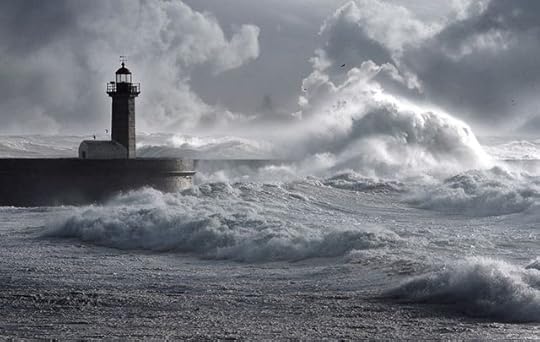
Image: Hurricane Ophelia and lighthouse, Ireland 16 October 2017 (Source.)
It’s in the broader theme of exile and concomitant loss that these stories resonate most strongly for me, especially around family. Boarding school was a kind of exile, even though I was happy there: it deepens belonging and isolation, and first made me aware of all the types of groupings in which I have no easy label, no comfortable home: class, money, politics, and many others. My family fractures down the generations, with estrangements, separations, and exiles: I take neither side, in neither group, I don’t fit. I “lost” something of my father when he left my mother nearly 50 years ago, and again, last year to the voluntary and permanent exile of death.
The resonance of these themes was enhanced by reading these stories almost immediately after All that I want to Forget by Bothayna Al-Essa, which deals with exile in a very different, and even more poetic way (see my review HERE).
One GR friend referred to the joy in O’Callaghan’s writing (a different book). I wouldn’t pick that word, but joy is sometimes ushered in after the losses of the storm, and if not joy, acceptance.
The Individual Stories in this Collection
All the protagonists in these 21 stories are in exile: some in very literal ways, and others more symbolically or psychologically; some are exiles by choice, and others by circumstance. All are lonely. But hope shines through many of the stories, and the writing is just beautiful, especially the way O’Callaghan describes weather, water, and light (see quotes, below).
Click the spoiler tag for a sentence or two about each story, without plot spoilers. I’ve indicated my three favourites as 5*.
Quotes about Weather, Water, and Light
• “The slow bruised trawl of the distant lighthouse’s yellow cast.”
• “Icy shards of sleet give the day a suicidal edge.”
• “The wind gloated in its vigour.”
• “The half-lit morning wore the cloaked aura of impending rain.”
• “A bleak light made the world ache with shadows.”
• “There was always some residual light to be had in a city house, the vague wash of a nearby streetlight or leakage from some other home’s front porch.”
• “Rain threatened, a February gloom fixed as though it owned the day. Cold, bleak light filtered through the bare branches of the garden willow… weather for tears.”
• “What little sliver of moon there was limited to timid flashes through the cloaking oaks.”
Other Quotes
• “Memories and aspirations glinted like shards of glass, splinters that carried all their times together.”
• “The hatchet swung from his left hand, a promise awaiting conclusion.”
• “In hotel rooms, loneliness can be catching.”
• "Dead, his staring eyes held fast the charcoal shell of his hometown sky."
• “Nobody even thought to mention love… Love was for stories, not the real world.”
• Sex “comforting in a fleshy sort of way, but inevitably hollow, and the least intimate part of their relationship, if relationship wasn't too strong.”
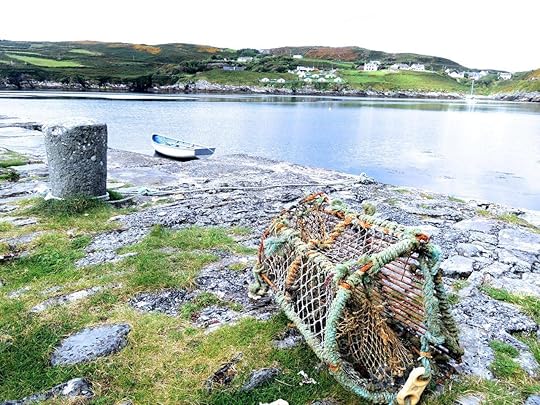
Image: Cape Clear, bay and lobster pot, by Colum Sands (Source.)
O’Callaghan’s Oeuvre
I first came to Billy O’Callaghan via his stunning short stories, specifically his third collection, The Things We Lose, The Things We Leave Behind. Having read all his other publications, I finally came to this, his first collection.
This was published more than ten years ago, and I expect some of the stories predate that. They’re not quite as polished as his more recent works, but they’re still recognisably O’Callaghan in terms of themes and writing style. They’re not all set in south west Ireland, but many of them are, and that’s what I chose for the photos.
One difference is that there are more stories involving killers: accidental killers, soldiers, assassins, terrorists, and others. They pack a punch, without being horribly graphic. They provide insight into dissonance, loyalty, false logic, habit, guilt, and redemption, so have broad relevance, which makes them challenging in a direct and positive way. They don’t ever condone, let alone recommend. (If you want to be told explicitly that killing is wrong, maybe stick to religious texts and children’s books.)
If I was rating this collection with no knowledge of what was to come, I would want to give 3.5*, and possibly round down. As I know what these seeds bloom to, I round up to 4*.
See my reviews of his other works:
• My Coney Island Baby (2019 novel), HERE. • The Things We Lose, The Things We Leave Behind (third story collection), HERE. • In Too Deep (second story collection), HERE. • The Dead House (novella), HERE. • A Death in the Family (long short story) HERE.
Bonus
When reading down the list of story titles, a few of them clung together, conjuring tiny stories of their own: • Ghosts, in exile. Waiting. • The wedding day: this is the end. • The hunchback in the darkness. And that’s without changing the sequence.
Boxed in by memories, laboring on farms and fishing boats, in temporal or spiritual exile, the protagonists in Billy O'Callaghan's 21 stories find that life's decisions crystallize in single moments: a rifle shot that ends a dog's life, a crewman's dismissal, or a grandmother's death. The stories are replete with moral ambiguity and wise about the internal struggles of ordinary people. Readers who enjoy Richard Russo's Trajectory, Jean Grainger's The Tour, or Patrick Taylor's An Irish Country Village would enjoy a deeper look into the hearts of O'Callaghan's fully imagined world.
Twenty-one stories from this underrated writer. Each different each beautifully crafted and written. The stories touch on hard aspects of life and how hard decisions are made and the consequences faced. Well worth a read if you like good descriptive writing or Irish lit.
Had I been reading a hard copy of this book, I would have rushed to get a highlighter and filled pages over pages marked with wonderful prose. The writing is powerful, no doubt. But as is often the case with beautiful writing, the plot does not stand a chance. Many stories are single 'scenes' which any other writer would have done away with in a page or two. Sure, O'Callaghan elevates them with his lush prose, often evoking deep sentiments, until you realize that the stories don't quite lead anywhere
Fine collection. 4.5 stars. Many of these stories are about hard choices made, and sometime regretted, in difficult situations. Not a minimalist writer, O'Callaghan sometimes takes beautifully lyrical, brief asides to describe weather, the landscape, what have you. These never get in the way of the story, and often, are breathtaking. Favorites were "The Body on the Boat", "Tourist Season", "Put Down", & "In Exile". Also liked very much "Ghosts", "In the Eyes of the Law", "War Song", "Deliver Us From Evil", "In the Darkness", and "No Room at the Inn", and others. Two that I loved except for the endings: "This Is the End"-- Difficult to explain without spoiling it, but for me, there wasn't enough of a set up to justify the ending. "The Hunchback" is a wonderful story, and while the ending was foreseeable, I was bothered by the dispassionate tone, only because (for the character in question), it seemed at odds with his highly emotional outburst that preceded it. But these are minor quibbles. This is a fine collection that makes me want to read more by this talented writer.