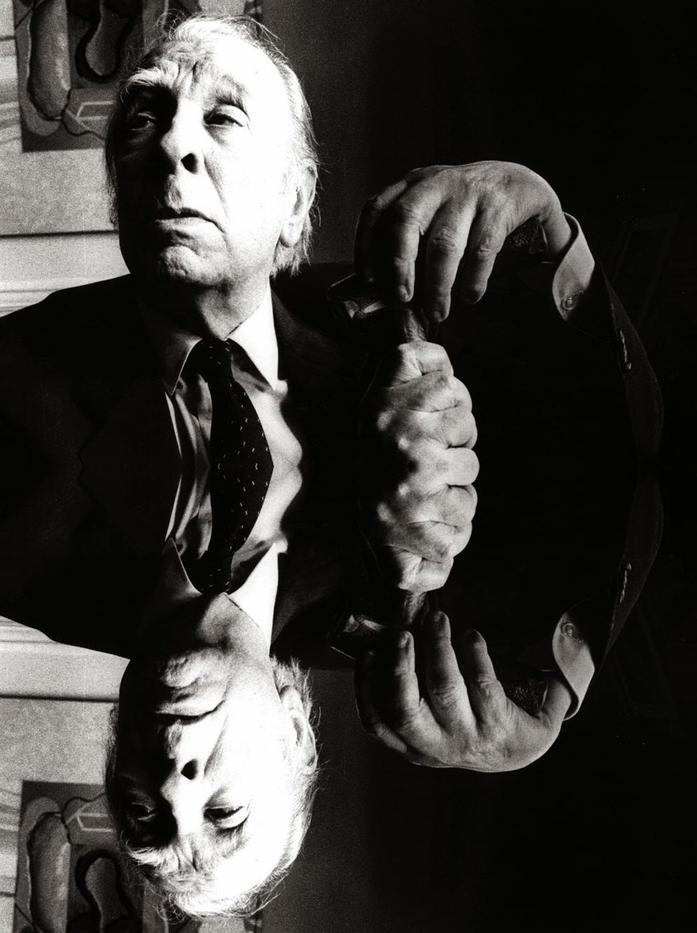
Jorge Francisco Isidoro Luis Borges Acevedo was an Argentine short-story writer, essayist, poet and translator regarded as a key figure in Spanish-language and international literature. His best-known works, Ficciones (transl. Fictions) and El Aleph (transl. The Aleph), published in the 1940s, are collections of short stories exploring motifs such as dreams, labyrinths, chance, infinity, archives, mirrors, fictional writers and mythology. Borges's works have contributed to philosophical literature and the fantasy genre, and have had a major influence on the magic realist movement in 20th century Latin American literature. Born in Buenos Aires, Borges later moved with his family to Switzerland in 1914, where he studied at the Collège de Genève. The family travelled widely in Europe, including Spain. On his return to Argentina in 1921, Borges began publishing his poems and essays in surrealist literary journals. He also worked as a librarian and public lecturer. In 1955, he was appointed director of the National Public Library and professor of English Literature at the University of Buenos Aires. He became completely blind by the age of 55. Scholars have suggested that his progressive blindness helped him to create innovative literary symbols through imagination. By the 1960s, his work was translated and published widely in the United States and Europe. Borges himself was fluent in several languages. In 1961, he came to international attention when he received the first Formentor Prize, which he shared with Samuel Beckett. In 1971, he won the Jerusalem Prize. His international reputation was consolidated in the 1960s, aided by the growing number of English translations, the Latin American Boom, and by the success of Gabriel García Márquez's One Hundred Years of Solitude. He dedicated his final work, The Conspirators, to the city of Geneva, Switzerland. Writer and essayist J.M. Coetzee said of him: "He, more than anyone, renovated the language of fiction and thus opened the way to a remarkable generation of Spanish-American novelists."
I am something of a connoisseur of mazes: not for nothing am I the great-grandson of that Ts-ui Pen who power in order to write a novel containing more characters than the Hung Lu Meng and construct a labyrinth in which all men would lose their way.
Who am I? The great question which has been haunting humankind since eternity, troubled the soul of the great Argentine author Jorge Luis Borges too. The small text explores the dilemma of existence through the relation between the private and public life of the narrator of the poem. What should it be called- a poem, or a story, perhaps it is like those of prose poems which do not care about metre, rhyme, and rhythm, only in words, for it fulfills the requirements of poetry if we consider the themes and imagery of it; probably it is futile to strive for classifications of the texts by Borges as his texts surpass many- his poems are being reads like stories, stories appear to be highly poetic with a great infusion of complex philosophical themes, probably it would be better to describe it as a parable as Borges used to call his texts.
The parable starts with the narrator questioning his existence, his relation to the ‘Borges,’ the other Borges we know. The narrator ruminates about his identity, his very being, apart from what we know about Borges, the author. It is as if he has robbed of his authentic being and he has to live as per his public persona, a sort of ‘bad-faith’ of existentialism since he tries to break from the public persona to his being, his true self which feels the worrisome burden of ‘Borges the author’. The narrator lists out his preferences- his likes and dislikes, thereby proposing that he is real, an entity with a being of its own. What people know as Borges is an image ad abstract image of him that does not exist without him. He contemplates upon his relationship with ‘Borges the author’ whom he knows through the correspondences with the public, he proposes that both of them exist in their own space as ‘Borges the author’ contrives literature while he goes on living; here the narrator essentially questions the very being of himself as he postulates that he has a life beyond literature but to his irony and disgust, the very literature created by him(Borges the author) defines him but he hardly sees himself in that, so it develops the basic problem of identity, the existence. He is essentially Borges but he is considered as Borges the author, thereby his very existence becomes inauthentic due to his public persona as if due to his public life he is devoid of his true self.
The narrator further discusses the literature itself, the very literature created by him, ‘Borges the author’ produced some great pieces of literature but even those great pieces are unable to define him, the narrator, as the author writes literature not him, for he burns in the hell of nothingness. However, those exceptional creations of literature belong to no one, as they have their own beings. It digresses me to an intriguing problem of creator and creation, which is that once created all literary artifacts stand on their own, these creations do not have anything to do with their creators after it, rather they belong to the language and tradition. In other words, these great pieces of literature do not belong to ‘Borges the author’ too. As everything in this universe, the narrator too is perishable, the very nature of the universe is perishable and over the years, he has divulged himself to ‘Borges the author’ and gradually he would give away everything to ‘Borges the author,’ and what would remain beyond him, is ‘Borges the author’ since everyone would forget the perishable narrator who, ironically, is responsible for the existence of ‘Borges the author’.
The parable represents the classical problem faced by celebrities when people assume their existence from their public personas without even touching their real being, and this real being gradually gets diminished in the eyes of ‘others’ as their public image rob them of everything else which constitute their being resulting into bad-faith and inauthentic existence. The narrator gradually gives away everything and he becomes even unrecognizable, as his public persona robbed him off his being, except perhaps in the laborious strumming of a guitar. Even though he mentions that years ago, he tried to free himself from this hell of nothingness and plunged himself into mythologies and interplay of time and infinity (as we know Borges explored time and infiniteness of the universe in his stories) but, to his utter dismay, those very interplays have been credited to ‘Borges the author’. Our narrator struggles through his life to live an authentic existence but he loses his being to ‘Borges the author’ and goes to the oblivion of nothingness or to him- ‘Borges the author,’ he can’t say anymore. He is not even sure which one of them has written the parable itself, everything becomes unreal, illusionary now, he doesn’t know who he is.
The parable “Borges and I” discusses the dissociation between an author and his real self that Borges experiences in his life. The narrator is afraid that as if his true self is used by ‘Borges the author’ and would disappear in him. The piece represents the fear of a celebrity or author to disappear in person in order for his celebrated self to live. It is a great dissection of the problem of self and persona, in the way ‘who we are and ‘who we pretend to be.’
Borges’s own diminishing eyesight perhaps helped his imagination to grow leaps and bound than to cause harm to him, which resulted in such an extraordinary achievement in world literature. It is one of those unforgettable experiences which one may come across once in a lifetime but every word of this gem is worth it. In his essay on Borges, Perez wrote that he has created his own type of post-Avant-grade literature- which shows the process of critical self-examination that reveals the moment in which literature becomes a reflection of itself, distanced from life- in order to reveal the formal and intellectual density involved in writing.
The other one, the one called Borges, is the one things happen to. I walk through the streets of Buenos Aires and stop for a moment, perhaps mechanically now, to look at the arch of an entrance hall and the grillwork on the gate; I know of Borges from the mail and see his name on a list of professors or in a biographical dictionary. I like hourglasses, maps, eighteenth-century typography, the taste of coffee and the prose of Stevenson; he shares these preferences, but in a vain way that turns them into the attributes of an actor. It would be an exaggeration to say that ours is a hostile relationship; I live, let myself go on living, so that Borges may contrive his literature, and this literature justifies me. It is no effort for me to confess that he has achieved some valid pages, but those pages cannot save me, perhaps because what is good belongs to no one, not even to him, but rather to the language and to tradition. Besides, I am destined to perish, definitively, and only some instant of myself can survive in him. Little by little, I am giving over everything to him, though I am quite aware of his perverse custom of falsifying and magnifying things.
Spinoza knew that all things long to persist in their being; the stone eternally wants to be a stone and the tiger a tiger. I shall remain in Borges, not in myself (if it is true that I am someone), but I recognize myself less in his books than in many others or in the laborious strumming of a guitar. Years ago I tried to free myself from him and went from the mythologies of the suburbs to the games with time and infinity, but those games belong to Borges now and I shall have to imagine other things. Thus my life is a flight and I lose everything and everything belongs to oblivion, or to him.
One of the most thought-provoking pieces of fiction ever written. And all is so few words. Only an author or individual, take your pick, with the name Jorge Luis Borges could pull off such a masterful stroke of the pen. Below are my top 10 questions after reading this quizzical buzzer followed by Jorge Luis Borges’ actual short story as essay or essay as short story. Beneath the story are my comments on specific lines of the story itself.
One: How much weight do you put on your public persona? With all the social media, one doesn’t have to be a famous author to have a very public personal. Matter of fact, it is quite easy to create a public persona that is a slight variation of a superhero.
Two: Is there really a solid you creating the persona in the first place? Many volumes in a Buddhist library are devoted to disassembling the solidness and ultimate reality of what we conceive of as a self.
Three: Are you influenced by the media in a way that has you imagining yourself as the main character in a TV show or movie?
Four: How much of our activity is done to maintain a public image? Are we really benefiting by identifying with a persona or self-identity bound to anything public?
Five: What part of us, if anything, persists after our death? How much of our answer to this question is predicated on faith or hope as contrasted with personal experience?
Six: How do you want to be remembered after your death? Your personal acts of kindness? Your personality? Your creative achievements? Is being remembered actually important at all?
Seven: In what ways do we customarily puff ourselves up? Is this acceptable, since it is natural?
Eight: If you are a writer or artist, how identified are you with your past writing and art? Could you, if you choose, wipe the slate clean and begin afresh?
Nine: If there was an emergency and all your personal belongings would be lost other than what would fit in a small suitcase, what would you pack?
Ten: How closely and frequently do you take the time for self-examination? Is this a frivolous question?
BORGES AND I The other one, the one called Borges, is the one things happen to. I walk through the streets of Buenos Aires and stop for a moment, perhaps mechanically now, to look at the arch of an entrance hall and the grillwork on the gate; I know of Borges from the mail and see his name on a list of professors or in a biographical dictionary. I like hourglasses, maps, eighteenth-century typography, the taste of coffee and the prose of Stevenson; he shares these preferences, but in a vain way that turns them into the attributes of an actor. It would be an exaggeration to say that ours is a hostile relationship; I live, let myself go on living, so that Borges may contrive his literature, and this literature justifies me. It is no effort for me to confess that he has achieved some valid pages, but those pages cannot save me, perhaps because what is good belongs to no one, not even to him, but rather to the language and to tradition. Besides, I am destined to perish, definitively, and only some instant of myself can survive in him. Little by little, I am giving over everything to him, though I am quite aware of his perverse custom of falsifying and magnifying things.
Spinoza knew that all things long to persist in their being; the stone eternally wants to be a stone and the tiger a tiger. I shall remain in Borges, not in myself (if it is true that I am someone), but I recognize myself less in his books than in many others or in the laborious strumming of a guitar. Years ago I tried to free myself from him and went from the mythologies of the suburbs to the games with time and infinity, but those games belong to Borges now and I shall have to imagine other things. Thus my life is a flight and I lose everything and everything belongs to oblivion, or to him.
I do not know which of us has written this page. =============
“The other one, the one called Borges, is the one things happen to. I walk through the streets of Buenos Aires and stop for a moment, perhaps mechanically now, to look at the arch of an entrance hall and the grillwork on the gate; I know of Borges from the mail and see his name on a list of professors or in a biographical dictionary.” ----------- The split between persona and inner self; the difference between the outer public Borges and the inner Borges. But . . . there is a bit of ambiguity in the first-person narrator saying the other one, the one they out there in the outside world called Borges, is ‘the one things happen to.’ How about a headache or fatigue or hunger? Which Borges are those things happening to?
"I like hourglasses, maps, eighteenth-century typography, the taste of coffee and the prose of Stevenson; he shares these preferences” ----------- Another bit of irony. So the inner Borges likes the taste of coffee. That makes sense since it doesn’t get any more subjective and “inner” than one’s taste buds. So, how does the Borges persona enjoy coffee? A famous author can write, as Borges does here, that he enjoys coffee but that is quite different than the actual tasting with one’s taste buds.
"But in a vain way that turns them into the attributes of an actor." --------- This is one of the possible dilemmas of being famous, particularly a famous author. Once your writing is in the public spotlight, any future biographical writing can feel as if you are writing about an actor on center stage.
"It would be an exaggeration to say that ours is a hostile relationship; I live, let myself go on living, so that Borges may contrive his literature, and this literature justifies me." --------- Keen observation, particularly when one gets old and suffers from chronic illness or an affliction like blindness. For a man (or woman) of letters, it can feel like engaging in writing and the literary arts is the very reason to keep on going. The lure would let the public persona go and simply sit back in a comfortable chair and zone out on pain killers.
"It is no effort for me to confess that he has achieved some valid pages, but those pages cannot save me, perhaps because what is good belongs to no one, not even to him, but rather to the language and to tradition." ------------ How true! If an artist, musician or writer is suffering from such things as depression or on the brink of death, all their artistic or literary achievements can appear a world away, not even close to saving them from sickness, old age and death.
"Besides, I am destined to perish, definitively, and only some instant of myself can survive in him." ---------- That’s right – no matter how great a writer or how personal the writing, the individual dies and it is the writing itself that continues to be published, translated, read, reviewed and analyzed.
"Little by little, I am giving over everything to him, though I am quite aware of his perverse custom of falsifying and magnifying things." --------- When you are in pain or dying, the vital, vigorous persona of the pubic author can appear to you as a puffed up sham.
"Spinoza knew that all things long to persist in their being; the stone eternally wants to be a stone and the tiger a tiger. I shall remain in Borges, not in myself (if it is true that I am someone), but I recognize myself less in his books than in many others or in the laborious strumming of a guitar." --------- Ha! Not so unusual for an author and literary person to identify more with the characters in other writings than in one’s own. I suspect if an author were to list their top five characters in literature, usually all five would be from the pen of another author.
"Years ago I tried to free myself from him and went from the mythologies of the suburbs to the games with time and infinity, but those games belong to Borges now and I shall have to imagine other things." ---------- After one’s books are published, they take on a life of their own. Actually, for an author to imagine other things, to move beyond past published works, is a good thing. Many the novelist whose identity is so entwined with their first book, they can’t move past that first novel once their first novel hits the shelves and becomes successful.
"Thus my life is a flight and I lose everything and everything belongs to oblivion, or to him." ----- To feel comfortable with ambiguity – the prime test in our postmodern world.
"I do not know which of us has written this page." ---------- No comment!
How can such depths of existential examination, epistemological rumination, and ontological conjecture be packed into the space of a few paltry paragraphs???
Well, if you’re name is Jorge Luis Borges, this is exactly the kinda shit that you do.
Such a short story, yet it contains such deep topics as 'Mind' and 'Free Will'. This story proved to me yet another time that ideology is with us all the time :) Here is my intro part of the essay on that book: "Everything has an ideology, and whenever more than one being is present, there is an ideological conflict. The 'Public' and 'Private Self' are in ideological fights with each other until the inevitable defeat of the 'inner self' and the consumption by the language of both, and the story 'Borges and I' perfectly shows this war. "
From the minute I read this short story, I fell in love with Borges writing and his ideas. In "Borges and I" the narrator describes a man named Borges. Perhaps the narrator and the author are the same person, perhaps not. The story's beauty and brevity comes with the fact that people who love it have to read it more than once, over and over, till they know it line for line. This is very much so in my case.
From here, I'll talk more about the story and what I think of it. Borges discusses the difference between him and "I" and what the author conveys is the oddity of human nature and how we tend to remember the worser things that happen to us. Something that clicked with me after reading this was that the beginning and end of an essay, poem, or idea for art is consciously decided, but in between all that, you go into a separate state of consciousness: not thinking at all just doing. This is where I believe the narrator loses the line of who writes what and who does what. In short, I love this book and I love Borges' genius that can create such a mind-blowing experience in only a paragraph of words.
This entire review has been hidden because of spoilers.
《por lo demás, yo estoy destinado a perderme, definitivamente, y solo algún instante de mí podrá sobrevivir en el otro》.
《spinoza entendió que todas las cosas quieren perseverar en su ser; la piedra eternamente quiere ser piedra y el tigre un tigre. yo he de quedar borges, no en mí (si es que alguien soy)...》
I read this short-story in The World's Greatest Short Stories, edited by James Daley. This book contains an excellent sample of short stories by well-known authors of the 19th and 20th centuries.
Literally, a one-page story (1962) of "Would the real Mr. Borges please stand up." Loved it.
i guess it’s time for my monthly existential crisis! but actually though, i read this at just the right time; self-discovery and identity has always been a struggle for me and lately it’s been getting a lot worse. thankfully though, i feel like these words capture the duality of human existence perfectly. borges, you speak to the souls of millions. thank you❤️
"Así mi vida es una fuga y todo lo pierdo y todo es del olvido, o del otro."
Leí este poema hace dos o tres años, cuando una profesora nos lo dio en clase, y quedé fascinada. Al terminarlo, nos pidió escribir una pieza parecida pero propia. Recuerdo que, aunque en ese momento no me gustaba escribir, me divertí muchísimo haciéndola. Sentí que entendía un poco más de mí: de mi otra yo.
Esa yo pensadora y habladora, la que no calla sus preguntas ni se avergüenza de los temas que le interesan; la que lee, estudia, aprende; la que analiza todo con una precisión casi exagerada. Una versión mía que solo aparece cuando la habitación queda vacía, que empieza a respirar libertad cuando la otra persona cierra la puerta. Esa que se formula preguntas y también intenta contestarlas, que se pierde tanto en sus propios pensamientos que el tiempo se vuelve difuso, como si el día y la noche se mezclaran sin avisar. En esos momentos no existe nada más: solo ella y yo.
Lamentablemente no recuerdo qué escribí aquella vez, y tampoco lo guardé. Pero si algo me dejó esa profesora, es este poema increíble de Borges, que todavía me acompaña.
Borges has clambered into my soul and nestled himself there eternally - I cannot say that of any other writer. Am I Borges? Is Borges me? I don't know, but I do know that a fragment of him has latched onto me and will remain that way until I am eaten by the vultures upon the circular temple.