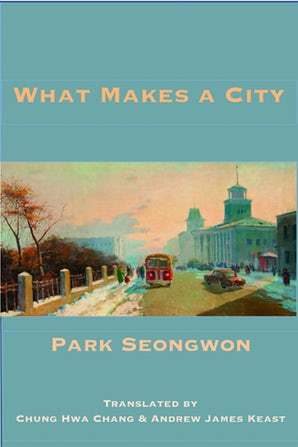
"What Is It That Makes Up a City? provides the reader with an intelligent perspective on the strange culture of our times and a series of adventures through which we explore universal human problems. Family, education, the media, popular culture, technology, alienation, financial power or the lack thereof . . . These are among the most prominent components of the eight stories which comprise this book, in which characters struggle—sometimes in despair, but usually with a sense of humor—to understand or at least accept their place in a world that often makes no sense. "
What Makes a City? is the latest in the Korean Voices series from White Pine Press
Translated by Chung Hwa Chang and Andrew James Keats from the original 도시는 무엇으로 이루어지는가 by Korean author 박성원 (Park Seongwon), it consists of 8 short stories of around 20-25 pages each. The stories are connected, some explicitly picking up on the stories of characters from earlier tales, others more thematically, all with an off-kilter and often darkly humorous feel.
The first By Motorhome to Ulan Bator has a stepbrother and sister at the funeral service for their eccentric father, a man who claimed to be a nomad, living outside of time, dreaming of the Gobi desert, but in reality barely leaving his sofa:
He said he was a man living outside of time, that only the masses lived inside of time. That keeping track of time was life, for the masses, and that they were able to live only as long as they stayed inside of time... no one’s departure could be tolerated. People might break laws, but time’s boundaries could never be violated.
“Laws change, kid, but time never changes. Time takes a fragment of stone, and makes a religion. Fossils become oil, lumps of carbon become diamonds. And people delude themselves, as if what they believed were the truth.
This is a person who can’t be tamed, who escapes the artifice of time. That person is truly free. People living inside time supposed themselves to be happy, but happiness like that is only the happiness of belief ... To take route inside of time is to become a comfortable slave, someone so comfortable that he doesn’t even know he’s a slave.”
But he only talked. The truth is that my father was a slave, a slave to drink.
But then end up disinterring his body, in the middle of a typhoon, to find a winning lottery ticket that may have been buried with him.
Later stories, one of which is set in the 2050s, pick up on the story of both the brother (who ends up inheriting his father’s mantra) and sister, and they also reappear as minor characters in other stories.
The blurb comes with a review from Kyung-sook Shin, the author of the bestselling Please Look After Mom, which nicely captures the mood of the collection.
“How strange these stories are, and what surprising merits they hold! Consider, for example, “By Motor-Home to Ulan Bator”. This is such an exciting story that one can not but read the whole piece, without interruption. There’s also “What Is It That Makes a City?”, read and finished so quickly that one feels one has been somehow possessed. And as an after-taste, there remains a sense of something like loneliness and something like alienation. One is aware of the connections between these stories, and yet each is quite independent. The stories may strike one as sarcastic, but they are also very warm and even bright, and composed with meticulous care. While these characters talk about the past, they seem to inhabit a future to which we have not yet been. Combined in the creation of these isolated characters, Park’s unique philosophical ideas, his tragic view of the world and his black humor make a surprise attack on what we believe in as true. Looking at these unique stories, we may call Park’s fiction “futuristic”, but it may also be that his new “nomads” have already been born, and are already making their attempts to settle outside of time.”
An excellent discovery and yet more evidence of the vibrancy of Korean fiction. 4 stars
“People lived to be on time, and people were able to go on living as long as they stayed within time. In my dad’s words, leaving – getting out, to the outside of time – is, in fact, death.” Time plays a huge role in the stories in What Makes a City? and especially in By Motorhome to Ulan Bator I and II. While most humans are subject to time’s regime, the nomad is different as the nomad won’t be tamed by time. He is very much alive even though he lives outside of time. If we draw the parallel with the digital nomads of our time I am not sure this holds up. While digital nomads have control over their day to day planning, most of them still have to abide by deadlines.
This brings me to the irony of the dad’s lottery deadline in By Motorhome to Ulan Bator I: there is just no time to waste for the main characters of the story. The kids obviously haven’t mastered the nomad way of thinking. What do they need in life to feel satisfied? When time seems to stop, will they find peace?
This story is followed by the first part of the story the book takes its name from; a story about love and loss, but also about a person being only one small part of a city. “The city, as if it had become a part of those earliest hours, was peacefully interred. He imagined that he was the only one there who could breathe and move, and again he was afraid.” What would it be like to be the only one moving in a big city? Not simply at night, but in general? Or feel like you’re the only one there while you’re actually the one standing still and everyone else is moving. The poor man is in shock and feels like he is dreaming. What do you do when you have no one? Even the little girl doesn’t have the power to draw him back. They could find each other in their loneliness, yet the way the story ends you have a bad feeling about what will happen in the next part of this story and as expected What Makes a City II is one of the darker and sadder stories.
The second part of By Motorhome to Ulan Bator is set in the future. It is about the interconnectedness of people and about meeting people that aren’t part of your usual circle. Even though the circumstances of the main character aren’t great, he still looks towards the future. “The past is a dead thing, and if it isn’t dead, I’ll kill it. So I just dream about the future and about the fantastic.” The writer hits the right tone every single time. I find it very impressive how he can make the characters come to life. “As I ran, I remembered again and again my father’s saying that the nail driven in so deep wouldn’t come out. For me too, it’s over now.” Nothing lasts forever. Hold on to each other while you can and love each other deeply. The world changes, yet not that fast that all will be better in the future. Unless you screw up your ‘now’…
The stories By Motorhome to Ulan Bator I and II and What Makes a City I and II impressed me the most because of the way they made me experience the turmoil and misery but also the moments of joy of the characters. On Logic was a completely different story, amusing me with the crazy turn of events. The main character got himself in such a mess that he deserved to get into trouble because of it.
The Story of a Wife deals with truth and lies and the power of secrets. “Only when a certain amount of a secret has escaped does a secret have value.” It is hard to break the pattern and do better than your parents. You can somewhat understand the main character. I mean, who doesn’t want to feel special sometimes? Especially if you feel your life is perfectly ordinary. “What we see is not the only truth. And not all of what we see is true.”
A Rejected Story also discusses ordinary people. It is about a city in which inhabitants are all the same; they watch the same series and wear the same clothes. Where are their unique identities? From an outside view, city residents are just like a colony of ants. “We’re seeing only the world we can see, and maybe we’re under the delusion that it’s the whole world.”
The last story in the book, Division, is about choices. Will you stand up for what you know is right, or choose your own survival? Never an easy choice especially when the choice you make is not final.
While reading the stories you come across many Korean cultural aspects like funeral habits, mountain hiking and the value of wild ginseng. The importance of marriage and having a family to rely on takes a prominent place in all stories.
Most stories are both dark and light at the same time with funny and positive thoughts over a darker undercurrent. They deal with heavy themes, like pedophilia, affairs, searching for someone, searching for truth, secrets, love, and loss. Yet with a sprinkle of hope, somewhere. Characters come and go and make an appearance in later stories. You recognize them immediately as it is not easy to forget about their struggles. All stories together tell one bigger story about time and about being a part of something bigger. But not a unique part.
After some of these stories I put the book down to think about what I had just read. The beautiful prose and memorable characters and their thoughts stayed with me. The writing style (or translation) made the stories more intense and had the power to draw my mind into the world inside the book. The book provides you with possible meanings and messages, but you can come up with many more while considering how it applies to your life and the way you live. What Makes a City? is not a book to read from cover to back, but rather one where you read a story a day and ponder on the meaning of that single story.
This is easily one of the more interesting books I read this year and also a book that I will reread every now and then. It inspires me to become a better writer and to add more ‘flow’ to my sentences.
“Only books have not abandoned you. You love these books of yours. Whenever you’ve felt lonely, you’ve sought refuge in books. The only things that wouldn’t leave you, have awaited your touch, have been books. The dark concealed itself, instantly covert within the light, and you saw the books, waiting for there for you. Yes, they were your books. They had accepted your mental, physical, emotional states, sighs, pain, and future worries. Had it not been for those books, you’d have become a wild maniac who turned his back to the world or anonymous nobody in pursuit of nothing!” Pp. 164-165.
What Makes A City? By the Korean Professor - Park Seong-Won - is a collection of eight stories. I have tried deciphering all the stories, characters, events, and feelings from the protagonists' perspectives, but I found it extremely difficult as I hail from a different culture with different values. What I mainly found overwhelming in Professor Seong-Won's writing was how he stopped my train of thoughts and forced me to think about: time, life, death, the pursuit of happiness, human attitudes, human pain, and the dichotomy between what is real and what is seen real.
Some of his stories, especially the first and last ones, made me hear how my thoughts sounded to me, which was a bit funny and scary in the same vein. I also liked how he emphasized the importance of reading and how he mocks writers who think they can write without mastering reading. There were some weird stories too. Then again, I assume that he was trying to tell readers like me that: “If you are blessed with a good life, it doesn’t mean others are gifted with the same bounty. Try to put yourself in other's shoes and feel them, if you can not replace your life with theirs,”.
This book matured me a little.
There are many thought-provoking lines such as: “And as for happiness, half of it is derived from other’s misery, so it’s not happiness that I am after,” pp.53. Bingo! 👏🏻👌🏻
Maybe I'm thin-skinned. I was actually enjoying this collection, and the short stories seemed to connect, almost in a Paul Auster-ish way. But when I got to a story about child-rape I didn't really feel any desire to continue (or finish the story, to be fair). I might revisit the other stories later, but I've had it for now.