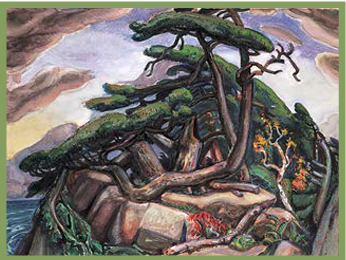
In the early twentieth century, a group of Toronto artists became friends. They shared a love of traveling and exploring Canada's landscape. Their paintings were very different from the art of the time, capturing not just how the landscape looked, but how it made the artists feel as well. In 1920, they exhibited their work together for the first time, calling themselves the Group of Seven. While some people were excited by their use of bright colors and rough brushstrokes, others were horrified by their strange styles. It took years for appreciation of their work to grow. But today, the Group of Seven are some of Canada's best-loved artists.
Just in time for the 100th anniversary of the Group of Seven's first exhibition, here's a reissue of a must-have reference, produced in collaboration with the Art Gallery of Ontario. Filled with illustrations, photographs and stunning reproductions of more than forty masterpieces, the book describes how the group formed, how and where they painted, their influence on Canadian art and more. It offers a perfect introduction to critical thinking about visual arts and biographies of artists. It's also an excellent social studies resource on Canadian heritage and history.
Original Group of Seven Franklin Carmichael, Lawren Harris, A. Y. Jackson, Frank Johnston, Arthur Lismer, J. E. H. MacDonald and Frederick H. Varley.
Being Canadian I was already fairly familiar with The Group of Seven's work. The history behind the art was just as fascinating as the work they all created. My favourite piece (Pine Wrack by: Arthur Lismer) was even featured in the book... Thank you NetGalley and Kids Can Press for my DRC.
A good book to discover original painters from Canada. It presented their works, techniques and life as well. Very well done and accessible. I personally really enjoy the art of Harris!
I thought this looked like an interesting non-fiction picture book. Unfortunately, I found it to be an utter bore. It reads very "young", and yet I don't know how many children in that age group are going to find this book of dry facts and art criticism very entertaining.
By far, the most interesting parts of this book are the bit about Tom Thomson's untimely death and the theories surrounding it (ironic, since he wasn't even an official member of the Group) and the brief examples of other non-Group art that was being done at the time as well as after. Aside from the short bios of the men, most of the rest of the book is taken up by reproductions of their work and--most annoyingly--explanations of what the paintings mean. Unfortunately, these interpretations are undermined by the section that talks about how everyone interprets art differently. (This is part of why the book seems "young" to me. There's almost a hand-holding aspect throughout much of it, where the authors have to tell the reader what the paintings mean. Why bother, if everything's open to interpretation?)
I think part of the problem is that I don't really like most of the Group's work. When I mentioned to my mom that I was reading this book, she told me that I'd been to see a Group of Seven exhibit. (She was partly joking. I was an infant at the time, so I obviously don't remember it!) She also said she wasn't that impressed with the paintings, and that she preferred Emily Carr's work instead. Carr is mentioned in this book, as she was acquainted with some of the Group, and her art is in the same sort of vein. But I must admit, I'm of the same opinion as my mom; Carr's work is much more pleasing to the eye, and I think I would've rather read a book about her.
Unless someone really loves the aesthetic of the Group of Seven, they're probably going to have a hard time engaging with this book. It's dry, pedantic, and a little condescending. The layout and look of the book are fine... but if you're not all that interested in the subject matter, none of that's going to make much of a difference.
Thank you to NetGalley and Kids Can Press for providing a digital ARC.
A must-read for all art lovers. Although aimed at children, it’s a perfect introduction to the work of the Group of Seven for adults as well. There are plenty of photos, illustrations and reproductions of their work, and a simple, straightforward text. I enjoyed it and found it a useful summary.
*received from netgalley for honest review* This was a really interesting book! I don't know much about Canadian art but I what I really liked about this book is it didn't just show their art or talk about them it also tried to make you think about their art and so much more!
Setting: Location - Canada Time Period - 1920-1933
Review
The book tells about the artwork of The Group of Seven and the artists who created them. It includes photographs of the artists and includes brief biographical information on each of the group members. It provides a nice pairing of art history and art appreciation ideal to introduce a child to the groups’ unique and vivd landscape painting methods.
The clean white pages let the artwork shine as the editors have avoided gaudy colors or gimmicks they so often use to try and appeal to young readers. Instead they have created an attractive book that will appeal to each child's creative minds eye.
Teacher Application
This is a no-nonsense approach to introducing the group of seven to students. It is ideal for an introduction, but for true art lovers bigger reproductions of the artwork would serve much better, as some are very small in this book. For this reason this is not ideal to read aloud in a large group setting, but will work best as an independent reader, or to read with one or two children at a time.
Contents Meet the Group of Seven What the Group Loved to Paint Why Did the Group of Seven Paint Landscapes? What Was So Different About Group Of Seven Paintings? The Group Coast to Coast Painting in the North How Did The Group Paint? The Mystery Of Tom Thompson Painting A Portrait Other Group of Seven Projects Did You Know…? Differing Opinions About The Group of Seven What Do People See in Works by the Group of Seven? Other Artists of the Time Learn About Nature with the Group of Seven Landscape Art Since the Group Remembering The Group So You Want to Own a Group of Seven Painting The Artists Credits Index
A very nice introduction to these artists. If you want to get yourself or your kids (or relatives) into knowing them or any artwork, this is nicely done. Quick to points, not in-depth.
Wow, what an interesting book! I know very little about Canadian art, and am very glad to have had this introduction to the Group of Seven. While this book is aimed at children, I found it very interesting, and it gave a good overview of the Group's work, what was so different about their work, what the artists' aims were, etc. The art theory bits of the text were informative and accessible, helping the reader understand aspects of looking at art more easily- a favorite of mine is about J.E.H. MacDonald's "The Solemn Land." We see a photograph of the view MacDonald painted, and the painting itself, along with this quote: "Why does the painting look so different from the photo? MacDonald is showing you what it was like for him to stand alone looking at this scene. He wants you to know not only what it was like to see the landscape, but also to feel the movement of the water and the clouds, to hear the sound of the wind and to smell the scent of the forest." In another section, we get opinions from several different people on the meaning of a painting, showing how the meaning of art is subjective. I don't recall seeing such ideas in art books as a child, and I wish I had. We also get tidbits of the lives of the artists, reactions from critics of the time, and examples of how their work influenced artists who came after them. The art itself is quite lovely, and I'd be hard-pressed to pick a favorite! Hopefully this book will make its way into U.S. classrooms- we're taught sadly little about our neighbor to the north in schools.
This was an eye-opener for me. I like art, but am by no means an expert. I had never heard of the Group of Seven, nor recognized any of their names. As a result, this was a very satisfying voyage, not only into new art, but through a piece of unfamiliar history. Teens who are interested in either aspect, or who love to discover new parts of our world, will find this a satisfying exploration. I suspect for some, it will lead to further exploration into Canadian art and artists. The reproductions in this book are all amazing and those where photographs or sketches done prior to the full painting are included, can add to the readers' awareness of how each person's eye sees differently, as well as how an artist's own experience and imagination can transform reality into something more.
The Group of Seven were a group of Toronto Artists, who, in the early 20th century experimented with modernist techniques in their paintings of the Canadian landscape. I really enjoyed this brief introduction to the work of Franklin Carmichael, Lawren Harris, A. Y. Jackson, Frank Johnston, Arthur Lismer, J. E. H. MacDonald, Tom Thomson (not an official member), and Frederick H. Varley.
The book discusses what the artists painted, why they were drawn to landscapes, and how their artistic style was new and innovative. Perhaps most importantly for a book about art, this edition is filled with beautiful color reproductions of the artists' paintings which help to illustrate the points made in the text.
I did not feel like the artists represented in the group of 7 led especially exciting lives. They were a bunch of white men painting nature in Canada. They did not make a lot of money painting so they had other jobs in teaching and advertising. I don't appreciate all of their artwork. I especially didn't like MacDonald and Thompson. And Thompson was randomly thrown in there. He wasn't ever a part of the group of 7 but he was their friend before they became "the group". This book isn't good for reading for fun. It might have a few facts a young researcher might want to use for art class but I don't see much other use for it.
A very good book, although I doubt anyone outside Canada will have ever heard of, let alone need a book about, this particular G7 for this age group. But I liked what I saw of the expressionist landscapes of these artists, and this portrait of how they worked, what pointers they left us of their environment and more, is a nice one. A strong four stars.
An intriguing look at the work of the Group of Seven, a collaborative of artists who challenged landscape painting norms of Canadian landscape painting.
A "must" for Canadian libraries, a recommend for American schools that focus on art.